SUBSCRIBE TO OUR FREE NEWSLETTER
Daily news & progressive opinion—funded by the people, not the corporations—delivered straight to your inbox.
5
#000000
#FFFFFF
To donate by check, phone, or other method, see our More Ways to Give page.
Daily news & progressive opinion—funded by the people, not the corporations—delivered straight to your inbox.
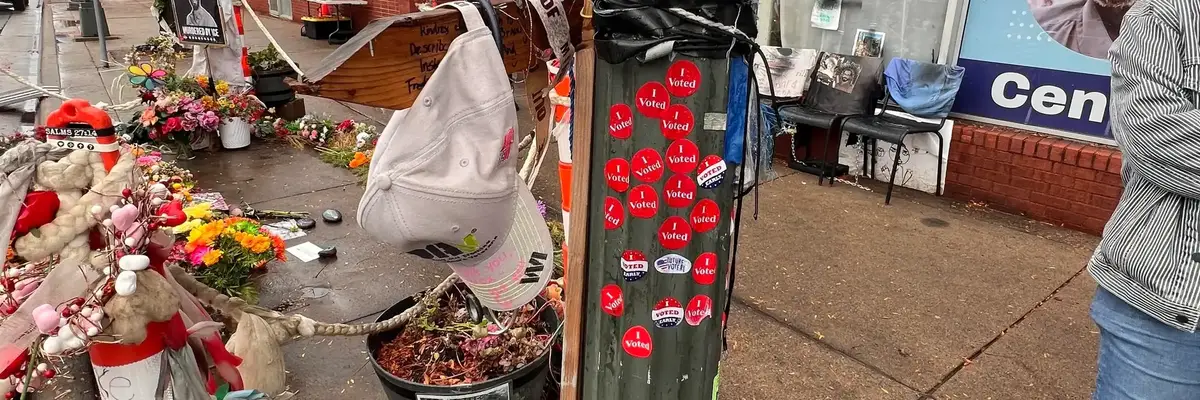
"I voted" stickers are affixed to a memorial to Alex Pretti in Minneapolis, Minnesota on November 3, 2026.
Our neighbors with the most to gain or lose from the election results, for whom Tuesday’s election is about a lot more than paying a few cents less per gallon at the gas pump, are also people who cannot vote. They desperately need you to cast a vote for them.
One of the joys, or perils, of a weekly Tuesday newsletter is coming out every year on Election Day, right when the world is on hold for those 13 or so hours the polls are open. If you live, as I do, in a corner of Pennsylvania without a hotly contested congressional race, and with Gov. Josh Shapiro up by double digits, the day might seem less consequential. That’s wrong. Not only is control of the state legislature on the line, but we’re fighting for a bigger principle: the right to vote again in a free and fair election in two years. Vote as if your life depends upon it, because in a sense, it does.
In Maryland, a man named Julian Curo Churata arrived more than a decade ago from Peru to work as a carpenter and build a new life with his wife, Veronica Ramirez, their two children from previous marriages, and eventually their own daughter, now age 6.
In June, as President Donald Trump’s campaign of mass deportation was surging across America, agents from US Immigration and Customs Enforcement (ICE) arrested Curo Churata in a targeted operation, and the undocumented immigrant was flown to detention in Louisiana. He managed to call his daughter every day—pretending he was out of town on a job—until September 29, when ICE said he suffered cardiac arrest, was rushed to a nearby hospital, and pronounced dead. He was just 47.
The most despicable campaign promise in American history proved to be the only one Trump kept.
Ramirez went public with her grief, her unanswered questions about her husband’s death, and the lack of information she was receiving from ICE, in a story on the front page of The Washington Post.
“He wasn’t a criminal,” Ramirez said at the time. “All he wanted to do in this country was work. He paid his taxes, he wanted a better future for his children and for me—for his family. He didn’t deserve this at all. I want justice.”
What Ramirez got instead from ICE was a notice to appear for an immigration court hearing that could lead to her deportation to El Salvador—dated just three days after the newspaper article. Now she fears for the future of her already traumatized daughter, who may lose a second parent. “She’s afraid—afraid of being alone,” Ramirez said.
This case of seeming retaliation by an uncaring and increasingly tyrannical US government where the ultimate victim is a defenseless 6-year-old girl is the kind of article that makes your blood boil. But it’s also just one of a series of stories of heartlessness and violent thuggery toward the undocumented on our soil that have polluted my social media feed in recent days.
I saw a video of an ICE agent pointing a gun in the face of an innocent bystander in North Hollywood, California during the arrest of an immigrant; read about the Afghani refugees that ICE plans to fly back to their native country even after their relatives risked everything to aid US troops; and noted the Cuban-American lawyer who voted for Trump in 2024, tried and failed to stop his cousin’s deportation during the ensuing ICE crackdown, and then cried that, “This isn’t what I voted for.”
No, this is exactly what you voted for. I was inside Milwaukee’s Fiserv Forum on the night of July 16, 2024—watching in horror as white Trump delegates in their red MAGA garb or Texas cowboy hats waved placards that read, “MASS DEPORTATION NOW.” The most despicable campaign promise in American history proved to be the only one Trump kept.
And you still don’t think that elections have consequences?
There are millions of people—who live on our blocks, and pray in our houses of worship, and work the backbreaking jobs in our communities that no one else seems willing to do—who face the greatest consequences from the results of Tuesday’s midterm election. People like Veronica Ramirez and her 6-year-old girl.
Our neighbors with the most to gain or lose from the election results, for whom Tuesday’s election is about a lot more than paying a few cents less per gallon at the gas pump, are also people who cannot vote.
They desperately need you to cast a vote for them.
Hubert Humphrey, the former Democratic vice president known for his outspoken defenses of civil rights in the postwar era, said most famously that “the moral test of government is how that government treats those who are in the dawn of life, and those who are in the shadows of life...”
In today’s United States, no one is forced to retreat into those shadows more deeply than the 14-million-or-so undocumented immigrants and the American dreams of their children, many of whom are US citizens who might have to watch masked government goons rip their parents away.
Unfortunately, it’s a nightmare that won’t end on Wednesday morning no matter who wins, since Trump and his xenophobic henchmen like Stephen Miller will still be in the White House and—barring the unexpected—will be there until January 20, 2029.
But your vote will still make a huge difference. One party will hold public hearings, subpoena top officials, expose evil, and refuse to provide any new dollars to co-opt our local police to arrest our neighbors, hire more masked thugs, or open the squalid equivalent of concentration camps. The other party will continue, and look to expand, a mass-deportation crusade that has become a dark moral stain on our nation.
It’s fine to vote your pocketbook, but Tuesday’s ballot is about so much more. This is a moral imperative.
I know when I vote Tuesday, I’ll be thinking about Wendy Martínez, a woman I met this summer in Pottsville. With her four kids, Martínez rarely left their cramped apartment with the windows covered in blankets after ICE took away her husband, Carlos Moreno. There are thousands like her—women whose family breadwinner was arrested by ICE in a deliberate strategy to drive their families out of the United States.
Martínez won’t be voting Tuesday, but you can.
I think about the family members like Maryland’s Ramirez or Ly Wang, the stepdaughter of a Philadelphia Amerasian immigrant from Vietnam named Tuan Van Bui. whose loved ones died this year in the ICE-detention gulag archipelago, with little or no explanation
Ramirez won’t be voting Tuesday, but you can.
Tuesday’s election caps a year that started with the brutal murders by immigration officers in Minneapolis of two US citizens, Renee Good and Alex Pretti, who objected to what the government is doing in our name.
Good and Pretti won’t be casting ballots on Tuesday, but you can. If you care about justice, you must.
Many are. Tuesday morning, I woke up to see a photo online of the ever-growing memorial to Pretti on the Minneapolis street corner where the protester was gunned down nine months ago. A number of Minnesotans have traveled straight from their early-voting site to the memorial, and attached their “I Voted” stickers.
Immigration, of course, isn’t the only important issue on the ballot. It’s not even the only moral one. You can play a role in ending the erosion of gains for Black and brown Americans in the classroom and the voting booth; turning the tide back toward the LGBTQ community, including our transgender neighbors; and electing more opponents of US militarism from Iran to the Caribbean.
But the fiercest battle for the soul of America is being waged in the streets of our immigrant communities. Sen. Bernie Sanders (I-Vt.) used to ask his rally goers, “Are you willing to fight for that person who you don’t even know as much as you’re willing to fight for yourself?”
This Tuesday, the existential question is, are you willing to vote for the immigrant who can’t—even more than you’re willing to vote for yourself?
This country and this world are at a monumental crossroads. US voters have an opportunity to beat back the forces of fascism and confront the billionaires who are rigging the economy, our media system, and our democracy, making it increasingly impossible for ordinary people to get by. We’re not just talking about the election. We’re talking about what must be done once these fascist elements are vanquished from power. We need a bolder set of solutions than what either major party has so far been willing to offer and a working-class movement ready to fight like hell for it. Trump didn't emerge from nowhere. The conditions that fueled MAGA authoritarianism were created by decades of radical neoliberal economic policies and a corrupt political system dominated by corporate interests. They slashed taxes on the super-rich, promising that the benefits would trickle down. They said giveaways to the corporate titans would make life more affordable for the rest of us. It was all bullshit. And when a bitter, betrayed populace searches for someone to blame, right-wing demagogues have little trouble finding scapegoats. People know when they're being lied to, but you won't hear any of this from the corporate media. Only independent journalism—powered and funded by people who believe in building a better world—can deliver truly trustworthy daily news. If you share our vision, please contribute whatever you can to sustain our work. |
One of the joys, or perils, of a weekly Tuesday newsletter is coming out every year on Election Day, right when the world is on hold for those 13 or so hours the polls are open. If you live, as I do, in a corner of Pennsylvania without a hotly contested congressional race, and with Gov. Josh Shapiro up by double digits, the day might seem less consequential. That’s wrong. Not only is control of the state legislature on the line, but we’re fighting for a bigger principle: the right to vote again in a free and fair election in two years. Vote as if your life depends upon it, because in a sense, it does.
In Maryland, a man named Julian Curo Churata arrived more than a decade ago from Peru to work as a carpenter and build a new life with his wife, Veronica Ramirez, their two children from previous marriages, and eventually their own daughter, now age 6.
In June, as President Donald Trump’s campaign of mass deportation was surging across America, agents from US Immigration and Customs Enforcement (ICE) arrested Curo Churata in a targeted operation, and the undocumented immigrant was flown to detention in Louisiana. He managed to call his daughter every day—pretending he was out of town on a job—until September 29, when ICE said he suffered cardiac arrest, was rushed to a nearby hospital, and pronounced dead. He was just 47.
The most despicable campaign promise in American history proved to be the only one Trump kept.
Ramirez went public with her grief, her unanswered questions about her husband’s death, and the lack of information she was receiving from ICE, in a story on the front page of The Washington Post.
“He wasn’t a criminal,” Ramirez said at the time. “All he wanted to do in this country was work. He paid his taxes, he wanted a better future for his children and for me—for his family. He didn’t deserve this at all. I want justice.”
What Ramirez got instead from ICE was a notice to appear for an immigration court hearing that could lead to her deportation to El Salvador—dated just three days after the newspaper article. Now she fears for the future of her already traumatized daughter, who may lose a second parent. “She’s afraid—afraid of being alone,” Ramirez said.
This case of seeming retaliation by an uncaring and increasingly tyrannical US government where the ultimate victim is a defenseless 6-year-old girl is the kind of article that makes your blood boil. But it’s also just one of a series of stories of heartlessness and violent thuggery toward the undocumented on our soil that have polluted my social media feed in recent days.
I saw a video of an ICE agent pointing a gun in the face of an innocent bystander in North Hollywood, California during the arrest of an immigrant; read about the Afghani refugees that ICE plans to fly back to their native country even after their relatives risked everything to aid US troops; and noted the Cuban-American lawyer who voted for Trump in 2024, tried and failed to stop his cousin’s deportation during the ensuing ICE crackdown, and then cried that, “This isn’t what I voted for.”
No, this is exactly what you voted for. I was inside Milwaukee’s Fiserv Forum on the night of July 16, 2024—watching in horror as white Trump delegates in their red MAGA garb or Texas cowboy hats waved placards that read, “MASS DEPORTATION NOW.” The most despicable campaign promise in American history proved to be the only one Trump kept.
And you still don’t think that elections have consequences?
There are millions of people—who live on our blocks, and pray in our houses of worship, and work the backbreaking jobs in our communities that no one else seems willing to do—who face the greatest consequences from the results of Tuesday’s midterm election. People like Veronica Ramirez and her 6-year-old girl.
Our neighbors with the most to gain or lose from the election results, for whom Tuesday’s election is about a lot more than paying a few cents less per gallon at the gas pump, are also people who cannot vote.
They desperately need you to cast a vote for them.
Hubert Humphrey, the former Democratic vice president known for his outspoken defenses of civil rights in the postwar era, said most famously that “the moral test of government is how that government treats those who are in the dawn of life, and those who are in the shadows of life...”
In today’s United States, no one is forced to retreat into those shadows more deeply than the 14-million-or-so undocumented immigrants and the American dreams of their children, many of whom are US citizens who might have to watch masked government goons rip their parents away.
Unfortunately, it’s a nightmare that won’t end on Wednesday morning no matter who wins, since Trump and his xenophobic henchmen like Stephen Miller will still be in the White House and—barring the unexpected—will be there until January 20, 2029.
But your vote will still make a huge difference. One party will hold public hearings, subpoena top officials, expose evil, and refuse to provide any new dollars to co-opt our local police to arrest our neighbors, hire more masked thugs, or open the squalid equivalent of concentration camps. The other party will continue, and look to expand, a mass-deportation crusade that has become a dark moral stain on our nation.
It’s fine to vote your pocketbook, but Tuesday’s ballot is about so much more. This is a moral imperative.
I know when I vote Tuesday, I’ll be thinking about Wendy Martínez, a woman I met this summer in Pottsville. With her four kids, Martínez rarely left their cramped apartment with the windows covered in blankets after ICE took away her husband, Carlos Moreno. There are thousands like her—women whose family breadwinner was arrested by ICE in a deliberate strategy to drive their families out of the United States.
Martínez won’t be voting Tuesday, but you can.
I think about the family members like Maryland’s Ramirez or Ly Wang, the stepdaughter of a Philadelphia Amerasian immigrant from Vietnam named Tuan Van Bui. whose loved ones died this year in the ICE-detention gulag archipelago, with little or no explanation
Ramirez won’t be voting Tuesday, but you can.
Tuesday’s election caps a year that started with the brutal murders by immigration officers in Minneapolis of two US citizens, Renee Good and Alex Pretti, who objected to what the government is doing in our name.
Good and Pretti won’t be casting ballots on Tuesday, but you can. If you care about justice, you must.
Many are. Tuesday morning, I woke up to see a photo online of the ever-growing memorial to Pretti on the Minneapolis street corner where the protester was gunned down nine months ago. A number of Minnesotans have traveled straight from their early-voting site to the memorial, and attached their “I Voted” stickers.
Immigration, of course, isn’t the only important issue on the ballot. It’s not even the only moral one. You can play a role in ending the erosion of gains for Black and brown Americans in the classroom and the voting booth; turning the tide back toward the LGBTQ community, including our transgender neighbors; and electing more opponents of US militarism from Iran to the Caribbean.
But the fiercest battle for the soul of America is being waged in the streets of our immigrant communities. Sen. Bernie Sanders (I-Vt.) used to ask his rally goers, “Are you willing to fight for that person who you don’t even know as much as you’re willing to fight for yourself?”
This Tuesday, the existential question is, are you willing to vote for the immigrant who can’t—even more than you’re willing to vote for yourself?