SUBSCRIBE TO OUR FREE NEWSLETTER
Daily news & progressive opinion—funded by the people, not the corporations—delivered straight to your inbox.
5
#000000
#FFFFFF
To donate by check, phone, or other method, see our More Ways to Give page.
Daily news & progressive opinion—funded by the people, not the corporations—delivered straight to your inbox.
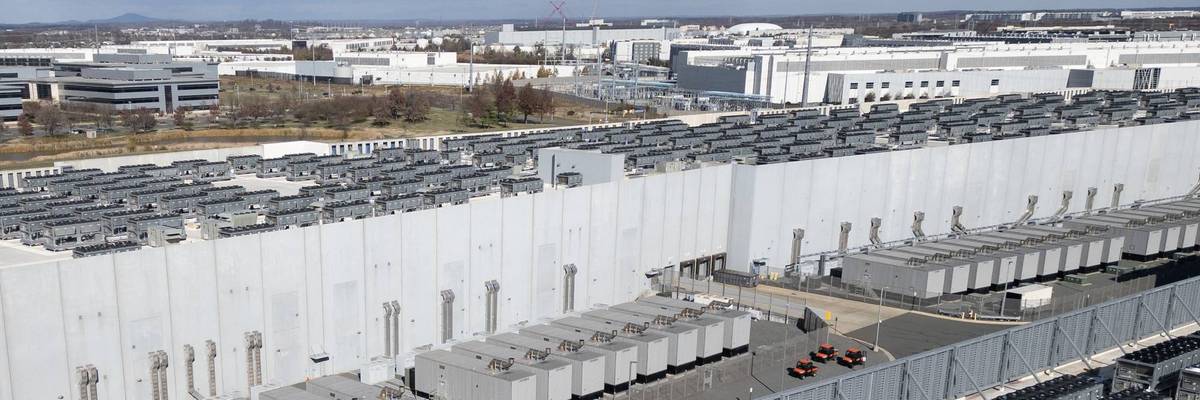
An aerial view shows cooling vent fans on the roof next to generators on the lower level of a Digital Realty data center in Ashburn, Virginia on November 12, 2025.
Virginia spent years asking how quickly it could build data centers. But Maryland and other states have an opportunity to ask a better question: How do we embrace innovation without sacrificing the affordability, environment, and quality of life that make our communities worth living in?
I’ve lived in Northern Virginia my whole life, but no one told us we would soon be living alongside one of the largest concentrations of data centers in the world.
No one asked our community whether we wanted them. No one explained what they would mean for our neighborhoods, our landscape, or our monthly bills. Then, almost overnight, they were everywhere. Massive industrial buildings rose where open space once stood. The constant hum became part of daily life. And one month, our electricity bill didn't gradually creep upward, it nearly doubled.
We were told these projects would bring jobs, innovation, and economic growth. What we weren't told was what residents would be expected to give up in return.
Now, as I watch Maryland debate whether to accelerate data center development, I can't help but feel like I've seen this story before.
As someone living with the consequences of Virginia's choices, my advice is simple: Don't wait until the bills arrive, the forests are gone, and the data centers are already built to ask whether they were worth it.
For years, Virginia has been held up as the nation's data center success story. But if Maryland leaders only see Virginia's balance sheet, they're missing the growing backlash from the people who live here.
I have watched forests disappear, industrial buildings replace open land, electricity demand surge, and communities be transformed by sprawling server farms. Everyone I know is asking whether the promised economic benefits outweigh the environmental and financial costs.
Maryland has a choice. You can rush to replicate Virginia's model, or you can learn from our mistakes before it's too late.
The conversation surrounding data centers has largely centered on artificial intelligence and economic development. But too often, what gets left out are the communities expected to absorb the costs.
Supporters frequently describe data centers as major job creators, but the reality is more complicated. Construction creates temporary employment, yet once operational, many hyperscale facilities require relatively few permanent workers. Communities are often asked to trade farmland, forests, neighborhoods, and increased pressure on utilities for projects that may never deliver the long-term economic engine they were promised.
That trade-off deserves far more scrutiny than it has received.
The race to build data centers is being driven largely by the explosive growth of artificial intelligence. Every major technology company wants more computing power, faster infrastructure, and greater capacity. But history teaches us that economic booms rarely continue unchecked. America has seen speculative waves in office construction, shopping malls, and commercial real estate that far exceeded demand before markets eventually corrected.
No one can say with certainty whether today's data center boom will follow the same path. But uncertainty itself is reason for caution, not acceleration.
Maryland should pause before repeating Virginia's mistakes. A statewide moratorium would give policymakers time to complete a comprehensive assessment of the environmental, economic, and energy impacts of these facilities; strengthen safeguards for communities; ensure developers bear the costs of new infrastructure; and give the public a meaningful voice in decisions that will shape their neighborhoods for generations.
Virginia spent years asking how quickly it could build data centers.
Maryland has an opportunity to ask a better question: How do we embrace innovation without sacrificing the affordability, environment, and quality of life that make our communities worth living in?
As someone living with the consequences of Virginia's choices, my advice is simple: Don't wait until the bills arrive, the forests are gone, and the data centers are already built to ask whether they were worth it.
By then, the answer may come too late.
Dear Common Dreams reader, It’s been nearly 30 years since I co-founded Common Dreams with my late wife, Lina Newhouser. We had the radical notion that journalism should serve the public good, not corporate profits. It was clear to us from the outset what it would take to build such a project. No paid advertisements. No corporate sponsors. No millionaire publisher telling us what to think or do. Many people said we wouldn't last a year, but we proved those doubters wrong. Together with a tremendous team of journalists and dedicated staff, we built an independent media outlet free from the constraints of profits and corporate control. Our mission has always been simple: To inform. To inspire. To ignite change for the common good. Building Common Dreams was not easy. Our survival was never guaranteed. When you take on the most powerful forces—Wall Street greed, fossil fuel industry destruction, Big Tech lobbyists, and uber-rich oligarchs who have spent billions upon billions rigging the economy and democracy in their favor—the only bulwark you have is supporters who believe in your work. But here’s the urgent message from me today. It's never been this bad out there. And it's never been this hard to keep us going. At the very moment Common Dreams is most needed, the threats we face are intensifying. We need your support now more than ever. We don't accept corporate advertising and never will. We don't have a paywall because we don't think people should be blocked from critical news based on their ability to pay. Everything we do is funded by the donations of readers like you. When everyone does the little they can afford, we are strong. But if that support retreats or dries up, so do we. Will you donate now to make sure Common Dreams not only survives but thrives? —Craig Brown, Co-founder |
I’ve lived in Northern Virginia my whole life, but no one told us we would soon be living alongside one of the largest concentrations of data centers in the world.
No one asked our community whether we wanted them. No one explained what they would mean for our neighborhoods, our landscape, or our monthly bills. Then, almost overnight, they were everywhere. Massive industrial buildings rose where open space once stood. The constant hum became part of daily life. And one month, our electricity bill didn't gradually creep upward, it nearly doubled.
We were told these projects would bring jobs, innovation, and economic growth. What we weren't told was what residents would be expected to give up in return.
Now, as I watch Maryland debate whether to accelerate data center development, I can't help but feel like I've seen this story before.
As someone living with the consequences of Virginia's choices, my advice is simple: Don't wait until the bills arrive, the forests are gone, and the data centers are already built to ask whether they were worth it.
For years, Virginia has been held up as the nation's data center success story. But if Maryland leaders only see Virginia's balance sheet, they're missing the growing backlash from the people who live here.
I have watched forests disappear, industrial buildings replace open land, electricity demand surge, and communities be transformed by sprawling server farms. Everyone I know is asking whether the promised economic benefits outweigh the environmental and financial costs.
Maryland has a choice. You can rush to replicate Virginia's model, or you can learn from our mistakes before it's too late.
The conversation surrounding data centers has largely centered on artificial intelligence and economic development. But too often, what gets left out are the communities expected to absorb the costs.
Supporters frequently describe data centers as major job creators, but the reality is more complicated. Construction creates temporary employment, yet once operational, many hyperscale facilities require relatively few permanent workers. Communities are often asked to trade farmland, forests, neighborhoods, and increased pressure on utilities for projects that may never deliver the long-term economic engine they were promised.
That trade-off deserves far more scrutiny than it has received.
The race to build data centers is being driven largely by the explosive growth of artificial intelligence. Every major technology company wants more computing power, faster infrastructure, and greater capacity. But history teaches us that economic booms rarely continue unchecked. America has seen speculative waves in office construction, shopping malls, and commercial real estate that far exceeded demand before markets eventually corrected.
No one can say with certainty whether today's data center boom will follow the same path. But uncertainty itself is reason for caution, not acceleration.
Maryland should pause before repeating Virginia's mistakes. A statewide moratorium would give policymakers time to complete a comprehensive assessment of the environmental, economic, and energy impacts of these facilities; strengthen safeguards for communities; ensure developers bear the costs of new infrastructure; and give the public a meaningful voice in decisions that will shape their neighborhoods for generations.
Virginia spent years asking how quickly it could build data centers.
Maryland has an opportunity to ask a better question: How do we embrace innovation without sacrificing the affordability, environment, and quality of life that make our communities worth living in?
As someone living with the consequences of Virginia's choices, my advice is simple: Don't wait until the bills arrive, the forests are gone, and the data centers are already built to ask whether they were worth it.
By then, the answer may come too late.
I’ve lived in Northern Virginia my whole life, but no one told us we would soon be living alongside one of the largest concentrations of data centers in the world.
No one asked our community whether we wanted them. No one explained what they would mean for our neighborhoods, our landscape, or our monthly bills. Then, almost overnight, they were everywhere. Massive industrial buildings rose where open space once stood. The constant hum became part of daily life. And one month, our electricity bill didn't gradually creep upward, it nearly doubled.
We were told these projects would bring jobs, innovation, and economic growth. What we weren't told was what residents would be expected to give up in return.
Now, as I watch Maryland debate whether to accelerate data center development, I can't help but feel like I've seen this story before.
As someone living with the consequences of Virginia's choices, my advice is simple: Don't wait until the bills arrive, the forests are gone, and the data centers are already built to ask whether they were worth it.
For years, Virginia has been held up as the nation's data center success story. But if Maryland leaders only see Virginia's balance sheet, they're missing the growing backlash from the people who live here.
I have watched forests disappear, industrial buildings replace open land, electricity demand surge, and communities be transformed by sprawling server farms. Everyone I know is asking whether the promised economic benefits outweigh the environmental and financial costs.
Maryland has a choice. You can rush to replicate Virginia's model, or you can learn from our mistakes before it's too late.
The conversation surrounding data centers has largely centered on artificial intelligence and economic development. But too often, what gets left out are the communities expected to absorb the costs.
Supporters frequently describe data centers as major job creators, but the reality is more complicated. Construction creates temporary employment, yet once operational, many hyperscale facilities require relatively few permanent workers. Communities are often asked to trade farmland, forests, neighborhoods, and increased pressure on utilities for projects that may never deliver the long-term economic engine they were promised.
That trade-off deserves far more scrutiny than it has received.
The race to build data centers is being driven largely by the explosive growth of artificial intelligence. Every major technology company wants more computing power, faster infrastructure, and greater capacity. But history teaches us that economic booms rarely continue unchecked. America has seen speculative waves in office construction, shopping malls, and commercial real estate that far exceeded demand before markets eventually corrected.
No one can say with certainty whether today's data center boom will follow the same path. But uncertainty itself is reason for caution, not acceleration.
Maryland should pause before repeating Virginia's mistakes. A statewide moratorium would give policymakers time to complete a comprehensive assessment of the environmental, economic, and energy impacts of these facilities; strengthen safeguards for communities; ensure developers bear the costs of new infrastructure; and give the public a meaningful voice in decisions that will shape their neighborhoods for generations.
Virginia spent years asking how quickly it could build data centers.
Maryland has an opportunity to ask a better question: How do we embrace innovation without sacrificing the affordability, environment, and quality of life that make our communities worth living in?
As someone living with the consequences of Virginia's choices, my advice is simple: Don't wait until the bills arrive, the forests are gone, and the data centers are already built to ask whether they were worth it.
By then, the answer may come too late.