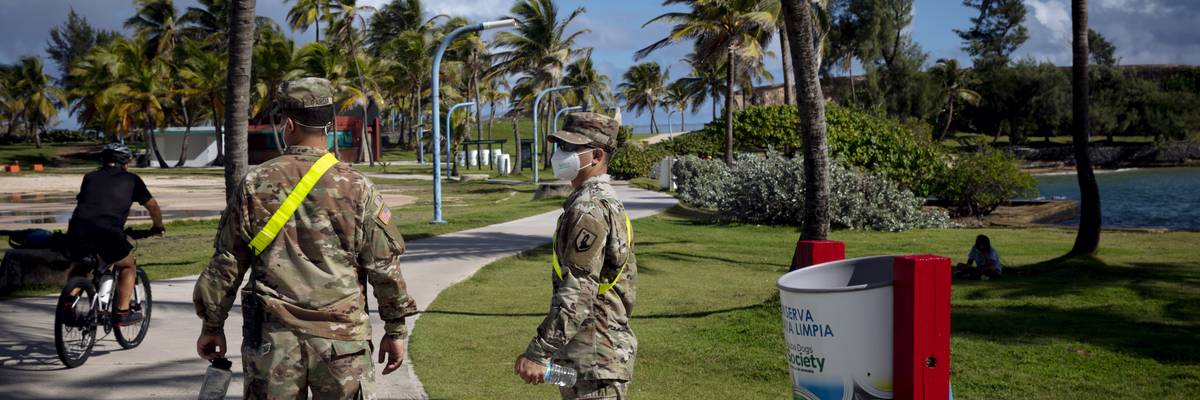
Two Puerto Rico National Guard members patrol the Escambron beach in San Juan, Puerto Rico on November 19, 2020
The Oldest Colony, the Newest War: Puerto Rico as a Launchpad for War on Venezuela
The island that has lived under US rule since 1898 is once again being used as a staging ground for US militarism, this time for Washington’s latest “war on drugs” narrative.
When President Donald Trump announced that the CIA had been authorized to conduct operations inside Venezuela, just as US drones struck another small boat off Venezuela’s coast, few people in the United States realized that much of this militarization begins on the soil of a land denied its own sovereignty: Puerto Rico.
The island that has lived under US rule since 1898 is once again being used as a staging ground for US militarism, this time for Washington’s latest “war on drugs” narrative, masking a campaign of coercion against Latin America’s independent governments.
After invading Puerto Rico in 1898, the United States quickly turned the island into a strategic military outpost: the “Gibraltar of the Caribbean,” with naval bases in Ceiba, Roosevelt Roads, and Vieques designed to dominate the eastern Caribbean and protect the new artery of empire: the Panama Canal.
From World War I onward, Puerto Ricans were drafted into every major US war, fighting and dying for a flag that still denies them full citizenship rights. Meanwhile, the island’s lands and waters were expropriated for bombing ranges, naval training, and intelligence operations.
Puerto Rico’s place in this strategy reveals Washington's core hypocrisy: It wages wars abroad in the name of freedom while denying that freedom to the colony it still holds.
For six decades, the US Navy used Vieques as a live-fire testing ground, dropping millions of pounds of explosives and munitions, including napalm and depleted uranium. The result was environmental devastation and one of the highest cancer rates in the region. It took a mass civil disobedience movement to finally force the Navy out in 2003.
That victory proved Puerto Ricans’ capacity for organized resistance, but the structures of empire never disappeared.
Two decades later, those same bases and runways are being reactivated. In 2025, Washington quietly expanded military operations on the island, deploying F-35 fighter jets, stationing P-8 maritime patrol aircraft, and rotating Marine and Special Operations units through Puerto Rican ports and airfields. The official justification is “counter-narcotics operations,” but the timing and scale point to something far larger: a regional military buildup aimed at Venezuela.
The aggression has now extended to Colombia, where Trump has cut off all US aid and accused President Gustavo Petro of being a “drug leader.” The announcement came just days after Colombia’s president denounced the US drone strikes off Venezuela’s coast, one of which, he warned, hit a Colombian vessel and killed Colombian citizens. Instead of accountability, Washington answered with insults and economic blackmail.
The Trump administration’s designation of a “non-international armed conflict with drug cartels” gives legal cover for drone strikes and covert missions far from US territory. Puerto Rico’s colonial status makes it the perfect staging ground: a place the Pentagon can operate freely without congressional debate or local consent.
For Puerto Ricans, this militarization is not an abstract issue. It means more surveillance, more environmental risk, and a deeper entanglement in wars they never chose. It also signals a return to the same imperial logic that made Vieques a bombing range: using occupied territory to project power abroad.
Puerto Rico remains the oldest colony in the modern world, a US “territory” whose people are “citizens” but not sovereign. They cannot vote for president, have no senators, and possess only a symbolic representative in Congress. That absence of sovereignty is what makes it so useful to the empire: a gray zone of legality where wars can be prepared without democratic consent.
This is not the first time Puerto Rico has been used as a military springboard. Its bases have served as logistical hubs for interventions across the hemisphere, from the US invasion of the Dominican Republic in 1965, to Grenada in 1983, and Panama in 1989.
Each of these operations was justified through Cold War rhetoric, the defense of “freedom,” “stability,” and “democracy,” while systematically targeting governments and social movements seeking independence from US control.
Puerto Rican born Rep. Nydia Velázquez (D-N.Y.) has warned that history is repeating itself. In a Newsweek op-ed, she reminded Washington of the lesson of Vieques: that the island’s people have already paid the price for US militarism through contamination, displacement, and neglect.
“Our people have already suffered enough from military pollution and colonial exploitation. Puerto Rico deserves peace, not more war,” she said.
Her call aligns with that of Caribbean and Latin American nations in CELAC, which have declared the region a “Zone of Peace.”
The buildup around Venezuela follows a long-standing pattern in US foreign policy: When a nation asserts control over its own resources or refuses to obey Washington’s dictates, it becomes a target. Venezuela, Cuba, and Nicaragua are punished for exactly that. Sanctions, blockades, and covert operations function as mechanisms of domination to keep the hemisphere open to US capital and military reach.
Puerto Rico’s place in this strategy reveals Washington's core hypocrisy: It wages wars abroad in the name of freedom while denying that freedom to the colony it still holds. Its people are governed without full representation, its land is used for war, and its economy remains bound to Washington’s dictates. Puerto Rico’s demand for independence is the same demand made by Venezuela, Cuba, and every nation that refuses to live on its knees: the right to determine its own future.
The struggle for peace, sovereignty, and dignity in Nuestra América runs through Puerto Rico’s shores. When US drones take off from Caribbean airstrips to strike Venezuela, they fly over the ghosts of Vieques, over the land where Puerto Ricans once stood unarmed against an empire.
Puerto Rico deserves a future of peace, environmental healing, and sovereignty, and Venezuela deserves the same: the right to live free from siege, to defend its independence, and to build its own destiny without fear of US bombs or blockades. To defend Puerto Rico’s right to peace is to defend Venezuela’s right to exist.
We are at a crossroads
This country and this world are at a monumental crossroads. In a few short weeks, US voters will have an opportunity to beat back the forces of fascism and confront the billionaires who are rigging the economy, our media system, and our democracy, making it increasingly impossible for ordinary people to get by. We’re not just talking about the election. We’re talking about what must be done once these fascist elements are vanquished from power. We need a bolder set of solutions than what either major party has so far been willing to offer and a working-class movement ready to fight like hell for it. Trump didn't emerge from nowhere. The conditions that fueled MAGA authoritarianism were created by decades of radical neoliberal economic policies and a corrupt political system dominated by corporate interests. They slashed taxes on the super-rich, promising that the benefits would trickle down. They said giveaways to the corporate titans would make life more affordable for the rest of us. It was all bullshit. And when a bitter, betrayed populace searches for someone to blame, right-wing demagogues have little trouble finding scapegoats. People know when they're being lied to, but you won't hear any of this from the corporate media. Only independent journalism—powered and funded by people who believe in building a better world—can deliver truly trustworthy daily news. Our Fall Campaign is underway, and we need your help. To power our newsroom through the rest of the year, we need to raise $125,000 by midnight on October 31. So if you share our vision, please contribute whatever you can to sustain our work. |
When President Donald Trump announced that the CIA had been authorized to conduct operations inside Venezuela, just as US drones struck another small boat off Venezuela’s coast, few people in the United States realized that much of this militarization begins on the soil of a land denied its own sovereignty: Puerto Rico.
The island that has lived under US rule since 1898 is once again being used as a staging ground for US militarism, this time for Washington’s latest “war on drugs” narrative, masking a campaign of coercion against Latin America’s independent governments.
After invading Puerto Rico in 1898, the United States quickly turned the island into a strategic military outpost: the “Gibraltar of the Caribbean,” with naval bases in Ceiba, Roosevelt Roads, and Vieques designed to dominate the eastern Caribbean and protect the new artery of empire: the Panama Canal.
From World War I onward, Puerto Ricans were drafted into every major US war, fighting and dying for a flag that still denies them full citizenship rights. Meanwhile, the island’s lands and waters were expropriated for bombing ranges, naval training, and intelligence operations.
Puerto Rico’s place in this strategy reveals Washington's core hypocrisy: It wages wars abroad in the name of freedom while denying that freedom to the colony it still holds.
For six decades, the US Navy used Vieques as a live-fire testing ground, dropping millions of pounds of explosives and munitions, including napalm and depleted uranium. The result was environmental devastation and one of the highest cancer rates in the region. It took a mass civil disobedience movement to finally force the Navy out in 2003.
That victory proved Puerto Ricans’ capacity for organized resistance, but the structures of empire never disappeared.
Two decades later, those same bases and runways are being reactivated. In 2025, Washington quietly expanded military operations on the island, deploying F-35 fighter jets, stationing P-8 maritime patrol aircraft, and rotating Marine and Special Operations units through Puerto Rican ports and airfields. The official justification is “counter-narcotics operations,” but the timing and scale point to something far larger: a regional military buildup aimed at Venezuela.
The aggression has now extended to Colombia, where Trump has cut off all US aid and accused President Gustavo Petro of being a “drug leader.” The announcement came just days after Colombia’s president denounced the US drone strikes off Venezuela’s coast, one of which, he warned, hit a Colombian vessel and killed Colombian citizens. Instead of accountability, Washington answered with insults and economic blackmail.
The Trump administration’s designation of a “non-international armed conflict with drug cartels” gives legal cover for drone strikes and covert missions far from US territory. Puerto Rico’s colonial status makes it the perfect staging ground: a place the Pentagon can operate freely without congressional debate or local consent.
For Puerto Ricans, this militarization is not an abstract issue. It means more surveillance, more environmental risk, and a deeper entanglement in wars they never chose. It also signals a return to the same imperial logic that made Vieques a bombing range: using occupied territory to project power abroad.
Puerto Rico remains the oldest colony in the modern world, a US “territory” whose people are “citizens” but not sovereign. They cannot vote for president, have no senators, and possess only a symbolic representative in Congress. That absence of sovereignty is what makes it so useful to the empire: a gray zone of legality where wars can be prepared without democratic consent.
This is not the first time Puerto Rico has been used as a military springboard. Its bases have served as logistical hubs for interventions across the hemisphere, from the US invasion of the Dominican Republic in 1965, to Grenada in 1983, and Panama in 1989.
Each of these operations was justified through Cold War rhetoric, the defense of “freedom,” “stability,” and “democracy,” while systematically targeting governments and social movements seeking independence from US control.
Puerto Rican born Rep. Nydia Velázquez (D-N.Y.) has warned that history is repeating itself. In a Newsweek op-ed, she reminded Washington of the lesson of Vieques: that the island’s people have already paid the price for US militarism through contamination, displacement, and neglect.
“Our people have already suffered enough from military pollution and colonial exploitation. Puerto Rico deserves peace, not more war,” she said.
Her call aligns with that of Caribbean and Latin American nations in CELAC, which have declared the region a “Zone of Peace.”
The buildup around Venezuela follows a long-standing pattern in US foreign policy: When a nation asserts control over its own resources or refuses to obey Washington’s dictates, it becomes a target. Venezuela, Cuba, and Nicaragua are punished for exactly that. Sanctions, blockades, and covert operations function as mechanisms of domination to keep the hemisphere open to US capital and military reach.
Puerto Rico’s place in this strategy reveals Washington's core hypocrisy: It wages wars abroad in the name of freedom while denying that freedom to the colony it still holds. Its people are governed without full representation, its land is used for war, and its economy remains bound to Washington’s dictates. Puerto Rico’s demand for independence is the same demand made by Venezuela, Cuba, and every nation that refuses to live on its knees: the right to determine its own future.
The struggle for peace, sovereignty, and dignity in Nuestra América runs through Puerto Rico’s shores. When US drones take off from Caribbean airstrips to strike Venezuela, they fly over the ghosts of Vieques, over the land where Puerto Ricans once stood unarmed against an empire.
Puerto Rico deserves a future of peace, environmental healing, and sovereignty, and Venezuela deserves the same: the right to live free from siege, to defend its independence, and to build its own destiny without fear of US bombs or blockades. To defend Puerto Rico’s right to peace is to defend Venezuela’s right to exist.
- The Fatal Expense of American Imperialism ›
- In Shadow of Puerto Rico's Nightmare, Virgin Islands and Others Facing Intense Struggle ›
- Cuba Warns US Moving Special Forces Closer to Venezuela Under Guise of 'Humanitarian Intervention' ›
- Trump’s Venezuela Drug War Gambit and the Militarization Playbook at Home ›
- Puerto Ricans Continue Protests Against US Militarism and War Threats | Common Dreams ›
- Opinion | Trumpian Colonialism Is Not Freedom | Common Dreams ›
- Opinion | Venezuela and the Return of Empire | Common Dreams ›