SUBSCRIBE TO OUR FREE NEWSLETTER
Daily news & progressive opinion—funded by the people, not the corporations—delivered straight to your inbox.
5
#000000
#FFFFFF
To donate by check, phone, or other method, see our More Ways to Give page.
Daily news & progressive opinion—funded by the people, not the corporations—delivered straight to your inbox.
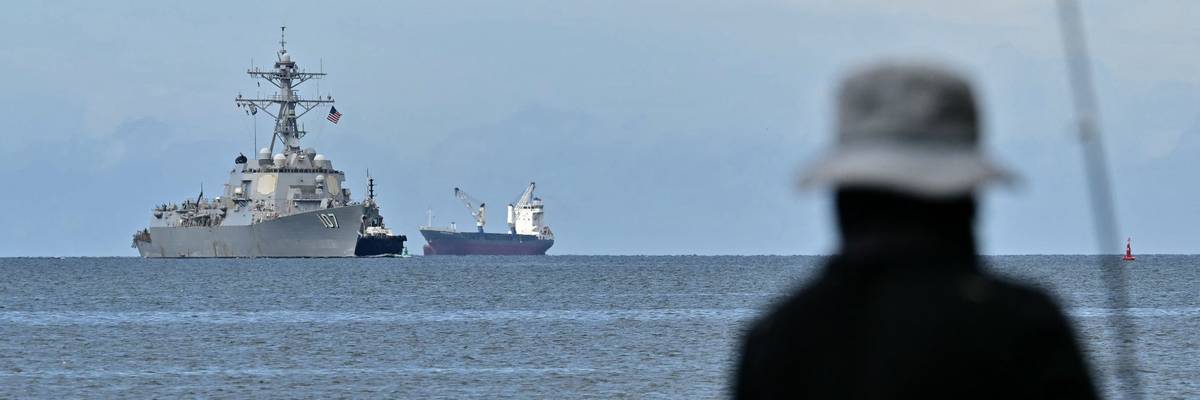
The USS Gravely warship is seen at a distance off the coast of Port of Spain on October 26, 2025, as fishermen look from the Trinidadian capital.
What is unfolding around Venezuela today is simply the latest iteration of a much older story: the US treatment of Latin America as its strategic backyard.
Three decades after the US invaded Panama, Washington is again amassing its largest military presence in the Caribbean. Aircraft carriers, stealth jets, and thousands of troops are being deployed in waters ringing Venezuela. The official pretext is the “war on drugs.” Yet the facts do not align with the rhetoric.
Washington claims its maritime attacks have stopped “85%” of drugs headed to the US. But the Drug Enforcement Administration’s own data tells another story: Most US-bound cocaine transits not through Venezuela, but through the Pacific and across the Mexican land border, usually smuggled by US citizens. Fentanyl—the drug repeatedly invoked by President Donald Trump—is not produced in Venezuela at all. South America neither manufactures nor consumes it at scale.
Despite this, more than 20 US strikes on small vessels in the Caribbean and Pacific since September have killed at least 83 people—mostly fishermen, according to regional governments. No evidence has been publicly presented that these boats carried narcotics. Independent human rights experts have condemned the campaign as a series of extrajudicial killings
Why, then, is Venezuela suddenly the target of this intensified pressure?
The region does not need another invasion disguised as war on drugs. It needs diplomacy and respect for sovereign political processes.
What is unfolding around Venezuela today is simply the latest iteration of a much older story. The United States is at it again. It is a familiar page out of its old playbook. And once again, the victims are not unfamiliar. Latin America has long served as the Empire’s preferred playground, where Washington has repeatedly engineered, enabled the toppling of democratically elected governments under the guise of protecting freedom, fighting communism, or now, defending democracy.
From the ouster of Guatemala’s Jacobo Árbenz in 1954 to the CIA-backed overthrow of Chile’s Salvador Allende in 1973, the region bears a long scar map of US interference. Washington supported or installed right-wing military dictatorships in Argentina, Chile, El Salvador, Guatemala—regimes that oversaw repression, disappearances, and mass killings. It funded and trained violent non-state actors such as the Contras in Nicaragua, whose campaign against the Sandinista government unleashed terror on rural communities.
Trump’s latest push for military action and regime change in Venezuela is a reaffirmation of the Monroe Doctrine—the 19th-century declaration that European powers must stay out of the Western Hemisphere because it belongs in the United States’ “sphere of interest.” Beneath its diplomatic phrasing lies a consistent message: Latin America is not sovereign land but a strategic backyard of the United States.
Venezuela offers a stage to counter the expanding presence of China, Russia, and Iran in the Western Hemisphere. A recent CSIS report shows nearly 100 Chinese military exchanges across Latin America and the Caribbean between 2022 and 2025, while Russia maintains security cooperation with governments such as Nicaragua and Venezuela. For Washington, projecting force in the region becomes a symbolic reaffirmation of the Monroe Doctrine: This hemisphere remains “ours.”
For five decades, the “war on drugs” has consumed over a $1 trillion, cost hundreds of thousands of lives, and utterly failed on its own terms. Cocaine production in Colombia is at historic highs. Mexico has lost more than 180,000 people to drug-related violence since 2018. And drug use in the United States has only increased. If anything, cartels have become more powerful, more militarized, and more deeply embedded in local economies. If the strategy hasn’t worked after 50 years, it won’t suddenly begin to work through missile strikes on fishing boats.
Even if one objects to Venezuelan President Nicolas Maduro’s authoritarianism, US military intervention has never delivered democracy or stability in Latin America. But even so, the United States has no right—moral, legal, or historical—to tinker yet again with regime change in the region already weighed down by economic contraction, inflation, and widening inequality. Venezuela in particular has suffered one of the deepest humanitarian crises outside war zones—shortages of food, medicine, water, and basic public services. Millions have fled. Any military escalation risks deepening the suffering of ordinary people while offering nothing meaningful in return.
Trump’s escalating posture toward Venezuela is not about drugs or democracy. And it is certainly not about humanitarian concern. It is about power. But if history is any guide, military intervention and regime change operations in Latin America have only ever worsened instability, strengthened authoritarianism, and led to more violence and displacement.
The region does not need another invasion disguised as war on drugs. It needs diplomacy and respect for sovereign political processes. Anything else is simply the empire repeating itself.
Dear Common Dreams reader, It’s been nearly 30 years since I co-founded Common Dreams with my late wife, Lina Newhouser. We had the radical notion that journalism should serve the public good, not corporate profits. It was clear to us from the outset what it would take to build such a project. No paid advertisements. No corporate sponsors. No millionaire publisher telling us what to think or do. Many people said we wouldn't last a year, but we proved those doubters wrong. Together with a tremendous team of journalists and dedicated staff, we built an independent media outlet free from the constraints of profits and corporate control. Our mission has always been simple: To inform. To inspire. To ignite change for the common good. Building Common Dreams was not easy. Our survival was never guaranteed. When you take on the most powerful forces—Wall Street greed, fossil fuel industry destruction, Big Tech lobbyists, and uber-rich oligarchs who have spent billions upon billions rigging the economy and democracy in their favor—the only bulwark you have is supporters who believe in your work. But here’s the urgent message from me today. It's never been this bad out there. And it's never been this hard to keep us going. At the very moment Common Dreams is most needed, the threats we face are intensifying. We need your support now more than ever. We don't accept corporate advertising and never will. We don't have a paywall because we don't think people should be blocked from critical news based on their ability to pay. Everything we do is funded by the donations of readers like you. When everyone does the little they can afford, we are strong. But if that support retreats or dries up, so do we. Will you donate now to make sure Common Dreams not only survives but thrives? —Craig Brown, Co-founder |
Three decades after the US invaded Panama, Washington is again amassing its largest military presence in the Caribbean. Aircraft carriers, stealth jets, and thousands of troops are being deployed in waters ringing Venezuela. The official pretext is the “war on drugs.” Yet the facts do not align with the rhetoric.
Washington claims its maritime attacks have stopped “85%” of drugs headed to the US. But the Drug Enforcement Administration’s own data tells another story: Most US-bound cocaine transits not through Venezuela, but through the Pacific and across the Mexican land border, usually smuggled by US citizens. Fentanyl—the drug repeatedly invoked by President Donald Trump—is not produced in Venezuela at all. South America neither manufactures nor consumes it at scale.
Despite this, more than 20 US strikes on small vessels in the Caribbean and Pacific since September have killed at least 83 people—mostly fishermen, according to regional governments. No evidence has been publicly presented that these boats carried narcotics. Independent human rights experts have condemned the campaign as a series of extrajudicial killings
Why, then, is Venezuela suddenly the target of this intensified pressure?
The region does not need another invasion disguised as war on drugs. It needs diplomacy and respect for sovereign political processes.
What is unfolding around Venezuela today is simply the latest iteration of a much older story. The United States is at it again. It is a familiar page out of its old playbook. And once again, the victims are not unfamiliar. Latin America has long served as the Empire’s preferred playground, where Washington has repeatedly engineered, enabled the toppling of democratically elected governments under the guise of protecting freedom, fighting communism, or now, defending democracy.
From the ouster of Guatemala’s Jacobo Árbenz in 1954 to the CIA-backed overthrow of Chile’s Salvador Allende in 1973, the region bears a long scar map of US interference. Washington supported or installed right-wing military dictatorships in Argentina, Chile, El Salvador, Guatemala—regimes that oversaw repression, disappearances, and mass killings. It funded and trained violent non-state actors such as the Contras in Nicaragua, whose campaign against the Sandinista government unleashed terror on rural communities.
Trump’s latest push for military action and regime change in Venezuela is a reaffirmation of the Monroe Doctrine—the 19th-century declaration that European powers must stay out of the Western Hemisphere because it belongs in the United States’ “sphere of interest.” Beneath its diplomatic phrasing lies a consistent message: Latin America is not sovereign land but a strategic backyard of the United States.
Venezuela offers a stage to counter the expanding presence of China, Russia, and Iran in the Western Hemisphere. A recent CSIS report shows nearly 100 Chinese military exchanges across Latin America and the Caribbean between 2022 and 2025, while Russia maintains security cooperation with governments such as Nicaragua and Venezuela. For Washington, projecting force in the region becomes a symbolic reaffirmation of the Monroe Doctrine: This hemisphere remains “ours.”
For five decades, the “war on drugs” has consumed over a $1 trillion, cost hundreds of thousands of lives, and utterly failed on its own terms. Cocaine production in Colombia is at historic highs. Mexico has lost more than 180,000 people to drug-related violence since 2018. And drug use in the United States has only increased. If anything, cartels have become more powerful, more militarized, and more deeply embedded in local economies. If the strategy hasn’t worked after 50 years, it won’t suddenly begin to work through missile strikes on fishing boats.
Even if one objects to Venezuelan President Nicolas Maduro’s authoritarianism, US military intervention has never delivered democracy or stability in Latin America. But even so, the United States has no right—moral, legal, or historical—to tinker yet again with regime change in the region already weighed down by economic contraction, inflation, and widening inequality. Venezuela in particular has suffered one of the deepest humanitarian crises outside war zones—shortages of food, medicine, water, and basic public services. Millions have fled. Any military escalation risks deepening the suffering of ordinary people while offering nothing meaningful in return.
Trump’s escalating posture toward Venezuela is not about drugs or democracy. And it is certainly not about humanitarian concern. It is about power. But if history is any guide, military intervention and regime change operations in Latin America have only ever worsened instability, strengthened authoritarianism, and led to more violence and displacement.
The region does not need another invasion disguised as war on drugs. It needs diplomacy and respect for sovereign political processes. Anything else is simply the empire repeating itself.
Three decades after the US invaded Panama, Washington is again amassing its largest military presence in the Caribbean. Aircraft carriers, stealth jets, and thousands of troops are being deployed in waters ringing Venezuela. The official pretext is the “war on drugs.” Yet the facts do not align with the rhetoric.
Washington claims its maritime attacks have stopped “85%” of drugs headed to the US. But the Drug Enforcement Administration’s own data tells another story: Most US-bound cocaine transits not through Venezuela, but through the Pacific and across the Mexican land border, usually smuggled by US citizens. Fentanyl—the drug repeatedly invoked by President Donald Trump—is not produced in Venezuela at all. South America neither manufactures nor consumes it at scale.
Despite this, more than 20 US strikes on small vessels in the Caribbean and Pacific since September have killed at least 83 people—mostly fishermen, according to regional governments. No evidence has been publicly presented that these boats carried narcotics. Independent human rights experts have condemned the campaign as a series of extrajudicial killings
Why, then, is Venezuela suddenly the target of this intensified pressure?
The region does not need another invasion disguised as war on drugs. It needs diplomacy and respect for sovereign political processes.
What is unfolding around Venezuela today is simply the latest iteration of a much older story. The United States is at it again. It is a familiar page out of its old playbook. And once again, the victims are not unfamiliar. Latin America has long served as the Empire’s preferred playground, where Washington has repeatedly engineered, enabled the toppling of democratically elected governments under the guise of protecting freedom, fighting communism, or now, defending democracy.
From the ouster of Guatemala’s Jacobo Árbenz in 1954 to the CIA-backed overthrow of Chile’s Salvador Allende in 1973, the region bears a long scar map of US interference. Washington supported or installed right-wing military dictatorships in Argentina, Chile, El Salvador, Guatemala—regimes that oversaw repression, disappearances, and mass killings. It funded and trained violent non-state actors such as the Contras in Nicaragua, whose campaign against the Sandinista government unleashed terror on rural communities.
Trump’s latest push for military action and regime change in Venezuela is a reaffirmation of the Monroe Doctrine—the 19th-century declaration that European powers must stay out of the Western Hemisphere because it belongs in the United States’ “sphere of interest.” Beneath its diplomatic phrasing lies a consistent message: Latin America is not sovereign land but a strategic backyard of the United States.
Venezuela offers a stage to counter the expanding presence of China, Russia, and Iran in the Western Hemisphere. A recent CSIS report shows nearly 100 Chinese military exchanges across Latin America and the Caribbean between 2022 and 2025, while Russia maintains security cooperation with governments such as Nicaragua and Venezuela. For Washington, projecting force in the region becomes a symbolic reaffirmation of the Monroe Doctrine: This hemisphere remains “ours.”
For five decades, the “war on drugs” has consumed over a $1 trillion, cost hundreds of thousands of lives, and utterly failed on its own terms. Cocaine production in Colombia is at historic highs. Mexico has lost more than 180,000 people to drug-related violence since 2018. And drug use in the United States has only increased. If anything, cartels have become more powerful, more militarized, and more deeply embedded in local economies. If the strategy hasn’t worked after 50 years, it won’t suddenly begin to work through missile strikes on fishing boats.
Even if one objects to Venezuelan President Nicolas Maduro’s authoritarianism, US military intervention has never delivered democracy or stability in Latin America. But even so, the United States has no right—moral, legal, or historical—to tinker yet again with regime change in the region already weighed down by economic contraction, inflation, and widening inequality. Venezuela in particular has suffered one of the deepest humanitarian crises outside war zones—shortages of food, medicine, water, and basic public services. Millions have fled. Any military escalation risks deepening the suffering of ordinary people while offering nothing meaningful in return.
Trump’s escalating posture toward Venezuela is not about drugs or democracy. And it is certainly not about humanitarian concern. It is about power. But if history is any guide, military intervention and regime change operations in Latin America have only ever worsened instability, strengthened authoritarianism, and led to more violence and displacement.
The region does not need another invasion disguised as war on drugs. It needs diplomacy and respect for sovereign political processes. Anything else is simply the empire repeating itself.