SUBSCRIBE TO OUR FREE NEWSLETTER
Daily news & progressive opinion—funded by the people, not the corporations—delivered straight to your inbox.
5
#000000
#FFFFFF
To donate by check, phone, or other method, see our More Ways to Give page.
Daily news & progressive opinion—funded by the people, not the corporations—delivered straight to your inbox.
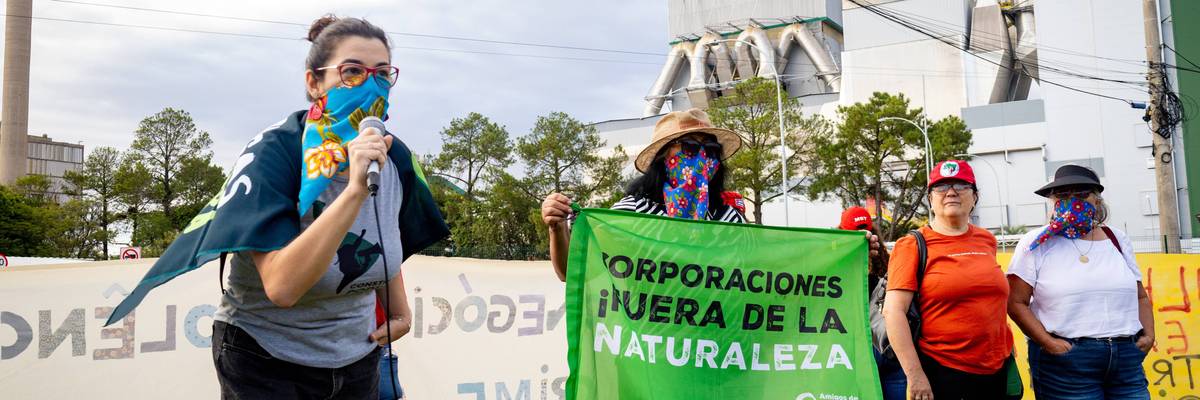
People protest the Natureza pulp mill project in Brazil.
As the United Nations Human Rights Council prepares for its 12th round of negotiations on a Binding Treaty on transnational corporations and human rights next week, a proposed pulp mill in Brazil offers a test of whether corporate accountability will finally extend beyond the factory gate.
In Guaíba, in southern Brazil, the effects of CMPC’s pulp mill enter people’s homes. Residents living nearby describe a rotten-egg smell from reduced sulfur compounds that irritates the eyes and nose and causes headaches and nausea. They live with noise and powerful vibrations, in some areas around the clock. Residents report cracks in their homes and disrupted sleep while sawdust and even foam from the mill’s effluent treatment plant fall on their houses. Soot and dust cover laundry hanging on clotheslines and cars parked in driveways, making it standard practice for the company to pay for the washing of neighborhood vehicles.
And then there are the accidents.
Workers have suffered poisoning and injuries, including fatal incidents. Chlorine leaks have affected residents living nearby, while communities still do not have an adequate emergency plan for a major accident.
Chilean pulp and paper company and monoculture tree plantation CMPC plans to build the so-called Natureza Project in Barra do Ribeiro, Rio Grande do Sul. The project isn’t simply a factory. It encompasses the expansion of massive eucalyptus monoculture plantations, roads, port infrastructure, dredging, transmission lines, and increased transportation, with production projected at millions of metric ton of pulp annually.
Indigenous and environmental organisations therefore question why the territorial, social, water-related, and ecological impacts of this tree monoculture expansion are not fully incorporated into the project’s assessment process.
And this is all happening as the industry continues to utilize an intense corporate lobby, leading to serious legal setbacks in corporate environmental regulation at the state and national levels. In 2023, environmental zoning regulations for forestry in Rio Grande do Sul were relaxed, allowing for the expansion of plantations from 1.2 million hectares to 4 million. And in 2024, forestry was excluded from the list of potentially polluting activities that consume environmental resources in Brazil, exempting tree monocultures from any type of environmental permit.
CMPC also actively greenwashes their activities, going as far as to fund local football tournaments. We see this as a broader scheme by corporations to mitigate pushback against their operations.
The proposed mill would discharge industrial effluent into Lake Guaíba, a crucial water body near Porto Alegre and other municipalities with a population of around 1.3 million people. Among the issues raised publicly are water quality; cumulative effects on a watershed already under pressure; and impacts related to dredging and navigation, mining, and the discharge of wastewater and industrial effluents (including those from the company’s existing factory). The volume of water consumed by the company and the pollutants discharged into Lake Guaíba would be equivalent to the water consumption and wastewater production of the entire population of the region. Possible contaminants include dioxins, extremely toxic chemical compounds that can enter the food chain and reach humans through the consumption of fish.
Lake Guaíba also supports fishing communities, contributes to drinking-water supplies, and is already under enormous ecological pressure. Asking whether a new factory complies with the technical conditions of a permit is therefore a narrower question than asking whether the entire corporate project is compatible with the rights of the people and ecosystems that are forced to absorb its consequences.
The Natureza Project presents a practical test for a global principle: Corporate human rights regulation must reflect the reality of corporate power.
The Federal Public Prosecutor’s Office says at least eight Mbyá Guarani villages fall within the project’s direct area of influence and 18 within its indirect area. As a result, its recommendations stress that consultation under International Labor Organization Convention 169 cannot be replaced by informal meetings or an Indigenous component study. Consultation must be free, prior, and informed and must respect the communities’ own protocols and decision-making processes. But the struggle goes beyond the consultation; it is about ensuring that communities have the right to say NO to the project.
That distinction is fundamental. Consultation is not a box to tick after the project has effectively been decided.
The proposed mill is also inseparable from a longer history. CMPC has been linked to the Laja-San Rosendo massacre, in which 19 people were murdered following Augusto Pinochet’s military coup. In 2021, the Concepción Court of Appeals convicted a former CMPC employee as an accomplice in the killings, finding coordination between state agents and company personnel. That history underscores why corporate accountability cannot be reduced to whether a company publishes sustainability reports or complies with a narrow administrative procedure.
The proposed legally binding instrument is intended to address precisely the gaps that arise when corporate impacts cross borders, jurisdictions, and stages of production. A meaningful treaty should require companies to identify, prevent, mitigate, and address human rights risks associated with the entire chain of activities under its control or linked to its project.
For a project like Natureza, that would mean assessing the mill alongside plantations, roads, ports, dredging, water use, emissions, and affected communities. It would mean treating Indigenous consultation as a substantive right rather than a procedural obstacle. It would mean ensuring access to information, participation, justice, and effective remedy.
Most importantly, it would clarify that responsibility cannot disappear simply because an impact occurs several steps away from the factory itself. That is the accountability gap the UN negotiations must confront.
The Natureza Project presents a practical test for a global principle: Corporate human rights regulation must reflect the reality of corporate power.
If a company’s business model transforms land, water, livelihoods, and Indigenous territories across an entire region, then the law must be capable of seeing that whole picture.
Anything less leaves the people bearing the consequences to carry the burden of a business model they never designed.
Dear Common Dreams reader, It’s been nearly 30 years since I co-founded Common Dreams with my late wife, Lina Newhouser. We had the radical notion that journalism should serve the public good, not corporate profits. It was clear to us from the outset what it would take to build such a project. No paid advertisements. No corporate sponsors. No millionaire publisher telling us what to think or do. Many people said we wouldn't last a year, but we proved those doubters wrong. Together with a tremendous team of journalists and dedicated staff, we built an independent media outlet free from the constraints of profits and corporate control. Our mission has always been simple: To inform. To inspire. To ignite change for the common good. Building Common Dreams was not easy. Our survival was never guaranteed. When you take on the most powerful forces—Wall Street greed, fossil fuel industry destruction, Big Tech lobbyists, and uber-rich oligarchs who have spent billions upon billions rigging the economy and democracy in their favor—the only bulwark you have is supporters who believe in your work. But here’s the urgent message from me today. It's never been this bad out there. And it's never been this hard to keep us going. At the very moment Common Dreams is most needed, the threats we face are intensifying. We need your support now more than ever. We don't accept corporate advertising and never will. We don't have a paywall because we don't think people should be blocked from critical news based on their ability to pay. Everything we do is funded by the donations of readers like you. When everyone does the little they can afford, we are strong. But if that support retreats or dries up, so do we. Will you donate now to make sure Common Dreams not only survives but thrives? —Craig Brown, Co-founder |
In Guaíba, in southern Brazil, the effects of CMPC’s pulp mill enter people’s homes. Residents living nearby describe a rotten-egg smell from reduced sulfur compounds that irritates the eyes and nose and causes headaches and nausea. They live with noise and powerful vibrations, in some areas around the clock. Residents report cracks in their homes and disrupted sleep while sawdust and even foam from the mill’s effluent treatment plant fall on their houses. Soot and dust cover laundry hanging on clotheslines and cars parked in driveways, making it standard practice for the company to pay for the washing of neighborhood vehicles.
And then there are the accidents.
Workers have suffered poisoning and injuries, including fatal incidents. Chlorine leaks have affected residents living nearby, while communities still do not have an adequate emergency plan for a major accident.
Chilean pulp and paper company and monoculture tree plantation CMPC plans to build the so-called Natureza Project in Barra do Ribeiro, Rio Grande do Sul. The project isn’t simply a factory. It encompasses the expansion of massive eucalyptus monoculture plantations, roads, port infrastructure, dredging, transmission lines, and increased transportation, with production projected at millions of metric ton of pulp annually.
Indigenous and environmental organisations therefore question why the territorial, social, water-related, and ecological impacts of this tree monoculture expansion are not fully incorporated into the project’s assessment process.
And this is all happening as the industry continues to utilize an intense corporate lobby, leading to serious legal setbacks in corporate environmental regulation at the state and national levels. In 2023, environmental zoning regulations for forestry in Rio Grande do Sul were relaxed, allowing for the expansion of plantations from 1.2 million hectares to 4 million. And in 2024, forestry was excluded from the list of potentially polluting activities that consume environmental resources in Brazil, exempting tree monocultures from any type of environmental permit.
CMPC also actively greenwashes their activities, going as far as to fund local football tournaments. We see this as a broader scheme by corporations to mitigate pushback against their operations.
The proposed mill would discharge industrial effluent into Lake Guaíba, a crucial water body near Porto Alegre and other municipalities with a population of around 1.3 million people. Among the issues raised publicly are water quality; cumulative effects on a watershed already under pressure; and impacts related to dredging and navigation, mining, and the discharge of wastewater and industrial effluents (including those from the company’s existing factory). The volume of water consumed by the company and the pollutants discharged into Lake Guaíba would be equivalent to the water consumption and wastewater production of the entire population of the region. Possible contaminants include dioxins, extremely toxic chemical compounds that can enter the food chain and reach humans through the consumption of fish.
Lake Guaíba also supports fishing communities, contributes to drinking-water supplies, and is already under enormous ecological pressure. Asking whether a new factory complies with the technical conditions of a permit is therefore a narrower question than asking whether the entire corporate project is compatible with the rights of the people and ecosystems that are forced to absorb its consequences.
The Natureza Project presents a practical test for a global principle: Corporate human rights regulation must reflect the reality of corporate power.
The Federal Public Prosecutor’s Office says at least eight Mbyá Guarani villages fall within the project’s direct area of influence and 18 within its indirect area. As a result, its recommendations stress that consultation under International Labor Organization Convention 169 cannot be replaced by informal meetings or an Indigenous component study. Consultation must be free, prior, and informed and must respect the communities’ own protocols and decision-making processes. But the struggle goes beyond the consultation; it is about ensuring that communities have the right to say NO to the project.
That distinction is fundamental. Consultation is not a box to tick after the project has effectively been decided.
The proposed mill is also inseparable from a longer history. CMPC has been linked to the Laja-San Rosendo massacre, in which 19 people were murdered following Augusto Pinochet’s military coup. In 2021, the Concepción Court of Appeals convicted a former CMPC employee as an accomplice in the killings, finding coordination between state agents and company personnel. That history underscores why corporate accountability cannot be reduced to whether a company publishes sustainability reports or complies with a narrow administrative procedure.
The proposed legally binding instrument is intended to address precisely the gaps that arise when corporate impacts cross borders, jurisdictions, and stages of production. A meaningful treaty should require companies to identify, prevent, mitigate, and address human rights risks associated with the entire chain of activities under its control or linked to its project.
For a project like Natureza, that would mean assessing the mill alongside plantations, roads, ports, dredging, water use, emissions, and affected communities. It would mean treating Indigenous consultation as a substantive right rather than a procedural obstacle. It would mean ensuring access to information, participation, justice, and effective remedy.
Most importantly, it would clarify that responsibility cannot disappear simply because an impact occurs several steps away from the factory itself. That is the accountability gap the UN negotiations must confront.
The Natureza Project presents a practical test for a global principle: Corporate human rights regulation must reflect the reality of corporate power.
If a company’s business model transforms land, water, livelihoods, and Indigenous territories across an entire region, then the law must be capable of seeing that whole picture.
Anything less leaves the people bearing the consequences to carry the burden of a business model they never designed.
In Guaíba, in southern Brazil, the effects of CMPC’s pulp mill enter people’s homes. Residents living nearby describe a rotten-egg smell from reduced sulfur compounds that irritates the eyes and nose and causes headaches and nausea. They live with noise and powerful vibrations, in some areas around the clock. Residents report cracks in their homes and disrupted sleep while sawdust and even foam from the mill’s effluent treatment plant fall on their houses. Soot and dust cover laundry hanging on clotheslines and cars parked in driveways, making it standard practice for the company to pay for the washing of neighborhood vehicles.
And then there are the accidents.
Workers have suffered poisoning and injuries, including fatal incidents. Chlorine leaks have affected residents living nearby, while communities still do not have an adequate emergency plan for a major accident.
Chilean pulp and paper company and monoculture tree plantation CMPC plans to build the so-called Natureza Project in Barra do Ribeiro, Rio Grande do Sul. The project isn’t simply a factory. It encompasses the expansion of massive eucalyptus monoculture plantations, roads, port infrastructure, dredging, transmission lines, and increased transportation, with production projected at millions of metric ton of pulp annually.
Indigenous and environmental organisations therefore question why the territorial, social, water-related, and ecological impacts of this tree monoculture expansion are not fully incorporated into the project’s assessment process.
And this is all happening as the industry continues to utilize an intense corporate lobby, leading to serious legal setbacks in corporate environmental regulation at the state and national levels. In 2023, environmental zoning regulations for forestry in Rio Grande do Sul were relaxed, allowing for the expansion of plantations from 1.2 million hectares to 4 million. And in 2024, forestry was excluded from the list of potentially polluting activities that consume environmental resources in Brazil, exempting tree monocultures from any type of environmental permit.
CMPC also actively greenwashes their activities, going as far as to fund local football tournaments. We see this as a broader scheme by corporations to mitigate pushback against their operations.
The proposed mill would discharge industrial effluent into Lake Guaíba, a crucial water body near Porto Alegre and other municipalities with a population of around 1.3 million people. Among the issues raised publicly are water quality; cumulative effects on a watershed already under pressure; and impacts related to dredging and navigation, mining, and the discharge of wastewater and industrial effluents (including those from the company’s existing factory). The volume of water consumed by the company and the pollutants discharged into Lake Guaíba would be equivalent to the water consumption and wastewater production of the entire population of the region. Possible contaminants include dioxins, extremely toxic chemical compounds that can enter the food chain and reach humans through the consumption of fish.
Lake Guaíba also supports fishing communities, contributes to drinking-water supplies, and is already under enormous ecological pressure. Asking whether a new factory complies with the technical conditions of a permit is therefore a narrower question than asking whether the entire corporate project is compatible with the rights of the people and ecosystems that are forced to absorb its consequences.
The Natureza Project presents a practical test for a global principle: Corporate human rights regulation must reflect the reality of corporate power.
The Federal Public Prosecutor’s Office says at least eight Mbyá Guarani villages fall within the project’s direct area of influence and 18 within its indirect area. As a result, its recommendations stress that consultation under International Labor Organization Convention 169 cannot be replaced by informal meetings or an Indigenous component study. Consultation must be free, prior, and informed and must respect the communities’ own protocols and decision-making processes. But the struggle goes beyond the consultation; it is about ensuring that communities have the right to say NO to the project.
That distinction is fundamental. Consultation is not a box to tick after the project has effectively been decided.
The proposed mill is also inseparable from a longer history. CMPC has been linked to the Laja-San Rosendo massacre, in which 19 people were murdered following Augusto Pinochet’s military coup. In 2021, the Concepción Court of Appeals convicted a former CMPC employee as an accomplice in the killings, finding coordination between state agents and company personnel. That history underscores why corporate accountability cannot be reduced to whether a company publishes sustainability reports or complies with a narrow administrative procedure.
The proposed legally binding instrument is intended to address precisely the gaps that arise when corporate impacts cross borders, jurisdictions, and stages of production. A meaningful treaty should require companies to identify, prevent, mitigate, and address human rights risks associated with the entire chain of activities under its control or linked to its project.
For a project like Natureza, that would mean assessing the mill alongside plantations, roads, ports, dredging, water use, emissions, and affected communities. It would mean treating Indigenous consultation as a substantive right rather than a procedural obstacle. It would mean ensuring access to information, participation, justice, and effective remedy.
Most importantly, it would clarify that responsibility cannot disappear simply because an impact occurs several steps away from the factory itself. That is the accountability gap the UN negotiations must confront.
The Natureza Project presents a practical test for a global principle: Corporate human rights regulation must reflect the reality of corporate power.
If a company’s business model transforms land, water, livelihoods, and Indigenous territories across an entire region, then the law must be capable of seeing that whole picture.
Anything less leaves the people bearing the consequences to carry the burden of a business model they never designed.