SUBSCRIBE TO OUR FREE NEWSLETTER
Daily news & progressive opinion—funded by the people, not the corporations—delivered straight to your inbox.
5
#000000
#FFFFFF
To donate by check, phone, or other method, see our More Ways to Give page.
Daily news & progressive opinion—funded by the people, not the corporations—delivered straight to your inbox.
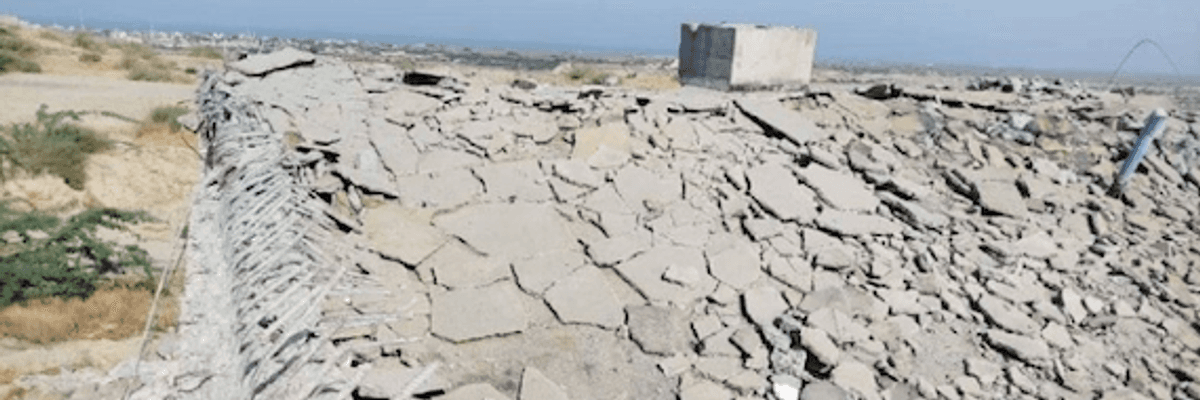
A photo shows alleged US damage to a water facility in Kuhestak, Iran.
If Iran felt its inhabitants were systematically being deprived of water due to US attacks, it could likely take out all the desalization plants in the territories of its Arab Gulf neighbors, without which none of those countries could survive more than three days.
In the midst of this week’s round of strikes and counterstrikes between the Trump administration and Iran, Iran’s IRIB News reported that on Tuesday the US had struck a reservoir and a water tank serving the inland town of Kuhestak as well as the port of Sirik on the Persian Gulf Coast.
Sirik is a small town of a few thousand inhabitants that serves as the capital for Sirik district of Hormozgan Province. It is not far from Bandar Abbas, the capital of the province. There is allegedly a base of the Iranian Revolutionary Guards Corps at Sirik, which is likely why the town was targeted. (H/t to BBC Monitoring for some of these Iran media links.)
If, however, the strike on the water tanks was deliberate, it was a war crime. Iranian media alleged that it deprived 20,000 people of drinking water in 113°F (45°C) temperatures and 60% humidity. This affected men, women, and children. The reservoir held 70K cubic feet of water and the water tank 17K cubic feet. Drinking water was unavailable for 12 hours.
Fatemeh Jarareh, the female representative in parliament of Hormozgan Province, called the attack a “blatant war crime against humanity.” She accused what she called the “terrorist army” of the United States of deliberately targeting key infrastructure necessary to human life and livelihood.
Quite apart from the question of whether it is a war crime to hit civilian water facilities, it is a very dangerous move.
The government said that repair crews restored water transmission lines in 12 hours and said that over the following 24 hours drinking water would stabilize.
During the 39-day all-out war in March, Iran asserted that the US or Israelis had damaged a desalinization plant providing drinking water to residents. Bahrain likewise said that a desalinization plant providing water to 30 villages had been damaged by an Iranian drone.
Quite apart from the question of whether it is a war crime to hit civilian water facilities, it is a very dangerous move. If Iran felt its inhabitants were systematically being deprived of water, it could likely take out all the desalization plants in the territories of its Arab Gulf neighbors, without which none of those countries could survive more than three days. That is how long it takes for renal failure from lack of water to kick in and kill you; it is why rescue teams after an earthquake gradually stop searching in the rubble for survivors after 36 hours, since the likelihood of someone surviving longer than that without water is low.
Some 80% of water in the United Arab Emirates, a country of 11 million, comes from desalinization plants. Their total destruction would provoke a vast exodus of the population and raise questions about the survival of the country, where 88% of the residents are non-citizen migrant workers and expatriates. In turn, the Emirates’ ability to export petroleum would be drastically impeded, hurting the whole world.
Hence, the Trump administration should think long and hard before hitting such civilian infrastructure in Iran. The whole Gulf region is full of glass houses, and if they are all shattered, the energy crisis would be unprecedented.
Dear Common Dreams reader, It’s been nearly 30 years since I co-founded Common Dreams with my late wife, Lina Newhouser. We had the radical notion that journalism should serve the public good, not corporate profits. It was clear to us from the outset what it would take to build such a project. No paid advertisements. No corporate sponsors. No millionaire publisher telling us what to think or do. Many people said we wouldn't last a year, but we proved those doubters wrong. Together with a tremendous team of journalists and dedicated staff, we built an independent media outlet free from the constraints of profits and corporate control. Our mission has always been simple: To inform. To inspire. To ignite change for the common good. Building Common Dreams was not easy. Our survival was never guaranteed. When you take on the most powerful forces—Wall Street greed, fossil fuel industry destruction, Big Tech lobbyists, and uber-rich oligarchs who have spent billions upon billions rigging the economy and democracy in their favor—the only bulwark you have is supporters who believe in your work. But here’s the urgent message from me today. It's never been this bad out there. And it's never been this hard to keep us going. At the very moment Common Dreams is most needed, the threats we face are intensifying. We need your support now more than ever. We don't accept corporate advertising and never will. We don't have a paywall because we don't think people should be blocked from critical news based on their ability to pay. Everything we do is funded by the donations of readers like you. When everyone does the little they can afford, we are strong. But if that support retreats or dries up, so do we. Will you donate now to make sure Common Dreams not only survives but thrives? —Craig Brown, Co-founder |
In the midst of this week’s round of strikes and counterstrikes between the Trump administration and Iran, Iran’s IRIB News reported that on Tuesday the US had struck a reservoir and a water tank serving the inland town of Kuhestak as well as the port of Sirik on the Persian Gulf Coast.
Sirik is a small town of a few thousand inhabitants that serves as the capital for Sirik district of Hormozgan Province. It is not far from Bandar Abbas, the capital of the province. There is allegedly a base of the Iranian Revolutionary Guards Corps at Sirik, which is likely why the town was targeted. (H/t to BBC Monitoring for some of these Iran media links.)
If, however, the strike on the water tanks was deliberate, it was a war crime. Iranian media alleged that it deprived 20,000 people of drinking water in 113°F (45°C) temperatures and 60% humidity. This affected men, women, and children. The reservoir held 70K cubic feet of water and the water tank 17K cubic feet. Drinking water was unavailable for 12 hours.
Fatemeh Jarareh, the female representative in parliament of Hormozgan Province, called the attack a “blatant war crime against humanity.” She accused what she called the “terrorist army” of the United States of deliberately targeting key infrastructure necessary to human life and livelihood.
Quite apart from the question of whether it is a war crime to hit civilian water facilities, it is a very dangerous move.
The government said that repair crews restored water transmission lines in 12 hours and said that over the following 24 hours drinking water would stabilize.
During the 39-day all-out war in March, Iran asserted that the US or Israelis had damaged a desalinization plant providing drinking water to residents. Bahrain likewise said that a desalinization plant providing water to 30 villages had been damaged by an Iranian drone.
Quite apart from the question of whether it is a war crime to hit civilian water facilities, it is a very dangerous move. If Iran felt its inhabitants were systematically being deprived of water, it could likely take out all the desalization plants in the territories of its Arab Gulf neighbors, without which none of those countries could survive more than three days. That is how long it takes for renal failure from lack of water to kick in and kill you; it is why rescue teams after an earthquake gradually stop searching in the rubble for survivors after 36 hours, since the likelihood of someone surviving longer than that without water is low.
Some 80% of water in the United Arab Emirates, a country of 11 million, comes from desalinization plants. Their total destruction would provoke a vast exodus of the population and raise questions about the survival of the country, where 88% of the residents are non-citizen migrant workers and expatriates. In turn, the Emirates’ ability to export petroleum would be drastically impeded, hurting the whole world.
Hence, the Trump administration should think long and hard before hitting such civilian infrastructure in Iran. The whole Gulf region is full of glass houses, and if they are all shattered, the energy crisis would be unprecedented.
In the midst of this week’s round of strikes and counterstrikes between the Trump administration and Iran, Iran’s IRIB News reported that on Tuesday the US had struck a reservoir and a water tank serving the inland town of Kuhestak as well as the port of Sirik on the Persian Gulf Coast.
Sirik is a small town of a few thousand inhabitants that serves as the capital for Sirik district of Hormozgan Province. It is not far from Bandar Abbas, the capital of the province. There is allegedly a base of the Iranian Revolutionary Guards Corps at Sirik, which is likely why the town was targeted. (H/t to BBC Monitoring for some of these Iran media links.)
If, however, the strike on the water tanks was deliberate, it was a war crime. Iranian media alleged that it deprived 20,000 people of drinking water in 113°F (45°C) temperatures and 60% humidity. This affected men, women, and children. The reservoir held 70K cubic feet of water and the water tank 17K cubic feet. Drinking water was unavailable for 12 hours.
Fatemeh Jarareh, the female representative in parliament of Hormozgan Province, called the attack a “blatant war crime against humanity.” She accused what she called the “terrorist army” of the United States of deliberately targeting key infrastructure necessary to human life and livelihood.
Quite apart from the question of whether it is a war crime to hit civilian water facilities, it is a very dangerous move.
The government said that repair crews restored water transmission lines in 12 hours and said that over the following 24 hours drinking water would stabilize.
During the 39-day all-out war in March, Iran asserted that the US or Israelis had damaged a desalinization plant providing drinking water to residents. Bahrain likewise said that a desalinization plant providing water to 30 villages had been damaged by an Iranian drone.
Quite apart from the question of whether it is a war crime to hit civilian water facilities, it is a very dangerous move. If Iran felt its inhabitants were systematically being deprived of water, it could likely take out all the desalization plants in the territories of its Arab Gulf neighbors, without which none of those countries could survive more than three days. That is how long it takes for renal failure from lack of water to kick in and kill you; it is why rescue teams after an earthquake gradually stop searching in the rubble for survivors after 36 hours, since the likelihood of someone surviving longer than that without water is low.
Some 80% of water in the United Arab Emirates, a country of 11 million, comes from desalinization plants. Their total destruction would provoke a vast exodus of the population and raise questions about the survival of the country, where 88% of the residents are non-citizen migrant workers and expatriates. In turn, the Emirates’ ability to export petroleum would be drastically impeded, hurting the whole world.
Hence, the Trump administration should think long and hard before hitting such civilian infrastructure in Iran. The whole Gulf region is full of glass houses, and if they are all shattered, the energy crisis would be unprecedented.