SUBSCRIBE TO OUR FREE NEWSLETTER
Daily news & progressive opinion—funded by the people, not the corporations—delivered straight to your inbox.
5
#000000
#FFFFFF
To donate by check, phone, or other method, see our More Ways to Give page.
Daily news & progressive opinion—funded by the people, not the corporations—delivered straight to your inbox.
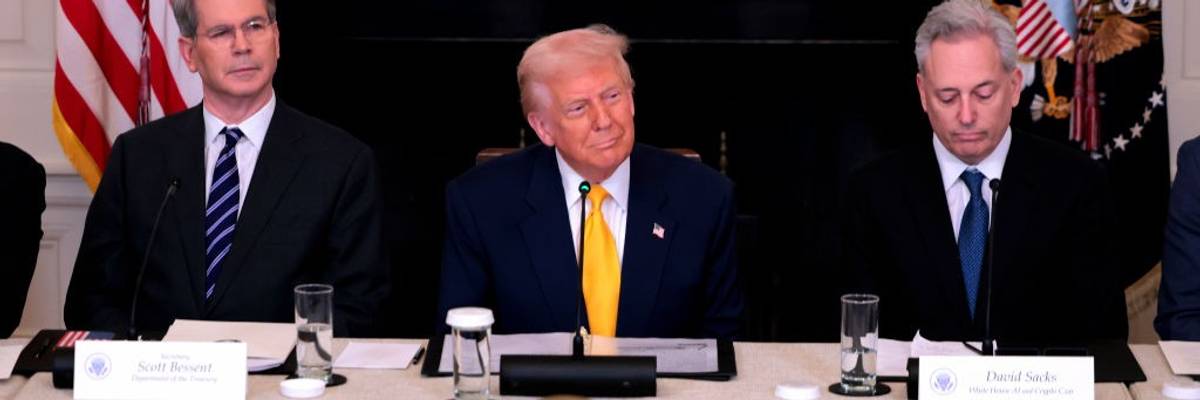
U.S. President Donald Trump speaks alongside Treasury Secretary Scott Bessent (L) and White House Crypto Czar David Sacks (R) at the The White House Digital Assets Summit on March 07, 2025.
A shadow cabinet would show us what it would mean to have a government of public servants who put the well being of American families ahead of the further enrichment of billionaires.
The rapid fire destruction initiated by President Trump, Elon Musk, and MAGA Republicans has overwhelmed Americans, with many scrambling to respond to one shock after another. Which was, of course, the point. The “flood the zone” strategy worked, for a while, leaving us alternating between fear and exhaustion.
But waiting for the lawsuits to stop the worst illegal moves or for disasters to expand to the point of collapse are losing strategies. Likewise, focusing exclusively on the failures of Trump administration policies leaves us feeling powerless and isolated.
What we need is a path forward.
Here’s one idea, discussed by North Carolina Democrat Rep. Wiley Nickel and historian and author Timothy Snyder: a shadow cabinet. The idea comes from other parliamentary democracies especially in Europe. In these systems, the opposition party establishes an alternative cabinet with specific portfolios that mirror those of the ruling government. These shadow ministers serve two crucial functions: they critique current policies while offering constructive alternatives.
Imagine having a shadow Attorney General who could provide journalists with informed counterpoints to administration claims while also creating a secure channel for alarmed federal employees to share concerns and leaks. Imagine a Secretary of Interior who could speak to the enduring value of American forests and parklands and why they should be protected.
What we need is to restore our sense of collective agency — to set a people’s agenda for the future and choose our own leaders.
A shadow cabinet would show us what it would mean to have a government of public servants who put the well being of American families ahead of the further enrichment of billionaires. During this time of overwhelm, when our physiological resources are limited by the impulse to “fight or flight,” this process could refocus us on our rights as citizens of this nation to have a government that works for us.
I propose one crucial variation on the approach proposed by Nickel and Snyder. The cabinet should not be appointed by the Democratic Party establishment — instead, we should embrace a truly democratic (small d) selection process. The Democratic Party establishment has failed to rise to the challenges of the times on many fronts, and many have felt alienated or left out.
Moreover, we need to recover our voices after the failed primary season of 2024 in which the nominations of Pres. Joe Biden followed by Vice President Kamala Harris were forgone conclusions. If Party leaders once again tell us who our leaders should be, alienation and cynicism would grow instead of engagement.
What we need is to restore our sense of collective agency — to set a people’s agenda for the future and choose our own leaders. So let’s create a grassroots process to debate priorities, hear from potential shadow cabinet candidates, and make selections collectively. We could consider a few key cabinet posts at a time. Caucuses at the local level could elect representatives to take community priorities and nominations for shadow secretaries to a national gathering for final selection.
This approach would be newsworthy, energizing, and shift our focus from mere opposition to creative problem-solving, visionary imagination, power-building, and community empowerment.
We could do this in locations across the country led by non-MAGA organizations that have large memberships and local chapters, for example The Working Families Party, Indivisible, the Women's March, Black Lives Matter, and Democratic Socialists of America come to mind, alongside local Democratic Party districts.
Americans are seeking genuine solutions to their everyday challenges, not ideological litmus tests. The questions we should be asking center on values and on practical approaches to improving the lives of current and future generations.
Our shadow cabinet members would serve as forward-looking spokespersons with the legitimacy of having been chosen through an inclusive process. They could effectively articulate alternative visions while also forming a deep bench of potential candidates for future elections.
Importantly, the democratic process itself would be enlivening. It would shift us away from the stale red-vs blue argument that too often miss the point. Is advocating for healthy lifestyles inherently conservative now that RFK Jr. is in office? Is supporting peace in Ukraine a right-wing position? Are immigration enforcement policies exclusively Republican when Democratic administrations have also implemented deportations?
Americans are seeking genuine solutions to their everyday challenges, not ideological litmus tests. The questions we should be asking center on values and on practical approaches to improving the lives of current and future generations.
This caucus process would provide valuable practice in democratic deliberation about real issues that are affecting our lives in local communities throughout the country. And it would expand our political imagination beyond the limitations imposed by establishment thinking, potentially embracing such popular proposals as Medicare for All.
No one is better equipped to define our national priorities and develop solutions than the American people themselves, engaged in pragmatic local conversations focused on constructive action. A democratic shadow cabinet offers a way to channel our energy toward building the future we want. By reclaiming our democratic voice through this process, we can begin building our vision and our power, re-engaging in our communities, and doing the essential work of renewal.
This country and this world are at a monumental crossroads. US voters have an opportunity to beat back the forces of fascism and confront the billionaires who are rigging the economy, our media system, and our democracy, making it increasingly impossible for ordinary people to get by. We’re not just talking about the election. We’re talking about what must be done once these fascist elements are vanquished from power. We need a bolder set of solutions than what either major party has so far been willing to offer and a working-class movement ready to fight like hell for it. Trump didn't emerge from nowhere. The conditions that fueled MAGA authoritarianism were created by decades of radical neoliberal economic policies and a corrupt political system dominated by corporate interests. They slashed taxes on the super-rich, promising that the benefits would trickle down. They said giveaways to the corporate titans would make life more affordable for the rest of us. It was all bullshit. And when a bitter, betrayed populace searches for someone to blame, right-wing demagogues have little trouble finding scapegoats. People know when they're being lied to, but you won't hear any of this from the corporate media. Only independent journalism—powered and funded by people who believe in building a better world—can deliver truly trustworthy daily news. If you share our vision, please contribute whatever you can to sustain our work. |
The rapid fire destruction initiated by President Trump, Elon Musk, and MAGA Republicans has overwhelmed Americans, with many scrambling to respond to one shock after another. Which was, of course, the point. The “flood the zone” strategy worked, for a while, leaving us alternating between fear and exhaustion.
But waiting for the lawsuits to stop the worst illegal moves or for disasters to expand to the point of collapse are losing strategies. Likewise, focusing exclusively on the failures of Trump administration policies leaves us feeling powerless and isolated.
What we need is a path forward.
Here’s one idea, discussed by North Carolina Democrat Rep. Wiley Nickel and historian and author Timothy Snyder: a shadow cabinet. The idea comes from other parliamentary democracies especially in Europe. In these systems, the opposition party establishes an alternative cabinet with specific portfolios that mirror those of the ruling government. These shadow ministers serve two crucial functions: they critique current policies while offering constructive alternatives.
Imagine having a shadow Attorney General who could provide journalists with informed counterpoints to administration claims while also creating a secure channel for alarmed federal employees to share concerns and leaks. Imagine a Secretary of Interior who could speak to the enduring value of American forests and parklands and why they should be protected.
What we need is to restore our sense of collective agency — to set a people’s agenda for the future and choose our own leaders.
A shadow cabinet would show us what it would mean to have a government of public servants who put the well being of American families ahead of the further enrichment of billionaires. During this time of overwhelm, when our physiological resources are limited by the impulse to “fight or flight,” this process could refocus us on our rights as citizens of this nation to have a government that works for us.
I propose one crucial variation on the approach proposed by Nickel and Snyder. The cabinet should not be appointed by the Democratic Party establishment — instead, we should embrace a truly democratic (small d) selection process. The Democratic Party establishment has failed to rise to the challenges of the times on many fronts, and many have felt alienated or left out.
Moreover, we need to recover our voices after the failed primary season of 2024 in which the nominations of Pres. Joe Biden followed by Vice President Kamala Harris were forgone conclusions. If Party leaders once again tell us who our leaders should be, alienation and cynicism would grow instead of engagement.
What we need is to restore our sense of collective agency — to set a people’s agenda for the future and choose our own leaders. So let’s create a grassroots process to debate priorities, hear from potential shadow cabinet candidates, and make selections collectively. We could consider a few key cabinet posts at a time. Caucuses at the local level could elect representatives to take community priorities and nominations for shadow secretaries to a national gathering for final selection.
This approach would be newsworthy, energizing, and shift our focus from mere opposition to creative problem-solving, visionary imagination, power-building, and community empowerment.
We could do this in locations across the country led by non-MAGA organizations that have large memberships and local chapters, for example The Working Families Party, Indivisible, the Women's March, Black Lives Matter, and Democratic Socialists of America come to mind, alongside local Democratic Party districts.
Americans are seeking genuine solutions to their everyday challenges, not ideological litmus tests. The questions we should be asking center on values and on practical approaches to improving the lives of current and future generations.
Our shadow cabinet members would serve as forward-looking spokespersons with the legitimacy of having been chosen through an inclusive process. They could effectively articulate alternative visions while also forming a deep bench of potential candidates for future elections.
Importantly, the democratic process itself would be enlivening. It would shift us away from the stale red-vs blue argument that too often miss the point. Is advocating for healthy lifestyles inherently conservative now that RFK Jr. is in office? Is supporting peace in Ukraine a right-wing position? Are immigration enforcement policies exclusively Republican when Democratic administrations have also implemented deportations?
Americans are seeking genuine solutions to their everyday challenges, not ideological litmus tests. The questions we should be asking center on values and on practical approaches to improving the lives of current and future generations.
This caucus process would provide valuable practice in democratic deliberation about real issues that are affecting our lives in local communities throughout the country. And it would expand our political imagination beyond the limitations imposed by establishment thinking, potentially embracing such popular proposals as Medicare for All.
No one is better equipped to define our national priorities and develop solutions than the American people themselves, engaged in pragmatic local conversations focused on constructive action. A democratic shadow cabinet offers a way to channel our energy toward building the future we want. By reclaiming our democratic voice through this process, we can begin building our vision and our power, re-engaging in our communities, and doing the essential work of renewal.