SUBSCRIBE TO OUR FREE NEWSLETTER
Daily news & progressive opinion—funded by the people, not the corporations—delivered straight to your inbox.
5
#000000
#FFFFFF
To donate by check, phone, or other method, see our More Ways to Give page.
Daily news & progressive opinion—funded by the people, not the corporations—delivered straight to your inbox.
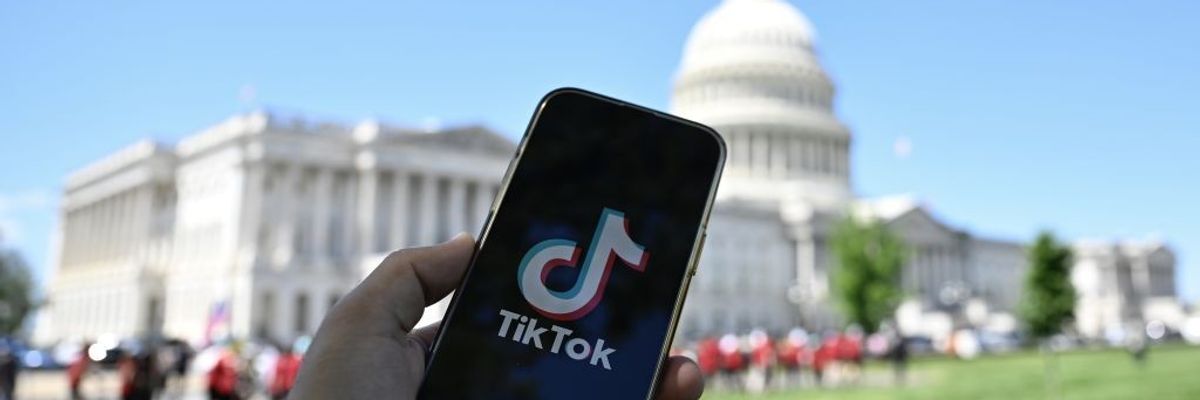
In this photo illustration, the logo of TikTok is displayed on a mobile phone screen in front of the White House in Washington D.C., United States on April 20, 2024.
What Congress is telling the world is that being a person or company that simply has origins in Asia is enough to be labeled a national security threat—no evidence required. That is racial profiling and an affront to the Constitution.
Today, the Supreme Court upheld Congress’s wrongheaded decision to ban TikTok in a unanimous decision. The ban on TikTok is set to take effect on Sunday January 19, 2025.
Ahead of this misguided ruling, 15 racial justice nonprofits submitted an emergency filing to the Supreme Court, explaining how the TikTok ban violates the rights of 170 million U.S. users and echoes a disgraceful history of anti-Asian racism.
It is no secret that our government wrongfully uses “national security” as a weapon against Asian American and Pacific Islander communities. Stop AAPI Hate’s research highlights how the government routinely scapegoats our communities for economic downturns, public health crises, and national security threats—often without any evidence.
When our government engages in anti-Asian racial profiling and biased enforcement, it encourages everyday people to do the same.
In the case of TikTok, the government claims that a ban is necessary to protect U.S. national security against China. However, the government also filed an affidavit in open court, signed by a senior U.S. national security official, stating there is “no information” that China had ever tried to use TikTok for nefarious purposes in the United States.
In other words, what Congress is telling the world is that being a person or company that simply has origins in Asia is enough to be labeled a national security threat—no evidence required.
That is racial profiling, plain and simple. And it is an affront to the Constitution.
It is disappointing, though unsurprising, that our government is targeting Asian American communities solely because of our race and national origins. Since our nation’s founding, our government has repeatedly trampled on the rights of Asians, Asian Americans, and other minority groups by relying on so-called “national security” concerns as a basis for outright racial discrimination.
Take, for example, the Chinese Exclusion Act of 1882, Japanese American incarceration during World War II, and government-sanctioned racial profiling and surveillance of innocent Muslim communities following the 9/11 attacks. More recently, we saw the China Initiative, a Department of Justice operation from 2018 to 2022 that unjustly targeted Chinese and Chinese American academics, ruined careers and livelihoods, and chilled scientific research.
Every time the government insisted that such laws or programs targeting Asian Americans were necessary, it reinforced the pernicious “perpetual foreigner” stereotype or the idea that all Asian people in America are inherently suspicious and disloyal to the United States based on our ancestry, skin color, or religious faith.
Those laws and programs were based on fearmongering and scapegoating. All three branches of government—the president, Congress, and the Supreme Court—eventually admitted that Japanese American incarceration violated the Constitution. Both the House and the Senate officially apologized for the Chinese Exclusion Act and other discriminatory laws. And the DOJ eventually shut down the China Initiative, acknowledging it perpetuated a discriminatory double standard against people with any ties to China, though President-elect Donald Trump wants to revive it.
Our government never seems to learn and instead continues to pass laws motivated by anti-Asian prejudice, like this TikTok ban.
The TikTok ban has real human costs. The ban will silence 170 million U.S. users, including communities like ours that rely on TikTok to build solidarity, share valuable information, practice their faith, and engage in free expression.
But what worries us even more is how the TikTok ban fuels hateful rhetoric and actions against Asian Americans. It is clear that Congress targeted TikTok because the company is Chinese. Other social media platforms like Facebook, Instagram, and YouTube collect vast amounts of user data and have had major privacy and security issues—yet the government is not applying the same level of scrutiny on those companies.
When our government engages in anti-Asian racial profiling and biased enforcement, it encourages everyday people to do the same. We saw this exact ripple effect of hate during the Covid-19 pandemic.
At the start of the pandemic, then-President Trump spewed racist, anti-Asian rhetoric blaming Chinese people for the virus, fueling a torrent of hate against AAPI communities. In fact, from 2020 to 2022, Stop AAPI Hate received over 2,000 reports of hate acts in which offenders mimicked Trump’s language. His rhetoric emboldened people to spit racist vitriol at our community members as we shopped for groceries, dropped our kids off at school, and took the bus to work. They shouted that we were diseased and told us to go back to our country. Since our founding in March 2020, we have received over 12,000 reports of anti-AAPI hate acts from across the country—and we know racism and discrimination increase when politicians target our communities.
That’s why AAPI communities must tell our leaders that we disagree with the TikTok ban. This decision is not only an affront to our civil liberties and free speech, it is also an affront to our safety. We need leaders who will defend our rights and safety—not strip it away.
Dear Common Dreams reader, It’s been nearly 30 years since I co-founded Common Dreams with my late wife, Lina Newhouser. We had the radical notion that journalism should serve the public good, not corporate profits. It was clear to us from the outset what it would take to build such a project. No paid advertisements. No corporate sponsors. No millionaire publisher telling us what to think or do. Many people said we wouldn't last a year, but we proved those doubters wrong. Together with a tremendous team of journalists and dedicated staff, we built an independent media outlet free from the constraints of profits and corporate control. Our mission has always been simple: To inform. To inspire. To ignite change for the common good. Building Common Dreams was not easy. Our survival was never guaranteed. When you take on the most powerful forces—Wall Street greed, fossil fuel industry destruction, Big Tech lobbyists, and uber-rich oligarchs who have spent billions upon billions rigging the economy and democracy in their favor—the only bulwark you have is supporters who believe in your work. But here’s the urgent message from me today. It's never been this bad out there. And it's never been this hard to keep us going. At the very moment Common Dreams is most needed, the threats we face are intensifying. We need your support now more than ever. We don't accept corporate advertising and never will. We don't have a paywall because we don't think people should be blocked from critical news based on their ability to pay. Everything we do is funded by the donations of readers like you. When everyone does the little they can afford, we are strong. But if that support retreats or dries up, so do we. Will you donate now to make sure Common Dreams not only survives but thrives? —Craig Brown, Co-founder |
Today, the Supreme Court upheld Congress’s wrongheaded decision to ban TikTok in a unanimous decision. The ban on TikTok is set to take effect on Sunday January 19, 2025.
Ahead of this misguided ruling, 15 racial justice nonprofits submitted an emergency filing to the Supreme Court, explaining how the TikTok ban violates the rights of 170 million U.S. users and echoes a disgraceful history of anti-Asian racism.
It is no secret that our government wrongfully uses “national security” as a weapon against Asian American and Pacific Islander communities. Stop AAPI Hate’s research highlights how the government routinely scapegoats our communities for economic downturns, public health crises, and national security threats—often without any evidence.
When our government engages in anti-Asian racial profiling and biased enforcement, it encourages everyday people to do the same.
In the case of TikTok, the government claims that a ban is necessary to protect U.S. national security against China. However, the government also filed an affidavit in open court, signed by a senior U.S. national security official, stating there is “no information” that China had ever tried to use TikTok for nefarious purposes in the United States.
In other words, what Congress is telling the world is that being a person or company that simply has origins in Asia is enough to be labeled a national security threat—no evidence required.
That is racial profiling, plain and simple. And it is an affront to the Constitution.
It is disappointing, though unsurprising, that our government is targeting Asian American communities solely because of our race and national origins. Since our nation’s founding, our government has repeatedly trampled on the rights of Asians, Asian Americans, and other minority groups by relying on so-called “national security” concerns as a basis for outright racial discrimination.
Take, for example, the Chinese Exclusion Act of 1882, Japanese American incarceration during World War II, and government-sanctioned racial profiling and surveillance of innocent Muslim communities following the 9/11 attacks. More recently, we saw the China Initiative, a Department of Justice operation from 2018 to 2022 that unjustly targeted Chinese and Chinese American academics, ruined careers and livelihoods, and chilled scientific research.
Every time the government insisted that such laws or programs targeting Asian Americans were necessary, it reinforced the pernicious “perpetual foreigner” stereotype or the idea that all Asian people in America are inherently suspicious and disloyal to the United States based on our ancestry, skin color, or religious faith.
Those laws and programs were based on fearmongering and scapegoating. All three branches of government—the president, Congress, and the Supreme Court—eventually admitted that Japanese American incarceration violated the Constitution. Both the House and the Senate officially apologized for the Chinese Exclusion Act and other discriminatory laws. And the DOJ eventually shut down the China Initiative, acknowledging it perpetuated a discriminatory double standard against people with any ties to China, though President-elect Donald Trump wants to revive it.
Our government never seems to learn and instead continues to pass laws motivated by anti-Asian prejudice, like this TikTok ban.
The TikTok ban has real human costs. The ban will silence 170 million U.S. users, including communities like ours that rely on TikTok to build solidarity, share valuable information, practice their faith, and engage in free expression.
But what worries us even more is how the TikTok ban fuels hateful rhetoric and actions against Asian Americans. It is clear that Congress targeted TikTok because the company is Chinese. Other social media platforms like Facebook, Instagram, and YouTube collect vast amounts of user data and have had major privacy and security issues—yet the government is not applying the same level of scrutiny on those companies.
When our government engages in anti-Asian racial profiling and biased enforcement, it encourages everyday people to do the same. We saw this exact ripple effect of hate during the Covid-19 pandemic.
At the start of the pandemic, then-President Trump spewed racist, anti-Asian rhetoric blaming Chinese people for the virus, fueling a torrent of hate against AAPI communities. In fact, from 2020 to 2022, Stop AAPI Hate received over 2,000 reports of hate acts in which offenders mimicked Trump’s language. His rhetoric emboldened people to spit racist vitriol at our community members as we shopped for groceries, dropped our kids off at school, and took the bus to work. They shouted that we were diseased and told us to go back to our country. Since our founding in March 2020, we have received over 12,000 reports of anti-AAPI hate acts from across the country—and we know racism and discrimination increase when politicians target our communities.
That’s why AAPI communities must tell our leaders that we disagree with the TikTok ban. This decision is not only an affront to our civil liberties and free speech, it is also an affront to our safety. We need leaders who will defend our rights and safety—not strip it away.
Today, the Supreme Court upheld Congress’s wrongheaded decision to ban TikTok in a unanimous decision. The ban on TikTok is set to take effect on Sunday January 19, 2025.
Ahead of this misguided ruling, 15 racial justice nonprofits submitted an emergency filing to the Supreme Court, explaining how the TikTok ban violates the rights of 170 million U.S. users and echoes a disgraceful history of anti-Asian racism.
It is no secret that our government wrongfully uses “national security” as a weapon against Asian American and Pacific Islander communities. Stop AAPI Hate’s research highlights how the government routinely scapegoats our communities for economic downturns, public health crises, and national security threats—often without any evidence.
When our government engages in anti-Asian racial profiling and biased enforcement, it encourages everyday people to do the same.
In the case of TikTok, the government claims that a ban is necessary to protect U.S. national security against China. However, the government also filed an affidavit in open court, signed by a senior U.S. national security official, stating there is “no information” that China had ever tried to use TikTok for nefarious purposes in the United States.
In other words, what Congress is telling the world is that being a person or company that simply has origins in Asia is enough to be labeled a national security threat—no evidence required.
That is racial profiling, plain and simple. And it is an affront to the Constitution.
It is disappointing, though unsurprising, that our government is targeting Asian American communities solely because of our race and national origins. Since our nation’s founding, our government has repeatedly trampled on the rights of Asians, Asian Americans, and other minority groups by relying on so-called “national security” concerns as a basis for outright racial discrimination.
Take, for example, the Chinese Exclusion Act of 1882, Japanese American incarceration during World War II, and government-sanctioned racial profiling and surveillance of innocent Muslim communities following the 9/11 attacks. More recently, we saw the China Initiative, a Department of Justice operation from 2018 to 2022 that unjustly targeted Chinese and Chinese American academics, ruined careers and livelihoods, and chilled scientific research.
Every time the government insisted that such laws or programs targeting Asian Americans were necessary, it reinforced the pernicious “perpetual foreigner” stereotype or the idea that all Asian people in America are inherently suspicious and disloyal to the United States based on our ancestry, skin color, or religious faith.
Those laws and programs were based on fearmongering and scapegoating. All three branches of government—the president, Congress, and the Supreme Court—eventually admitted that Japanese American incarceration violated the Constitution. Both the House and the Senate officially apologized for the Chinese Exclusion Act and other discriminatory laws. And the DOJ eventually shut down the China Initiative, acknowledging it perpetuated a discriminatory double standard against people with any ties to China, though President-elect Donald Trump wants to revive it.
Our government never seems to learn and instead continues to pass laws motivated by anti-Asian prejudice, like this TikTok ban.
The TikTok ban has real human costs. The ban will silence 170 million U.S. users, including communities like ours that rely on TikTok to build solidarity, share valuable information, practice their faith, and engage in free expression.
But what worries us even more is how the TikTok ban fuels hateful rhetoric and actions against Asian Americans. It is clear that Congress targeted TikTok because the company is Chinese. Other social media platforms like Facebook, Instagram, and YouTube collect vast amounts of user data and have had major privacy and security issues—yet the government is not applying the same level of scrutiny on those companies.
When our government engages in anti-Asian racial profiling and biased enforcement, it encourages everyday people to do the same. We saw this exact ripple effect of hate during the Covid-19 pandemic.
At the start of the pandemic, then-President Trump spewed racist, anti-Asian rhetoric blaming Chinese people for the virus, fueling a torrent of hate against AAPI communities. In fact, from 2020 to 2022, Stop AAPI Hate received over 2,000 reports of hate acts in which offenders mimicked Trump’s language. His rhetoric emboldened people to spit racist vitriol at our community members as we shopped for groceries, dropped our kids off at school, and took the bus to work. They shouted that we were diseased and told us to go back to our country. Since our founding in March 2020, we have received over 12,000 reports of anti-AAPI hate acts from across the country—and we know racism and discrimination increase when politicians target our communities.
That’s why AAPI communities must tell our leaders that we disagree with the TikTok ban. This decision is not only an affront to our civil liberties and free speech, it is also an affront to our safety. We need leaders who will defend our rights and safety—not strip it away.