SUBSCRIBE TO OUR FREE NEWSLETTER
Daily news & progressive opinion—funded by the people, not the corporations—delivered straight to your inbox.
5
#000000
#FFFFFF
To donate by check, phone, or other method, see our More Ways to Give page.
Daily news & progressive opinion—funded by the people, not the corporations—delivered straight to your inbox.
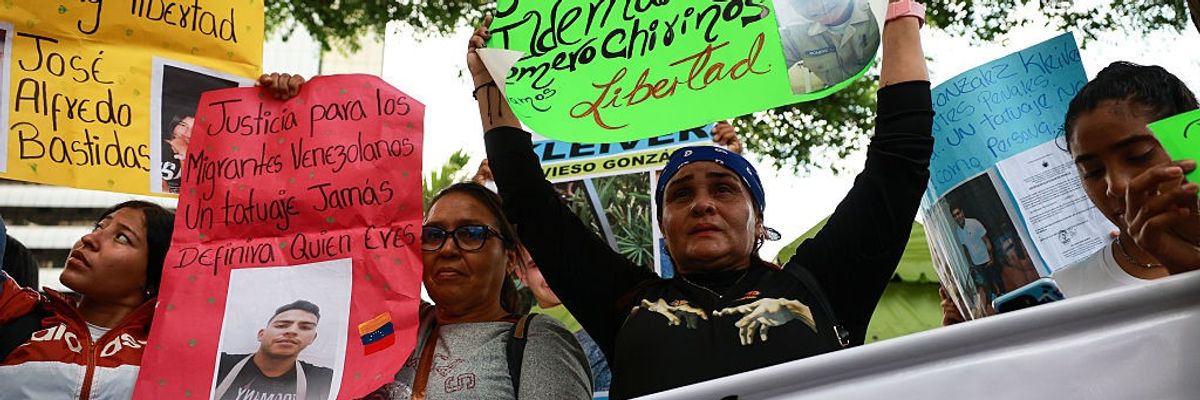
People take part in a protest against the deportation of alleged Venezuelan criminals from the USA to a high-security prison in El Salvador in Caracas, Venezuela on April 9, 2025.
By permitting the U.S. government to deport asylum-seekers and noncriminal undocumented immigrants to random third countries, the six Republicans on the bench handed a dangerous tool to a man most inclined to abuse it.
The American people just got a taste of authoritarianism wrapped in judicial robes. In a stunning 6-3 ruling this week, the Supreme Court green-lit the mass deportation of immigrants, not to their home countries but to third nations where they have no legal status, no family, and often no hope.
In her dissent, Justice Sonja Sotomayor, calling the shadow docket ruling “inexcusable,” pointed out how destructive this is to the rule of law (both U.S. and international law largely prohibit this) and to the lives of the people who may be deported without due process:
The Government has made clear in word and deed that it feels itself unconstrained by law, free to deport anyone anywhere without notice or an opportunity to be heard. The episodes of noncompliance in this very case illustrate the risks.
The Due Process Clause represents “the principle that ours is a government of laws, not of men, and that we submit ourselves to rulers only if under rules.” By rewarding lawlessness, the court once again undermines that foundational principle.
In matters of life and death, it is best to proceed with caution. In this case, the government took the opposite approach. It wrongfully deported one plaintiff to Guatemala, even though an Immigration judge found he was likely to face torture there. Then, in clear violation of a court order, it deported six more to South Sudan, a nation the State Department considers too unsafe for all but its most critical personnel.
This ruling by six corrupt Republican justices allows Donald Trump or any future president to designate any country they choose as a “safe third country” and deport people there without meaningful review, even if they’ve committed no crime and have a valid asylum claim.
If that sounds familiar, it should. It echoes one of the most cold-blooded decisions made by Adolf Hitler’s Nazi regime: to locate their extermination camps not within Germany, but in the foreign lands of occupied Poland.
Let’s be clear: Deportation is not genocide. But both decisions—then and now—are grounded in the same logic of moral evasion through geographic displacement.
When regimes want to commit acts that would stir conscience or provoke backlash at home, they find ways to outsource the cruelty.
The decision wasn’t just about deportation. It was about moral laundering, washing the blood off our hands by putting it on someone else’s tarmac.
The Nazi leadership understood that while Germany’s public had been bombarded with antisemitic propaganda for years, they still might balk at the wholesale slaughter of millions of people inside German borders. So they built Auschwitz, Treblinka, Sobibor, and Belzec far away, deep in Poland, where there were no German newspapers, no prying eyes, and no courts to second-guess their machinery of death.
As Raul Hilberg and other Holocaust historians have documented, Nazi leaders like Heinrich Himmler and Reinhard Heydrich made this decision deliberately to preserve the illusion of “moral cleanliness” at home while carrying out genocide abroad.
Today’s Trump version of this practice is more sanitized, but no less cynical.
By permitting the U.S. government to deport asylum-seekers and noncriminal undocumented immigrants to random third countries—often places they’ve never even set foot in—the Supreme Court has granted the executive branch a license to erase moral responsibility.
As long as the suffering happens somewhere else, we’re told, it’s not our fault. It’s not our soil. Not our responsibility.
That kind of logic is the death of democracy, human rights, and the rule of law. As Federal Judge Patricia Millett said of Trump’s deportation of Venezuelan prisoners to a concentration camp in El Salvador, compared with FDR’s actions in WWII, “Nazis got better treatment under the Alien Enemies Act.”
A future president with dictatorial ambitions could cite this ruling to round up political dissidents, journalists, or whistleblowers and ship them off to “safe third countries” that are anything but.
The Trump administration argued—and the court’s on-the-take, Republican-appointed majority agreed—that migrants have no right to American judicial processes once they’re transferred elsewhere. In other words, we can dodge our legal obligations under both U.S. and international law simply by putting someone on a plane.
This is the same loophole thinking that allowed George W. Bush’s administration to kidnap terror suspects and ship them to places like Egypt and Syria, where they were tortured out of view. That policy was called “extraordinary rendition.” Today, we might call this new policy extraordinary rejection: a way to deny asylum without confronting its human cost.
And here’s the truly chilling part: Once someone has been deported to a third country, they are functionally outside the U.S. legal system. They can’t sue. They can’t appeal. They may not even survive. And, to Trump’s delight, it’ll all be outside the reach of American courts and U.S. media.
This obscene policy isn’t about safety, it’s about displacement as punishment and the creation of a pseudo-legal infrastructure of indifference to the humanity of the people we’re “processing.”
Whether it’s a camp outside Kraków or a deportation center in Guatemala, the strategy is the same: create a zone of moral invisibility. A legal no-man’s-land where acts that would outrage decent people become routine, because they happen far away, beyond the reach of media, law, and conscience.
That’s not how democracies behave: That’s how authoritarian regimes insulate themselves from dissent.
And like all authoritarian tools, once it exists, it will be used again.
You may think this only affects immigrants. But consider: The legal precedent now exists for the government to forcibly remove someone from U.S. soil and drop them in another country without due process. Today it’s asylum-seekers. Tomorrow, who knows?
A future president with dictatorial ambitions could cite this ruling to round up political dissidents, journalists, or whistleblowers and ship them off to “safe third countries” that are anything but.
You think that’s paranoid? So did people in 1932 Berlin.
The genius of the American system—at least in theory—is that it puts checks on state power. The executive cannot act like a king. The courts must protect the vulnerable. And the public must have visibility into the actions done in our name.
This week, though, the Supreme Court abdicated that role. And in doing so, the six Republicans on the bench handed a dangerous tool to a man most inclined to abuse it.
Let’s not kid ourselves. The decision wasn’t just about deportation. It was about moral laundering, washing the blood off our hands by putting it on someone else’s tarmac.
The Nazis did it. So did the Bush administration. Now Trump’s backers on the court have opened the door once more.
History doesn’t repeat, but, as Mark Twain said, it rhymes. And if we’re not careful, we may soon find that rhyme turning into a full verse we’ve heard before.
Dear Common Dreams reader, It’s been nearly 30 years since I co-founded Common Dreams with my late wife, Lina Newhouser. We had the radical notion that journalism should serve the public good, not corporate profits. It was clear to us from the outset what it would take to build such a project. No paid advertisements. No corporate sponsors. No millionaire publisher telling us what to think or do. Many people said we wouldn't last a year, but we proved those doubters wrong. Together with a tremendous team of journalists and dedicated staff, we built an independent media outlet free from the constraints of profits and corporate control. Our mission has always been simple: To inform. To inspire. To ignite change for the common good. Building Common Dreams was not easy. Our survival was never guaranteed. When you take on the most powerful forces—Wall Street greed, fossil fuel industry destruction, Big Tech lobbyists, and uber-rich oligarchs who have spent billions upon billions rigging the economy and democracy in their favor—the only bulwark you have is supporters who believe in your work. But here’s the urgent message from me today. It's never been this bad out there. And it's never been this hard to keep us going. At the very moment Common Dreams is most needed, the threats we face are intensifying. We need your support now more than ever. We don't accept corporate advertising and never will. We don't have a paywall because we don't think people should be blocked from critical news based on their ability to pay. Everything we do is funded by the donations of readers like you. When everyone does the little they can afford, we are strong. But if that support retreats or dries up, so do we. Will you donate now to make sure Common Dreams not only survives but thrives? —Craig Brown, Co-founder |
The American people just got a taste of authoritarianism wrapped in judicial robes. In a stunning 6-3 ruling this week, the Supreme Court green-lit the mass deportation of immigrants, not to their home countries but to third nations where they have no legal status, no family, and often no hope.
In her dissent, Justice Sonja Sotomayor, calling the shadow docket ruling “inexcusable,” pointed out how destructive this is to the rule of law (both U.S. and international law largely prohibit this) and to the lives of the people who may be deported without due process:
The Government has made clear in word and deed that it feels itself unconstrained by law, free to deport anyone anywhere without notice or an opportunity to be heard. The episodes of noncompliance in this very case illustrate the risks.
The Due Process Clause represents “the principle that ours is a government of laws, not of men, and that we submit ourselves to rulers only if under rules.” By rewarding lawlessness, the court once again undermines that foundational principle.
In matters of life and death, it is best to proceed with caution. In this case, the government took the opposite approach. It wrongfully deported one plaintiff to Guatemala, even though an Immigration judge found he was likely to face torture there. Then, in clear violation of a court order, it deported six more to South Sudan, a nation the State Department considers too unsafe for all but its most critical personnel.
This ruling by six corrupt Republican justices allows Donald Trump or any future president to designate any country they choose as a “safe third country” and deport people there without meaningful review, even if they’ve committed no crime and have a valid asylum claim.
If that sounds familiar, it should. It echoes one of the most cold-blooded decisions made by Adolf Hitler’s Nazi regime: to locate their extermination camps not within Germany, but in the foreign lands of occupied Poland.
Let’s be clear: Deportation is not genocide. But both decisions—then and now—are grounded in the same logic of moral evasion through geographic displacement.
When regimes want to commit acts that would stir conscience or provoke backlash at home, they find ways to outsource the cruelty.
The decision wasn’t just about deportation. It was about moral laundering, washing the blood off our hands by putting it on someone else’s tarmac.
The Nazi leadership understood that while Germany’s public had been bombarded with antisemitic propaganda for years, they still might balk at the wholesale slaughter of millions of people inside German borders. So they built Auschwitz, Treblinka, Sobibor, and Belzec far away, deep in Poland, where there were no German newspapers, no prying eyes, and no courts to second-guess their machinery of death.
As Raul Hilberg and other Holocaust historians have documented, Nazi leaders like Heinrich Himmler and Reinhard Heydrich made this decision deliberately to preserve the illusion of “moral cleanliness” at home while carrying out genocide abroad.
Today’s Trump version of this practice is more sanitized, but no less cynical.
By permitting the U.S. government to deport asylum-seekers and noncriminal undocumented immigrants to random third countries—often places they’ve never even set foot in—the Supreme Court has granted the executive branch a license to erase moral responsibility.
As long as the suffering happens somewhere else, we’re told, it’s not our fault. It’s not our soil. Not our responsibility.
That kind of logic is the death of democracy, human rights, and the rule of law. As Federal Judge Patricia Millett said of Trump’s deportation of Venezuelan prisoners to a concentration camp in El Salvador, compared with FDR’s actions in WWII, “Nazis got better treatment under the Alien Enemies Act.”
A future president with dictatorial ambitions could cite this ruling to round up political dissidents, journalists, or whistleblowers and ship them off to “safe third countries” that are anything but.
The Trump administration argued—and the court’s on-the-take, Republican-appointed majority agreed—that migrants have no right to American judicial processes once they’re transferred elsewhere. In other words, we can dodge our legal obligations under both U.S. and international law simply by putting someone on a plane.
This is the same loophole thinking that allowed George W. Bush’s administration to kidnap terror suspects and ship them to places like Egypt and Syria, where they were tortured out of view. That policy was called “extraordinary rendition.” Today, we might call this new policy extraordinary rejection: a way to deny asylum without confronting its human cost.
And here’s the truly chilling part: Once someone has been deported to a third country, they are functionally outside the U.S. legal system. They can’t sue. They can’t appeal. They may not even survive. And, to Trump’s delight, it’ll all be outside the reach of American courts and U.S. media.
This obscene policy isn’t about safety, it’s about displacement as punishment and the creation of a pseudo-legal infrastructure of indifference to the humanity of the people we’re “processing.”
Whether it’s a camp outside Kraków or a deportation center in Guatemala, the strategy is the same: create a zone of moral invisibility. A legal no-man’s-land where acts that would outrage decent people become routine, because they happen far away, beyond the reach of media, law, and conscience.
That’s not how democracies behave: That’s how authoritarian regimes insulate themselves from dissent.
And like all authoritarian tools, once it exists, it will be used again.
You may think this only affects immigrants. But consider: The legal precedent now exists for the government to forcibly remove someone from U.S. soil and drop them in another country without due process. Today it’s asylum-seekers. Tomorrow, who knows?
A future president with dictatorial ambitions could cite this ruling to round up political dissidents, journalists, or whistleblowers and ship them off to “safe third countries” that are anything but.
You think that’s paranoid? So did people in 1932 Berlin.
The genius of the American system—at least in theory—is that it puts checks on state power. The executive cannot act like a king. The courts must protect the vulnerable. And the public must have visibility into the actions done in our name.
This week, though, the Supreme Court abdicated that role. And in doing so, the six Republicans on the bench handed a dangerous tool to a man most inclined to abuse it.
Let’s not kid ourselves. The decision wasn’t just about deportation. It was about moral laundering, washing the blood off our hands by putting it on someone else’s tarmac.
The Nazis did it. So did the Bush administration. Now Trump’s backers on the court have opened the door once more.
History doesn’t repeat, but, as Mark Twain said, it rhymes. And if we’re not careful, we may soon find that rhyme turning into a full verse we’ve heard before.
The American people just got a taste of authoritarianism wrapped in judicial robes. In a stunning 6-3 ruling this week, the Supreme Court green-lit the mass deportation of immigrants, not to their home countries but to third nations where they have no legal status, no family, and often no hope.
In her dissent, Justice Sonja Sotomayor, calling the shadow docket ruling “inexcusable,” pointed out how destructive this is to the rule of law (both U.S. and international law largely prohibit this) and to the lives of the people who may be deported without due process:
The Government has made clear in word and deed that it feels itself unconstrained by law, free to deport anyone anywhere without notice or an opportunity to be heard. The episodes of noncompliance in this very case illustrate the risks.
The Due Process Clause represents “the principle that ours is a government of laws, not of men, and that we submit ourselves to rulers only if under rules.” By rewarding lawlessness, the court once again undermines that foundational principle.
In matters of life and death, it is best to proceed with caution. In this case, the government took the opposite approach. It wrongfully deported one plaintiff to Guatemala, even though an Immigration judge found he was likely to face torture there. Then, in clear violation of a court order, it deported six more to South Sudan, a nation the State Department considers too unsafe for all but its most critical personnel.
This ruling by six corrupt Republican justices allows Donald Trump or any future president to designate any country they choose as a “safe third country” and deport people there without meaningful review, even if they’ve committed no crime and have a valid asylum claim.
If that sounds familiar, it should. It echoes one of the most cold-blooded decisions made by Adolf Hitler’s Nazi regime: to locate their extermination camps not within Germany, but in the foreign lands of occupied Poland.
Let’s be clear: Deportation is not genocide. But both decisions—then and now—are grounded in the same logic of moral evasion through geographic displacement.
When regimes want to commit acts that would stir conscience or provoke backlash at home, they find ways to outsource the cruelty.
The decision wasn’t just about deportation. It was about moral laundering, washing the blood off our hands by putting it on someone else’s tarmac.
The Nazi leadership understood that while Germany’s public had been bombarded with antisemitic propaganda for years, they still might balk at the wholesale slaughter of millions of people inside German borders. So they built Auschwitz, Treblinka, Sobibor, and Belzec far away, deep in Poland, where there were no German newspapers, no prying eyes, and no courts to second-guess their machinery of death.
As Raul Hilberg and other Holocaust historians have documented, Nazi leaders like Heinrich Himmler and Reinhard Heydrich made this decision deliberately to preserve the illusion of “moral cleanliness” at home while carrying out genocide abroad.
Today’s Trump version of this practice is more sanitized, but no less cynical.
By permitting the U.S. government to deport asylum-seekers and noncriminal undocumented immigrants to random third countries—often places they’ve never even set foot in—the Supreme Court has granted the executive branch a license to erase moral responsibility.
As long as the suffering happens somewhere else, we’re told, it’s not our fault. It’s not our soil. Not our responsibility.
That kind of logic is the death of democracy, human rights, and the rule of law. As Federal Judge Patricia Millett said of Trump’s deportation of Venezuelan prisoners to a concentration camp in El Salvador, compared with FDR’s actions in WWII, “Nazis got better treatment under the Alien Enemies Act.”
A future president with dictatorial ambitions could cite this ruling to round up political dissidents, journalists, or whistleblowers and ship them off to “safe third countries” that are anything but.
The Trump administration argued—and the court’s on-the-take, Republican-appointed majority agreed—that migrants have no right to American judicial processes once they’re transferred elsewhere. In other words, we can dodge our legal obligations under both U.S. and international law simply by putting someone on a plane.
This is the same loophole thinking that allowed George W. Bush’s administration to kidnap terror suspects and ship them to places like Egypt and Syria, where they were tortured out of view. That policy was called “extraordinary rendition.” Today, we might call this new policy extraordinary rejection: a way to deny asylum without confronting its human cost.
And here’s the truly chilling part: Once someone has been deported to a third country, they are functionally outside the U.S. legal system. They can’t sue. They can’t appeal. They may not even survive. And, to Trump’s delight, it’ll all be outside the reach of American courts and U.S. media.
This obscene policy isn’t about safety, it’s about displacement as punishment and the creation of a pseudo-legal infrastructure of indifference to the humanity of the people we’re “processing.”
Whether it’s a camp outside Kraków or a deportation center in Guatemala, the strategy is the same: create a zone of moral invisibility. A legal no-man’s-land where acts that would outrage decent people become routine, because they happen far away, beyond the reach of media, law, and conscience.
That’s not how democracies behave: That’s how authoritarian regimes insulate themselves from dissent.
And like all authoritarian tools, once it exists, it will be used again.
You may think this only affects immigrants. But consider: The legal precedent now exists for the government to forcibly remove someone from U.S. soil and drop them in another country without due process. Today it’s asylum-seekers. Tomorrow, who knows?
A future president with dictatorial ambitions could cite this ruling to round up political dissidents, journalists, or whistleblowers and ship them off to “safe third countries” that are anything but.
You think that’s paranoid? So did people in 1932 Berlin.
The genius of the American system—at least in theory—is that it puts checks on state power. The executive cannot act like a king. The courts must protect the vulnerable. And the public must have visibility into the actions done in our name.
This week, though, the Supreme Court abdicated that role. And in doing so, the six Republicans on the bench handed a dangerous tool to a man most inclined to abuse it.
Let’s not kid ourselves. The decision wasn’t just about deportation. It was about moral laundering, washing the blood off our hands by putting it on someone else’s tarmac.
The Nazis did it. So did the Bush administration. Now Trump’s backers on the court have opened the door once more.
History doesn’t repeat, but, as Mark Twain said, it rhymes. And if we’re not careful, we may soon find that rhyme turning into a full verse we’ve heard before.