SUBSCRIBE TO OUR FREE NEWSLETTER
Daily news & progressive opinion—funded by the people, not the corporations—delivered straight to your inbox.
5
#000000
#FFFFFF
To donate by check, phone, or other method, see our More Ways to Give page.
Daily news & progressive opinion—funded by the people, not the corporations—delivered straight to your inbox.
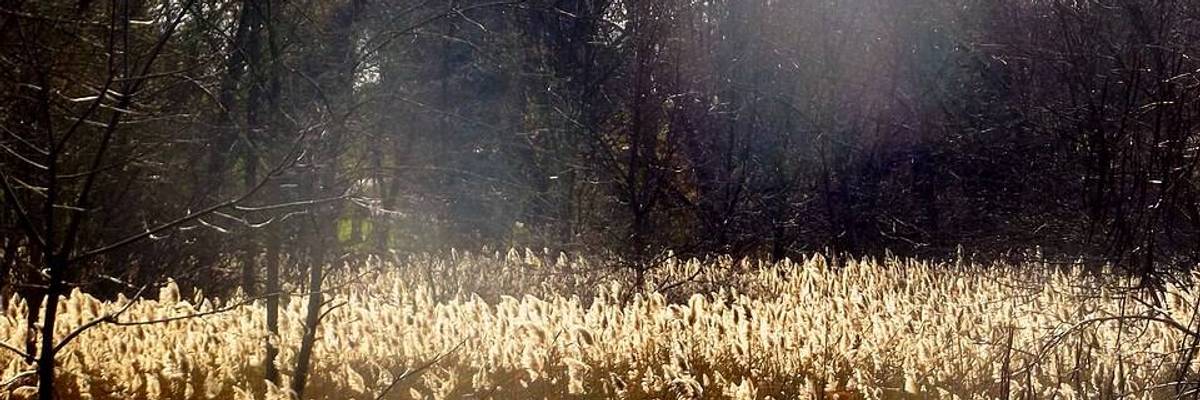
Phragmite glowing in the marshes along the "peninsula" trail in Mount Kisco, New York.
Our movements must question mythologies and admit contradictions if we intend to build a new world that’s sustainable, reciprocal, and inclusive for all.
As a guest on the 2019 podcast “Post-doom with Michael Dowd,” terrestrial ecologist Tom Wessels agrees humanity is entering a “bottleneck,” a condition that can afflict any species that ceases to live in relationship and reciprocity. Ballooning populations get stuck trying to claim space in an un-expandable hole, and many die.
This is what’s going through my head as I idle in an impossibly long single line of traffic on the road into Mount Kisco, New York. My kids are in the back of the car, asking for snacks. It is three days since Renee Good’s murder, 10 days since the end of the deadliest month in the deadliest year for people in Immigration and Customs Enforcement (ICE) custody.
“No snacks,” I tell the kids, scanning for parking. “You should eat your meals. Then I wouldn’t have to throw away food and bring a buffet everywhere we go.”
Pedestrians pass our car with protest signs as car exhaust blows through the vents. I feel an unexpected pang of tenderness for our quiet kitchen table, its leftover bowls of cereal and uneaten peanut-butter toasts. I already know I’ll give in, as all mothers do, when they can, when their children want to eat.
This land is no one’s land. This land was not made for you and me. This land is part of us, as we are part of it.
“But we compost the food,” my 7-year-old says, “so it’s actually good for the Earth when we throw it away.”
Our eyes meet in the rearview mirror as I prepare a response, but then the car behind me beeps and I see a distant light has turned green.
We crawl past the demonstration and I honk in support. Upbeat `80s pop blares from a speaker, backdrop to the protesters’ screams, whistles, and bells. My three-year-old, already a musician, moves his head as close as his car seat will allow, trying to deconstruct the music and noises.
“Go again, mommy,” he says. But at that moment I find a miraculous spot, just down the street from the main event, open perhaps because of the one-hour limit on the meter. I claim the space anyway; lug the kids, coats, and backpack out of the car; lock the doors; fill the meter; and grab hands for the walk toward the protest.
A few steps into the journey, a woman asks if she can photograph my kids. I smile and say, "No thank you," covering their faces with my hands. Photos become a constant request over the next hour. Many people ask, but others just lift and click. My son picks up a sign in the grass and I read it to him: No Fascist USA. More phones point in our direction.
I survey the crowd and think of something Monique Cullars-Doty, co-founder of Black Lives Matter Minnesota, said on the news the other day. “America has never addressed its love affair with white supremacy,” she said, connecting the ICE murder of Renee Good to the state-sanctioned violence that has assaulted Black and brown communities for centuries.
It is one thing to agree with this assessment—that white supremacy made colonialism possible, slavery imperative, resource hoarding commendable, ecological collapse acceptable, and ICE inevitable. It is quite another to admit our complicity, to connect our daily transgressions—a need for the latest gadget, an idling tailpipe, a thoughtless unkindness—to the generations of violence that made all this possible.
I squat in the wet grass and dig through the backpack, dipping my fingers deeper until I hear crinkling plastic. The kids hold out their hands expectantly and whisper, “Yes!” when their favorite granola bars emerge from the bag.
The music stops abruptly, and a woman with a kind face speaks over a microphone. She is Woody Guthrie’s granddaughter, simply by association evoking a simpler time, a sepia time, a time of acoustic guitar and faith in good intentions.
Thinking of her grandfather makes me think of mine—a Jewish Romanian immigrant’s son who stood with Black neighbors in 1950s Milwaukee when other Jewish neighbors, newly minted “white” by America’s slippery standards, wanted to prevent more Black families from moving in. My grandfather now floats above the scene, a beloved figure whose own people’s history was weaponized as justification for more land grabs and violence.
Guthrie’s granddaughter begins to sing:
This land is your land; This land is my land
And my blue-eyed son who loves music, the child I’ve always somehow felt the need to remind people is technically Jewish despite his blonde hair and last name, drops his snack, steps forward into the circle, and opens his mouth to sing along. A hundred phones rise in unison to capture the image.
I resist the urge to cover his face, crouch next to him, and try to join in. But the words catch in my throat.
My land. Your land.
As far as I can tell, not a single Indigenous Lenape person, the first peoples who walked this place now called Mt. Kisco, is present.
This land was made for you and me.
Behind the song circle is a vast cement parking lot, and before it a busy road. The bear, wild turkey, wolves, birds, and aquatic species once so abundant as to be considered eternal, are nowhere to be seen.
From California to the New York island
Places unnamable and unknowable, claimed in this song that once defined a movement, but never created a path or vision for us all.
And yet, here is my son singing, somber, understanding that what he’s participating in is important. And there is my daughter, running around behind the crowd, feeling the joy of community together, the freedom of cool air on her skin. The wrongness and the beauty of it all seem too hard to untangle, and I wonder if this is one way the bottleneck shows up—as the end of the road for a fundamental myth.
In the 2019 interview, Wessels addresses this. He speaks with curiosity about what might come next. Communities for much of human history were “…actually emotionally quite rich,” he says. “They had vibrant relationships within their clan community, they had a vibrant relationship with Mother Earth, they had stories and myths that made that linkage even stronger… so life could have been physically hard, but might have been experientially rich.”
Is there a way for us to treat our past myths with tenderness, while still recognizing where they went horribly wrong? Can we compost rather than discard them, and maintain the parts that serve? Can we teach our children new myths to carry them to a richer, more vibrant, gentle, reciprocal, and inclusive world?
This land is no one’s land. This land was not made for you and me. This land is part of us, as we are part of it.
The song ends, and worries of a parking ticket push a new world’s mythologies from my mind. I grab my son’s hand and scan for my daughter, whose silhouette I spot immediately. She’s reaching for the branches of an ancient fir tree by the road, drawn in by its shade and pungent scent, as so many have been before.
Dear Common Dreams reader, It’s been nearly 30 years since I co-founded Common Dreams with my late wife, Lina Newhouser. We had the radical notion that journalism should serve the public good, not corporate profits. It was clear to us from the outset what it would take to build such a project. No paid advertisements. No corporate sponsors. No millionaire publisher telling us what to think or do. Many people said we wouldn't last a year, but we proved those doubters wrong. Together with a tremendous team of journalists and dedicated staff, we built an independent media outlet free from the constraints of profits and corporate control. Our mission has always been simple: To inform. To inspire. To ignite change for the common good. Building Common Dreams was not easy. Our survival was never guaranteed. When you take on the most powerful forces—Wall Street greed, fossil fuel industry destruction, Big Tech lobbyists, and uber-rich oligarchs who have spent billions upon billions rigging the economy and democracy in their favor—the only bulwark you have is supporters who believe in your work. But here’s the urgent message from me today. It's never been this bad out there. And it's never been this hard to keep us going. At the very moment Common Dreams is most needed, the threats we face are intensifying. We need your support now more than ever. We don't accept corporate advertising and never will. We don't have a paywall because we don't think people should be blocked from critical news based on their ability to pay. Everything we do is funded by the donations of readers like you. When everyone does the little they can afford, we are strong. But if that support retreats or dries up, so do we. Will you donate now to make sure Common Dreams not only survives but thrives? —Craig Brown, Co-founder |
As a guest on the 2019 podcast “Post-doom with Michael Dowd,” terrestrial ecologist Tom Wessels agrees humanity is entering a “bottleneck,” a condition that can afflict any species that ceases to live in relationship and reciprocity. Ballooning populations get stuck trying to claim space in an un-expandable hole, and many die.
This is what’s going through my head as I idle in an impossibly long single line of traffic on the road into Mount Kisco, New York. My kids are in the back of the car, asking for snacks. It is three days since Renee Good’s murder, 10 days since the end of the deadliest month in the deadliest year for people in Immigration and Customs Enforcement (ICE) custody.
“No snacks,” I tell the kids, scanning for parking. “You should eat your meals. Then I wouldn’t have to throw away food and bring a buffet everywhere we go.”
Pedestrians pass our car with protest signs as car exhaust blows through the vents. I feel an unexpected pang of tenderness for our quiet kitchen table, its leftover bowls of cereal and uneaten peanut-butter toasts. I already know I’ll give in, as all mothers do, when they can, when their children want to eat.
This land is no one’s land. This land was not made for you and me. This land is part of us, as we are part of it.
“But we compost the food,” my 7-year-old says, “so it’s actually good for the Earth when we throw it away.”
Our eyes meet in the rearview mirror as I prepare a response, but then the car behind me beeps and I see a distant light has turned green.
We crawl past the demonstration and I honk in support. Upbeat `80s pop blares from a speaker, backdrop to the protesters’ screams, whistles, and bells. My three-year-old, already a musician, moves his head as close as his car seat will allow, trying to deconstruct the music and noises.
“Go again, mommy,” he says. But at that moment I find a miraculous spot, just down the street from the main event, open perhaps because of the one-hour limit on the meter. I claim the space anyway; lug the kids, coats, and backpack out of the car; lock the doors; fill the meter; and grab hands for the walk toward the protest.
A few steps into the journey, a woman asks if she can photograph my kids. I smile and say, "No thank you," covering their faces with my hands. Photos become a constant request over the next hour. Many people ask, but others just lift and click. My son picks up a sign in the grass and I read it to him: No Fascist USA. More phones point in our direction.
I survey the crowd and think of something Monique Cullars-Doty, co-founder of Black Lives Matter Minnesota, said on the news the other day. “America has never addressed its love affair with white supremacy,” she said, connecting the ICE murder of Renee Good to the state-sanctioned violence that has assaulted Black and brown communities for centuries.
It is one thing to agree with this assessment—that white supremacy made colonialism possible, slavery imperative, resource hoarding commendable, ecological collapse acceptable, and ICE inevitable. It is quite another to admit our complicity, to connect our daily transgressions—a need for the latest gadget, an idling tailpipe, a thoughtless unkindness—to the generations of violence that made all this possible.
I squat in the wet grass and dig through the backpack, dipping my fingers deeper until I hear crinkling plastic. The kids hold out their hands expectantly and whisper, “Yes!” when their favorite granola bars emerge from the bag.
The music stops abruptly, and a woman with a kind face speaks over a microphone. She is Woody Guthrie’s granddaughter, simply by association evoking a simpler time, a sepia time, a time of acoustic guitar and faith in good intentions.
Thinking of her grandfather makes me think of mine—a Jewish Romanian immigrant’s son who stood with Black neighbors in 1950s Milwaukee when other Jewish neighbors, newly minted “white” by America’s slippery standards, wanted to prevent more Black families from moving in. My grandfather now floats above the scene, a beloved figure whose own people’s history was weaponized as justification for more land grabs and violence.
Guthrie’s granddaughter begins to sing:
This land is your land; This land is my land
And my blue-eyed son who loves music, the child I’ve always somehow felt the need to remind people is technically Jewish despite his blonde hair and last name, drops his snack, steps forward into the circle, and opens his mouth to sing along. A hundred phones rise in unison to capture the image.
I resist the urge to cover his face, crouch next to him, and try to join in. But the words catch in my throat.
My land. Your land.
As far as I can tell, not a single Indigenous Lenape person, the first peoples who walked this place now called Mt. Kisco, is present.
This land was made for you and me.
Behind the song circle is a vast cement parking lot, and before it a busy road. The bear, wild turkey, wolves, birds, and aquatic species once so abundant as to be considered eternal, are nowhere to be seen.
From California to the New York island
Places unnamable and unknowable, claimed in this song that once defined a movement, but never created a path or vision for us all.
And yet, here is my son singing, somber, understanding that what he’s participating in is important. And there is my daughter, running around behind the crowd, feeling the joy of community together, the freedom of cool air on her skin. The wrongness and the beauty of it all seem too hard to untangle, and I wonder if this is one way the bottleneck shows up—as the end of the road for a fundamental myth.
In the 2019 interview, Wessels addresses this. He speaks with curiosity about what might come next. Communities for much of human history were “…actually emotionally quite rich,” he says. “They had vibrant relationships within their clan community, they had a vibrant relationship with Mother Earth, they had stories and myths that made that linkage even stronger… so life could have been physically hard, but might have been experientially rich.”
Is there a way for us to treat our past myths with tenderness, while still recognizing where they went horribly wrong? Can we compost rather than discard them, and maintain the parts that serve? Can we teach our children new myths to carry them to a richer, more vibrant, gentle, reciprocal, and inclusive world?
This land is no one’s land. This land was not made for you and me. This land is part of us, as we are part of it.
The song ends, and worries of a parking ticket push a new world’s mythologies from my mind. I grab my son’s hand and scan for my daughter, whose silhouette I spot immediately. She’s reaching for the branches of an ancient fir tree by the road, drawn in by its shade and pungent scent, as so many have been before.
As a guest on the 2019 podcast “Post-doom with Michael Dowd,” terrestrial ecologist Tom Wessels agrees humanity is entering a “bottleneck,” a condition that can afflict any species that ceases to live in relationship and reciprocity. Ballooning populations get stuck trying to claim space in an un-expandable hole, and many die.
This is what’s going through my head as I idle in an impossibly long single line of traffic on the road into Mount Kisco, New York. My kids are in the back of the car, asking for snacks. It is three days since Renee Good’s murder, 10 days since the end of the deadliest month in the deadliest year for people in Immigration and Customs Enforcement (ICE) custody.
“No snacks,” I tell the kids, scanning for parking. “You should eat your meals. Then I wouldn’t have to throw away food and bring a buffet everywhere we go.”
Pedestrians pass our car with protest signs as car exhaust blows through the vents. I feel an unexpected pang of tenderness for our quiet kitchen table, its leftover bowls of cereal and uneaten peanut-butter toasts. I already know I’ll give in, as all mothers do, when they can, when their children want to eat.
This land is no one’s land. This land was not made for you and me. This land is part of us, as we are part of it.
“But we compost the food,” my 7-year-old says, “so it’s actually good for the Earth when we throw it away.”
Our eyes meet in the rearview mirror as I prepare a response, but then the car behind me beeps and I see a distant light has turned green.
We crawl past the demonstration and I honk in support. Upbeat `80s pop blares from a speaker, backdrop to the protesters’ screams, whistles, and bells. My three-year-old, already a musician, moves his head as close as his car seat will allow, trying to deconstruct the music and noises.
“Go again, mommy,” he says. But at that moment I find a miraculous spot, just down the street from the main event, open perhaps because of the one-hour limit on the meter. I claim the space anyway; lug the kids, coats, and backpack out of the car; lock the doors; fill the meter; and grab hands for the walk toward the protest.
A few steps into the journey, a woman asks if she can photograph my kids. I smile and say, "No thank you," covering their faces with my hands. Photos become a constant request over the next hour. Many people ask, but others just lift and click. My son picks up a sign in the grass and I read it to him: No Fascist USA. More phones point in our direction.
I survey the crowd and think of something Monique Cullars-Doty, co-founder of Black Lives Matter Minnesota, said on the news the other day. “America has never addressed its love affair with white supremacy,” she said, connecting the ICE murder of Renee Good to the state-sanctioned violence that has assaulted Black and brown communities for centuries.
It is one thing to agree with this assessment—that white supremacy made colonialism possible, slavery imperative, resource hoarding commendable, ecological collapse acceptable, and ICE inevitable. It is quite another to admit our complicity, to connect our daily transgressions—a need for the latest gadget, an idling tailpipe, a thoughtless unkindness—to the generations of violence that made all this possible.
I squat in the wet grass and dig through the backpack, dipping my fingers deeper until I hear crinkling plastic. The kids hold out their hands expectantly and whisper, “Yes!” when their favorite granola bars emerge from the bag.
The music stops abruptly, and a woman with a kind face speaks over a microphone. She is Woody Guthrie’s granddaughter, simply by association evoking a simpler time, a sepia time, a time of acoustic guitar and faith in good intentions.
Thinking of her grandfather makes me think of mine—a Jewish Romanian immigrant’s son who stood with Black neighbors in 1950s Milwaukee when other Jewish neighbors, newly minted “white” by America’s slippery standards, wanted to prevent more Black families from moving in. My grandfather now floats above the scene, a beloved figure whose own people’s history was weaponized as justification for more land grabs and violence.
Guthrie’s granddaughter begins to sing:
This land is your land; This land is my land
And my blue-eyed son who loves music, the child I’ve always somehow felt the need to remind people is technically Jewish despite his blonde hair and last name, drops his snack, steps forward into the circle, and opens his mouth to sing along. A hundred phones rise in unison to capture the image.
I resist the urge to cover his face, crouch next to him, and try to join in. But the words catch in my throat.
My land. Your land.
As far as I can tell, not a single Indigenous Lenape person, the first peoples who walked this place now called Mt. Kisco, is present.
This land was made for you and me.
Behind the song circle is a vast cement parking lot, and before it a busy road. The bear, wild turkey, wolves, birds, and aquatic species once so abundant as to be considered eternal, are nowhere to be seen.
From California to the New York island
Places unnamable and unknowable, claimed in this song that once defined a movement, but never created a path or vision for us all.
And yet, here is my son singing, somber, understanding that what he’s participating in is important. And there is my daughter, running around behind the crowd, feeling the joy of community together, the freedom of cool air on her skin. The wrongness and the beauty of it all seem too hard to untangle, and I wonder if this is one way the bottleneck shows up—as the end of the road for a fundamental myth.
In the 2019 interview, Wessels addresses this. He speaks with curiosity about what might come next. Communities for much of human history were “…actually emotionally quite rich,” he says. “They had vibrant relationships within their clan community, they had a vibrant relationship with Mother Earth, they had stories and myths that made that linkage even stronger… so life could have been physically hard, but might have been experientially rich.”
Is there a way for us to treat our past myths with tenderness, while still recognizing where they went horribly wrong? Can we compost rather than discard them, and maintain the parts that serve? Can we teach our children new myths to carry them to a richer, more vibrant, gentle, reciprocal, and inclusive world?
This land is no one’s land. This land was not made for you and me. This land is part of us, as we are part of it.
The song ends, and worries of a parking ticket push a new world’s mythologies from my mind. I grab my son’s hand and scan for my daughter, whose silhouette I spot immediately. She’s reaching for the branches of an ancient fir tree by the road, drawn in by its shade and pungent scent, as so many have been before.