SUBSCRIBE TO OUR FREE NEWSLETTER
Daily news & progressive opinion—funded by the people, not the corporations—delivered straight to your inbox.
5
#000000
#FFFFFF
To donate by check, phone, or other method, see our More Ways to Give page.
Daily news & progressive opinion—funded by the people, not the corporations—delivered straight to your inbox.
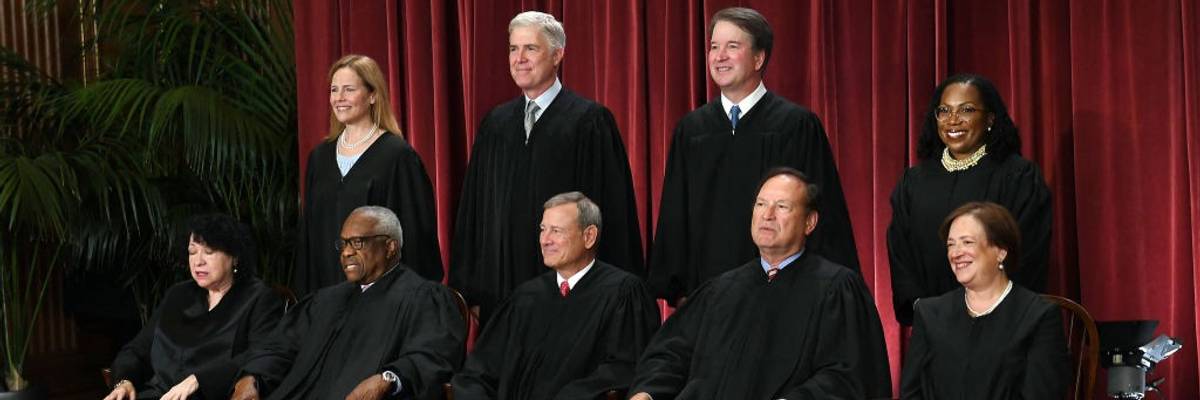
Justices of the U.S. Supreme Court pose for their official photo at the Supreme Court in Washington, D.C. on October 7, 2022.
If the majority on the Supreme Court thinks that the leader they have enabled will allow them to regulate his actions, it can only be because of their ignorance of history.
The Supreme Court in Trump v. United States has enabled Fascism in America.
We can see why if we examine the best book I know about Nazi Germany, Ernst Fraenkel’s The Dual State. Fraenkel was a German-Jewish attorney in Weimar Germany. He continued to practice after the Nazis came to power, emigrating to the United Kingdom in 1938 and to the United States in 1939. In The Dual State, published shortly after he arrived in the United States, Fraenkel characterizes the nature of the Nazi state, showing how Adolf Hitler ruled using prerogative powers. Fraenkel draws an analogy between Hitler’s rule and the king’s use of prerogative powers prior to the English Revolution in the 17th century.
Fraenkel shows, well before the events, how, after the court’s decision, as Sonia Sotomayor stated in her dissent, “the President is now a king above the law,” a king with the ability to act arbitrarily, without fear of sanction, in violation of the constitutional restraints the English Revolution sought to impose on the King in the 17th century, and the restraints that prior to the court’s decision, the U.S. Constitution was understood to impose on the president.
The clearest indication, so far, that Trump intends to rule using prerogative powers is his desire to infringe on the Senate’s authority to confirm or reject his appointments.
In patrimonialism, agents in the state function as “personal servants” of the leader. They are the vehicle for the expansion of the scope of the leader’s power, which is enhanced to control areas previously understood as outside the executive’s purview, including many that were previously legislative or judicial.
Charles I was king within an institutionalized state. He was able to claim that his misuse of prerogative powers, substituting them for actions that fell within the scope of parliamentary powers, was legitimate. When Hitler was named chancellor, he quickly moved from an illegal expansion of his powers to a coup d’état, governing using arbitrary prerogative powers. Like Charles I, he cloaked his usurpations in legal terms, but, in fact, as Fraenkel put it, characterizing the Nazi “constitutional” state, “There are no legal rules governing the political sphere. It is regulated by arbitrary measures (Massnahmen), in which the dominant officials exercise their discretionary prerogatives. Hence the expression ‘Prerogative State’ (Massnahmenstaat),” a patrimonial state.
In Nazi Germany, “Absolute dictatorial power is exercised by the leader and chancellor either personally or through his subordinate authorities. His sole decision determines how this power shall be wielded.” In his attempt to legalize his absolute power, the support given to Hitler by traditional conservative forces, including those within a fundamentally conservative legal order, was crucial. While there were sporadic attempts to curtail Hitler’s prerogative, they failed, because of institutional deficiencies and because of the timidity of those who were in a position to defend the Weimar political and legal order. Likewise, in the USA, where the constitutional-judicial safeguards are stronger, the conservatives within the legal and political order have followed their leader like lemmings walking off a cliff. Now the Supreme Court has enabled future presidents to claim, without fear of sanction, sovereign, patrimonial power, immunity for all “official” actions undertaken as president.
Crucially, the determination of what falls under the prerogative is made by the leader himself. As Fraenkel puts it, “The decisions of the state are free from normative restrictions. The state becomes absolute in the literal sense of the word.” The Nazi state suggested that “politics” was independent of the law, “and that the definition of the boundary lines between the two rests in the hands of the political authorities themselves.” If the majority on the Supreme Court thinks that the leader they have enabled will allow them to regulate his actions, it can only be because of their ignorance of history.
While the leader’s prerogative powers may derive from an emergency, it is often the fascist movement that creates the emergency it claims the power to resolve. In Nazi Germany, Fraenkel tells us, “Normal life is ruled by legal norms. But since martial law has become permanent in Germany, exceptions to the normal law are continually made... Whether the decision in an individual case is made in accordance with the law or with ‘expediency’ is entirely in the hands of those in whom the sovereign power is vested. Their sovereignty consists in the very fact that they determine the permanent emergency...”
“From this follows the principle that the presumption of jurisdiction rests with the Normative State,” he continues. “The jurisdiction over jurisdiction rests with the Prerogative state. The limits of the Prerogative State are not imposed upon it; there is not a single issue in which the Prerogative State cannot claim jurisdiction.”
As Fraenkel contends, “the legal situation of the 17th century has been reincarnated. The tendency defeated in England in the 17th century gradually attained success in [Nazi] Germany” (my italics). Now, with the aid of the Supreme Court, we in the United States are at peril of repeating this history, of witnessing President-elect Donald Trump, or one of his successors, acting with absolute immunity in what he chooses to define as his constitutional authority, and the Supreme Court will find that they have authorized him to do so.
The clearest indication, so far, that Trump intends to rule using prerogative powers is his desire to infringe on the Senate’s authority to confirm or reject his appointments. He wants the Senate to let him make recess appointments without their consent, and he has chosen a set of candidates who are among the most unqualified and dangerous in American history. The question now is whether the Senate will guard its constitutional authority to both vet and reject Trump’s candidates. If they do not do so, they, along with SCOTUS, will chart a path to fascism.
Dear Common Dreams reader, It’s been nearly 30 years since I co-founded Common Dreams with my late wife, Lina Newhouser. We had the radical notion that journalism should serve the public good, not corporate profits. It was clear to us from the outset what it would take to build such a project. No paid advertisements. No corporate sponsors. No millionaire publisher telling us what to think or do. Many people said we wouldn't last a year, but we proved those doubters wrong. Together with a tremendous team of journalists and dedicated staff, we built an independent media outlet free from the constraints of profits and corporate control. Our mission has always been simple: To inform. To inspire. To ignite change for the common good. Building Common Dreams was not easy. Our survival was never guaranteed. When you take on the most powerful forces—Wall Street greed, fossil fuel industry destruction, Big Tech lobbyists, and uber-rich oligarchs who have spent billions upon billions rigging the economy and democracy in their favor—the only bulwark you have is supporters who believe in your work. But here’s the urgent message from me today. It's never been this bad out there. And it's never been this hard to keep us going. At the very moment Common Dreams is most needed, the threats we face are intensifying. We need your support now more than ever. We don't accept corporate advertising and never will. We don't have a paywall because we don't think people should be blocked from critical news based on their ability to pay. Everything we do is funded by the donations of readers like you. When everyone does the little they can afford, we are strong. But if that support retreats or dries up, so do we. Will you donate now to make sure Common Dreams not only survives but thrives? —Craig Brown, Co-founder |
The Supreme Court in Trump v. United States has enabled Fascism in America.
We can see why if we examine the best book I know about Nazi Germany, Ernst Fraenkel’s The Dual State. Fraenkel was a German-Jewish attorney in Weimar Germany. He continued to practice after the Nazis came to power, emigrating to the United Kingdom in 1938 and to the United States in 1939. In The Dual State, published shortly after he arrived in the United States, Fraenkel characterizes the nature of the Nazi state, showing how Adolf Hitler ruled using prerogative powers. Fraenkel draws an analogy between Hitler’s rule and the king’s use of prerogative powers prior to the English Revolution in the 17th century.
Fraenkel shows, well before the events, how, after the court’s decision, as Sonia Sotomayor stated in her dissent, “the President is now a king above the law,” a king with the ability to act arbitrarily, without fear of sanction, in violation of the constitutional restraints the English Revolution sought to impose on the King in the 17th century, and the restraints that prior to the court’s decision, the U.S. Constitution was understood to impose on the president.
The clearest indication, so far, that Trump intends to rule using prerogative powers is his desire to infringe on the Senate’s authority to confirm or reject his appointments.
In patrimonialism, agents in the state function as “personal servants” of the leader. They are the vehicle for the expansion of the scope of the leader’s power, which is enhanced to control areas previously understood as outside the executive’s purview, including many that were previously legislative or judicial.
Charles I was king within an institutionalized state. He was able to claim that his misuse of prerogative powers, substituting them for actions that fell within the scope of parliamentary powers, was legitimate. When Hitler was named chancellor, he quickly moved from an illegal expansion of his powers to a coup d’état, governing using arbitrary prerogative powers. Like Charles I, he cloaked his usurpations in legal terms, but, in fact, as Fraenkel put it, characterizing the Nazi “constitutional” state, “There are no legal rules governing the political sphere. It is regulated by arbitrary measures (Massnahmen), in which the dominant officials exercise their discretionary prerogatives. Hence the expression ‘Prerogative State’ (Massnahmenstaat),” a patrimonial state.
In Nazi Germany, “Absolute dictatorial power is exercised by the leader and chancellor either personally or through his subordinate authorities. His sole decision determines how this power shall be wielded.” In his attempt to legalize his absolute power, the support given to Hitler by traditional conservative forces, including those within a fundamentally conservative legal order, was crucial. While there were sporadic attempts to curtail Hitler’s prerogative, they failed, because of institutional deficiencies and because of the timidity of those who were in a position to defend the Weimar political and legal order. Likewise, in the USA, where the constitutional-judicial safeguards are stronger, the conservatives within the legal and political order have followed their leader like lemmings walking off a cliff. Now the Supreme Court has enabled future presidents to claim, without fear of sanction, sovereign, patrimonial power, immunity for all “official” actions undertaken as president.
Crucially, the determination of what falls under the prerogative is made by the leader himself. As Fraenkel puts it, “The decisions of the state are free from normative restrictions. The state becomes absolute in the literal sense of the word.” The Nazi state suggested that “politics” was independent of the law, “and that the definition of the boundary lines between the two rests in the hands of the political authorities themselves.” If the majority on the Supreme Court thinks that the leader they have enabled will allow them to regulate his actions, it can only be because of their ignorance of history.
While the leader’s prerogative powers may derive from an emergency, it is often the fascist movement that creates the emergency it claims the power to resolve. In Nazi Germany, Fraenkel tells us, “Normal life is ruled by legal norms. But since martial law has become permanent in Germany, exceptions to the normal law are continually made... Whether the decision in an individual case is made in accordance with the law or with ‘expediency’ is entirely in the hands of those in whom the sovereign power is vested. Their sovereignty consists in the very fact that they determine the permanent emergency...”
“From this follows the principle that the presumption of jurisdiction rests with the Normative State,” he continues. “The jurisdiction over jurisdiction rests with the Prerogative state. The limits of the Prerogative State are not imposed upon it; there is not a single issue in which the Prerogative State cannot claim jurisdiction.”
As Fraenkel contends, “the legal situation of the 17th century has been reincarnated. The tendency defeated in England in the 17th century gradually attained success in [Nazi] Germany” (my italics). Now, with the aid of the Supreme Court, we in the United States are at peril of repeating this history, of witnessing President-elect Donald Trump, or one of his successors, acting with absolute immunity in what he chooses to define as his constitutional authority, and the Supreme Court will find that they have authorized him to do so.
The clearest indication, so far, that Trump intends to rule using prerogative powers is his desire to infringe on the Senate’s authority to confirm or reject his appointments. He wants the Senate to let him make recess appointments without their consent, and he has chosen a set of candidates who are among the most unqualified and dangerous in American history. The question now is whether the Senate will guard its constitutional authority to both vet and reject Trump’s candidates. If they do not do so, they, along with SCOTUS, will chart a path to fascism.
The Supreme Court in Trump v. United States has enabled Fascism in America.
We can see why if we examine the best book I know about Nazi Germany, Ernst Fraenkel’s The Dual State. Fraenkel was a German-Jewish attorney in Weimar Germany. He continued to practice after the Nazis came to power, emigrating to the United Kingdom in 1938 and to the United States in 1939. In The Dual State, published shortly after he arrived in the United States, Fraenkel characterizes the nature of the Nazi state, showing how Adolf Hitler ruled using prerogative powers. Fraenkel draws an analogy between Hitler’s rule and the king’s use of prerogative powers prior to the English Revolution in the 17th century.
Fraenkel shows, well before the events, how, after the court’s decision, as Sonia Sotomayor stated in her dissent, “the President is now a king above the law,” a king with the ability to act arbitrarily, without fear of sanction, in violation of the constitutional restraints the English Revolution sought to impose on the King in the 17th century, and the restraints that prior to the court’s decision, the U.S. Constitution was understood to impose on the president.
The clearest indication, so far, that Trump intends to rule using prerogative powers is his desire to infringe on the Senate’s authority to confirm or reject his appointments.
In patrimonialism, agents in the state function as “personal servants” of the leader. They are the vehicle for the expansion of the scope of the leader’s power, which is enhanced to control areas previously understood as outside the executive’s purview, including many that were previously legislative or judicial.
Charles I was king within an institutionalized state. He was able to claim that his misuse of prerogative powers, substituting them for actions that fell within the scope of parliamentary powers, was legitimate. When Hitler was named chancellor, he quickly moved from an illegal expansion of his powers to a coup d’état, governing using arbitrary prerogative powers. Like Charles I, he cloaked his usurpations in legal terms, but, in fact, as Fraenkel put it, characterizing the Nazi “constitutional” state, “There are no legal rules governing the political sphere. It is regulated by arbitrary measures (Massnahmen), in which the dominant officials exercise their discretionary prerogatives. Hence the expression ‘Prerogative State’ (Massnahmenstaat),” a patrimonial state.
In Nazi Germany, “Absolute dictatorial power is exercised by the leader and chancellor either personally or through his subordinate authorities. His sole decision determines how this power shall be wielded.” In his attempt to legalize his absolute power, the support given to Hitler by traditional conservative forces, including those within a fundamentally conservative legal order, was crucial. While there were sporadic attempts to curtail Hitler’s prerogative, they failed, because of institutional deficiencies and because of the timidity of those who were in a position to defend the Weimar political and legal order. Likewise, in the USA, where the constitutional-judicial safeguards are stronger, the conservatives within the legal and political order have followed their leader like lemmings walking off a cliff. Now the Supreme Court has enabled future presidents to claim, without fear of sanction, sovereign, patrimonial power, immunity for all “official” actions undertaken as president.
Crucially, the determination of what falls under the prerogative is made by the leader himself. As Fraenkel puts it, “The decisions of the state are free from normative restrictions. The state becomes absolute in the literal sense of the word.” The Nazi state suggested that “politics” was independent of the law, “and that the definition of the boundary lines between the two rests in the hands of the political authorities themselves.” If the majority on the Supreme Court thinks that the leader they have enabled will allow them to regulate his actions, it can only be because of their ignorance of history.
While the leader’s prerogative powers may derive from an emergency, it is often the fascist movement that creates the emergency it claims the power to resolve. In Nazi Germany, Fraenkel tells us, “Normal life is ruled by legal norms. But since martial law has become permanent in Germany, exceptions to the normal law are continually made... Whether the decision in an individual case is made in accordance with the law or with ‘expediency’ is entirely in the hands of those in whom the sovereign power is vested. Their sovereignty consists in the very fact that they determine the permanent emergency...”
“From this follows the principle that the presumption of jurisdiction rests with the Normative State,” he continues. “The jurisdiction over jurisdiction rests with the Prerogative state. The limits of the Prerogative State are not imposed upon it; there is not a single issue in which the Prerogative State cannot claim jurisdiction.”
As Fraenkel contends, “the legal situation of the 17th century has been reincarnated. The tendency defeated in England in the 17th century gradually attained success in [Nazi] Germany” (my italics). Now, with the aid of the Supreme Court, we in the United States are at peril of repeating this history, of witnessing President-elect Donald Trump, or one of his successors, acting with absolute immunity in what he chooses to define as his constitutional authority, and the Supreme Court will find that they have authorized him to do so.
The clearest indication, so far, that Trump intends to rule using prerogative powers is his desire to infringe on the Senate’s authority to confirm or reject his appointments. He wants the Senate to let him make recess appointments without their consent, and he has chosen a set of candidates who are among the most unqualified and dangerous in American history. The question now is whether the Senate will guard its constitutional authority to both vet and reject Trump’s candidates. If they do not do so, they, along with SCOTUS, will chart a path to fascism.