SUBSCRIBE TO OUR FREE NEWSLETTER
Daily news & progressive opinion—funded by the people, not the corporations—delivered straight to your inbox.
5
#000000
#FFFFFF
To donate by check, phone, or other method, see our More Ways to Give page.
Daily news & progressive opinion—funded by the people, not the corporations—delivered straight to your inbox.
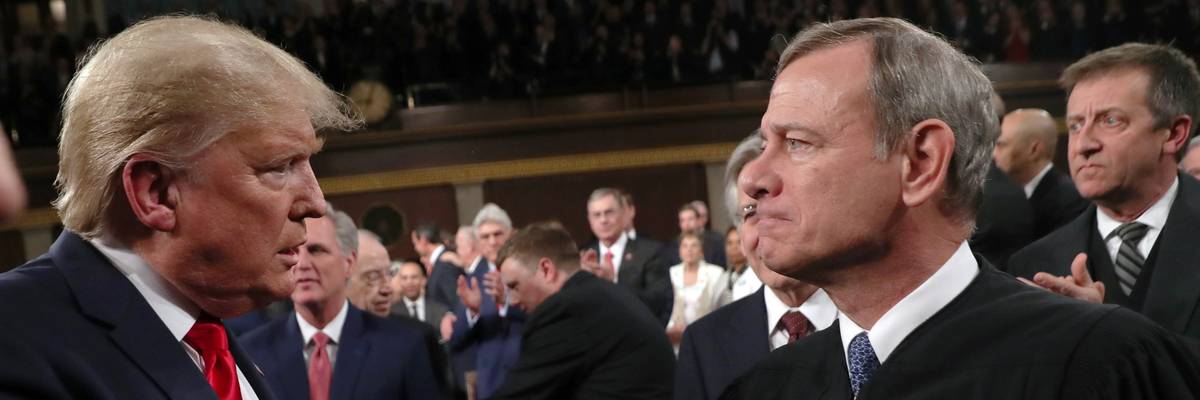
US President Donald Trump shakes hands with Supreme Court Chief Justice John Roberts before the State of the Union address in the House chamber on February 4, 2020 in Washington, DC.
By gutting the Voting Rights Act and granting President Donald Trump irmmunity, the Supreme Court has helped set up a fight over the future of US democracy.
Is the United States headed for a second Civil War? According to a survey of likely midterm voters published by the Leadership Conference on Civil and Human Rights, 57% of Americans believe it is. Sixty-nine percent say democracy is under serious threat; and an equal percentage of non-white voters say they fear rising white supremacy.
While President Donald Trump and his MAGA movement deserve the lion’s share of blame for such findings, the Supreme Court has done its part. Under the stewardship of Chief Justice John Roberts, the court has issued a blistering succession of dangerously polarizing rulings, ranging from presidential immunity, union organizing, the death penalty, environmental protection, and gun control to affirmative action and abortion rights. The resulting jurisprudential carnage has accelerated the nation’s rupture into irreconcilable belligerent tribes and prompted speculation that we are headed for another existential conflict.
The Roberts Court has taken a particularly malevolent interest in destroying the Voting Rights Act (VRA) of 1965. Last month’s decision in Louisiana v. Callais gutted Section 2 of the landmark legislation, which was amended in 1982 to permit the Justice Department and private citizens to challenge election laws that have the effect of diluting minority voting power.
The court’s 6-3 majority opinion by Justice Samuel Alito invalidated Louisiana’s 2024 congressional map that created a second majority-Black congressional district to operate alongside the state’s five white-majority districts, roughly reflecting the size of Louisiana’s Black population. The ruling handed a victory to the lead plaintiff in the case, Phillip “Bert” Callais, an election denier and alleged conspiracy theorist who had attended the January 6, 2021 “Stop the Steal” rally on the White House Ellipse that eventually snowballed into the insurrection at the Capitol. Barely concealing their racial animus, Callais and his co-plaintiffs described themselves in court filings as “non-African American voters” who were the victims of reverse discrimination. Louisiana has since moved to redraw its voting maps.
Neutering the Voting Rights Act represents the culmination of Roberts’ lifelong calling and warrants his ranking alongside Taney as the most disgraceful chief justice in history.
With the demise of the “effects test,” future Section 2 plaintiffs will have to meet the nearly impossible burden of proving that redistricting maps were created with overt discriminatory intent rather than for political purposes. And as the court held in a 2019 opinion written by Roberts in Rucho v. Common Cause, political gerrymandering claims cannot be brought in federal courts because, as the Republican majority sees it, they present nonjusticiable “political questions.”
Both Callais and Rucho built upon Roberts’ 2013 majority opinion in Shelby County v. Alabama gutting two other sections of the VRA that required state and local jurisdictions with histories of egregious voter discrimination to obtain advance federal approval—known as preclearance—before making changes to their election procedures. Like Alito in Callais, Roberts declared in Shelby that racial discrimination in voting was a thing of the past and thus special protections for minorities were no longer necessary.
The combined effects of Shelby and Rucho have led to a proliferation of voting roll purges, onerous photo ID laws, and limitations on mail-in ballots in red states across the country. Now, with Callais, election law experts predict that as many as 19 Democratic congressional seats in Tennessee, Alabama, Mississippi, South Carolina, Florida, and Louisiana could be eliminated, returning the former states of the Confederacy to one-party rule.
The court’s handiwork has sparked outrage and alarm. Rep. Bennie Thompson, the only Democrat in Mississippi’s congressional delegation, who will likely lose his seat to gerrymandering, has condemned Callais as “equivalent to a second Civil War.” Other observers have compared the current moment in the US to the 1850s, when debates over the future of slavery eventually led to secession and war.
Chief Justice Roberts has also drawn comparisons to Chief Justice Roger Taney, whose 1857 majority opinion in Dred Scott v. Sandford held that Black Americans had “no rights that the white man was bound to respect.” The Dred Scott decision helped precipitate the Civil War, and is widely considered the most infamous in the court’s history.
The parallels between Taney and Roberts are beyond hyperbole. Both men began their legal careers as zealous partisan political advocates. Before ascending to the Supreme Court in 1836, Taney was elected to the General Assembly of Maryland, and later served as a loyal foot soldier to President Andrew Jackson, first as secretary of war and then as attorney general, in which capacity he penned an advisory opinion that prefigured his Dred Scott ruling, arguing that the Constitution and the Bill of Rights were inapplicable to Black people, even those living in free states.
Similarly, the young Roberts established himself as a dependable right-wing operative, clerking for Chief Justice William Rehnquist and afterward serving as special assistant to Attorney General William French Smith in the Reagan administration. There, he authored upward of 25 memos opposing the 1982 amendment that added the effects test to the Voting Rights Act in addition to ghosting op-eds for Smith and preparing administration officials for their testimony before Congress on the test. Later, as an attorney in private practice, he played an important role as a consultant, lawsuit editor, and prep coach for the GOP’s legal arguments in the run-up to Bush v. Gore, the case that decided the 2000 presidential election.
Neutering the Voting Rights Act represents the culmination of Roberts’ lifelong calling and warrants his ranking alongside Taney as the most disgraceful chief justice in history. As the civil rights activist and writer William Spivey argued in an essay published earlier this month in the online journal Level:
Taney held that no Black person, free or enslaved, could ever be a US citizen. He believed that Black people were not part of the political community and the Constitution was written for white men only.
Chief Justice Roberts has been more effective than anyone in disenfranchising Black people. Most of what Taney accomplished can be traced to a single decision that remained in place for 11 years before being reversed [by the 13th and 14th Amendments]. Roberts has spent an entire career whittling away at the Voting Rights Act of 1965, affirmative action and, most recently, the diversity, equity, and inclusion movement.
Roberts will also be remembered for composing the majority opinion in Trump v. United States in 2024 that gave the president near-complete immunity from criminal prosecution for his official acts. That decision, along with the evisceration of voting rights, has emboldened Trump to threaten the deployment of Immigration and Customs Enforcement and the military to polling places and hatch other plots to rig the midterm elections and consolidate Republican power.
It may be premature to conclude a new Civil War is upon us, but a high-stakes battle for the future of the country is well underway.
Dear Common Dreams reader, It’s been nearly 30 years since I co-founded Common Dreams with my late wife, Lina Newhouser. We had the radical notion that journalism should serve the public good, not corporate profits. It was clear to us from the outset what it would take to build such a project. No paid advertisements. No corporate sponsors. No millionaire publisher telling us what to think or do. Many people said we wouldn't last a year, but we proved those doubters wrong. Together with a tremendous team of journalists and dedicated staff, we built an independent media outlet free from the constraints of profits and corporate control. Our mission has always been simple: To inform. To inspire. To ignite change for the common good. Building Common Dreams was not easy. Our survival was never guaranteed. When you take on the most powerful forces—Wall Street greed, fossil fuel industry destruction, Big Tech lobbyists, and uber-rich oligarchs who have spent billions upon billions rigging the economy and democracy in their favor—the only bulwark you have is supporters who believe in your work. But here’s the urgent message from me today. It's never been this bad out there. And it's never been this hard to keep us going. At the very moment Common Dreams is most needed, the threats we face are intensifying. We need your support now more than ever. We don't accept corporate advertising and never will. We don't have a paywall because we don't think people should be blocked from critical news based on their ability to pay. Everything we do is funded by the donations of readers like you. When everyone does the little they can afford, we are strong. But if that support retreats or dries up, so do we. Will you donate now to make sure Common Dreams not only survives but thrives? —Craig Brown, Co-founder |
Is the United States headed for a second Civil War? According to a survey of likely midterm voters published by the Leadership Conference on Civil and Human Rights, 57% of Americans believe it is. Sixty-nine percent say democracy is under serious threat; and an equal percentage of non-white voters say they fear rising white supremacy.
While President Donald Trump and his MAGA movement deserve the lion’s share of blame for such findings, the Supreme Court has done its part. Under the stewardship of Chief Justice John Roberts, the court has issued a blistering succession of dangerously polarizing rulings, ranging from presidential immunity, union organizing, the death penalty, environmental protection, and gun control to affirmative action and abortion rights. The resulting jurisprudential carnage has accelerated the nation’s rupture into irreconcilable belligerent tribes and prompted speculation that we are headed for another existential conflict.
The Roberts Court has taken a particularly malevolent interest in destroying the Voting Rights Act (VRA) of 1965. Last month’s decision in Louisiana v. Callais gutted Section 2 of the landmark legislation, which was amended in 1982 to permit the Justice Department and private citizens to challenge election laws that have the effect of diluting minority voting power.
The court’s 6-3 majority opinion by Justice Samuel Alito invalidated Louisiana’s 2024 congressional map that created a second majority-Black congressional district to operate alongside the state’s five white-majority districts, roughly reflecting the size of Louisiana’s Black population. The ruling handed a victory to the lead plaintiff in the case, Phillip “Bert” Callais, an election denier and alleged conspiracy theorist who had attended the January 6, 2021 “Stop the Steal” rally on the White House Ellipse that eventually snowballed into the insurrection at the Capitol. Barely concealing their racial animus, Callais and his co-plaintiffs described themselves in court filings as “non-African American voters” who were the victims of reverse discrimination. Louisiana has since moved to redraw its voting maps.
Neutering the Voting Rights Act represents the culmination of Roberts’ lifelong calling and warrants his ranking alongside Taney as the most disgraceful chief justice in history.
With the demise of the “effects test,” future Section 2 plaintiffs will have to meet the nearly impossible burden of proving that redistricting maps were created with overt discriminatory intent rather than for political purposes. And as the court held in a 2019 opinion written by Roberts in Rucho v. Common Cause, political gerrymandering claims cannot be brought in federal courts because, as the Republican majority sees it, they present nonjusticiable “political questions.”
Both Callais and Rucho built upon Roberts’ 2013 majority opinion in Shelby County v. Alabama gutting two other sections of the VRA that required state and local jurisdictions with histories of egregious voter discrimination to obtain advance federal approval—known as preclearance—before making changes to their election procedures. Like Alito in Callais, Roberts declared in Shelby that racial discrimination in voting was a thing of the past and thus special protections for minorities were no longer necessary.
The combined effects of Shelby and Rucho have led to a proliferation of voting roll purges, onerous photo ID laws, and limitations on mail-in ballots in red states across the country. Now, with Callais, election law experts predict that as many as 19 Democratic congressional seats in Tennessee, Alabama, Mississippi, South Carolina, Florida, and Louisiana could be eliminated, returning the former states of the Confederacy to one-party rule.
The court’s handiwork has sparked outrage and alarm. Rep. Bennie Thompson, the only Democrat in Mississippi’s congressional delegation, who will likely lose his seat to gerrymandering, has condemned Callais as “equivalent to a second Civil War.” Other observers have compared the current moment in the US to the 1850s, when debates over the future of slavery eventually led to secession and war.
Chief Justice Roberts has also drawn comparisons to Chief Justice Roger Taney, whose 1857 majority opinion in Dred Scott v. Sandford held that Black Americans had “no rights that the white man was bound to respect.” The Dred Scott decision helped precipitate the Civil War, and is widely considered the most infamous in the court’s history.
The parallels between Taney and Roberts are beyond hyperbole. Both men began their legal careers as zealous partisan political advocates. Before ascending to the Supreme Court in 1836, Taney was elected to the General Assembly of Maryland, and later served as a loyal foot soldier to President Andrew Jackson, first as secretary of war and then as attorney general, in which capacity he penned an advisory opinion that prefigured his Dred Scott ruling, arguing that the Constitution and the Bill of Rights were inapplicable to Black people, even those living in free states.
Similarly, the young Roberts established himself as a dependable right-wing operative, clerking for Chief Justice William Rehnquist and afterward serving as special assistant to Attorney General William French Smith in the Reagan administration. There, he authored upward of 25 memos opposing the 1982 amendment that added the effects test to the Voting Rights Act in addition to ghosting op-eds for Smith and preparing administration officials for their testimony before Congress on the test. Later, as an attorney in private practice, he played an important role as a consultant, lawsuit editor, and prep coach for the GOP’s legal arguments in the run-up to Bush v. Gore, the case that decided the 2000 presidential election.
Neutering the Voting Rights Act represents the culmination of Roberts’ lifelong calling and warrants his ranking alongside Taney as the most disgraceful chief justice in history. As the civil rights activist and writer William Spivey argued in an essay published earlier this month in the online journal Level:
Taney held that no Black person, free or enslaved, could ever be a US citizen. He believed that Black people were not part of the political community and the Constitution was written for white men only.
Chief Justice Roberts has been more effective than anyone in disenfranchising Black people. Most of what Taney accomplished can be traced to a single decision that remained in place for 11 years before being reversed [by the 13th and 14th Amendments]. Roberts has spent an entire career whittling away at the Voting Rights Act of 1965, affirmative action and, most recently, the diversity, equity, and inclusion movement.
Roberts will also be remembered for composing the majority opinion in Trump v. United States in 2024 that gave the president near-complete immunity from criminal prosecution for his official acts. That decision, along with the evisceration of voting rights, has emboldened Trump to threaten the deployment of Immigration and Customs Enforcement and the military to polling places and hatch other plots to rig the midterm elections and consolidate Republican power.
It may be premature to conclude a new Civil War is upon us, but a high-stakes battle for the future of the country is well underway.
Is the United States headed for a second Civil War? According to a survey of likely midterm voters published by the Leadership Conference on Civil and Human Rights, 57% of Americans believe it is. Sixty-nine percent say democracy is under serious threat; and an equal percentage of non-white voters say they fear rising white supremacy.
While President Donald Trump and his MAGA movement deserve the lion’s share of blame for such findings, the Supreme Court has done its part. Under the stewardship of Chief Justice John Roberts, the court has issued a blistering succession of dangerously polarizing rulings, ranging from presidential immunity, union organizing, the death penalty, environmental protection, and gun control to affirmative action and abortion rights. The resulting jurisprudential carnage has accelerated the nation’s rupture into irreconcilable belligerent tribes and prompted speculation that we are headed for another existential conflict.
The Roberts Court has taken a particularly malevolent interest in destroying the Voting Rights Act (VRA) of 1965. Last month’s decision in Louisiana v. Callais gutted Section 2 of the landmark legislation, which was amended in 1982 to permit the Justice Department and private citizens to challenge election laws that have the effect of diluting minority voting power.
The court’s 6-3 majority opinion by Justice Samuel Alito invalidated Louisiana’s 2024 congressional map that created a second majority-Black congressional district to operate alongside the state’s five white-majority districts, roughly reflecting the size of Louisiana’s Black population. The ruling handed a victory to the lead plaintiff in the case, Phillip “Bert” Callais, an election denier and alleged conspiracy theorist who had attended the January 6, 2021 “Stop the Steal” rally on the White House Ellipse that eventually snowballed into the insurrection at the Capitol. Barely concealing their racial animus, Callais and his co-plaintiffs described themselves in court filings as “non-African American voters” who were the victims of reverse discrimination. Louisiana has since moved to redraw its voting maps.
Neutering the Voting Rights Act represents the culmination of Roberts’ lifelong calling and warrants his ranking alongside Taney as the most disgraceful chief justice in history.
With the demise of the “effects test,” future Section 2 plaintiffs will have to meet the nearly impossible burden of proving that redistricting maps were created with overt discriminatory intent rather than for political purposes. And as the court held in a 2019 opinion written by Roberts in Rucho v. Common Cause, political gerrymandering claims cannot be brought in federal courts because, as the Republican majority sees it, they present nonjusticiable “political questions.”
Both Callais and Rucho built upon Roberts’ 2013 majority opinion in Shelby County v. Alabama gutting two other sections of the VRA that required state and local jurisdictions with histories of egregious voter discrimination to obtain advance federal approval—known as preclearance—before making changes to their election procedures. Like Alito in Callais, Roberts declared in Shelby that racial discrimination in voting was a thing of the past and thus special protections for minorities were no longer necessary.
The combined effects of Shelby and Rucho have led to a proliferation of voting roll purges, onerous photo ID laws, and limitations on mail-in ballots in red states across the country. Now, with Callais, election law experts predict that as many as 19 Democratic congressional seats in Tennessee, Alabama, Mississippi, South Carolina, Florida, and Louisiana could be eliminated, returning the former states of the Confederacy to one-party rule.
The court’s handiwork has sparked outrage and alarm. Rep. Bennie Thompson, the only Democrat in Mississippi’s congressional delegation, who will likely lose his seat to gerrymandering, has condemned Callais as “equivalent to a second Civil War.” Other observers have compared the current moment in the US to the 1850s, when debates over the future of slavery eventually led to secession and war.
Chief Justice Roberts has also drawn comparisons to Chief Justice Roger Taney, whose 1857 majority opinion in Dred Scott v. Sandford held that Black Americans had “no rights that the white man was bound to respect.” The Dred Scott decision helped precipitate the Civil War, and is widely considered the most infamous in the court’s history.
The parallels between Taney and Roberts are beyond hyperbole. Both men began their legal careers as zealous partisan political advocates. Before ascending to the Supreme Court in 1836, Taney was elected to the General Assembly of Maryland, and later served as a loyal foot soldier to President Andrew Jackson, first as secretary of war and then as attorney general, in which capacity he penned an advisory opinion that prefigured his Dred Scott ruling, arguing that the Constitution and the Bill of Rights were inapplicable to Black people, even those living in free states.
Similarly, the young Roberts established himself as a dependable right-wing operative, clerking for Chief Justice William Rehnquist and afterward serving as special assistant to Attorney General William French Smith in the Reagan administration. There, he authored upward of 25 memos opposing the 1982 amendment that added the effects test to the Voting Rights Act in addition to ghosting op-eds for Smith and preparing administration officials for their testimony before Congress on the test. Later, as an attorney in private practice, he played an important role as a consultant, lawsuit editor, and prep coach for the GOP’s legal arguments in the run-up to Bush v. Gore, the case that decided the 2000 presidential election.
Neutering the Voting Rights Act represents the culmination of Roberts’ lifelong calling and warrants his ranking alongside Taney as the most disgraceful chief justice in history. As the civil rights activist and writer William Spivey argued in an essay published earlier this month in the online journal Level:
Taney held that no Black person, free or enslaved, could ever be a US citizen. He believed that Black people were not part of the political community and the Constitution was written for white men only.
Chief Justice Roberts has been more effective than anyone in disenfranchising Black people. Most of what Taney accomplished can be traced to a single decision that remained in place for 11 years before being reversed [by the 13th and 14th Amendments]. Roberts has spent an entire career whittling away at the Voting Rights Act of 1965, affirmative action and, most recently, the diversity, equity, and inclusion movement.
Roberts will also be remembered for composing the majority opinion in Trump v. United States in 2024 that gave the president near-complete immunity from criminal prosecution for his official acts. That decision, along with the evisceration of voting rights, has emboldened Trump to threaten the deployment of Immigration and Customs Enforcement and the military to polling places and hatch other plots to rig the midterm elections and consolidate Republican power.
It may be premature to conclude a new Civil War is upon us, but a high-stakes battle for the future of the country is well underway.