SUBSCRIBE TO OUR FREE NEWSLETTER
Daily news & progressive opinion—funded by the people, not the corporations—delivered straight to your inbox.
5
#000000
#FFFFFF
To donate by check, phone, or other method, see our More Ways to Give page.
Daily news & progressive opinion—funded by the people, not the corporations—delivered straight to your inbox.
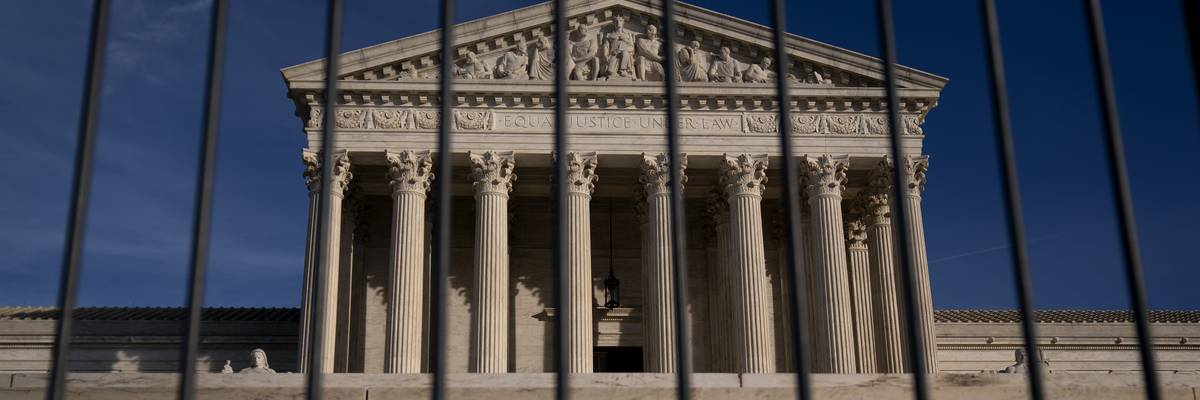
Police barricades stand in front of the US Supreme Court on December 11, 2020 in Washington, DC.
The court has given the country sparse assurance that it will push back on Trump’s unique claims of expansive presidential powers.
The “F-word,” fascism, has recently seen increasing use in American public discourse—and for good reason. Some critics claim that the word, fascism, has been overused—and wrongly applied to the behavior and propaganda of President Donald Trump and his regime. They are wrong. Even though other words do describe Trump’s behavior, such as authoritarian, corrupt, cruel, vindictive, racist, or misogynistic, they do not wholly capture the political essence of Donald J. Trump. “Fascist” clearly does.
What are the classic hallmarks of fascism? The analyses of several historians and other experts, such as Ruth Ben-Ghiat (Strongmen), Timothy Snyder (On Tyranny), Jason Stanley (How Fascism Works) and Umberto Eco ("Eternal Fascism," 1995 article in the New York Review of Books) describe fascism as including these features: mythologizing the past; persecution of racial, religious, or ethnic minorities and celebrating violence against them; pseudo patriotic and militaristic spectacles; big business capture of government; suppression of civil liberties, including free speech; white supremacy, combined with a sense of victimhood; and male dominance. Without any doubt, Trump and his regime qualify as fascist, or at the very least, incipient fascist.
Only recently, the Trump regime issued a memorandum (NSPM-7) in which Trump directs his officials to investigate supposed incidents of “anti-Americanism, anti-capitalism and anti-Christianity.” Trump falsely claims that leftists and other “antifa” activists use violence to accomplish their political goals. The memorandum facilitates Trump’s threat to go after “the enemy within”—which is anybody who opposes his policies or toxic rhetoric. The “enemy within” designation was widely used by Hitler’s Nazi regime to denigrate Jews. The similarities between the propaganda and legal distortions of that regime and those of the Trump administration are chilling. (See, Hitler’s Justice: The Courts of the Third Reich, by Ingo Müller). Trump has also announced that he will use the military to enforce the criminal laws throughout the country—despite the prohibitions contained in the Posse Comitatus Act of 1878.
What hope can we have that the Supreme Court of the United States will put the brakes on Trump’s fascist policies?
Will the Republican majority on the Supreme Court—embracing the unitary executive theory—eventually approve of Trump’s twisted and vindictive use of political prosecutions to silence his political foes?
The starting point toward venturing an answer to this question has to be the court’s 2024 decision in Trump vs. United States, in which it held that a president has absolute immunity for “official acts” taken in the performance of his presidential duties. That shocking decision constituted not only a “get-out-of-jail-free” card for Trump in the prosecutions the court was then reviewing; it also cloaked him with immunity for any crimes he might commit in the future as president. As a practical matter, that immunity will probably include any US murder charges which might have been brought for his having ordered alleged drug smugglers to be killed on boats in the Caribbean, since he was arguably acting as commander-in-chief of the armed forces when giving the orders. (International jurisdictions might not go along with the Supreme Court’s immunity grant).
With the exception of the April 2025 decision which the Supreme Court issued in the deportation case of Kilmar Albrego Garcia, (holding that the government had violated the immigrant’s due process rights by deporting him to El Salvador, and that the government had to “facilitate” his return to the US), the court has given the country sparse assurance that it will push back on Trump’s unique claims of expansive presidential powers.
In its emergency (“shadow”) docket rulings during Trump’s second administration, the Supreme Court has granted stays or reversals in the vast majority of cases in which the administration has appealed against US district court decisions that had slapped down various unprecedented power claims asserted by Trump. When those cases are eventually decided on their merits, the court may well embrace the “unitary executive” theory upon which many of the administration’s claims have rested. Should that come to pass, Trump’s descent into fascism may well be accelerated. Unfortunately, there is no space to elaborate on those shadow docket decisions here.
Most recently, Trump threatened on social media six Democratic members of Congress with “execution” and “death” for alleged “sedition,” that is, their having had the nerve to make a video reminding military officers and enlisted personnel that they have the right, and in some cases, the duty, under the Uniform Code of Military Justice, to refuse obedience to illegal orders. Those threats inspired at least hundreds of anonymous death threats against those Democrats in the ensuing days. That was one of Trump’s most crazy and reckless capers. It was also one of his most fascistic.
Trump’s placement of incompetent sycophants into top positions of the Justice Department and his directing them to prosecute his political rivals and critics is one of the most destructive of American norm-busting actions undertaken by Trump. Will the Republican majority on the Supreme Court—embracing the unitary executive theory—eventually approve of Trump’s twisted and vindictive use of political prosecutions to silence his political foes? Nobody knows, but the prospects are not very encouraging.
The resistance to Trump’s fascism must come from us.
Dear Common Dreams reader, It’s been nearly 30 years since I co-founded Common Dreams with my late wife, Lina Newhouser. We had the radical notion that journalism should serve the public good, not corporate profits. It was clear to us from the outset what it would take to build such a project. No paid advertisements. No corporate sponsors. No millionaire publisher telling us what to think or do. Many people said we wouldn't last a year, but we proved those doubters wrong. Together with a tremendous team of journalists and dedicated staff, we built an independent media outlet free from the constraints of profits and corporate control. Our mission has always been simple: To inform. To inspire. To ignite change for the common good. Building Common Dreams was not easy. Our survival was never guaranteed. When you take on the most powerful forces—Wall Street greed, fossil fuel industry destruction, Big Tech lobbyists, and uber-rich oligarchs who have spent billions upon billions rigging the economy and democracy in their favor—the only bulwark you have is supporters who believe in your work. But here’s the urgent message from me today. It's never been this bad out there. And it's never been this hard to keep us going. At the very moment Common Dreams is most needed, the threats we face are intensifying. We need your support now more than ever. We don't accept corporate advertising and never will. We don't have a paywall because we don't think people should be blocked from critical news based on their ability to pay. Everything we do is funded by the donations of readers like you. When everyone does the little they can afford, we are strong. But if that support retreats or dries up, so do we. Will you donate now to make sure Common Dreams not only survives but thrives? —Craig Brown, Co-founder |
The “F-word,” fascism, has recently seen increasing use in American public discourse—and for good reason. Some critics claim that the word, fascism, has been overused—and wrongly applied to the behavior and propaganda of President Donald Trump and his regime. They are wrong. Even though other words do describe Trump’s behavior, such as authoritarian, corrupt, cruel, vindictive, racist, or misogynistic, they do not wholly capture the political essence of Donald J. Trump. “Fascist” clearly does.
What are the classic hallmarks of fascism? The analyses of several historians and other experts, such as Ruth Ben-Ghiat (Strongmen), Timothy Snyder (On Tyranny), Jason Stanley (How Fascism Works) and Umberto Eco ("Eternal Fascism," 1995 article in the New York Review of Books) describe fascism as including these features: mythologizing the past; persecution of racial, religious, or ethnic minorities and celebrating violence against them; pseudo patriotic and militaristic spectacles; big business capture of government; suppression of civil liberties, including free speech; white supremacy, combined with a sense of victimhood; and male dominance. Without any doubt, Trump and his regime qualify as fascist, or at the very least, incipient fascist.
Only recently, the Trump regime issued a memorandum (NSPM-7) in which Trump directs his officials to investigate supposed incidents of “anti-Americanism, anti-capitalism and anti-Christianity.” Trump falsely claims that leftists and other “antifa” activists use violence to accomplish their political goals. The memorandum facilitates Trump’s threat to go after “the enemy within”—which is anybody who opposes his policies or toxic rhetoric. The “enemy within” designation was widely used by Hitler’s Nazi regime to denigrate Jews. The similarities between the propaganda and legal distortions of that regime and those of the Trump administration are chilling. (See, Hitler’s Justice: The Courts of the Third Reich, by Ingo Müller). Trump has also announced that he will use the military to enforce the criminal laws throughout the country—despite the prohibitions contained in the Posse Comitatus Act of 1878.
What hope can we have that the Supreme Court of the United States will put the brakes on Trump’s fascist policies?
Will the Republican majority on the Supreme Court—embracing the unitary executive theory—eventually approve of Trump’s twisted and vindictive use of political prosecutions to silence his political foes?
The starting point toward venturing an answer to this question has to be the court’s 2024 decision in Trump vs. United States, in which it held that a president has absolute immunity for “official acts” taken in the performance of his presidential duties. That shocking decision constituted not only a “get-out-of-jail-free” card for Trump in the prosecutions the court was then reviewing; it also cloaked him with immunity for any crimes he might commit in the future as president. As a practical matter, that immunity will probably include any US murder charges which might have been brought for his having ordered alleged drug smugglers to be killed on boats in the Caribbean, since he was arguably acting as commander-in-chief of the armed forces when giving the orders. (International jurisdictions might not go along with the Supreme Court’s immunity grant).
With the exception of the April 2025 decision which the Supreme Court issued in the deportation case of Kilmar Albrego Garcia, (holding that the government had violated the immigrant’s due process rights by deporting him to El Salvador, and that the government had to “facilitate” his return to the US), the court has given the country sparse assurance that it will push back on Trump’s unique claims of expansive presidential powers.
In its emergency (“shadow”) docket rulings during Trump’s second administration, the Supreme Court has granted stays or reversals in the vast majority of cases in which the administration has appealed against US district court decisions that had slapped down various unprecedented power claims asserted by Trump. When those cases are eventually decided on their merits, the court may well embrace the “unitary executive” theory upon which many of the administration’s claims have rested. Should that come to pass, Trump’s descent into fascism may well be accelerated. Unfortunately, there is no space to elaborate on those shadow docket decisions here.
Most recently, Trump threatened on social media six Democratic members of Congress with “execution” and “death” for alleged “sedition,” that is, their having had the nerve to make a video reminding military officers and enlisted personnel that they have the right, and in some cases, the duty, under the Uniform Code of Military Justice, to refuse obedience to illegal orders. Those threats inspired at least hundreds of anonymous death threats against those Democrats in the ensuing days. That was one of Trump’s most crazy and reckless capers. It was also one of his most fascistic.
Trump’s placement of incompetent sycophants into top positions of the Justice Department and his directing them to prosecute his political rivals and critics is one of the most destructive of American norm-busting actions undertaken by Trump. Will the Republican majority on the Supreme Court—embracing the unitary executive theory—eventually approve of Trump’s twisted and vindictive use of political prosecutions to silence his political foes? Nobody knows, but the prospects are not very encouraging.
The resistance to Trump’s fascism must come from us.
The “F-word,” fascism, has recently seen increasing use in American public discourse—and for good reason. Some critics claim that the word, fascism, has been overused—and wrongly applied to the behavior and propaganda of President Donald Trump and his regime. They are wrong. Even though other words do describe Trump’s behavior, such as authoritarian, corrupt, cruel, vindictive, racist, or misogynistic, they do not wholly capture the political essence of Donald J. Trump. “Fascist” clearly does.
What are the classic hallmarks of fascism? The analyses of several historians and other experts, such as Ruth Ben-Ghiat (Strongmen), Timothy Snyder (On Tyranny), Jason Stanley (How Fascism Works) and Umberto Eco ("Eternal Fascism," 1995 article in the New York Review of Books) describe fascism as including these features: mythologizing the past; persecution of racial, religious, or ethnic minorities and celebrating violence against them; pseudo patriotic and militaristic spectacles; big business capture of government; suppression of civil liberties, including free speech; white supremacy, combined with a sense of victimhood; and male dominance. Without any doubt, Trump and his regime qualify as fascist, or at the very least, incipient fascist.
Only recently, the Trump regime issued a memorandum (NSPM-7) in which Trump directs his officials to investigate supposed incidents of “anti-Americanism, anti-capitalism and anti-Christianity.” Trump falsely claims that leftists and other “antifa” activists use violence to accomplish their political goals. The memorandum facilitates Trump’s threat to go after “the enemy within”—which is anybody who opposes his policies or toxic rhetoric. The “enemy within” designation was widely used by Hitler’s Nazi regime to denigrate Jews. The similarities between the propaganda and legal distortions of that regime and those of the Trump administration are chilling. (See, Hitler’s Justice: The Courts of the Third Reich, by Ingo Müller). Trump has also announced that he will use the military to enforce the criminal laws throughout the country—despite the prohibitions contained in the Posse Comitatus Act of 1878.
What hope can we have that the Supreme Court of the United States will put the brakes on Trump’s fascist policies?
Will the Republican majority on the Supreme Court—embracing the unitary executive theory—eventually approve of Trump’s twisted and vindictive use of political prosecutions to silence his political foes?
The starting point toward venturing an answer to this question has to be the court’s 2024 decision in Trump vs. United States, in which it held that a president has absolute immunity for “official acts” taken in the performance of his presidential duties. That shocking decision constituted not only a “get-out-of-jail-free” card for Trump in the prosecutions the court was then reviewing; it also cloaked him with immunity for any crimes he might commit in the future as president. As a practical matter, that immunity will probably include any US murder charges which might have been brought for his having ordered alleged drug smugglers to be killed on boats in the Caribbean, since he was arguably acting as commander-in-chief of the armed forces when giving the orders. (International jurisdictions might not go along with the Supreme Court’s immunity grant).
With the exception of the April 2025 decision which the Supreme Court issued in the deportation case of Kilmar Albrego Garcia, (holding that the government had violated the immigrant’s due process rights by deporting him to El Salvador, and that the government had to “facilitate” his return to the US), the court has given the country sparse assurance that it will push back on Trump’s unique claims of expansive presidential powers.
In its emergency (“shadow”) docket rulings during Trump’s second administration, the Supreme Court has granted stays or reversals in the vast majority of cases in which the administration has appealed against US district court decisions that had slapped down various unprecedented power claims asserted by Trump. When those cases are eventually decided on their merits, the court may well embrace the “unitary executive” theory upon which many of the administration’s claims have rested. Should that come to pass, Trump’s descent into fascism may well be accelerated. Unfortunately, there is no space to elaborate on those shadow docket decisions here.
Most recently, Trump threatened on social media six Democratic members of Congress with “execution” and “death” for alleged “sedition,” that is, their having had the nerve to make a video reminding military officers and enlisted personnel that they have the right, and in some cases, the duty, under the Uniform Code of Military Justice, to refuse obedience to illegal orders. Those threats inspired at least hundreds of anonymous death threats against those Democrats in the ensuing days. That was one of Trump’s most crazy and reckless capers. It was also one of his most fascistic.
Trump’s placement of incompetent sycophants into top positions of the Justice Department and his directing them to prosecute his political rivals and critics is one of the most destructive of American norm-busting actions undertaken by Trump. Will the Republican majority on the Supreme Court—embracing the unitary executive theory—eventually approve of Trump’s twisted and vindictive use of political prosecutions to silence his political foes? Nobody knows, but the prospects are not very encouraging.
The resistance to Trump’s fascism must come from us.