
SUBSCRIBE TO OUR FREE NEWSLETTER
Daily news & progressive opinion—funded by the people, not the corporations—delivered straight to your inbox.
5
#000000
#FFFFFF
To donate by check, phone, or other method, see our More Ways to Give page.


Daily news & progressive opinion—funded by the people, not the corporations—delivered straight to your inbox.
"I will be a senator," said Graham Platner, "for all those who can't buy senators."
Launching a US Senate run to unseat five-term Maine Republican Sen. Susan Collins, oyster farmer Graham Platner on Tuesday made clear in his inaugural ad that beating the "fake" moderate also means taking on the power-hungry billionaire class that has helped keep her in power all these years.
The enemy that the vast majority of Americans and Mainers have in common, said Platner, "is the oligarchy."
"It's the billionaires who pay for it," he added. "The politicians who sell us out. And yeah, that means politicians like Susan Collins."
Platner, who told The New York Times political organizers recruited him to enter the race, spoke in the ad about how Maine has "become unlivable for working people."
"Nobody I know around here can afford a house," said Platner. "Healthcare is a disaster, hospitals are closing. We have watched all of that get ripped away from us, and everyone's just trying to keep it all together."
My name is Graham Platner and I’m running for US Senate to defeat Susan Collins and topple the oligarchy that’s destroying our country.
I’m a veteran, oysterman, and working class Mainer who’s seen this state become unlivable for working people. And that makes me deeply angry. pic.twitter.com/QZfAm528N1
— Graham Platner for Senate (@grahamformaine) August 19, 2025
Maine has the 11th-highest cost of living in the country, and according to the Massachusetts Institute of Technology's Living Wage Calculator, the state's minimum wage of $14.65 doesn't qualify as a living wage for single adults, married couples, or parents—even if both parents work full time.
The fact that many Mainers have to "work two or three different jobs" to survive—as nearly 8% of workers do in the state—"makes me deeply angry," said Platner.
The oyster farmer and local planning board chair is a veteran of both the U.S. Army and Marine Corps, and his campaign platform includes calls for ending homelessness among veterans and fully funding job training and healthcare for those who have served in the armed forces.
But Platner's tone in his opening campaign video contrasted with that other veterans who have been recruited by Democrats to run for public office, like former Kentucky Senate candidate Amy McGrath and a number of former service members who the party is currently pushing to run in 2026 in the hopes that they'll be seen as "politically moderate."
"There is a very tired playbook that the Democrats have run for a while where DC chooses establishment candidates that they base upon their fundraising capacity, and in 2020... they just got battered, and Susan Collins held the seat," Platner told Zeteo, referring to Democrats' decision to run state House Speaker Sara Gideon, who lost by nearly nine points despite vastly outraising Collins. "So in my opinion, we need to be doing something else. I mean, clearly that is a failed strategy."
Platner explicitly called for far-reaching, progressive policies that would serve all Americans—those that are frequently lambasted as dangerous "socialist" ideas by conservatives and dismissed as "unrealistic" by centrist Democrats.
"Why can't we have universal healthcare like every other first-world country?" asked Platner. "Why are we funding endless wars and bombing children? Why are CEOs more powerful than unions? We've fought three different wars since the last time we raised the minimum wage."
On his campaign website, Platner added that he would "be a strong supporter of a Medicare for All system, moving away from the for-profit insurance system that has brought us nothing but grief," protect Social Security, push for a "billionaire minimum tax," "fight for urgent action on climate change," and strengthen legislation to ensure that "enforcement against massive polluters and repeat offenders does not depend upon the whims of whoever happens to be president."
In an interview with Politico, Platner said that if elected, he would not support Senate Minority Leader Chuck Schumer (D-N.Y.) as the party's leader in the Senate, saying that "the next leader needs to be one of vision and also somebody who is willing to fight."
Along with House Minority Leader Hakeem Jeffries (D-N.Y.), Schumer has angered progressives and self-described moderate Democrats alike by voting with Republicans to advance the GOP's spending bill—claiming doing so was necessary to stop a government shutdown—and refusing to endorse New York City Democratic mayoral candidate Zohran Mamdani, who like Platner has centered affordability in his campaign.
Platner has hired Morris Katz, a top strategist for Mamdani, and his campaign so far carries echoes of the mayoral candidate. In addition to unapologetically calling for policies to further economic justice, Platner told Zeteo that Israel's U.S.-backed assault on Gaza, which was a flashpoint in New York City's Democratic primary, is "the ultimate moral test of our time."
Since Mamdani's primary victory in June, Democrats including Jeffries and former Transportation Secretary Pete Buttigieg have claimed the mayoral candidate has not yet proven that his progressive platform has broad appeal.
"I think a lot of people are focused on the leftism, the ideological leftism, that I think we shouldn't be so surprised that prevailed in a New York Democratic Party primary," Buttigieg told NPR last month. "But I think if my party wants to learn lessons from Mamdani's success that are portable to a place like Michigan, where I live, it's less about the ideology and more about the message discipline of focusing on what people care about and the tactical wisdom of getting out there and talking to everybody."
Platner, who is one of six declared Democratic primary candidates in a race that could also soon include Gov. Janet Mills, appears intent on proving that defeating the oligarchy and the billionaires who have outsized influence on US politics and fighting for policies aimed at improving all Americans' lives are winning ideas even in the largely rural state of Maine.
"While my platform spans many issues, I view most of my job as a US senator as to do two things," reads Platner's website. "One, to ban billionaires buying elections; two, to dismantle the 'billionaire economy' in favor of an economy that works for the American worker, for small business, for the vast majority of Americans."
"I will be a senator," the platform reads, "for all those who can't buy senators."

We are in absolutely no doubt, both from a medical and societal perspective, that a genocide is exactly what is being perpetrated by Israel in Gaza.
As medical doctors, we are bound by an oath to do no harm. That oath compels us to speak out and act against the ongoing genocide in Gaza, now in its 22nd month, a genocide marked by deliberate starvation, medical extermination, and mass civilian casualties. And we are equally compelled to expose the failure of institutions and governments who could stop it but have chosen silence and complicity.
We called the organization we founded in November 2023 Doctors Against Genocide (DAG) because despite the debate around the word’s precise legal definition, we are in absolutely no doubt, both from a medical and societal perspective, that a genocide is exactly what is being perpetrated by Israel in Gaza.
We are in touch daily with our medical colleagues in Gaza, like their patients now suffering from starvation themselves and working in almost impossible conditions. Israel routinely cuts or limits access to electricity, putting ICU and other patients at dire risk and forcing surgeons to operate using the flashlights on their phones. Some have fainted during 48-hours shifts. Their patients are lying in corridors or being turned away due to overcrowding. Doctors in Gaza have been deliberately targeted by Israeli forces, abducted, tortured, imprisoned, and even murdered.
Because of the high prevalence of extreme malnutrition, patients who might otherwise recover from wounds and injuries inflicted by Israeli gunfire and bombings fail to survive. Put simply, a starving body cannot heal and a starving mother cannot nurse her child. Yet, Israel has blocked infant formula from entering Gaza, even confiscating it from our international colleagues when they volunteer for medical missions there.
After more than 600 days of atrocities, the prevention of a genocide is no longer possible. But it can still be stopped.
The fuel shortages also drive the water shortages, as pumps that draw up clean water from the depths of the water table are unable to function. This has left the population dependent on lower quality water sources, leading to enterovirus outbreaks.
Now we are seeing outbreaks of meningitis, measles, hepatitis, and polio. These are diseases either eradicated or extremely rare, resurging now due to the intentional denial of food, water, and medicine. Meanwhile, Israel has blocked lifesaving aid, bombed hospitals, and abducted doctors. Our colleague, pediatrician Dr. Hussam Abu Safiya, was abducted in December 2024. He has reportedly lost nearly 90 pounds and remains in Israeli custody, tortured, starved, and held without charge.
We have done everything we can. Members of our organization have made countless trips to Capitol Hill, held press conferences, called their senators and representatives and even the White House, all to no avail. We educated our colleagues and our elected officials. We have even faced arrest for demanding “bread not bombs.”
But with each passing day, the bombs continue, and the medical annihilation worsens. Only 27 U.S. senators voted last month to stop a shipment of 20,000 assault rifles to Israel. Just 24 voted against sending more bombs. Few have even acknowledged this as genocide.
Disgracefully, our major US medical institutions, most notably, the American Medical Association, remain silent, abandoning their ethical obligations and forfeiting moral leadership. We no longer seek change from these bodies.
Because we built strong relationships with trusted local actors, we were able to quickly pivot. In late July, DAG began sending funds directly to aid groups across Gaza to deliver hot meals, fresh produce, clean water, and bread to those in immediate need. Prices are astronomical, but the time for perfect solutions is long gone. People are starving now. We chose to act.
The funds we are sending will help offset the financial strain for local aid groups on the ground who must get food to people now, saving them from having to enter the Gaza Humanitarian Foundation’s brutal distribution points, which have become killing zones.
Among those we’re helping are more than 1,200 people who became newly blind from direct eye injuries during Israeli attacks, and another 4,000 who have lost partial vision. We are also supporting a broader disabled community that cannot reach distant or militarized aid sites.
Our organization is also raising funds to build an urgently needed field hospital on the grounds of the partially ruined Al-Shifa Hospital in northern Gaza, once the largest hospital serving the Palestinian population there. Plans have been drawn up for a 140-bed hospital housed outdoors in sturdy tents, along with two operating theaters, two recovery rooms, and communal space for employees. We know it may be targeted, like all of Gaza’s hospitals. But doing nothing is not an option.
After more than 600 days of atrocities, the prevention of a genocide is no longer possible. But it can still be stopped. One phone call from US President Donald Trump could end it. We urge him to make that call, and we urge our colleagues around the world to act with the urgency this moment demands.
As in so many arenas of American politics today, the Democrats’ inability or unwillingness to seize more power when the opportunity presents itself has led to disastrous downstream effects.
On Monday, August 11, U.S. President Donald Trump’s authoritarian gaze landed on Washington, D.C., the city of 700,000 people in the White House’s backyard. In a move of extreme overreach, he announced that he would be invoking Section 740 of the Home Rule Act, which gives the president the ability to command D.C.’s Metropolitan Police Department for “federal purposes.” Trump claimed, despite much evidence to the contrary, that D.C. was in the midst of a crippling crime wave that necessitated a federal response. That Trump’s power grab is legally dubious and almost certainly outside the ambit of what the authors of the Home Rule Act had in mind is beside the point. Because of its lack of statehood, D.C. has been a sitting target for the right wing for decades.
D.C. statehood is often framed as a daunting, pie-in-the-sky goal, but making D.C. a state would only be as hard as getting a bill passed through Congress. D.C. could be granted statehood by an act of Congress, signed into law by the president, and immediately be given the rights to self-government which residents of all 50 states currently enjoy.
A bill granting D.C. statehood, HR 51, has already been introduced in this session by D.C. Congresswoman Eleanor Holmes Norton. ( A companion Senate bill has been introduced by Maryland Senator Chris Van Hollen.) In fact, bills granting D.C. statehood have been introduced consistently since 2017. In 2020, in the wake of the Black Lives Matter uprisings in D.C. and Trump’s deployment of the National Guard against protestors, the House of Representatives passed an act admitting D.C. as the 51st state. This bill, however, died in the Republican-controlled Senate.
These efforts have been largely ceremonial. Congressional Democrats should be well aware that these bills stand no chance of passing a Republican-controlled Senate chamber, nor is there any way such legislation would avoid a veto by a Republican president. The reason is simple: If granted the full benefits of statehood, D.C. would immediately become the bluest state in the country. (D.C.’s percentage of registered Democrats, 75%, is more than 20 points ahead of the next-bluest state by registration, Maryland.) That would mean two more reliably Democratic senators, and at least one more Democrat in the House.
If the shoe were on the other foot, it is hard to imagine the current Republican Party feeling any compunction about forcing through the establishment of a 51st state that would guarantee two more Republican seats in the Senate.
Instead of jumping at the opportunity to consolidate this advantage, however, Democrats have been gun shy at the prospect of pushing in earnest for D.C. statehood when the right conditions have arisen. In the first few months of Barack Obama’s first term in office Democrats held a filibuster-proof majority. This era is remembered largely for being the window that Obama and Democrats used to pass the Affordable Care Act. Democrats could have also used this moment to push through a D.C. statehood bill; no such legislation was introduced by the majority party in either chamber of Congress.
More recently, Democrats held control of both the House and Senate during the first half of Joe Biden’s term as president. Rep. Holmes Norton also introduced a statehood bill during that session of Congress, which passed the House along a largely party-line vote. However, the bill was not taken up in the Senate, despite Democrats’ control of that body. This had largely to do with then-Senators Joe Manchin and Kyrsten Sinema’s pivotal positions in determining what legislation had a chance at passage in the Senate. Manchin declared that he did not support the statehood bill while Sinema’s support was unclear. This effectively killed the legislation, which would have also required Democrats to make the politically risky move of scrapping the filibuster to realize D.C. statehood.
With inconstant support from Democrats in Congress, the statehood movement has stalled out again. While Democrats profess support for D.C. statehood, they have done little to prioritize it in practice. Their 2024 platform makes a single mention of the party’s support for statehood, and pins the responsibility entirely on Republicans for blocking statehood votes when, in reality, intransigence within the Democratic ranks shares equal blame in recent history.
If the shoe were on the other foot, it is hard to imagine the current Republican Party feeling any compunction about forcing through the establishment of a 51st state that would guarantee two more Republican seats in the Senate. As in so many arenas of American politics today, the Democrats’ inability or unwillingness to seize more power when the opportunity presents itself has led to disastrous downstream effects.
Now, D.C.’s residents are entirely exposed to Trump’s capricious and volatile brand of politicking. He has vowed to clear encampments of the unhoused, arrest children, and target the undocumented using the full force of the Metropolitan Police Department and the National Guard. He has encouraged police to brutalize citizens if they wish, and raised the specter of calling active duty military into the city. These actions are clearly designed to create a spectacle and shore up his strongman image, at the expense of 700,000 people who are American citizens without political recourse or representation.
Whatever happens in the coming days and weeks, it is important to remember that D.C. residents don’t have to live like this. The Democratic Party should put D.C. statehood at the front of its political platform, in 2028 and beyond, and ensure that no wannabe despot can ever use the city as his punching bag again.
Why the historic vote on blocking weapons to Israel matters for progressive politics and the fight against Trump.
Wednesday’s Senate votes on Sen. Bernie Sanders’ Joint Resolutions of Disapproval (JRDs) that would have blocked specific weapons transfers to Israel crystallized two critical realities within the Democratic Party as well as within the progressive movement more broadly. On one hand, 27 Senators, a majority of Democratic caucus, listened to their consciences and made a historic break with decades of unquestioned U.S. military aid to Israel. On the other hand, a substantial contingent of Democratic senators—some from states with progressive reputations and others who are self-styled progressive leaders—joined every single Republican senator in refusing to challenge the influential pro-Israel lobby.
The bipartisan consensus supporting unquestioned military aid to Israel had so far withheld a real reckoning as Gaza’s civilian population faces staggering devastation—bombed hospitals, restricted humanitarian access, and mounting numbers of civilians killed. Meanwhile, those realities in Gaza have caused a sea change with the Democratic Party’s increasingly justice-minded rank and file.
A Gallup poll from just this month found that a paltry 8% of Democratic voters approve of Israel’s military actions in Gaza, down sharply from 24% in late 2024, reflecting unprecedented disapproval amid mounting civilian casualties and humanitarian suffering. This collapse in support highlights a widening chasm between those Democratic leaders who continue to back unconditional military aid and the overwhelming majority of their base. This stark divide weakens the party as it tries to oppose U.S. President Donald Trump in D.C. and as it heads into upcoming elections.
How can Sen. Chuck Schumer (D-N.Y.) lead the Democratic Party against Trumpism if he sides with Bibi Netanyahu’s worst authoritarian instincts instead of with Sens. Elizabeth Warren (D-Mass.) and Bernie Sanders (I-Vt.) and the fight for human rights? How can someone like Sen. Cory Booker (D-N.J.) give anti-authoritarian speeches about fighting “for the moral soul of the nation” while he votes to keep the U.S. complicit in starving a people and other war crimes? How can Sens. Kirsten Gillibrand (D-N.Y.), Adam Schiff (D-Calif.) and Alex Padilla (D-Calif.) claim to truly represent voters in progressive states like New York and California when they side with the Israel lobby over 90% of their base voters?
To present a robust counterweight to Trump’s authoritarianism, Democrats must articulate a fundamentally different vision—one that rejects complicity in violence abroad and centers human rights as a cornerstone of both its domestic and foreign policy.
As the atrocities in Gaza mount each day, the costs of listening to lobbying groups like the American Israel Public Affairs Committee (AIPAC) and aligned hardline organizations are growing. These groups leverage extraordinary financial and institutional clout, but they do so while representing a smaller and smaller subset of the electorate. At the same time, AIPAC has become a Republican dominated and Republican mega-donor funded organization. It is the largest conduit for Republican donors to meddle in Democratic primaries. It’s past time for the Democratic Party to divorce AIPAC and groups like it.
The electoral consequences of backing Israel’s war and oppression are already evident. A YouGov/IMEU survey reveals that nearly one-third of 2020 Biden voters who turned away from former Vice President Kamala Harris in 2024 cited the Gaza crisis and U.S. policy on Israel as the decisive issue—outranking traditional concerns such as healthcare and the economy.
Alignment with entrenched special interests, including a hardline Israeli government accused of genocide and other war crimes, undercuts the party’s credibility with key constituencies and diminishes the Democratic Party’s ability to offer a coherent alternative to Donald Trump. To present a robust counterweight to Trump’s authoritarianism, Democrats must articulate a fundamentally different vision—one that rejects complicity in violence abroad and centers human rights as a cornerstone of both its domestic and foreign policy. The longer party leaders cling to the status quo, the more it creates openings for authoritarian narratives to resonate with disaffected voters.
Meanwhile, left and progressive forces within and outside the party must use this opening wisely—mobilizing progressive coalitions for clear, principled anti-authoritarian shifts in U.S. foreign policy, including robust opposition to ongoing military aid that enables war crimes and ethnic cleansing. This week’s vote can provide a springboard for mobilization to thank senators who voted yes and cement their support for an end to the war—and Israel’s apartheid policies. Even more importantly, those who voted against holding Israel accountable for its war crimes must hear from their constituents in their offices, at town halls, and with overflowing phone lines and email inboxes.
The stakes could not be higher. Gaza is facing mass starvation, and 90% of Palestinians in Gaza are displaced. The decisions made in the coming months, especially around military aid appropriations and diplomatic strategy to end the war, will determine not only the future of Palestinians under siege but the credibility and political fortunes of the Democratic Party and any ability to push back Trump’s reactionary authoritarianism.
Those of us who care about the fate of the Palestinians have a role to play in shaping these outcomes. Power from below—organizing, mobilization, and moral witness—can push these elected officials to finally end U.S. complicity. Now is the time to push more senators to join the 27 who voted to block weapons this week. At the same time, we can also organize behind the Block the Bombs campaign in the House. Reps. Delia Ramirez (D-Ill.), Sara Jacobs (D-Calif.), Pramila Jayapal (D-Wash.), and Mark Pocan (D-Wis.), along with 18 colleagues, have introduced historic legislation to block the U.S. weapons being sent to Israel and used in human rights violations. Supporters are campaigning this August to get as much support in Congress for this effort as possible. If all this mobilization can force more and more members of Congress to take a stand for human rights and justice, that will be good for Palestinians suffering in Gaza and good for American democracy.
"What will come out next about Bove?" said one senator as a confirmation vote loomed. "That's precisely the problem with this disaster of a nominee. And why Senate Republicans are rushing through his nomination."
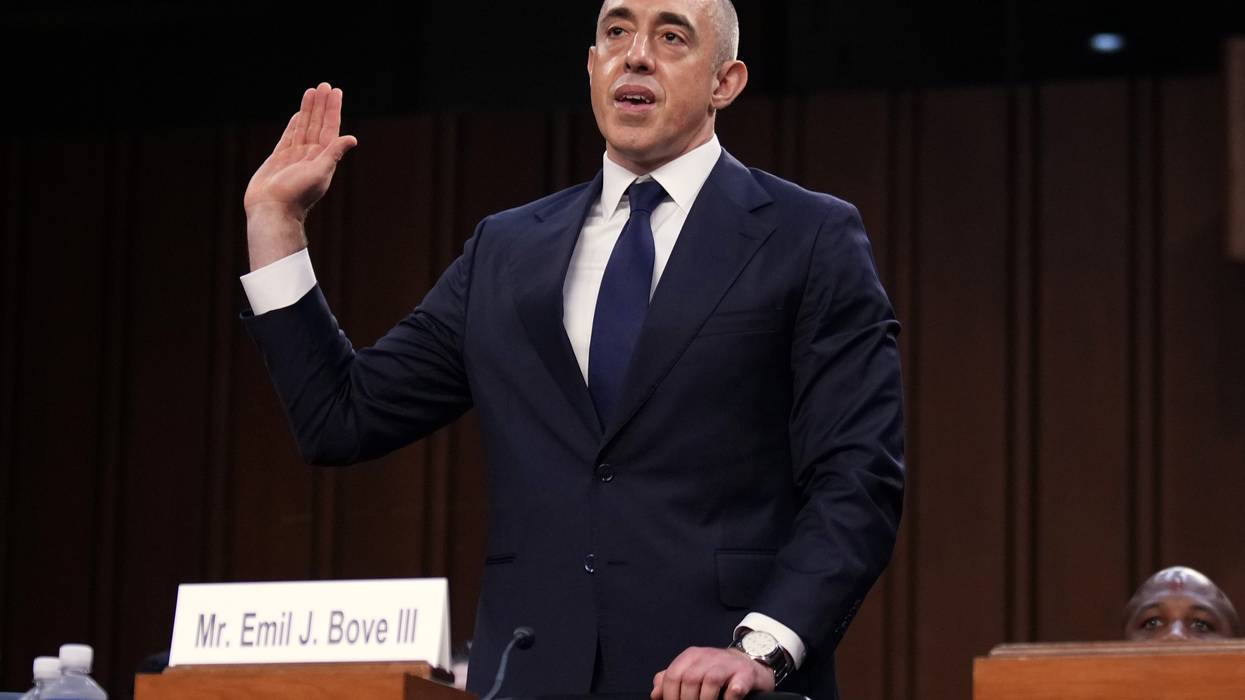
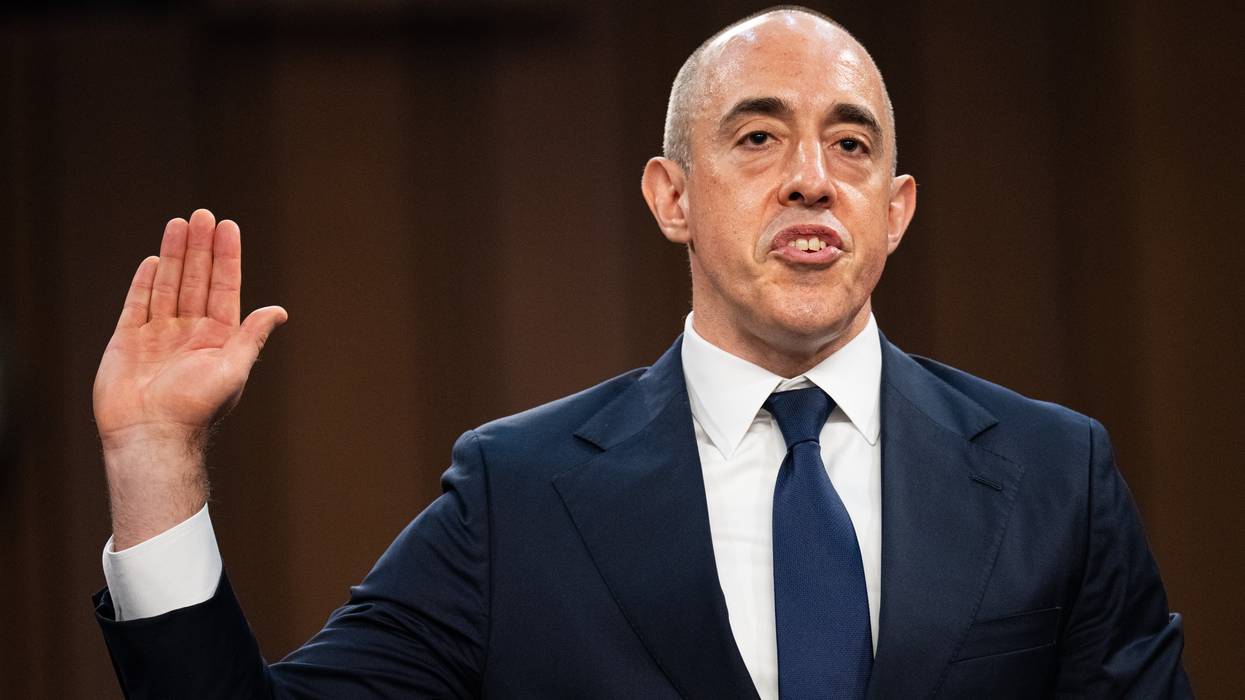
With the U.S. Senate poised to vote as early as Tuesday on Trump administration official Emil Bove's nomination for a lifetime appointment as a federal judge, a third whistleblower came forward with information about Bove's conduct at the Department of Justice and Democratic senators made their latest push to stop his confirmation.
As The Washington Post reported, a whistleblower shared evidence with lawmakers that Bove, the principal associate deputy attorney general and a former personal attorney to President Donald Trump, misled the Senate Judiciary Committee regarding his role in the DOJ's dismissal of corruption charges against New York City Mayor Eric Adams.
During his confirmation hearing in June, Bove told senators that U.S. District Judge Dale Ho granted the DOJ's motion to dismiss the Adams case because it "reflected a valid exercise of prosecutorial discretion."
He denied the existence of the DOJ deal with Adams to drop the charges in exchange for the mayor's cooperation with Trump's mass deportation agenda, saying that "the suggestion that there was some kind of quid pro quo was just plain false."
The decision to drop the charges led several prosecutors to resign from the DOJ in protest.
Sen. Cory Booker (D-N.J.), who serves on the Senate Judiciary Committee and condemned Republicans' decision to advance Bove's nomination earlier this month, first received evidence from the third whistleblower, according to the Post. Several other Democrats have also reviewed the evidence, which Booker told the outlet was "significant."
"We have substantial information relevant to the truthfulness of the nominee," Booker said on the Senate floor, calling on Republicans on the committee to review the new evidence.
"Another whistleblower has come forward with evidence that raises serious concerns with Emil Bove's misconduct. Senate Republicans will bear full responsibility for the consequences if they rubber stamp Mr. Bove's nomination."
Lawyers for the anonymous whistleblower told the Post on Tuesday that they had turned over the new information provided by the person to the DOJ inspector general.
Booker was joined by Sen. Adam Schiff (D-Calif.) on Tuesday in calling on the DOJ's inspector general to promptly open an investigation into Bove in light of the latest whistleblower complaint.
"In the event these whistleblower complaints and other reports have not already prompted investigations by your office, we urge you to undertake a thorough review of these disclosures and allegations," said the lawmakers.
Two other whistleblowers have come forward in recent weeks, alleging Bove told DOJ lawyers to ignore court orders that would impede Trump's mass deportation agenda. Former DOJ attorneys and federal and state judges have urged the Senate to oppose his nomination.
Schiff condemned Republicans on the committee for attempting to dismiss the whistleblowers' complaints.
"What will come out next about Bove?" said Schiff. "That's precisely the problem with this disaster of a nominee. And why Senate Republicans are rushing through his nomination. Before more disqualifying information can come out."
Sen. Sheldon Whitehouse (D-R.I.) emphasized that the fight to stop Bove's confirmation "isn't over, even when subservient Senate Republicans ignore another whistleblower and shove this character through their new-low, hide-the-ball Senate confirmation process and onto the bench."
Republicans can afford to lose only three votes for Bove and still confirm him with a tie-breaker vote from Vice President JD Vance. Sens. Susan Collins (R-Maine) and Lisa Murkowski (R-Alaska) are expected to oppose him.
Josh Sorbe, a spokesperson for Sen. Dick Durbin (D-Ill.), the Judiciary Committee's ranking member, said the latest complaint is "another damning indictment of a man who should never be a federal judge."
"Another whistleblower has come forward with evidence that raises serious concerns with Emil Bove's misconduct," said Sorbe. "Senate Republicans will bear full responsibility for the consequences if they rubber stamp Mr. Bove's nomination."
"It's a fundamental injustice that the very people we entrust with our children's education and well-being are often paid so little that they have to work second or third jobs," said one teacher.
After hearing from hundreds of public school educators and advocates at a town hall on chronically low teacher pay on Thursday, U.S. Sen. Bernie Sanders introduced legislation to ensure all educators make at least $60,000 per year and benefit from other federal investments.
Currently, about a third of public school K-12 teachers earn less than $60,000 per year, and about 1 in 6 take on extra jobs during the school year to help make ends meet—including teachers who have years of experience.
Sanders (I-Vt.) held a town hall in Washington, D.C. Thursday, hearing from teachers about their experiences with what he called "America's teacher pay crisis."
Billie Helean, a first grade teacher and president of her local teachers union in Rio Rancho, New Mexico, asked the Democratic lawmakers who joined educators for the town hall to "consider June," one of her colleagues.
"After working all day with kindergartners, she'd rush to her second job and barely see her family," said Helean. "It's a fundamental injustice that the very people we entrust with our children's education and well-being are often paid so little that they have to work second or third jobs just to keep their heads above water."
Carole Gauronskas, a special needs educator and vice president of the Florida Education Association, described how she and her husband struggled to keep food on the table after he lost his job as an engineer.
"After working morning care, afternoon care, summer school and a second job at Home Depot, and babysitting most of the summer, I barely made $29,000," Gauronskas said. "Take away the health insurance and the deductibles... and I took home less than $16,000 per year."
"I was the 'one medical emergency or car emergency away from losing everything,'" she added. "This bill will be life-altering for hundreds of thousands of paraprofessionals."
Along with ensuring all teachers earn a minimum of $60,000 per year, the Pay Teachers Act would require districts to give educators raises throughout their career and provide them with at least $1,000 per year to pay for classroom supply expenses.
According to the National Education Association (NEA), U.S. teachers spend between $500 and $750, on average, for school supplies annually.
The bill would also raise pay for paraprofessionals and educational support staff to at least $45,000 per year; currently, about 35% of these educators make less than $25,000 per year.
The Pay Teachers Act would "significantly increase federal investments in teachers and public schools, including tripling Title I-A funding and funding for rural education programs, diversifying and expanding the teacher pipeline, and strengthening leadership and advancement opportunities for educators," said Sanders.
The senator noted that the town hall was held weeks after President Donald Trump signed the massive Republican budget bill into law—handing out a $900 billion tax cut to large corporations and a $1 trillion tax cut to the wealthiest 1% of households while slashing $300 billion in education funding.
"Across the country, most of us across race, place, and background want the same thing—strong public schools where every student can thrive and strong communities that support them. In order to attract and retain the passionate, qualified educators that inspire our students, give them the one-on-one support, and do everything in their power to help each student succeed, we need to pay teachers like the professionals they are. America's educators applaud Sen. Bernie Sanders for introducing the Pay Teachers Act," said NEA vice president Princess Moss. "We urge senators to support educators and co-sponsor this commonsense legislation that invests in our students, educators, and public schools."
The U.S. government's refusal to demand accountability from Israel, they said, has led to an "unacceptable culture of impunity when it comes to incidents where civilians have been killed in the West Bank, including Americans."
While the two Republican senators from Florida who represented U.S. citizen and Tampa resident Sayfollah Musallet have yet to speak out publicly about his killing in the West Bank earlier this month, 29 of their Democratic colleagues on Thursday demanded the Trump administration open an investigation into what Palestinian authorities say was deadly Israeli settler violence that killed the 20-year-old.
Led by Sen. Chris Van Hollen (D-Md.), the Democratic senators noted that the U.S. government has refused to "secure accountability" for the killings of six other U.S. citizens who have been killed in the West Bank since January 2022, including Al Jazeera journalist Shireen Abu Akleh and activist Ayşenur Ezgi Eygi.
Since President Donald Trump took office and revoked sanctions against Israeli settlers there, they wrote, settler attacks have surged—with Musallet, a Palestinian-American who was born in Florida, one of the latest victims.
"We urge you to immediately launch an independent investigation into the brutal killing of Saifullah Kamel Musallet," said more than half of the Senate Democratic Caucus members, including Sens. Bernie Sanders (I-Vt.), Ed Markey (D-Mass.), and Mazie Hirono (D-Hawaii).
Palestinian officials in the West Bank and Musallet's family have reported that Israeli settlers surrounded the young man after brutally beating him on July 11, when he was visiting relatives for the summer. The settlers reportedly prevented ambulances and paramedics from reaching Musallet, and he died before his brother was finally able to retrieve him and take him to a hospital.
The Trump administration said after Musallet's killing was reported that the U.S. State Department "has no higher priority than the safety and security of U.S. citizens overseas," but said nothing about how it would proceed. Following outcry, U.S. Ambassador to Israel Mike Huckabee called on Prime Minister Benjamin Netanyahu's government to "aggressively investigate" Musallet's death and called his killing a "criminal and terrorist act."
"The killings of these Americans in the West Bank have been met by a lack of accountability from the Netanyahu government and an inability to secure justice by the U.S. government."
The U.S. has generally accepted the results of Israel's investigations into the killings of U.S. citizens in the West Bank. A Department of Justice probe into the killing of Abu Akleh was opened in 2022, but the DOJ has yet to release its findings. No one has faced criminal charges for killing a U.S. citizen in the illegally occupied territory.
"The killings of these Americans in the West Bank have been met by a lack of accountability from the Netanyahu government and an inability to secure justice by the U.S. government," the Democrats wrote. "These failures have contributed to an unacceptable culture of impunity when it comes to incidents where civilians have been killed in the West Bank, including Americans."
Along with Florida's Republican Sens. Rick Scott and Ashley Moody, U.S. Rep. Laurel Lee (R-Fla.)—who represented Musallet in the House—and Gov. Ron DeSantis, also a Republican, have remained silent about their constituent's killing.
"When American citizens like Saif are killed overseas, especially by Israeli settlers backed by the Israeli government, looking the other way sends a dangerous message: that some American lives simply don't matter," the Council on American-Islamic Relations said days after Musallet's killing. "We demand better."
The Democratic senators called on Secretary of State Marco Rubio and Attorney General Pam Bondi to launch an independent investigation into the fatal beating of Musallet as well as "the circumstances that blocked ambulances from reaching him."
"We also ask that you provide us with an update on the status of any investigations into the killings of the six other Americans who have been killed since January 2022," they wrote, "and provide us with a briefing on actions you are taking to ensure accountability for their deaths and to prevent future killings of Americans in the West Bank."
"Today's Senate Judiciary Committee meeting was a clear indication of MAGA Republicans' willingness to put blind loyalty to Trump before their oaths of office and duties to their constituents," said one advocate.
Democrats on the U.S. Senate Judiciary Committee on Thursday said Republicans on the panel had broken several Senate rules by forcing a vote on judicial nominee Emil Bove, and questioned whether the committee's vote to advance Bove's nomination to the chamber floor was legitimate, since it took place after they walked out in protest.
As NBC News reported, a spokesperson for Sen. Dick Durbin (D-Ill.) said Democrats are questioning whether the vote to advance Bove was officially reported out, and the question "may be up to the Senate parliamentarian" because the GOP broke several committee rules when Chair Chuck Grassley (R-Iowa) shut down debate.
The Democratic members of the committee walked out of the hearing room after Grassley said the debate would not continue regarding Bove, who was the subject of a whistleblower report that alleged he told Department of Justice lawyers to ignore court rulings that got in the way of President Donald Trump's mass deportation agenda.
Bove, currently the principal associate deputy attorney general, reportedly said the DOJ should "consider telling the courts 'fuck you' and ignore" court orders that aimed to stop deportation flights from taking off, carrying hundreds of migrants to other countries without due process.
Earlier this week, Grassley rejected a request by Democrats on the committee to hold a hearing so the whistleblower, former DOJ attorney Erez Reuveni, could testify.
Grassley said he saw no reason to delay a committee vote on Bove, who in addition to being the subject of Reuveni's complaint, has been accused of belittling subordinates, making "power plays," and lacking professionalism during his tenure in New York's Southern District.
"Bove is an extreme ideologue, and his lifetime appointment sets the stage for the president and his allies to seek out favorable rulings no matter how unconstitutional their actions," said Caroline Ciccone, president of Accountable.US. "It's reprehensible that Senate Republicans silenced a basic acknowledgement of the facts, in order to jam through judicial appointments who will be a rubber stamp for Trump's out-of-touch agenda."
Bove also refused to condemn the January 6, 2021 attack on the U.S. Capitol and played a key role in the DOJ decision to drop federal corruption charges against New York City Mayor Eric Adams. Bove's former role as Trump's personal attorney led 75 former state and federal judges to warn this week that his nomination to be a judge on the U.S. Court of Appeals for the 3rd Circuit was "deeply inappropriate."
"He has been trailed by a history of complaints, long predating his affiliation with President Trump about his temperament, his poor judgment, and lack of candor in front of the court," said Durbin on Thursday. "Think of it: We're talking about a judge for life."
Ahead of the committee's proceedings on Thursday, more than 900 former DOJ attorneys joined the call for lawmakers to reject Bove's nomination, saying it was "intolerable... that anyone who disgraces the Justice Department would be promoted to one of the highest courts in the land, as it should be intolerable to anyone committed to maintaining our ordered system of justice."
But Grassley disregarded the warning and other protests from Democratic committee members as he cut off the debate over Bove during Thursday's session.
"This is out of order," Sen. Cory Booker (D-N.J.) said. "This is absolutely insane. What is the rush?"
After the rest of the Democrats left the room in protest, Booker remained in the hearing room and shouted over the votes of several other judicial nominees before joining his colleagues.
"This lacks decency. It lacks decorum. It shows that you do not want to simply hear from your colleagues," Booker said. "This is us simply trying to rush through one of the most controversial nominees we've had under this presidential administration."
Grassley denounced the concerns raised about Bove as a "political hit job," but Booker emphasized that "time and time again, there were allegations made against this nominee by independent people, by Republicans, by career professionals, and we are not listening to them or demanding answers."
As Bove's nomination headed to the Senate floor, Durbin and Booker also brought up questions about whether Bove was involved in a DOJ decision not to release files regarding convicted sex offender Jeffrey Epstein, who was a former associate of Trump's and was found dead in his jail cell in 2019.
Booker wrote a letter to Bove on Wednesday, saying his "involvement in the DOJ's review of the Epstein files is a matter of significant public importance given the contradictory statements by Attorney General [Pam] Bondi concerning the existence of an Epstein 'client list' and DOJ's stated commitment to transparency. Furthermore, it warrants scrutiny whether the DOJ intentionally withheld evidence related to the trafficking and sexual abuse of minors to protect certain individuals."
Maggie Jo Buchanan, interim executive director of the advocacy group Demand Justice, said Booker had "correctly accused his colleagues across the aisle of abusing their power. We applaud his efforts to ensure the public could learn more about the serious allegations Bove faces, as well as the committee Democrats who walked out of the meeting in light of their Republican colleagues' actions."
"Today's Senate Judiciary Committee meeting was a clear indication of MAGA Republicans' willingness to put blind loyalty to Trump before their oaths of office and duties to their constituents," said Buchanan urging senators from both parties to reject Bove's nomination now that it has advanced to the Senate floor.
"Senators on both sides of the aisle must show their commitment to judicial independence and keep this extreme, Trump loyalist off the federal bench," she said. "Voting 'no' should not be a difficult choice for any senator with an ounce of self-respect or respect for the courts."
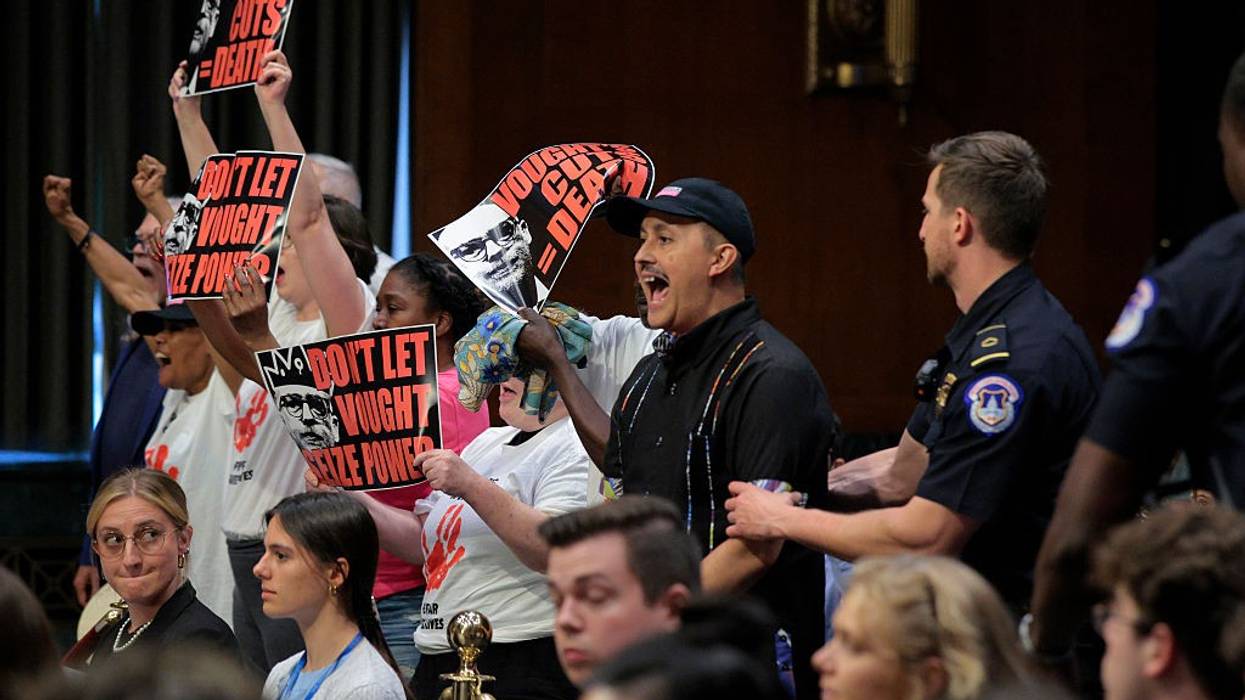
One humanitarian leader pointed out that the bill contains $1.3 billion in cuts to initiatives "every bit as lifesaving" as the AIDS prevention program that Republicans spared amid public pressure.
Progressives and public health advocates on Tuesday were among those urging U.S. senators to vote against Republican legislation that would let President Donald Trump claw back billions of dollars already appropriated by Congress, even as GOP lawmakers ditched plans to cut funding for an HIV-AIDS prevention program that has saved tens of millions of lives in Africa.
Politico reported that Senate Republicans will remove $400 million in funding cuts to the President's Emergency Plan For AIDS Relief (PEPFAR), an initiative of former President George W. Bush credited with saving more than 25 million lives in Africa since its implementation in 2003.
However, the rescission package—a version of which was passed last month by the House of Representatives—still includes $1.3 billion in cuts to humanitarian aid programs that Jeremy Konyndyk, president of the advocacy group Refugees International, called "every bit as lifesaving as PEPFAR."
These include programs to fund public health, emergency food and shelter assistance, peacekeeping, economic development, and other essential aid that helps stabilize war- and disaster-stricken populations in the Global South.
"Even though the Senate has removed $400 million in PEPFAR funding from the rescissions package, another $500 million in global health funding could still be cut," Think Global Health managing editor Nsikan Akpan noted Tuesday.
Office of Management and Budget Director Russell Vought said Tuesday that the White House has agreed to an exemption for PEPFAR funding via a substitute amendment.
"It's substantially the same package and the Senate has to work its will and we've appreciated the work along the way to get to a place where they've got the votes," he explained.
Jacob Leibenluft and Devin O'Connor, respectively senior adviser and senior fellow at the Washington, D.C.-based Center on Budget and Policy Priorities, noted that in addition to cuts to critical programs, the rescission package, combined with the Trump administration's wider campaign of unlawfully impounding funds, "could also make it far more difficult for Congress to fund the government in a bipartisan way in the future."
As the pair explained:
Most of the funds in the rescission package were enacted in March legislation that was passed by Congress—including on a bipartisan basis in the Senate—and signed into law by the president to fund the government for the rest of fiscal year 2025. To provide the 60 votes required to avoid a Senate filibuster, at least eight Democratic senators needed to join with 52 Republican senators to invoke cloture on the funding bill.
But presidential rescission requests operate under different rules and require only 51 votes to pass the Senate, so no Democratic votes are needed. If the Senate approves the package (which passed the House on a party-line vote), this would show that Republicans could quickly revise on a partisan basis, with merely 51 votes in the Senate, a bipartisan funding agreement reached only a few months earlier that required support from no fewer than 60 senators.
"Senators should keep those consequences in mind as they consider the president's current rescission request," Leibenluft and O'Connor advised.
The consumer advocacy group Public Citizen cited both PEPFAR and the billions of dollars in other cuts to foreign aid contained in the package as reasons to oppose it.
Sen. Bernie Sanders (I-Vt.) took aim at the bill's $1.1 billion in cuts to the Corporation for Public Broadcasting (CPB), which funds PBS and NPR.
"Like all authoritarians, Trump doesn't like criticism or objective reporting. He just wants flattery," the senator said on social media. "That's why he wants to defund NPR and PBS. We need media in this country that is not owned by billionaires and corporate interests. I will vote to support public broadcasting."
The chairs of the Congressional Tri-Caucus—Congressional Asian Pacific American Caucus Chair Grace Meng (D-N.Y.), Congressional Black Caucus Chair Yvette Clarke (D-N.Y.), and Congressional Hispanic Caucus Chair Adriano Espaillat (D-N.Y.)—on Tuesday led a letter urging senators to reject the rescissions bill due to CPB cuts.
"CPB's elimination would decimate public media infrastructure, as the vast majority of its funding goes directly to local stations, many of which rely on it for over half their operating budgets," the lawmakers wrote. "In rural and tribal areas, this would shut down stations that serve as lifelines for public safety, education, and culturally relevant programming. Eighty percent of Native American and Alaska Native communities are rural or remote, and public television is often the only station reaching them consistently."
Polling published Tuesday by Data for Progress revealed that the proposed cuts in the rescission package are deeply unpopular, with a majority of respondents saying that funding for global health programs, public broadcasting, and developmental aid should be maintained at current levels or increased.
NEW: As Senate Republicans approach the Friday deadline to pass Trump’s rescissions package, voters reject the proposed billions of dollars in cuts to global aid and public broadcasting.We find that less than 30% of voters want cuts to these programs.www.dataforprogress.org/datasets/pol...
[image or embed]
— Data for Progress (@dataforprogress.org) July 15, 2025 at 6:54 AM
GOP senators—who are under pressure, as the proposed cuts must be approved by Friday under the Impoundment Control Act (ICA) of 1974, the law they are using to skirt a Democratic filibuster—say they hope to pass the entire package before next month's summer recess.
On Monday, a coalition of 24 states and the District of Columbia sued the Trump administration, alleging it violated the ICA and demanding the release of $6.8 billion in approved education funds that the suit argues have been illegally withheld.
"Courts across the country have made it clear to Donald Trump that he and his administration do not have the authority to unilaterally block funding that Congress has already approved," Democratic Michigan Attorney General Dana Nessel said in a statement. "These education grants are designed to help Michigan students thrive. By freezing them, the Trump White House is not just breaking the law but jeopardizing our kids' future."
"Mr. Bove's egregious record of mistreating law enforcement officers, abusing power, and disregarding the law itself disqualifies him for this position."
With two days to go until the U.S. Senate Judiciary Committee is set to vote on advancing the judicial nomination of President Donald Trump's former personal attorney, Emil Bove, more than 75 former federal and state judges wrote to lawmakers to demand they reject the "deeply inappropriate" appointment.
Confirming Bove to a lifetime seat on the U.S. Court of Appeals for the 3rd Circuit would not only "compromise the integrity of the courts" and "set a dangerous precedent" that "personal fealty rather than constitutional duty" can secure judicial power, said the judges, but would also elevate someone who has allegedly "plotted to violate court orders," according to a recent whistleblower report.
The judges noted that the whistleblower, former Department of Justice lawyer Erez Reuveni, has offered to testify under oath and has provided the committee with "compelling evidence" that Bove told DOJ staffers to "ignore" any court orders that challenged Trump's mass deportation operation—yet the Republican-controlled panel has not invited Reuveni to speak to lawmakers.
On Tuesday, committee Chair Charles Grassley (R-Iowa) rejected a request to hold additional hearings on Bove's nomination before voting, saying they were "unnecessary."
"The Senate has a duty to hear that testimony," said the former judges, including Republican-nominated former circuit judges J. Michael Luttig, Timothy Lewis, and Paul Michel.
The judges wrote that "Mr. Bove's egregious record of mistreating law enforcement officers, abusing power, and disregarding the law itself disqualifies him for this position."
The letter is only the latest push to stop senators from confirming Bove, currently the principal associate deputy attorney general at the DOJ. The Leadership Conference on Civil and Human Rights, a coalition of more than 240 civil society organizations, wrote to senators last month, saying Bove does not meet the "basic requirements" to be a federal judge, including being "fair-minded, well-qualified, and committed to civil and human rights."
Like the Leadership Conference, the judges on Tuesday pointed to Bove's views on and conduct regarding the January 6, 2021 attack on the U.S. Capitol, which the DOJ official "refuses to condemn." Bove also investigated and fired dozens of FBI agents who had been involved in probing the attacks, which were aimed at stopping lawmakers from certifying Trump's 2020 election loss.
"It is disqualifying alone that Mr. Bove targeted or terminated Federal Bureau of Investigation personnel and career DOJ prosecutors for honorably investigating violent criminals who assaulted police officers and intended to murder members of Congress and our nation's vice president on January 6, 2021," wrote the judges.
They also pointed to Bove's role in dropping corruption charges against New York Mayor Eric Adams, which prompted the resignation of several disgusted staff attorneys, and his record of belittling and abusing staffers when he was a federal prosecutor in New York's Southern District—a pattern that made him the subject of an email from defense attorneys who expressed concern about Bove's "power plays" and "professionalism."
"Mr. Bove's egregious record of mistreating law enforcement officers, abusing power, and disregarding the law itself disqualifies him for this position," wrote the lawyers.
Gregg Nunziata, executive director at the Society for the Rule of Law, said the "remarkable" letter demonstrated how "the case against Mr. Bove's confirmation" is "about fundamental unfitness for the judicial role."
The Senate committee is set to vote on Bove's nomination on Thursday, and Republicans on the panel are expected to approve the appointment—even though Sen. Thom Tillis (R-N.C.) previously said he would not support nominations of people who refused to condemn the January 6 attacks. After the committee vote, Bove would need to be confirmed by the full chamber.
On a questionnaire given to him by the Senate as part of his confirmation process, Bove said "the characterization of the events on January 6 is a matter of significant political debate," and declined to comment on his views.
On the same document, Bove did not rule out Trump's potential run for a third term—which would violate the U.S. Constitution's 22nd Amendment.
While the judges outlined Bove's unfitness for the lifetime appeals court seat, journalist Lydia Polgreen noted that as the committee moved toward a likely confirmation, condemnation should also be aimed at members of the Democratic Party who "caved to anti-Muslim smears" last year and failed to confirm veteran lawyer Adeel Mangi for the seat on the 3rd Circuit—leaving the spot open for Trump's former personal attorney.
As Common Dreams reported last year, Republicans on the Senate Judiciary Committee questioned whether Mangi condemned the September 11, 2001 attacks and the Hamas-led attacks on southern Israel in October 2023. They also accused Mangi of antisemitism due to his membership on the advisory board for the Rutgers Center for Security, Race, and Rights, which hosted speakers who—like more than half of U.S. adults currently—were critical of Israel.
The "monthslong onslaught of baseless, disgusting attacks on Mangi," as HuffPost reporter Jennifer Bendery called them, were successful, and convinced Sens. Catherine Cortez Masto (D-Nev.), Jacky Rosen (D-Nev.), and Joe Manchin (D-W.Va.) to vote against the "highly qualified, widely endorsed, successful litigator."
"The history of trying to fill this powerful court seat," said Bendery, "is just as infuriating as where it could be headed."