SUBSCRIBE TO OUR FREE NEWSLETTER
Daily news & progressive opinion—funded by the people, not the corporations—delivered straight to your inbox.
5
#000000
#FFFFFF
To donate by check, phone, or other method, see our More Ways to Give page.
Daily news & progressive opinion—funded by the people, not the corporations—delivered straight to your inbox.
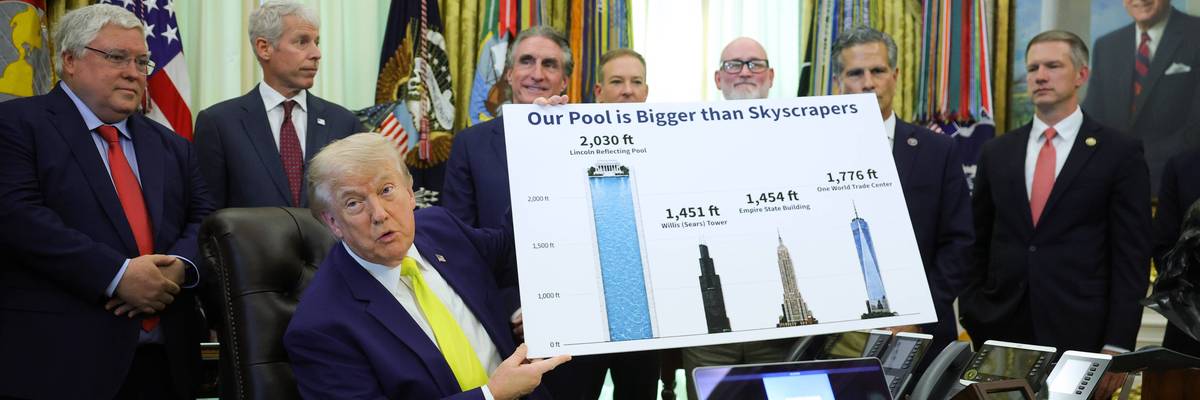
US President Donald Trump displays a graph entitled "Our Pool is Bigger than Skyscrapers" as he speaks on his renovations to the Lincoln Memorial Reflecting Pool during a "Beautiful, Clean Coal" event in the Oval Office of the White House on June 4, 2026 in Washington, DC.
The Trump administration has devoted extraordinary attention, taxpayer dollars, and even the power of government to projects centered on the president himself instead of the challenges facing the American people and the core responsibilities of government.
While Americans worried about rising costs at home and another war in the Middle East, President Donald Trump spent much of June talking about construction projects at the White House.
According to a Washington Post analysis of the president's speeches, interviews, social media posts, and other public remarks, he discussed his construction and beautification projects on nearly 4 out of every 5 days in June—more often than healthcare or wages, and about as often as inflation and prices.
That focus has become so pronounced that veteran White House reporter Maggie Haberman recently remarked that roughly "70%" of President Trump's attention appears devoted to his renovation projects.
The issue isn't just President Trump's construction projects. It's what they reveal about this presidency's priorities. Again and again, this administration has devoted extraordinary attention, taxpayer dollars, and even the power of government to projects centered on the president himself instead of the challenges facing the American people and the core responsibilities of government.
Americans should expect the same urgency in pursuing justice for survivors and greater transparency that this administration showed in protecting a presidential monument.
To begin with, consider where President Trump has chosen to focus his attention.
Over the past several months, President Trump has repeatedly returned to his new White House ballroom, the rebuilt Lincoln Memorial Reflecting Pool, triumphal arches, portraits, flagpoles, and other additions that bear his personal imprint. When asked who his proposed triumphal arch was intended to honor, he answered with one word: "Me."
But few presidents have devoted so much attention to themselves while Americans confronted far more pressing challenges. Families continue to struggle with the cost of groceries, housing, childcare, and healthcare. Students and parents are trying to pay for college. Small businesses face rising costs and tariff uncertainty. Conflict in the Middle East threatens American service members, regional stability, and higher energy prices here at home.
Second, consider how those same priorities have shaped the way taxpayer dollars have been spent.
A recent New York Times analysis found that the known costs of the president's construction projects total roughly $1.2 billion. In my home state of Illinois, that same money could restore Supplemental Nutrition Assistance Program benefits for almost all families expected to lose them this year or preserve Medicaid coverage for nearly 130,000 residents at risk of losing it.
Finally, the most troubling example is how this administration has used the power of government.
The Justice Department aggressively pursued people accused of damaging President Trump's Reflecting Pool. One defendant, former Olympic canoeist David Hearn, faced a felony carrying up to 10 years in prison before prosecutors acknowledged last week that the damage was caused by a botched installation—not vandalism—and dropped the case.
Since Jeffrey Epstein's 2019 federal arrest, no one beyond Epstein and Ghislaine Maxwell has been criminally prosecuted in the United States for participating in Epstein's sex-trafficking network, yet acting Attorney General Todd Blanche has defended the administration's refusal to release additional Epstein records while arguing there is no current basis for further prosecutions.
Years of litigation, congressional investigations, investigative reporting, and millions of pages of records have documented the network around Jeffrey Epstein. Leon Black paid Epstein more than $158 million. Lesley Groff spent 18 years as Epstein's longtime assistant, scheduling thousands of massages while Epstein abused underage girls. Yet the Justice Department has shown little urgency in pursuing accountability beyond Epstein and Maxwell.
The administration rushed to bring a felony case over alleged damage to President Trump's Reflecting Pool before acknowledging the damage resulted from a botched government installation—not vandalism—and dismissing the case. Yet when it comes to the people who enabled one of the largest sex-trafficking operations in modern history, that urgency has been nowhere to be found.
Every prosecution must rest on the evidence and the law. But Americans should expect the same urgency in pursuing justice for survivors and greater transparency that this administration showed in protecting a presidential monument.
The presidency is a public trust. It should be measured not by the monuments a president leaves behind, but by whether Americans are stronger, more secure, and more prosperous because of the choices he made.
This country and this world are at a monumental crossroads. US voters have an opportunity to beat back the forces of fascism and confront the billionaires who are rigging the economy, our media system, and our democracy, making it increasingly impossible for ordinary people to get by. We’re not just talking about the election. We’re talking about what must be done once these fascist elements are vanquished from power. We need a bolder set of solutions than what either major party has so far been willing to offer and a working-class movement ready to fight like hell for it. Trump didn't emerge from nowhere. The conditions that fueled MAGA authoritarianism were created by decades of radical neoliberal economic policies and a corrupt political system dominated by corporate interests. They slashed taxes on the super-rich, promising that the benefits would trickle down. They said giveaways to the corporate titans would make life more affordable for the rest of us. It was all bullshit. And when a bitter, betrayed populace searches for someone to blame, right-wing demagogues have little trouble finding scapegoats. People know when they're being lied to, but you won't hear any of this from the corporate media. Only independent journalism—powered and funded by people who believe in building a better world—can deliver truly trustworthy daily news. If you share our vision, please contribute whatever you can to sustain our work. |
While Americans worried about rising costs at home and another war in the Middle East, President Donald Trump spent much of June talking about construction projects at the White House.
According to a Washington Post analysis of the president's speeches, interviews, social media posts, and other public remarks, he discussed his construction and beautification projects on nearly 4 out of every 5 days in June—more often than healthcare or wages, and about as often as inflation and prices.
That focus has become so pronounced that veteran White House reporter Maggie Haberman recently remarked that roughly "70%" of President Trump's attention appears devoted to his renovation projects.
The issue isn't just President Trump's construction projects. It's what they reveal about this presidency's priorities. Again and again, this administration has devoted extraordinary attention, taxpayer dollars, and even the power of government to projects centered on the president himself instead of the challenges facing the American people and the core responsibilities of government.
Americans should expect the same urgency in pursuing justice for survivors and greater transparency that this administration showed in protecting a presidential monument.
To begin with, consider where President Trump has chosen to focus his attention.
Over the past several months, President Trump has repeatedly returned to his new White House ballroom, the rebuilt Lincoln Memorial Reflecting Pool, triumphal arches, portraits, flagpoles, and other additions that bear his personal imprint. When asked who his proposed triumphal arch was intended to honor, he answered with one word: "Me."
But few presidents have devoted so much attention to themselves while Americans confronted far more pressing challenges. Families continue to struggle with the cost of groceries, housing, childcare, and healthcare. Students and parents are trying to pay for college. Small businesses face rising costs and tariff uncertainty. Conflict in the Middle East threatens American service members, regional stability, and higher energy prices here at home.
Second, consider how those same priorities have shaped the way taxpayer dollars have been spent.
A recent New York Times analysis found that the known costs of the president's construction projects total roughly $1.2 billion. In my home state of Illinois, that same money could restore Supplemental Nutrition Assistance Program benefits for almost all families expected to lose them this year or preserve Medicaid coverage for nearly 130,000 residents at risk of losing it.
Finally, the most troubling example is how this administration has used the power of government.
The Justice Department aggressively pursued people accused of damaging President Trump's Reflecting Pool. One defendant, former Olympic canoeist David Hearn, faced a felony carrying up to 10 years in prison before prosecutors acknowledged last week that the damage was caused by a botched installation—not vandalism—and dropped the case.
Since Jeffrey Epstein's 2019 federal arrest, no one beyond Epstein and Ghislaine Maxwell has been criminally prosecuted in the United States for participating in Epstein's sex-trafficking network, yet acting Attorney General Todd Blanche has defended the administration's refusal to release additional Epstein records while arguing there is no current basis for further prosecutions.
Years of litigation, congressional investigations, investigative reporting, and millions of pages of records have documented the network around Jeffrey Epstein. Leon Black paid Epstein more than $158 million. Lesley Groff spent 18 years as Epstein's longtime assistant, scheduling thousands of massages while Epstein abused underage girls. Yet the Justice Department has shown little urgency in pursuing accountability beyond Epstein and Maxwell.
The administration rushed to bring a felony case over alleged damage to President Trump's Reflecting Pool before acknowledging the damage resulted from a botched government installation—not vandalism—and dismissing the case. Yet when it comes to the people who enabled one of the largest sex-trafficking operations in modern history, that urgency has been nowhere to be found.
Every prosecution must rest on the evidence and the law. But Americans should expect the same urgency in pursuing justice for survivors and greater transparency that this administration showed in protecting a presidential monument.
The presidency is a public trust. It should be measured not by the monuments a president leaves behind, but by whether Americans are stronger, more secure, and more prosperous because of the choices he made.