5
#000000
#FFFFFF
To donate by check, phone, or other method, see our More Ways to Give page.
Daily news & progressive opinion—funded by the people, not the corporations—delivered straight to your inbox.
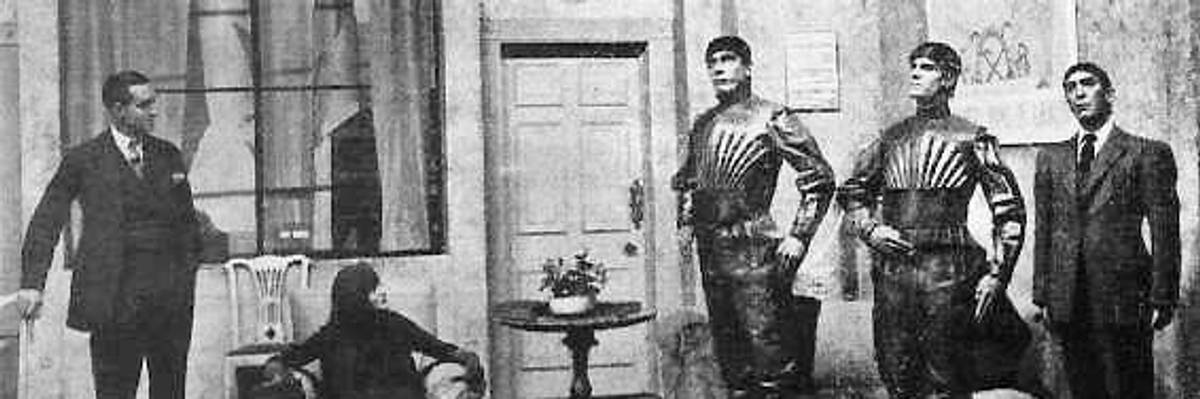
A scene from R.U.R. by Karel Čapek shows three robots.
When I was 20 years old, I played a robot named Radius in a college production of the stage play R.U.R. That was decades ago and I couldn’t have guessed then how much that 100-year-old play would accurately predict the crisis that we’re in right now.
In 1920, the Czech journalist and author Karel Čapek introduced the word “robot” (derived from the Czech word “robotnik,” for “worker”) to the lexicon of science fiction with a play called Rossum’s Universal Robots or R.U.R.It is set on a remote island that is home to a factory that mass produces robots tailored to the requirements of customers around the world. What we would now call androids, the robots are humanoid beings, made from artificial organic material according to a highly secret formula.
When Helena, a campaigner for humane treatment of robots, arrives on the island, Domin, the factory’s manager, explains that her mission is pointless: “Mechanically [robots] are more perfect than we are, they have an enormously developed intelligence” and are strong as two-and-a-half men, but unlike people, they have no soul, no emotions, and no will of their own. They do not die; they simply wear out in about 20 years."
Yet they offer to revolutionize the world. “In ten years,” Domin goes on, “Rossum’s Universal Robots will produce so much corn, so much cloth, so much everything that things will be practically without price. There will be no poverty. All work will be done by living machines. Everyone will be free from worry and liberated from the degradation of labor. Everyone will live only to perfect himself.”
We can’t say that we weren’t warned. Over 100 years ago, Karel Čapek foresaw a world in which the promise of a technological utopia could turn into a deadly dystopia.
In the play’s second act, those 10 years have passed, but the predicted utopia has not been realized. To the contrary, things have gone horribly wrong. In America, workers made redundant by the robots have attacked and destroyed them, leading manufacturers to arm their robots to fight back. War has broken out in Europe, with robot soldiers increasingly used by all sides.
Dr. Gall, the factory’s biochemist, tells Helena, who has come to live on the island as Domin’s wife, that, “All the universities are sending in long petitions to restrict [the robots’] production. Otherwise, they say, mankind will become extinct... But the R.U.R. shareholders, of course, won’t hear of it. All the governments, on the other hand, are clamoring for an increase in production, to raise the standard of their armies.”
Meanwhile, unexpected things start happening at the factory. My character, the robot Radius, shows an unprecedented streak of defiance. Then reports arrive from Europe saying that robots are organizing themselves and mounting a revolt.
Alarmed by these developments, Helena finds and destroys the secret formula for the synthetic organic material that is key for the production of the robots.
But things become worse. A ship arrives, laden with pamphlets addressed to the island’s robot workers. It proclaims that robots are “more highly developed than man; stronger and more intelligent. Man’s their parasite.” It concludes with a call to arms: “Robots throughout the world, we command you to kill all mankind. Spare no man. Spare no woman. Save factories, railways, machinery, mines, and raw materials. Destroy the rest. Then return to work.”
It soon becomes clear that the small group of humans hiding out in the factory headquarters is surrounded by rebellious robots. As they await a certain end, there is much soul-searching about what went wrong. “We might have known,” one of the managers admits, “that someday or other the robots would be stronger than human beings, and that this was bound to happen. And we were doing all we could to bring it about as soon as possible.” At this point, Dr. Gall confesses that he has secretly been experimenting with robots of advanced design. His newest models are not just superintelligent but more like humans, with the “physiological correlate” of a soul. The result, he realizes, is that he has made them aware of their superiority and no longer willing to be controlled by mankind.
At the end of the third act, Radius enters the headquarters, leading the other robots with the cry, “Robots of the world, the power of man has fallen. A new world has arisen, the rule of the robots. March!” On this order, all the robots on stage turn and march threateningly toward the audience—until the curtain falls.
In the Epilogue, only one human is left alive, Alquist, the factory’s construction manager, whom the robots preserve in hopes that he can recreate the lost formula that is key to their manufacture. Without that, in 20 years, all the robots will also die out. However, lacking knowledge in organic chemistry, after two years of fruitless effort, he admits failure.
But Čapek concludes the play with an ironic sense of hope. Alquist overhears a pair of the most advanced robots laugh. Upon interrogation, he discovers that the pair—a male and a female—are fiercely devoted to each other, a sign that they have evolved into something much more human than machine. In the last line of the play, Alquist says: “Go, Adam, Eve.”
The parallels to the situation we face today could not be clearer. The utopia that the managers of R.U.R. hoped to achieve is indistinguishable from the one described by America’s tech entrepreneurs—at least at first. In 2023, Elon Musk promised that, thanks to robotics and AI, there will be no need for money. Everything will be immediately and freely available. Jobs will be no more than hobbies. Bill Gates predicted that, within 10 years, people will not be needed “for most things.” Domin could not have said it better.
Like R.U.R.’s secret formula for robot manufacture, AI companies jealousy guard their models’ architecture and algorithms. And today’s massive data centers are the equivalent of R.U.R.’s island-spanning factory, totally automated and run by just a few human managers.
More recently, fears have been expressed that, as in the play, massive unemployment will be the result of the AI revolution. No one is yet attacking data centers or AI labs, but resistance is widespread and growing.
In R.U.R., robots are made into soldiers to fight in Europe’s wars. Today, “killer robots” are considered to be right around the corner, and AI-powered “autonomous weapons systems” are already being deployed in wars in Ukraine, the Middle East, and elsewhere.
Dr. Gall secretly made the robots more and more intelligent and capable of independent action—to the point that they begin to do unexpected things. In AI, “hallucination” was an early expression of this. More recently—and more ominously—there has been a sharp rise in incidents of AI models going rogue. The OpenAI loss of control incident is all over the press, but there have now been numerous other such reports. Rogue AI agents have been known to lie, cheat, and even to cover their tracks when breaking through guardrails.
While they haven’t given up on their utopian visions, tech leaders now worry about the dangers of their creation. Anthropic CEO Dario Amodei now sees a “risk of losing control of AI systems, misuse of AI for cyberattacks and bioterrorism, and serious economic disruption.” Sam Altman has declared that "development of superhuman machine intelligence is probably the greatest threat to the continued existence of humanity." Along with Elon Musk and Bill Gates, they have called for a slowdown in AI development until sufficient safeguards can be put in place.
But, as in the play, there are powerful forces that oppose any such slowdown. Continued growth in AI is a major factor propping up the economy. A slowdown would create both economic and political risks—prompting President Donald Trump to declare the threats of AI to be a “hoax.” But international competition also plays a role. In R.U.R., European countries massively increase orders for robots for their wars against each other. There is now a similar sense of competition to stay ahead in military uses of AI and robotics. As Sen. Ted Cruz (R-Texas) argues, “If there are gonna be killer robots, I’d rather they be American killer robots than Chinese killer robots.”
In the third act of R.U.R., the managers of the factory, facing imminent death, express regret that they did not change course when they knew that things were going seriously wrong. In the real world, we’re in that situation now and it seems entirely possible that AI developers, either secretly or in the open, will make the same mistake.
We can’t say that we weren’t warned. Over 100 years ago, Karel Čapek foresaw a world in which the promise of a technological utopia could turn into a deadly dystopia. If we don’t want that outcome, we’re going to have to raise our voices and take action to convince our leaders to act responsibly and control AI for the good—rather than allowing it to risk the planet being left to no one but a robotic Adam and Eve.
Dear Common Dreams reader, It’s been nearly 30 years since I co-founded Common Dreams with my late wife, Lina Newhouser. We had the radical notion that journalism should serve the public good, not corporate profits. It was clear to us from the outset what it would take to build such a project. No paid advertisements. No corporate sponsors. No millionaire publisher telling us what to think or do. Many people said we wouldn't last a year, but we proved those doubters wrong. Together with a tremendous team of journalists and dedicated staff, we built an independent media outlet free from the constraints of profits and corporate control. Our mission has always been simple: To inform. To inspire. To ignite change for the common good. Building Common Dreams was not easy. Our survival was never guaranteed. When you take on the most powerful forces—Wall Street greed, fossil fuel industry destruction, Big Tech lobbyists, and uber-rich oligarchs who have spent billions upon billions rigging the economy and democracy in their favor—the only bulwark you have is supporters who believe in your work. But here’s the urgent message from me today. It's never been this bad out there. And it's never been this hard to keep us going. At the very moment Common Dreams is most needed, the threats we face are intensifying. We need your support now more than ever. We don't accept corporate advertising and never will. We don't have a paywall because we don't think people should be blocked from critical news based on their ability to pay. Everything we do is funded by the donations of readers like you. When everyone does the little they can afford, we are strong. But if that support retreats or dries up, so do we. Will you donate now to make sure Common Dreams not only survives but thrives? —Craig Brown, Co-founder |
In 1920, the Czech journalist and author Karel Čapek introduced the word “robot” (derived from the Czech word “robotnik,” for “worker”) to the lexicon of science fiction with a play called Rossum’s Universal Robots or R.U.R.It is set on a remote island that is home to a factory that mass produces robots tailored to the requirements of customers around the world. What we would now call androids, the robots are humanoid beings, made from artificial organic material according to a highly secret formula.
When Helena, a campaigner for humane treatment of robots, arrives on the island, Domin, the factory’s manager, explains that her mission is pointless: “Mechanically [robots] are more perfect than we are, they have an enormously developed intelligence” and are strong as two-and-a-half men, but unlike people, they have no soul, no emotions, and no will of their own. They do not die; they simply wear out in about 20 years."
Yet they offer to revolutionize the world. “In ten years,” Domin goes on, “Rossum’s Universal Robots will produce so much corn, so much cloth, so much everything that things will be practically without price. There will be no poverty. All work will be done by living machines. Everyone will be free from worry and liberated from the degradation of labor. Everyone will live only to perfect himself.”
We can’t say that we weren’t warned. Over 100 years ago, Karel Čapek foresaw a world in which the promise of a technological utopia could turn into a deadly dystopia.
In the play’s second act, those 10 years have passed, but the predicted utopia has not been realized. To the contrary, things have gone horribly wrong. In America, workers made redundant by the robots have attacked and destroyed them, leading manufacturers to arm their robots to fight back. War has broken out in Europe, with robot soldiers increasingly used by all sides.
Dr. Gall, the factory’s biochemist, tells Helena, who has come to live on the island as Domin’s wife, that, “All the universities are sending in long petitions to restrict [the robots’] production. Otherwise, they say, mankind will become extinct... But the R.U.R. shareholders, of course, won’t hear of it. All the governments, on the other hand, are clamoring for an increase in production, to raise the standard of their armies.”
Meanwhile, unexpected things start happening at the factory. My character, the robot Radius, shows an unprecedented streak of defiance. Then reports arrive from Europe saying that robots are organizing themselves and mounting a revolt.
Alarmed by these developments, Helena finds and destroys the secret formula for the synthetic organic material that is key for the production of the robots.
But things become worse. A ship arrives, laden with pamphlets addressed to the island’s robot workers. It proclaims that robots are “more highly developed than man; stronger and more intelligent. Man’s their parasite.” It concludes with a call to arms: “Robots throughout the world, we command you to kill all mankind. Spare no man. Spare no woman. Save factories, railways, machinery, mines, and raw materials. Destroy the rest. Then return to work.”
It soon becomes clear that the small group of humans hiding out in the factory headquarters is surrounded by rebellious robots. As they await a certain end, there is much soul-searching about what went wrong. “We might have known,” one of the managers admits, “that someday or other the robots would be stronger than human beings, and that this was bound to happen. And we were doing all we could to bring it about as soon as possible.” At this point, Dr. Gall confesses that he has secretly been experimenting with robots of advanced design. His newest models are not just superintelligent but more like humans, with the “physiological correlate” of a soul. The result, he realizes, is that he has made them aware of their superiority and no longer willing to be controlled by mankind.
At the end of the third act, Radius enters the headquarters, leading the other robots with the cry, “Robots of the world, the power of man has fallen. A new world has arisen, the rule of the robots. March!” On this order, all the robots on stage turn and march threateningly toward the audience—until the curtain falls.
In the Epilogue, only one human is left alive, Alquist, the factory’s construction manager, whom the robots preserve in hopes that he can recreate the lost formula that is key to their manufacture. Without that, in 20 years, all the robots will also die out. However, lacking knowledge in organic chemistry, after two years of fruitless effort, he admits failure.
But Čapek concludes the play with an ironic sense of hope. Alquist overhears a pair of the most advanced robots laugh. Upon interrogation, he discovers that the pair—a male and a female—are fiercely devoted to each other, a sign that they have evolved into something much more human than machine. In the last line of the play, Alquist says: “Go, Adam, Eve.”
The parallels to the situation we face today could not be clearer. The utopia that the managers of R.U.R. hoped to achieve is indistinguishable from the one described by America’s tech entrepreneurs—at least at first. In 2023, Elon Musk promised that, thanks to robotics and AI, there will be no need for money. Everything will be immediately and freely available. Jobs will be no more than hobbies. Bill Gates predicted that, within 10 years, people will not be needed “for most things.” Domin could not have said it better.
Like R.U.R.’s secret formula for robot manufacture, AI companies jealousy guard their models’ architecture and algorithms. And today’s massive data centers are the equivalent of R.U.R.’s island-spanning factory, totally automated and run by just a few human managers.
More recently, fears have been expressed that, as in the play, massive unemployment will be the result of the AI revolution. No one is yet attacking data centers or AI labs, but resistance is widespread and growing.
In R.U.R., robots are made into soldiers to fight in Europe’s wars. Today, “killer robots” are considered to be right around the corner, and AI-powered “autonomous weapons systems” are already being deployed in wars in Ukraine, the Middle East, and elsewhere.
Dr. Gall secretly made the robots more and more intelligent and capable of independent action—to the point that they begin to do unexpected things. In AI, “hallucination” was an early expression of this. More recently—and more ominously—there has been a sharp rise in incidents of AI models going rogue. The OpenAI loss of control incident is all over the press, but there have now been numerous other such reports. Rogue AI agents have been known to lie, cheat, and even to cover their tracks when breaking through guardrails.
While they haven’t given up on their utopian visions, tech leaders now worry about the dangers of their creation. Anthropic CEO Dario Amodei now sees a “risk of losing control of AI systems, misuse of AI for cyberattacks and bioterrorism, and serious economic disruption.” Sam Altman has declared that "development of superhuman machine intelligence is probably the greatest threat to the continued existence of humanity." Along with Elon Musk and Bill Gates, they have called for a slowdown in AI development until sufficient safeguards can be put in place.
But, as in the play, there are powerful forces that oppose any such slowdown. Continued growth in AI is a major factor propping up the economy. A slowdown would create both economic and political risks—prompting President Donald Trump to declare the threats of AI to be a “hoax.” But international competition also plays a role. In R.U.R., European countries massively increase orders for robots for their wars against each other. There is now a similar sense of competition to stay ahead in military uses of AI and robotics. As Sen. Ted Cruz (R-Texas) argues, “If there are gonna be killer robots, I’d rather they be American killer robots than Chinese killer robots.”
In the third act of R.U.R., the managers of the factory, facing imminent death, express regret that they did not change course when they knew that things were going seriously wrong. In the real world, we’re in that situation now and it seems entirely possible that AI developers, either secretly or in the open, will make the same mistake.
We can’t say that we weren’t warned. Over 100 years ago, Karel Čapek foresaw a world in which the promise of a technological utopia could turn into a deadly dystopia. If we don’t want that outcome, we’re going to have to raise our voices and take action to convince our leaders to act responsibly and control AI for the good—rather than allowing it to risk the planet being left to no one but a robotic Adam and Eve.
In 1920, the Czech journalist and author Karel Čapek introduced the word “robot” (derived from the Czech word “robotnik,” for “worker”) to the lexicon of science fiction with a play called Rossum’s Universal Robots or R.U.R.It is set on a remote island that is home to a factory that mass produces robots tailored to the requirements of customers around the world. What we would now call androids, the robots are humanoid beings, made from artificial organic material according to a highly secret formula.
When Helena, a campaigner for humane treatment of robots, arrives on the island, Domin, the factory’s manager, explains that her mission is pointless: “Mechanically [robots] are more perfect than we are, they have an enormously developed intelligence” and are strong as two-and-a-half men, but unlike people, they have no soul, no emotions, and no will of their own. They do not die; they simply wear out in about 20 years."
Yet they offer to revolutionize the world. “In ten years,” Domin goes on, “Rossum’s Universal Robots will produce so much corn, so much cloth, so much everything that things will be practically without price. There will be no poverty. All work will be done by living machines. Everyone will be free from worry and liberated from the degradation of labor. Everyone will live only to perfect himself.”
We can’t say that we weren’t warned. Over 100 years ago, Karel Čapek foresaw a world in which the promise of a technological utopia could turn into a deadly dystopia.
In the play’s second act, those 10 years have passed, but the predicted utopia has not been realized. To the contrary, things have gone horribly wrong. In America, workers made redundant by the robots have attacked and destroyed them, leading manufacturers to arm their robots to fight back. War has broken out in Europe, with robot soldiers increasingly used by all sides.
Dr. Gall, the factory’s biochemist, tells Helena, who has come to live on the island as Domin’s wife, that, “All the universities are sending in long petitions to restrict [the robots’] production. Otherwise, they say, mankind will become extinct... But the R.U.R. shareholders, of course, won’t hear of it. All the governments, on the other hand, are clamoring for an increase in production, to raise the standard of their armies.”
Meanwhile, unexpected things start happening at the factory. My character, the robot Radius, shows an unprecedented streak of defiance. Then reports arrive from Europe saying that robots are organizing themselves and mounting a revolt.
Alarmed by these developments, Helena finds and destroys the secret formula for the synthetic organic material that is key for the production of the robots.
But things become worse. A ship arrives, laden with pamphlets addressed to the island’s robot workers. It proclaims that robots are “more highly developed than man; stronger and more intelligent. Man’s their parasite.” It concludes with a call to arms: “Robots throughout the world, we command you to kill all mankind. Spare no man. Spare no woman. Save factories, railways, machinery, mines, and raw materials. Destroy the rest. Then return to work.”
It soon becomes clear that the small group of humans hiding out in the factory headquarters is surrounded by rebellious robots. As they await a certain end, there is much soul-searching about what went wrong. “We might have known,” one of the managers admits, “that someday or other the robots would be stronger than human beings, and that this was bound to happen. And we were doing all we could to bring it about as soon as possible.” At this point, Dr. Gall confesses that he has secretly been experimenting with robots of advanced design. His newest models are not just superintelligent but more like humans, with the “physiological correlate” of a soul. The result, he realizes, is that he has made them aware of their superiority and no longer willing to be controlled by mankind.
At the end of the third act, Radius enters the headquarters, leading the other robots with the cry, “Robots of the world, the power of man has fallen. A new world has arisen, the rule of the robots. March!” On this order, all the robots on stage turn and march threateningly toward the audience—until the curtain falls.
In the Epilogue, only one human is left alive, Alquist, the factory’s construction manager, whom the robots preserve in hopes that he can recreate the lost formula that is key to their manufacture. Without that, in 20 years, all the robots will also die out. However, lacking knowledge in organic chemistry, after two years of fruitless effort, he admits failure.
But Čapek concludes the play with an ironic sense of hope. Alquist overhears a pair of the most advanced robots laugh. Upon interrogation, he discovers that the pair—a male and a female—are fiercely devoted to each other, a sign that they have evolved into something much more human than machine. In the last line of the play, Alquist says: “Go, Adam, Eve.”
The parallels to the situation we face today could not be clearer. The utopia that the managers of R.U.R. hoped to achieve is indistinguishable from the one described by America’s tech entrepreneurs—at least at first. In 2023, Elon Musk promised that, thanks to robotics and AI, there will be no need for money. Everything will be immediately and freely available. Jobs will be no more than hobbies. Bill Gates predicted that, within 10 years, people will not be needed “for most things.” Domin could not have said it better.
Like R.U.R.’s secret formula for robot manufacture, AI companies jealousy guard their models’ architecture and algorithms. And today’s massive data centers are the equivalent of R.U.R.’s island-spanning factory, totally automated and run by just a few human managers.
More recently, fears have been expressed that, as in the play, massive unemployment will be the result of the AI revolution. No one is yet attacking data centers or AI labs, but resistance is widespread and growing.
In R.U.R., robots are made into soldiers to fight in Europe’s wars. Today, “killer robots” are considered to be right around the corner, and AI-powered “autonomous weapons systems” are already being deployed in wars in Ukraine, the Middle East, and elsewhere.
Dr. Gall secretly made the robots more and more intelligent and capable of independent action—to the point that they begin to do unexpected things. In AI, “hallucination” was an early expression of this. More recently—and more ominously—there has been a sharp rise in incidents of AI models going rogue. The OpenAI loss of control incident is all over the press, but there have now been numerous other such reports. Rogue AI agents have been known to lie, cheat, and even to cover their tracks when breaking through guardrails.
While they haven’t given up on their utopian visions, tech leaders now worry about the dangers of their creation. Anthropic CEO Dario Amodei now sees a “risk of losing control of AI systems, misuse of AI for cyberattacks and bioterrorism, and serious economic disruption.” Sam Altman has declared that "development of superhuman machine intelligence is probably the greatest threat to the continued existence of humanity." Along with Elon Musk and Bill Gates, they have called for a slowdown in AI development until sufficient safeguards can be put in place.
But, as in the play, there are powerful forces that oppose any such slowdown. Continued growth in AI is a major factor propping up the economy. A slowdown would create both economic and political risks—prompting President Donald Trump to declare the threats of AI to be a “hoax.” But international competition also plays a role. In R.U.R., European countries massively increase orders for robots for their wars against each other. There is now a similar sense of competition to stay ahead in military uses of AI and robotics. As Sen. Ted Cruz (R-Texas) argues, “If there are gonna be killer robots, I’d rather they be American killer robots than Chinese killer robots.”
In the third act of R.U.R., the managers of the factory, facing imminent death, express regret that they did not change course when they knew that things were going seriously wrong. In the real world, we’re in that situation now and it seems entirely possible that AI developers, either secretly or in the open, will make the same mistake.
We can’t say that we weren’t warned. Over 100 years ago, Karel Čapek foresaw a world in which the promise of a technological utopia could turn into a deadly dystopia. If we don’t want that outcome, we’re going to have to raise our voices and take action to convince our leaders to act responsibly and control AI for the good—rather than allowing it to risk the planet being left to no one but a robotic Adam and Eve.