SUBSCRIBE TO OUR FREE NEWSLETTER
Daily news & progressive opinion—funded by the people, not the corporations—delivered straight to your inbox.
5
#000000
#FFFFFF
To donate by check, phone, or other method, see our More Ways to Give page.
Daily news & progressive opinion—funded by the people, not the corporations—delivered straight to your inbox.
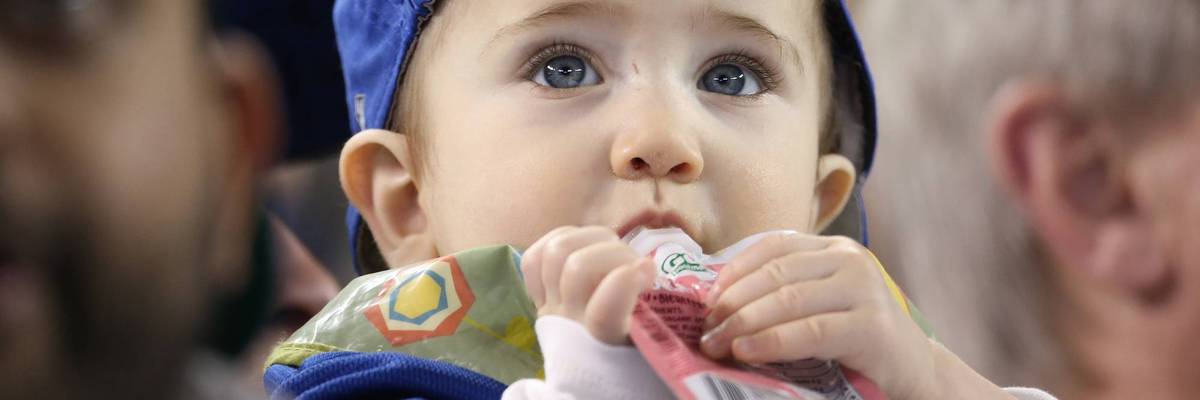
A baby eats baby food from a plastic pouch while watching the Toronto Blue Jays MLB game against the Boston Red Sox on April 9, 2016 at Rogers Centre in Toronto, Ontario, Canada.
Current scientific evidence on microplastics and plastic chemicals justifies global and national precautionary action to drastically reduce and ultimately eliminate babies’ exposure to plastics-related contaminants.
As new parents, we cherish the fleeting firsts: the first laugh, the first unsteady steps, and the first foods at family dinners. We research, we plan, and we try to give our babies the healthiest start possible. And in the swirl of advice from every direction, we often lean on what feels familiar and trusted.
For generations, store-bought baby food provided some of the earliest meals for babies across the country. The distinctive, petite glass jars have long symbolized the kind of wholesome, uncomplicated nourishment many parents reach for when they want something healthy and reliable.
Over time, many of these glass jars were replaced with plastic pouches—but plastic food containers have given us something new to consider.
Many of us think of plastic as a simple, single material. It is not. It is made from more than 16,000 chemicals, including 4,200 known to harm human health. And plastic doesn’t truly break down; it breaks into microplastics—tiny plastic particles less than 5 millimeters in size—that can leach into packaged food, inadvertently adding a large number of health concerns.
Parents should not have to be scientists to feed their children safely.
None of that belongs anywhere near a baby's meal.
Babies are uniquely vulnerable: Their organs and nervous systems are developing rapidly, and even small exposures to certain chemicals—such as the hormone-disrupting chemicals found in plastics—during these formative months can have lifelong effects on growth, metabolism, and reproductive systems.
Previous research found significant microplastic contamination of baby formula from many different brands. And now, a recent report produced by our colleagues highlights lab testing that found microplastics in the pouches of two of the world’s leading baby food companies: Gerber and Happy Baby Organics. A single pouch of Gerber baby food contains an estimated 5,000 microplastic particles, with the plastic lining likely the source. One gram from the Happy Baby Organics pouch (the weight of a small raisin) contained up to 99 microplastic particles, on average—the equivalent of up to 495 microplastics per teaspoon.
And it’s not just these two food products. Much of today’s baby food aisle is wrapped in plastic—from the now-ubiquitous squeezable pouches to purées in plastic tubs and packaged snacks. Single-use squeezable plastic pouches exceed all other forms of baby food packaging, with production growing year on year by over 8%. Millions of single-use baby food pouches are used daily, meaning that every day, millions of babies may be ingesting invisible contaminants along with their plastic-packaged food.
In addition, it’s forecast that the market for all types of multilayered flexible plastic packaging—the most notoriously problematic and polluting form of plastic packaging—will grow by 5.3% year-on-year through 2035.
No parent should have to confront the risks of all that microplastic and chemical exposure. Amid navigating near-constant decisions about our babies’ health, parents should not have to be scientists to feed their children safely.
The current US administration campaigned on protecting Americans’ health, especially children's, under its Make America Healthy Again (MAHA) agenda. It even declared a war on microplastics. Yet parents across the political spectrum are still waiting, with many in the MAHA base voicing frustration about the slow pace of change on chemicals and plastics.
Instead of meaningful protection, we’ve seen failed promises, gutted agencies, and announcements about more research at a time when many families are calling for concrete action. Our babies don’t have time for more research. More importantly, they should not be subjects in a science experiment to which they did not consent.
Current scientific evidence on microplastics and plastic chemicals justifies global and national precautionary action to drastically reduce and ultimately eliminate babies’ exposure to plastics-related contaminants. Research on microplastics is still emerging, but decision-makers have enough information to act. Yet, regulation has not kept pace, and does not protect people’s health from microplastics and hazardous chemicals in food packaging, failing to account for the unique vulnerability of babies in particular.
We have a real opportunity right now: Congress can close a decades-old loophole in our food safety system. Under current rules, plastic producers and food companies determine for themselves whether the chemicals in packaging are “safe.” Congress could finally close that gap and help prevent exposure to microplastics, particularly for children—but the real question is whether they will honor their promises to protect the most vulnerable among us.
We’ve risen to moments like this before—pushing to eliminate lead from toys and teething products, demanding safer cribs and bedding materials, and adopting modern car safety standards that have saved countless children’s lives. This crisis calls for the same resolve. Ours should be the last generation of babies forced to grow up in a food system that puts plastic and profits over their long-term health.
Dear Common Dreams reader, It’s been nearly 30 years since I co-founded Common Dreams with my late wife, Lina Newhouser. We had the radical notion that journalism should serve the public good, not corporate profits. It was clear to us from the outset what it would take to build such a project. No paid advertisements. No corporate sponsors. No millionaire publisher telling us what to think or do. Many people said we wouldn't last a year, but we proved those doubters wrong. Together with a tremendous team of journalists and dedicated staff, we built an independent media outlet free from the constraints of profits and corporate control. Our mission has always been simple: To inform. To inspire. To ignite change for the common good. Building Common Dreams was not easy. Our survival was never guaranteed. When you take on the most powerful forces—Wall Street greed, fossil fuel industry destruction, Big Tech lobbyists, and uber-rich oligarchs who have spent billions upon billions rigging the economy and democracy in their favor—the only bulwark you have is supporters who believe in your work. But here’s the urgent message from me today. It's never been this bad out there. And it's never been this hard to keep us going. At the very moment Common Dreams is most needed, the threats we face are intensifying. We need your support now more than ever. We don't accept corporate advertising and never will. We don't have a paywall because we don't think people should be blocked from critical news based on their ability to pay. Everything we do is funded by the donations of readers like you. When everyone does the little they can afford, we are strong. But if that support retreats or dries up, so do we. Will you donate now to make sure Common Dreams not only survives but thrives? —Craig Brown, Co-founder |
As new parents, we cherish the fleeting firsts: the first laugh, the first unsteady steps, and the first foods at family dinners. We research, we plan, and we try to give our babies the healthiest start possible. And in the swirl of advice from every direction, we often lean on what feels familiar and trusted.
For generations, store-bought baby food provided some of the earliest meals for babies across the country. The distinctive, petite glass jars have long symbolized the kind of wholesome, uncomplicated nourishment many parents reach for when they want something healthy and reliable.
Over time, many of these glass jars were replaced with plastic pouches—but plastic food containers have given us something new to consider.
Many of us think of plastic as a simple, single material. It is not. It is made from more than 16,000 chemicals, including 4,200 known to harm human health. And plastic doesn’t truly break down; it breaks into microplastics—tiny plastic particles less than 5 millimeters in size—that can leach into packaged food, inadvertently adding a large number of health concerns.
Parents should not have to be scientists to feed their children safely.
None of that belongs anywhere near a baby's meal.
Babies are uniquely vulnerable: Their organs and nervous systems are developing rapidly, and even small exposures to certain chemicals—such as the hormone-disrupting chemicals found in plastics—during these formative months can have lifelong effects on growth, metabolism, and reproductive systems.
Previous research found significant microplastic contamination of baby formula from many different brands. And now, a recent report produced by our colleagues highlights lab testing that found microplastics in the pouches of two of the world’s leading baby food companies: Gerber and Happy Baby Organics. A single pouch of Gerber baby food contains an estimated 5,000 microplastic particles, with the plastic lining likely the source. One gram from the Happy Baby Organics pouch (the weight of a small raisin) contained up to 99 microplastic particles, on average—the equivalent of up to 495 microplastics per teaspoon.
And it’s not just these two food products. Much of today’s baby food aisle is wrapped in plastic—from the now-ubiquitous squeezable pouches to purées in plastic tubs and packaged snacks. Single-use squeezable plastic pouches exceed all other forms of baby food packaging, with production growing year on year by over 8%. Millions of single-use baby food pouches are used daily, meaning that every day, millions of babies may be ingesting invisible contaminants along with their plastic-packaged food.
In addition, it’s forecast that the market for all types of multilayered flexible plastic packaging—the most notoriously problematic and polluting form of plastic packaging—will grow by 5.3% year-on-year through 2035.
No parent should have to confront the risks of all that microplastic and chemical exposure. Amid navigating near-constant decisions about our babies’ health, parents should not have to be scientists to feed their children safely.
The current US administration campaigned on protecting Americans’ health, especially children's, under its Make America Healthy Again (MAHA) agenda. It even declared a war on microplastics. Yet parents across the political spectrum are still waiting, with many in the MAHA base voicing frustration about the slow pace of change on chemicals and plastics.
Instead of meaningful protection, we’ve seen failed promises, gutted agencies, and announcements about more research at a time when many families are calling for concrete action. Our babies don’t have time for more research. More importantly, they should not be subjects in a science experiment to which they did not consent.
Current scientific evidence on microplastics and plastic chemicals justifies global and national precautionary action to drastically reduce and ultimately eliminate babies’ exposure to plastics-related contaminants. Research on microplastics is still emerging, but decision-makers have enough information to act. Yet, regulation has not kept pace, and does not protect people’s health from microplastics and hazardous chemicals in food packaging, failing to account for the unique vulnerability of babies in particular.
We have a real opportunity right now: Congress can close a decades-old loophole in our food safety system. Under current rules, plastic producers and food companies determine for themselves whether the chemicals in packaging are “safe.” Congress could finally close that gap and help prevent exposure to microplastics, particularly for children—but the real question is whether they will honor their promises to protect the most vulnerable among us.
We’ve risen to moments like this before—pushing to eliminate lead from toys and teething products, demanding safer cribs and bedding materials, and adopting modern car safety standards that have saved countless children’s lives. This crisis calls for the same resolve. Ours should be the last generation of babies forced to grow up in a food system that puts plastic and profits over their long-term health.
As new parents, we cherish the fleeting firsts: the first laugh, the first unsteady steps, and the first foods at family dinners. We research, we plan, and we try to give our babies the healthiest start possible. And in the swirl of advice from every direction, we often lean on what feels familiar and trusted.
For generations, store-bought baby food provided some of the earliest meals for babies across the country. The distinctive, petite glass jars have long symbolized the kind of wholesome, uncomplicated nourishment many parents reach for when they want something healthy and reliable.
Over time, many of these glass jars were replaced with plastic pouches—but plastic food containers have given us something new to consider.
Many of us think of plastic as a simple, single material. It is not. It is made from more than 16,000 chemicals, including 4,200 known to harm human health. And plastic doesn’t truly break down; it breaks into microplastics—tiny plastic particles less than 5 millimeters in size—that can leach into packaged food, inadvertently adding a large number of health concerns.
Parents should not have to be scientists to feed their children safely.
None of that belongs anywhere near a baby's meal.
Babies are uniquely vulnerable: Their organs and nervous systems are developing rapidly, and even small exposures to certain chemicals—such as the hormone-disrupting chemicals found in plastics—during these formative months can have lifelong effects on growth, metabolism, and reproductive systems.
Previous research found significant microplastic contamination of baby formula from many different brands. And now, a recent report produced by our colleagues highlights lab testing that found microplastics in the pouches of two of the world’s leading baby food companies: Gerber and Happy Baby Organics. A single pouch of Gerber baby food contains an estimated 5,000 microplastic particles, with the plastic lining likely the source. One gram from the Happy Baby Organics pouch (the weight of a small raisin) contained up to 99 microplastic particles, on average—the equivalent of up to 495 microplastics per teaspoon.
And it’s not just these two food products. Much of today’s baby food aisle is wrapped in plastic—from the now-ubiquitous squeezable pouches to purées in plastic tubs and packaged snacks. Single-use squeezable plastic pouches exceed all other forms of baby food packaging, with production growing year on year by over 8%. Millions of single-use baby food pouches are used daily, meaning that every day, millions of babies may be ingesting invisible contaminants along with their plastic-packaged food.
In addition, it’s forecast that the market for all types of multilayered flexible plastic packaging—the most notoriously problematic and polluting form of plastic packaging—will grow by 5.3% year-on-year through 2035.
No parent should have to confront the risks of all that microplastic and chemical exposure. Amid navigating near-constant decisions about our babies’ health, parents should not have to be scientists to feed their children safely.
The current US administration campaigned on protecting Americans’ health, especially children's, under its Make America Healthy Again (MAHA) agenda. It even declared a war on microplastics. Yet parents across the political spectrum are still waiting, with many in the MAHA base voicing frustration about the slow pace of change on chemicals and plastics.
Instead of meaningful protection, we’ve seen failed promises, gutted agencies, and announcements about more research at a time when many families are calling for concrete action. Our babies don’t have time for more research. More importantly, they should not be subjects in a science experiment to which they did not consent.
Current scientific evidence on microplastics and plastic chemicals justifies global and national precautionary action to drastically reduce and ultimately eliminate babies’ exposure to plastics-related contaminants. Research on microplastics is still emerging, but decision-makers have enough information to act. Yet, regulation has not kept pace, and does not protect people’s health from microplastics and hazardous chemicals in food packaging, failing to account for the unique vulnerability of babies in particular.
We have a real opportunity right now: Congress can close a decades-old loophole in our food safety system. Under current rules, plastic producers and food companies determine for themselves whether the chemicals in packaging are “safe.” Congress could finally close that gap and help prevent exposure to microplastics, particularly for children—but the real question is whether they will honor their promises to protect the most vulnerable among us.
We’ve risen to moments like this before—pushing to eliminate lead from toys and teething products, demanding safer cribs and bedding materials, and adopting modern car safety standards that have saved countless children’s lives. This crisis calls for the same resolve. Ours should be the last generation of babies forced to grow up in a food system that puts plastic and profits over their long-term health.