SUBSCRIBE TO OUR FREE NEWSLETTER
Daily news & progressive opinion—funded by the people, not the corporations—delivered straight to your inbox.
5
#000000
#FFFFFF
To donate by check, phone, or other method, see our More Ways to Give page.
Daily news & progressive opinion—funded by the people, not the corporations—delivered straight to your inbox.
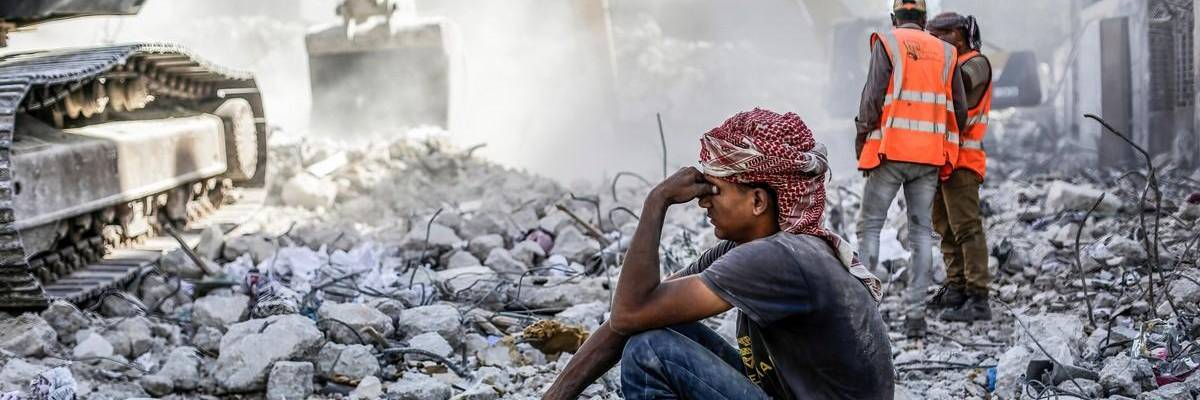
A Palestinian man sits on the rubble of a destroyed house in the Gaza Strip after 11 days of violence in May. (Photo: Mahmoud Issa/SOPA Images/LightRocket via Getty Images)
At a recent New York event, the President of the Foreign Press Association Ian Williams declared, before an approving audience, that it is time "to reclaim the narrative on Palestine".
This phrase--'reclaiming the narrative'--is relatively new to the Palestinian discourse. Years ago, the concept, let alone its implementation, were quite alien: the pro-Israel crowd refused, and still refuses, to acknowledge that Palestinians, their history and political discourse matter; some in the pro-Palestinian movement relegated Palestinian voices as if they were simply incapable of articulating a coherent narrative.
When a people do not exist, their history vanishes, too, their culture is erased and, by extension, their political aspirations become irrelevant. Only Israel existed--and mattered--within western political and academic circles.
For many years, I, along with other Palestinian intellectuals, raged against the misrepresentation and marginalization of Palestine and the Palestinians, not only by Israel and its allies in mainstream media, but also against the elitism that existed within the Palestinian movement itself.
Hearing Williams utter these words was quite satisfying. More important was the context in which these words were said. The event, 'Distant Voice No More? Giving Rise to a New Generation of Palestinian Journalists', was hosted by the new and vibrant organization Palestine Deep Dive (PDD) and co-hosted by the Foreign Press Association. The idea behind the inception of PDD is to challenge the common narrative that has permeated corporate media on Palestine and Israel for decades. This new organization has done an impressive job within a fairly short period of time.
The attendees included international rockstar Roger Waters who, over the years, has become an icon for the Palestine international solidarity movement, the same way that his songs, among them 'Another Brick in the Wall', symbolized global support for the anti-apartheid movement in South Africa.
At the same event, Columbia Professor and famed Palestinian intellectual and author, Rashid Khalidi, launched his book, "The Hundred Years' War on Palestine: A History of Settler Colonialism and Resistance, 1917-2017." He spoke about the history of Palestine and the significance of personal experiences in the Palestinian discourse. His talk was directed mainly at his target audience--young Palestinian intellectuals and activists.
Young Palestinians were the center of the entire discussion, the likes of Mohammed El-Kurd, brother of Muna, both of whom continue to lead the popular resistance against the ethnic cleansing of the Sheikh Jarrah neighborhood in occupied East Jerusalem.
Actually, the growing awareness of the significance of the Palestinian narrative has been in the making for years. Before we consider the reason behind this position shift, we ought to remember why Palestinians were expunged from their own history and political reality in the first place.
Historically, the Palestinian narrative was denied altogether, as the Palestinian people, in the words of former Israeli Prime Minister, Golda Meir, "didn't exist." When a people do not exist, their history vanishes, too, their culture is erased and, by extension, their political aspirations become irrelevant. Only Israel existed--and mattered--within western political and academic circles.
However, when Palestinians began registering in world consciousness as a people with a legitimate claim to freedom, they were not immediately endowed with all the rights and respect that a nation of such rooted culture, impressive history and unmatched courage deserved. They were still relegated, assigned the role of the "terrorist" and, occasionally, the hapless victim. The latter notion, in particular, had impacted the way that many sympathetic historians wrote about Palestine, corrupting even the perception of many genuine activists, who felt that they, not the Palestinians, are more capable of dismantling the Israeli Zionist propaganda. According to this thinking, Palestinians can only serve the role of the spectator, providing endless streams of photos, videos and tragic numbers illustrating their victimization.
Of course, there were exceptions. Powerful Palestinian voices such as the late Edward Said, Hisham Sharabi, Ghada Karmi, and Khalidi himself, have insisted on the centrality of Palestine to the Palestinian discourse.
In mainstream western media, Palestinians too made their occasional appearances, but only within acceptable limits and restrictive language. Palestinian Authority officials, dubbed 'moderates', represented the good Palestinian to CNN viewers and the readers of the New York Times. All others were deemed terrorists, radicals and extremists and, thus, completely ignored - though, plainly, they were much closer to the true aspirations of Palestinians, especially if compared to the corrupt PA elites.
Even those chosen few were eventually canceled out, especially during the Trump Administration and, even now, under the Joe Biden Administration. As long as there is no 'peace process' to speak of, the token PA Palestinian is of no interest to the US government and, therefore, to US media.
Yet, the change towards a genuine Palestinian intellectual and media representation is real. It is taking place, not because of the benevolence of corporate media or some moral awakening of politicians, but because of the Palestinian people themselves. While Palestinian factions continue to feud, fighting for their political interests, a new, unified Palestinian generation of intellectuals, inspired by the Palestinian people's unity at home, is rising. For these intellectuals, neither faction, nor ideology nor political privilege should be prioritized over the rights of the Palestinian people, not only in the Occupied Territories but throughout historic Palestine and the world.
The earth-shattering events in Palestine of last May must not simply be classified as just another Israeli war and another "round of violence". They represented a paradigm shift in the history of Palestine, where the Palestinians emerged less factional and more unified than ever before. This unity can also be found in a new political discourse championed by Palestinian intellectuals worldwide.
The fact that we are now speaking candidly about the need to "reclaim the narrative on Palestine" and not being met by confused looks but by thundering applause speaks volumes about the paradigm shift underway. It is now the responsibility of young Palestinian activists to take the helm and to truly communicate the message of the Palestinian people as they continue to fight for freedom and justice.
This is not a mere intellectual exercise. Without that genuine and engaged Palestinian intellectual, the world's priorities will continue to gravitate towards Israeli priorities, towards US interests and their subsequent fraudulent language about 'peace,' security' and such. This misleading narrative must be entirely removed from the discussion on Palestine.
Indeed, for Palestine to be free, for the Palestinian people to achieve their full rights and for the Right of Return for Palestinian refugees to be honored, the story of Palestine has to be told by the Palestinians themselves.
Dear Common Dreams reader, It’s been nearly 30 years since I co-founded Common Dreams with my late wife, Lina Newhouser. We had the radical notion that journalism should serve the public good, not corporate profits. It was clear to us from the outset what it would take to build such a project. No paid advertisements. No corporate sponsors. No millionaire publisher telling us what to think or do. Many people said we wouldn't last a year, but we proved those doubters wrong. Together with a tremendous team of journalists and dedicated staff, we built an independent media outlet free from the constraints of profits and corporate control. Our mission has always been simple: To inform. To inspire. To ignite change for the common good. Building Common Dreams was not easy. Our survival was never guaranteed. When you take on the most powerful forces—Wall Street greed, fossil fuel industry destruction, Big Tech lobbyists, and uber-rich oligarchs who have spent billions upon billions rigging the economy and democracy in their favor—the only bulwark you have is supporters who believe in your work. But here’s the urgent message from me today. It's never been this bad out there. And it's never been this hard to keep us going. At the very moment Common Dreams is most needed, the threats we face are intensifying. We need your support now more than ever. We don't accept corporate advertising and never will. We don't have a paywall because we don't think people should be blocked from critical news based on their ability to pay. Everything we do is funded by the donations of readers like you. When everyone does the little they can afford, we are strong. But if that support retreats or dries up, so do we. Will you donate now to make sure Common Dreams not only survives but thrives? —Craig Brown, Co-founder |
At a recent New York event, the President of the Foreign Press Association Ian Williams declared, before an approving audience, that it is time "to reclaim the narrative on Palestine".
This phrase--'reclaiming the narrative'--is relatively new to the Palestinian discourse. Years ago, the concept, let alone its implementation, were quite alien: the pro-Israel crowd refused, and still refuses, to acknowledge that Palestinians, their history and political discourse matter; some in the pro-Palestinian movement relegated Palestinian voices as if they were simply incapable of articulating a coherent narrative.
When a people do not exist, their history vanishes, too, their culture is erased and, by extension, their political aspirations become irrelevant. Only Israel existed--and mattered--within western political and academic circles.
For many years, I, along with other Palestinian intellectuals, raged against the misrepresentation and marginalization of Palestine and the Palestinians, not only by Israel and its allies in mainstream media, but also against the elitism that existed within the Palestinian movement itself.
Hearing Williams utter these words was quite satisfying. More important was the context in which these words were said. The event, 'Distant Voice No More? Giving Rise to a New Generation of Palestinian Journalists', was hosted by the new and vibrant organization Palestine Deep Dive (PDD) and co-hosted by the Foreign Press Association. The idea behind the inception of PDD is to challenge the common narrative that has permeated corporate media on Palestine and Israel for decades. This new organization has done an impressive job within a fairly short period of time.
The attendees included international rockstar Roger Waters who, over the years, has become an icon for the Palestine international solidarity movement, the same way that his songs, among them 'Another Brick in the Wall', symbolized global support for the anti-apartheid movement in South Africa.
At the same event, Columbia Professor and famed Palestinian intellectual and author, Rashid Khalidi, launched his book, "The Hundred Years' War on Palestine: A History of Settler Colonialism and Resistance, 1917-2017." He spoke about the history of Palestine and the significance of personal experiences in the Palestinian discourse. His talk was directed mainly at his target audience--young Palestinian intellectuals and activists.
Young Palestinians were the center of the entire discussion, the likes of Mohammed El-Kurd, brother of Muna, both of whom continue to lead the popular resistance against the ethnic cleansing of the Sheikh Jarrah neighborhood in occupied East Jerusalem.
Actually, the growing awareness of the significance of the Palestinian narrative has been in the making for years. Before we consider the reason behind this position shift, we ought to remember why Palestinians were expunged from their own history and political reality in the first place.
Historically, the Palestinian narrative was denied altogether, as the Palestinian people, in the words of former Israeli Prime Minister, Golda Meir, "didn't exist." When a people do not exist, their history vanishes, too, their culture is erased and, by extension, their political aspirations become irrelevant. Only Israel existed--and mattered--within western political and academic circles.
However, when Palestinians began registering in world consciousness as a people with a legitimate claim to freedom, they were not immediately endowed with all the rights and respect that a nation of such rooted culture, impressive history and unmatched courage deserved. They were still relegated, assigned the role of the "terrorist" and, occasionally, the hapless victim. The latter notion, in particular, had impacted the way that many sympathetic historians wrote about Palestine, corrupting even the perception of many genuine activists, who felt that they, not the Palestinians, are more capable of dismantling the Israeli Zionist propaganda. According to this thinking, Palestinians can only serve the role of the spectator, providing endless streams of photos, videos and tragic numbers illustrating their victimization.
Of course, there were exceptions. Powerful Palestinian voices such as the late Edward Said, Hisham Sharabi, Ghada Karmi, and Khalidi himself, have insisted on the centrality of Palestine to the Palestinian discourse.
In mainstream western media, Palestinians too made their occasional appearances, but only within acceptable limits and restrictive language. Palestinian Authority officials, dubbed 'moderates', represented the good Palestinian to CNN viewers and the readers of the New York Times. All others were deemed terrorists, radicals and extremists and, thus, completely ignored - though, plainly, they were much closer to the true aspirations of Palestinians, especially if compared to the corrupt PA elites.
Even those chosen few were eventually canceled out, especially during the Trump Administration and, even now, under the Joe Biden Administration. As long as there is no 'peace process' to speak of, the token PA Palestinian is of no interest to the US government and, therefore, to US media.
Yet, the change towards a genuine Palestinian intellectual and media representation is real. It is taking place, not because of the benevolence of corporate media or some moral awakening of politicians, but because of the Palestinian people themselves. While Palestinian factions continue to feud, fighting for their political interests, a new, unified Palestinian generation of intellectuals, inspired by the Palestinian people's unity at home, is rising. For these intellectuals, neither faction, nor ideology nor political privilege should be prioritized over the rights of the Palestinian people, not only in the Occupied Territories but throughout historic Palestine and the world.
The earth-shattering events in Palestine of last May must not simply be classified as just another Israeli war and another "round of violence". They represented a paradigm shift in the history of Palestine, where the Palestinians emerged less factional and more unified than ever before. This unity can also be found in a new political discourse championed by Palestinian intellectuals worldwide.
The fact that we are now speaking candidly about the need to "reclaim the narrative on Palestine" and not being met by confused looks but by thundering applause speaks volumes about the paradigm shift underway. It is now the responsibility of young Palestinian activists to take the helm and to truly communicate the message of the Palestinian people as they continue to fight for freedom and justice.
This is not a mere intellectual exercise. Without that genuine and engaged Palestinian intellectual, the world's priorities will continue to gravitate towards Israeli priorities, towards US interests and their subsequent fraudulent language about 'peace,' security' and such. This misleading narrative must be entirely removed from the discussion on Palestine.
Indeed, for Palestine to be free, for the Palestinian people to achieve their full rights and for the Right of Return for Palestinian refugees to be honored, the story of Palestine has to be told by the Palestinians themselves.
At a recent New York event, the President of the Foreign Press Association Ian Williams declared, before an approving audience, that it is time "to reclaim the narrative on Palestine".
This phrase--'reclaiming the narrative'--is relatively new to the Palestinian discourse. Years ago, the concept, let alone its implementation, were quite alien: the pro-Israel crowd refused, and still refuses, to acknowledge that Palestinians, their history and political discourse matter; some in the pro-Palestinian movement relegated Palestinian voices as if they were simply incapable of articulating a coherent narrative.
When a people do not exist, their history vanishes, too, their culture is erased and, by extension, their political aspirations become irrelevant. Only Israel existed--and mattered--within western political and academic circles.
For many years, I, along with other Palestinian intellectuals, raged against the misrepresentation and marginalization of Palestine and the Palestinians, not only by Israel and its allies in mainstream media, but also against the elitism that existed within the Palestinian movement itself.
Hearing Williams utter these words was quite satisfying. More important was the context in which these words were said. The event, 'Distant Voice No More? Giving Rise to a New Generation of Palestinian Journalists', was hosted by the new and vibrant organization Palestine Deep Dive (PDD) and co-hosted by the Foreign Press Association. The idea behind the inception of PDD is to challenge the common narrative that has permeated corporate media on Palestine and Israel for decades. This new organization has done an impressive job within a fairly short period of time.
The attendees included international rockstar Roger Waters who, over the years, has become an icon for the Palestine international solidarity movement, the same way that his songs, among them 'Another Brick in the Wall', symbolized global support for the anti-apartheid movement in South Africa.
At the same event, Columbia Professor and famed Palestinian intellectual and author, Rashid Khalidi, launched his book, "The Hundred Years' War on Palestine: A History of Settler Colonialism and Resistance, 1917-2017." He spoke about the history of Palestine and the significance of personal experiences in the Palestinian discourse. His talk was directed mainly at his target audience--young Palestinian intellectuals and activists.
Young Palestinians were the center of the entire discussion, the likes of Mohammed El-Kurd, brother of Muna, both of whom continue to lead the popular resistance against the ethnic cleansing of the Sheikh Jarrah neighborhood in occupied East Jerusalem.
Actually, the growing awareness of the significance of the Palestinian narrative has been in the making for years. Before we consider the reason behind this position shift, we ought to remember why Palestinians were expunged from their own history and political reality in the first place.
Historically, the Palestinian narrative was denied altogether, as the Palestinian people, in the words of former Israeli Prime Minister, Golda Meir, "didn't exist." When a people do not exist, their history vanishes, too, their culture is erased and, by extension, their political aspirations become irrelevant. Only Israel existed--and mattered--within western political and academic circles.
However, when Palestinians began registering in world consciousness as a people with a legitimate claim to freedom, they were not immediately endowed with all the rights and respect that a nation of such rooted culture, impressive history and unmatched courage deserved. They were still relegated, assigned the role of the "terrorist" and, occasionally, the hapless victim. The latter notion, in particular, had impacted the way that many sympathetic historians wrote about Palestine, corrupting even the perception of many genuine activists, who felt that they, not the Palestinians, are more capable of dismantling the Israeli Zionist propaganda. According to this thinking, Palestinians can only serve the role of the spectator, providing endless streams of photos, videos and tragic numbers illustrating their victimization.
Of course, there were exceptions. Powerful Palestinian voices such as the late Edward Said, Hisham Sharabi, Ghada Karmi, and Khalidi himself, have insisted on the centrality of Palestine to the Palestinian discourse.
In mainstream western media, Palestinians too made their occasional appearances, but only within acceptable limits and restrictive language. Palestinian Authority officials, dubbed 'moderates', represented the good Palestinian to CNN viewers and the readers of the New York Times. All others were deemed terrorists, radicals and extremists and, thus, completely ignored - though, plainly, they were much closer to the true aspirations of Palestinians, especially if compared to the corrupt PA elites.
Even those chosen few were eventually canceled out, especially during the Trump Administration and, even now, under the Joe Biden Administration. As long as there is no 'peace process' to speak of, the token PA Palestinian is of no interest to the US government and, therefore, to US media.
Yet, the change towards a genuine Palestinian intellectual and media representation is real. It is taking place, not because of the benevolence of corporate media or some moral awakening of politicians, but because of the Palestinian people themselves. While Palestinian factions continue to feud, fighting for their political interests, a new, unified Palestinian generation of intellectuals, inspired by the Palestinian people's unity at home, is rising. For these intellectuals, neither faction, nor ideology nor political privilege should be prioritized over the rights of the Palestinian people, not only in the Occupied Territories but throughout historic Palestine and the world.
The earth-shattering events in Palestine of last May must not simply be classified as just another Israeli war and another "round of violence". They represented a paradigm shift in the history of Palestine, where the Palestinians emerged less factional and more unified than ever before. This unity can also be found in a new political discourse championed by Palestinian intellectuals worldwide.
The fact that we are now speaking candidly about the need to "reclaim the narrative on Palestine" and not being met by confused looks but by thundering applause speaks volumes about the paradigm shift underway. It is now the responsibility of young Palestinian activists to take the helm and to truly communicate the message of the Palestinian people as they continue to fight for freedom and justice.
This is not a mere intellectual exercise. Without that genuine and engaged Palestinian intellectual, the world's priorities will continue to gravitate towards Israeli priorities, towards US interests and their subsequent fraudulent language about 'peace,' security' and such. This misleading narrative must be entirely removed from the discussion on Palestine.
Indeed, for Palestine to be free, for the Palestinian people to achieve their full rights and for the Right of Return for Palestinian refugees to be honored, the story of Palestine has to be told by the Palestinians themselves.