SUBSCRIBE TO OUR FREE NEWSLETTER
Daily news & progressive opinion—funded by the people, not the corporations—delivered straight to your inbox.
5
#000000
#FFFFFF
To donate by check, phone, or other method, see our More Ways to Give page.
Daily news & progressive opinion—funded by the people, not the corporations—delivered straight to your inbox.
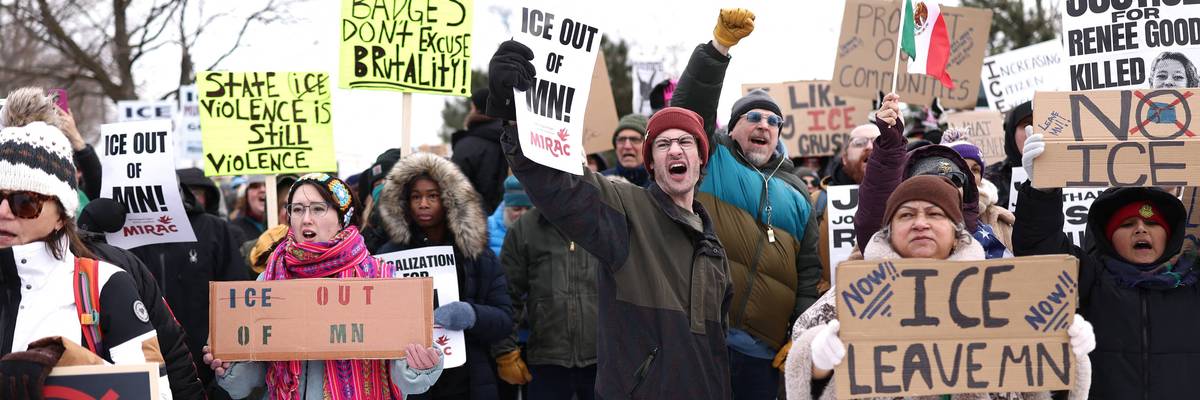
People protest against ICE after the fatal shooting of Renee Nicole Good in downtown Minneapolis, Minnesota on January 10, 2026.
The structures that enabled the mass mobilizations that pushed ICE out of Minnesota were built long before officers touched down in late 2025.
We’ll never know the exact reasons why the Trump administration decided to bring the full force of immigration enforcement down on the Twin Cities and the rest of Minnesota last winter.
We do know they weren’t expecting the reception they got.
Operation Metro Surge and Operation Parris were the largest immigration enforcement operations in the history of the United States of America. Immigration and Customs Enforcement (ICE) officers came in the thousands, decked out with military gear, assault weapons, and surveillance systems built for a battlefield.
We’re proactively arming ourselves and our communities with the knowledge and tactics necessary to resist if President Donald Trump makes good on his threats on the sanctity of the midterms.
The Trump administration was counting on our residents believing, deep down, that immigrants and people of color are not really American. But they didn’t prepare for one thing: Minnesotans know that’s a lie.
It did not pass over our houses. Why? Because we were prepared. The preparation process must continue.
The structures that enabled the mass mobilizations that pushed ICE out of Minnesota were built long before officers touched down in late 2025.
The local immigrants rights movement built capacity and infrastructure for over two decades through the Dreamer’s Movement and the campaign for drivers licenses for all. And then during the Covid-19 pandemic, after George Floyd was killed by police in our streets, the Movement for Black Lives taught everyone in this state what mutual aid looks like at scale.
How to feed each other when regular systems fail. How to keep watch on a corner through the night. How to grieve and organize in the same breath. How to refuse the choreography of fear that a militarized response is designed to produce.
That’s the model we followed when launching Project Monarca in February of 2025. Over the next year we trained 50,000 Minnesotans in constitutionally protected observation.
In retrospect, a lot of those trainings looked like a rehearsal. We equipped our neighbors with a coherent analysis, a clear picture of the strategy being run against us, and the room to wrestle with their own choices. Will I document, or will I observe? What happens when I delay the operation? When I choose to defend my neighbor, how will I do it?
Minnesotans rehearsed high-risk scenarios with their own bodies and their own fear, and they made their choices out of our values and our relentless public love.
So when the moment came, Minnesotans led. We put democratic participation into practice, and onboarded residents into our movements as we went. I want to be careful not to romanticize what happened last winter. People were terrified. People are still grieving. The cost was real, and it is not over.
But something happened in those weeks that I have been trying to find words for, and the only word I keep coming back to is recognition. People recognized each other.
White grandmothers in wealthy neighborhoods recognized themselves in immigrant mothers in Minneapolis. Lutheran pastors recognized the face of Christ in undocumented children. Labor union members recognized that the boot on their neighbor’s neck was the same boot that would come for them. Small business owners recognized that the Constitution was either for everyone or it was for no one—and they chose everyone.
We put signs in our windows. We opened our homes for children and pets left behind. We said, “Not in our state” to men with badges. They had guns, we had whistles. They had technology and surveillance systems, we had the Constitution. They had millions of dollars in infrastructure, we had one another as neighbors. We kept each other safe.
Over the past couple of months, we’ve shifted Monarca toward training community members to defend democracy against the tactics of ICE agents.
Our rights to fair and free elections are at risk. So we’re proactively arming ourselves and our communities with the knowledge and tactics necessary to resist if President Donald Trump makes good on his threats on the sanctity of the midterms.
Dear Common Dreams reader, It’s been nearly 30 years since I co-founded Common Dreams with my late wife, Lina Newhouser. We had the radical notion that journalism should serve the public good, not corporate profits. It was clear to us from the outset what it would take to build such a project. No paid advertisements. No corporate sponsors. No millionaire publisher telling us what to think or do. Many people said we wouldn't last a year, but we proved those doubters wrong. Together with a tremendous team of journalists and dedicated staff, we built an independent media outlet free from the constraints of profits and corporate control. Our mission has always been simple: To inform. To inspire. To ignite change for the common good. Building Common Dreams was not easy. Our survival was never guaranteed. When you take on the most powerful forces—Wall Street greed, fossil fuel industry destruction, Big Tech lobbyists, and uber-rich oligarchs who have spent billions upon billions rigging the economy and democracy in their favor—the only bulwark you have is supporters who believe in your work. But here’s the urgent message from me today. It's never been this bad out there. And it's never been this hard to keep us going. At the very moment Common Dreams is most needed, the threats we face are intensifying. We need your support now more than ever. We don't accept corporate advertising and never will. We don't have a paywall because we don't think people should be blocked from critical news based on their ability to pay. Everything we do is funded by the donations of readers like you. When everyone does the little they can afford, we are strong. But if that support retreats or dries up, so do we. Will you donate now to make sure Common Dreams not only survives but thrives? —Craig Brown, Co-founder |
We’ll never know the exact reasons why the Trump administration decided to bring the full force of immigration enforcement down on the Twin Cities and the rest of Minnesota last winter.
We do know they weren’t expecting the reception they got.
Operation Metro Surge and Operation Parris were the largest immigration enforcement operations in the history of the United States of America. Immigration and Customs Enforcement (ICE) officers came in the thousands, decked out with military gear, assault weapons, and surveillance systems built for a battlefield.
We’re proactively arming ourselves and our communities with the knowledge and tactics necessary to resist if President Donald Trump makes good on his threats on the sanctity of the midterms.
The Trump administration was counting on our residents believing, deep down, that immigrants and people of color are not really American. But they didn’t prepare for one thing: Minnesotans know that’s a lie.
It did not pass over our houses. Why? Because we were prepared. The preparation process must continue.
The structures that enabled the mass mobilizations that pushed ICE out of Minnesota were built long before officers touched down in late 2025.
The local immigrants rights movement built capacity and infrastructure for over two decades through the Dreamer’s Movement and the campaign for drivers licenses for all. And then during the Covid-19 pandemic, after George Floyd was killed by police in our streets, the Movement for Black Lives taught everyone in this state what mutual aid looks like at scale.
How to feed each other when regular systems fail. How to keep watch on a corner through the night. How to grieve and organize in the same breath. How to refuse the choreography of fear that a militarized response is designed to produce.
That’s the model we followed when launching Project Monarca in February of 2025. Over the next year we trained 50,000 Minnesotans in constitutionally protected observation.
In retrospect, a lot of those trainings looked like a rehearsal. We equipped our neighbors with a coherent analysis, a clear picture of the strategy being run against us, and the room to wrestle with their own choices. Will I document, or will I observe? What happens when I delay the operation? When I choose to defend my neighbor, how will I do it?
Minnesotans rehearsed high-risk scenarios with their own bodies and their own fear, and they made their choices out of our values and our relentless public love.
So when the moment came, Minnesotans led. We put democratic participation into practice, and onboarded residents into our movements as we went. I want to be careful not to romanticize what happened last winter. People were terrified. People are still grieving. The cost was real, and it is not over.
But something happened in those weeks that I have been trying to find words for, and the only word I keep coming back to is recognition. People recognized each other.
White grandmothers in wealthy neighborhoods recognized themselves in immigrant mothers in Minneapolis. Lutheran pastors recognized the face of Christ in undocumented children. Labor union members recognized that the boot on their neighbor’s neck was the same boot that would come for them. Small business owners recognized that the Constitution was either for everyone or it was for no one—and they chose everyone.
We put signs in our windows. We opened our homes for children and pets left behind. We said, “Not in our state” to men with badges. They had guns, we had whistles. They had technology and surveillance systems, we had the Constitution. They had millions of dollars in infrastructure, we had one another as neighbors. We kept each other safe.
Over the past couple of months, we’ve shifted Monarca toward training community members to defend democracy against the tactics of ICE agents.
Our rights to fair and free elections are at risk. So we’re proactively arming ourselves and our communities with the knowledge and tactics necessary to resist if President Donald Trump makes good on his threats on the sanctity of the midterms.
We’ll never know the exact reasons why the Trump administration decided to bring the full force of immigration enforcement down on the Twin Cities and the rest of Minnesota last winter.
We do know they weren’t expecting the reception they got.
Operation Metro Surge and Operation Parris were the largest immigration enforcement operations in the history of the United States of America. Immigration and Customs Enforcement (ICE) officers came in the thousands, decked out with military gear, assault weapons, and surveillance systems built for a battlefield.
We’re proactively arming ourselves and our communities with the knowledge and tactics necessary to resist if President Donald Trump makes good on his threats on the sanctity of the midterms.
The Trump administration was counting on our residents believing, deep down, that immigrants and people of color are not really American. But they didn’t prepare for one thing: Minnesotans know that’s a lie.
It did not pass over our houses. Why? Because we were prepared. The preparation process must continue.
The structures that enabled the mass mobilizations that pushed ICE out of Minnesota were built long before officers touched down in late 2025.
The local immigrants rights movement built capacity and infrastructure for over two decades through the Dreamer’s Movement and the campaign for drivers licenses for all. And then during the Covid-19 pandemic, after George Floyd was killed by police in our streets, the Movement for Black Lives taught everyone in this state what mutual aid looks like at scale.
How to feed each other when regular systems fail. How to keep watch on a corner through the night. How to grieve and organize in the same breath. How to refuse the choreography of fear that a militarized response is designed to produce.
That’s the model we followed when launching Project Monarca in February of 2025. Over the next year we trained 50,000 Minnesotans in constitutionally protected observation.
In retrospect, a lot of those trainings looked like a rehearsal. We equipped our neighbors with a coherent analysis, a clear picture of the strategy being run against us, and the room to wrestle with their own choices. Will I document, or will I observe? What happens when I delay the operation? When I choose to defend my neighbor, how will I do it?
Minnesotans rehearsed high-risk scenarios with their own bodies and their own fear, and they made their choices out of our values and our relentless public love.
So when the moment came, Minnesotans led. We put democratic participation into practice, and onboarded residents into our movements as we went. I want to be careful not to romanticize what happened last winter. People were terrified. People are still grieving. The cost was real, and it is not over.
But something happened in those weeks that I have been trying to find words for, and the only word I keep coming back to is recognition. People recognized each other.
White grandmothers in wealthy neighborhoods recognized themselves in immigrant mothers in Minneapolis. Lutheran pastors recognized the face of Christ in undocumented children. Labor union members recognized that the boot on their neighbor’s neck was the same boot that would come for them. Small business owners recognized that the Constitution was either for everyone or it was for no one—and they chose everyone.
We put signs in our windows. We opened our homes for children and pets left behind. We said, “Not in our state” to men with badges. They had guns, we had whistles. They had technology and surveillance systems, we had the Constitution. They had millions of dollars in infrastructure, we had one another as neighbors. We kept each other safe.
Over the past couple of months, we’ve shifted Monarca toward training community members to defend democracy against the tactics of ICE agents.
Our rights to fair and free elections are at risk. So we’re proactively arming ourselves and our communities with the knowledge and tactics necessary to resist if President Donald Trump makes good on his threats on the sanctity of the midterms.