Here’s how Lee Raymond’s hometown paper, the Houston Chronicle, remembered him Thursday morning.
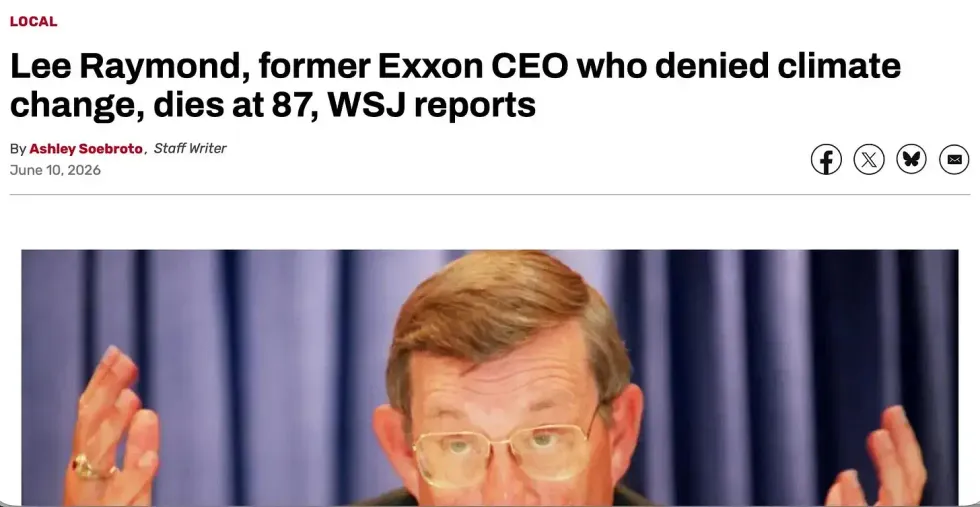
The Texas paper was more direct, and more accurate, than anyone else covering the story. The Times obit gave top billing to the fact that he led the acquisition of Mobil and “cut costs relentlessly;” the Wall Street Journal waited till paragraph six to note that he was “openly skeptical” of climate science (much like The Wall Street Journal). But the Chron had it right—when people think back in a hundred years or a thousand or ten thousand, the one thing worth remembering about him will be the crucial role he played in holding back action on climate change.
I’m going to recount the lowlights of the story here, and add one that gets very little notice in the obituaries, but that ties directly to the ongoing crisis.
Raymond was a research engineer who spent his whole career at what was then the world’s largest company. He joined its board in 1984, already a leading candidate for CEO, which means he was near the top during the 1980s, the period when (as we now know thanks to great investigative reporting) the company’s scientists correctly identified the dangers of global warming and linked them directly to Exxon’s products. That research, as Inside Climate News reported in 2015,
laid the groundwork for a 1982 corporate primer on carbon dioxide and climate change prepared by its environmental affairs office. Marked “not to be distributed externally,” it contained information that “has been given wide circulation to Exxon management.” In it, the company recognized, despite the many lingering unknowns, that heading off global warming “would require major reductions in fossil fuel combustion.”
Unless that happened, “there are some potentially catastrophic events that must be considered,” the primer said, citing independent experts. “Once the effects are measurable, they might not be reversible.”
This was, of course, the same decade when Jim Hansen was carrying out his groundbreaking research at NASA (and I was writing The End of Nature). Exxon, as it turns out, was on precisely the same wavelength. Here’s, to me, one of the great historical what-ifs: Imagine that, on the night that Hansen made his remarks to Congress, an Exxon exec like Raymond had gone on the evening news and told Tom Brokaw, Dan Rather, or Peter Jennings that “our research shows pretty much the same thing.” No one would have accused Exxon of climate alarmism; instead, we would have gotten to work as a civilization.
Instead, they chose denial. And it was Raymond who played a lead role, as Exxon helped form the Global Climate Coalition, first of the obfuscation fronts. He became the spokesman for anti-science in many ways: In 1997, as the world approached the first global climate talks in Kyoto, he gave what may be a speech second only in importance to Hansen’s original testimony. Speaking in Beijing to the Worl Petroleum Congress, he contended that the world was cooling, that there was no way to know if carbon dioxide was to blame, and that in any event “it is highly unlikely that the temperature in the middle of the next century will be significantly affected whether policies are enacted now or 20 years from now.”
These, of course, were exactly the things Exxon’s scientists had told them were not true. Indeed, they’d been explicitly warned that
man has a time window of five to ten years before the need for hard decisions regarding changes in energy strategies might become critical.
And Exxon had believed its scientists. As a 2015 Los Angeles Times report made clear, they’d begun building drilling rigs higher to counteract rising sea levels, and plotting out what parts of the Arctic might be prime for oil drilling once they’d helped melt the ice.
Exxon, more than any single force on Earth, made sure that the planet didn’t address climate change while it had time. Given what it knew in the 1980s Exxon could have had a head start on building and owning the solutions like sun and wind. But, as one of Raymond’s successors said two years ago, that didn’t happen because “we don’t see the ability to generate above-average returns for our shareholders” with clean energy. And he was right. You can make money putting up solar panels, but you can’t make Exxon money, because the sun delivers energy for free. It doesn’t offer the same scope for greed.
And greed was the word here. For his role in helping wreck the Earth’s climate system, Exxon paid him $686 million, or $144,573 a day, during his tenure as CEO. His retirement package was $400 million.
And even when he finally left Exxon in 2005 he continued on doing damage—this is the often overlooked part of his story. He was the lead independent director at JP Morgan Chase, which had been the Exxon house bank, and which, as I chronicled for Rolling Stone in 2020, became the fossil fuel industry’s biggest lender—the “doomsday bank.”
Many of us ginned up a campaign to get him off that board (along with Rev. Lennox Yearwood and other protesters, and with Jane Fonda looking in through the glass windows, I was arrested at a DC Chase branch to help kick off that fight in 2020). It was eventually successful—that summer he was demoted as lead director, and left the board in December.
But Raymond’s legacy lives on. Just as Exxon has gone on pumping out oil (and climate nonsense), Chase has kept pumping out money. As the brand new edition of the Banking on Climate Chaos report pointed out last week, Chase remains the No. 1 financier of fossil fuels around the world, besting Mitsubishi, Citigroup, and Bank of America; since 2021 they’ve pumped a quarter-trillion dollars into this effort. Asked by The Guardian for a comment, a Chase spokesman said, “As one of the world’s largest financiers of energy, we support the full range of energy solutions and technologies, with a focus on reliability, affordability, security, and long-term resilience.” That kind of bland corporate-speak hides an almost unimaginable multitude of sins.
Like a great many Christians, I don’t believe a loving God consigns people to eternal damnation. But I do believe that Lee Raymond, Exxon, and Chase have helped send the rest of us to a kind of hell. As Jeff Masters just reported:
The world recorded its highest burned area for any January-May during the past 15 years, with more than 150 million hectares burned globally—22% higher than the previous high set in 2020 and about double the recent average for this period. In the US, the burned area so far in 2026 has been the highest for at least the past 10 years—about double the 10-year average—according to the National Interagency Fire Center.
Here’s how Lee Raymond’s hometown paper, the Houston Chronicle, remembered him Thursday morning.
The Texas paper was more direct, and more accurate, than anyone else covering the story. The Times obit gave top billing to the fact that he led the acquisition of Mobil and “cut costs relentlessly;” the Wall Street Journal waited till paragraph six to note that he was “openly skeptical” of climate science (much like The Wall Street Journal). But the Chron had it right—when people think back in a hundred years or a thousand or ten thousand, the one thing worth remembering about him will be the crucial role he played in holding back action on climate change.
I’m going to recount the lowlights of the story here, and add one that gets very little notice in the obituaries, but that ties directly to the ongoing crisis.
Raymond was a research engineer who spent his whole career at what was then the world’s largest company. He joined its board in 1984, already a leading candidate for CEO, which means he was near the top during the 1980s, the period when (as we now know thanks to great investigative reporting) the company’s scientists correctly identified the dangers of global warming and linked them directly to Exxon’s products. That research, as Inside Climate News reported in 2015,
laid the groundwork for a 1982 corporate primer on carbon dioxide and climate change prepared by its environmental affairs office. Marked “not to be distributed externally,” it contained information that “has been given wide circulation to Exxon management.” In it, the company recognized, despite the many lingering unknowns, that heading off global warming “would require major reductions in fossil fuel combustion.”
Unless that happened, “there are some potentially catastrophic events that must be considered,” the primer said, citing independent experts. “Once the effects are measurable, they might not be reversible.”
This was, of course, the same decade when Jim Hansen was carrying out his groundbreaking research at NASA (and I was writing The End of Nature). Exxon, as it turns out, was on precisely the same wavelength. Here’s, to me, one of the great historical what-ifs: Imagine that, on the night that Hansen made his remarks to Congress, an Exxon exec like Raymond had gone on the evening news and told Tom Brokaw, Dan Rather, or Peter Jennings that “our research shows pretty much the same thing.” No one would have accused Exxon of climate alarmism; instead, we would have gotten to work as a civilization.
Instead, they chose denial. And it was Raymond who played a lead role, as Exxon helped form the Global Climate Coalition, first of the obfuscation fronts. He became the spokesman for anti-science in many ways: In 1997, as the world approached the first global climate talks in Kyoto, he gave what may be a speech second only in importance to Hansen’s original testimony. Speaking in Beijing to the Worl Petroleum Congress, he contended that the world was cooling, that there was no way to know if carbon dioxide was to blame, and that in any event “it is highly unlikely that the temperature in the middle of the next century will be significantly affected whether policies are enacted now or 20 years from now.”
These, of course, were exactly the things Exxon’s scientists had told them were not true. Indeed, they’d been explicitly warned that
man has a time window of five to ten years before the need for hard decisions regarding changes in energy strategies might become critical.
And Exxon had believed its scientists. As a 2015 Los Angeles Times report made clear, they’d begun building drilling rigs higher to counteract rising sea levels, and plotting out what parts of the Arctic might be prime for oil drilling once they’d helped melt the ice.
Exxon, more than any single force on Earth, made sure that the planet didn’t address climate change while it had time. Given what it knew in the 1980s Exxon could have had a head start on building and owning the solutions like sun and wind. But, as one of Raymond’s successors said two years ago, that didn’t happen because “we don’t see the ability to generate above-average returns for our shareholders” with clean energy. And he was right. You can make money putting up solar panels, but you can’t make Exxon money, because the sun delivers energy for free. It doesn’t offer the same scope for greed.
And greed was the word here. For his role in helping wreck the Earth’s climate system, Exxon paid him $686 million, or $144,573 a day, during his tenure as CEO. His retirement package was $400 million.
And even when he finally left Exxon in 2005 he continued on doing damage—this is the often overlooked part of his story. He was the lead independent director at JP Morgan Chase, which had been the Exxon house bank, and which, as I chronicled for Rolling Stone in 2020, became the fossil fuel industry’s biggest lender—the “doomsday bank.”
Many of us ginned up a campaign to get him off that board (along with Rev. Lennox Yearwood and other protesters, and with Jane Fonda looking in through the glass windows, I was arrested at a DC Chase branch to help kick off that fight in 2020). It was eventually successful—that summer he was demoted as lead director, and left the board in December.
But Raymond’s legacy lives on. Just as Exxon has gone on pumping out oil (and climate nonsense), Chase has kept pumping out money. As the brand new edition of the Banking on Climate Chaos report pointed out last week, Chase remains the No. 1 financier of fossil fuels around the world, besting Mitsubishi, Citigroup, and Bank of America; since 2021 they’ve pumped a quarter-trillion dollars into this effort. Asked by The Guardian for a comment, a Chase spokesman said, “As one of the world’s largest financiers of energy, we support the full range of energy solutions and technologies, with a focus on reliability, affordability, security, and long-term resilience.” That kind of bland corporate-speak hides an almost unimaginable multitude of sins.
Like a great many Christians, I don’t believe a loving God consigns people to eternal damnation. But I do believe that Lee Raymond, Exxon, and Chase have helped send the rest of us to a kind of hell. As Jeff Masters just reported:
The world recorded its highest burned area for any January-May during the past 15 years, with more than 150 million hectares burned globally—22% higher than the previous high set in 2020 and about double the recent average for this period. In the US, the burned area so far in 2026 has been the highest for at least the past 10 years—about double the 10-year average—according to the National Interagency Fire Center.
- JPMorgan Chase, Under Fire From All Sides Over Fossil Financing, to Host Online AGM ›
- When It Comes to the Climate Crisis, Those Responsible Should Be Held Accountable ›
- 'This Is Only the Beginning': JPMorgan Chase Faces Investor Revolt Over Financing Climate Destruction ›
- 'Milestone Moment' as JPMorgan Chase Announces Former Exxon CEO to No Longer Be Lead Director of Bank's Board ›
Here’s how Lee Raymond’s hometown paper, the Houston Chronicle, remembered him Thursday morning.
The Texas paper was more direct, and more accurate, than anyone else covering the story. The Times obit gave top billing to the fact that he led the acquisition of Mobil and “cut costs relentlessly;” the Wall Street Journal waited till paragraph six to note that he was “openly skeptical” of climate science (much like The Wall Street Journal). But the Chron had it right—when people think back in a hundred years or a thousand or ten thousand, the one thing worth remembering about him will be the crucial role he played in holding back action on climate change.
I’m going to recount the lowlights of the story here, and add one that gets very little notice in the obituaries, but that ties directly to the ongoing crisis.
Raymond was a research engineer who spent his whole career at what was then the world’s largest company. He joined its board in 1984, already a leading candidate for CEO, which means he was near the top during the 1980s, the period when (as we now know thanks to great investigative reporting) the company’s scientists correctly identified the dangers of global warming and linked them directly to Exxon’s products. That research, as Inside Climate News reported in 2015,
laid the groundwork for a 1982 corporate primer on carbon dioxide and climate change prepared by its environmental affairs office. Marked “not to be distributed externally,” it contained information that “has been given wide circulation to Exxon management.” In it, the company recognized, despite the many lingering unknowns, that heading off global warming “would require major reductions in fossil fuel combustion.”
Unless that happened, “there are some potentially catastrophic events that must be considered,” the primer said, citing independent experts. “Once the effects are measurable, they might not be reversible.”
This was, of course, the same decade when Jim Hansen was carrying out his groundbreaking research at NASA (and I was writing The End of Nature). Exxon, as it turns out, was on precisely the same wavelength. Here’s, to me, one of the great historical what-ifs: Imagine that, on the night that Hansen made his remarks to Congress, an Exxon exec like Raymond had gone on the evening news and told Tom Brokaw, Dan Rather, or Peter Jennings that “our research shows pretty much the same thing.” No one would have accused Exxon of climate alarmism; instead, we would have gotten to work as a civilization.
Instead, they chose denial. And it was Raymond who played a lead role, as Exxon helped form the Global Climate Coalition, first of the obfuscation fronts. He became the spokesman for anti-science in many ways: In 1997, as the world approached the first global climate talks in Kyoto, he gave what may be a speech second only in importance to Hansen’s original testimony. Speaking in Beijing to the Worl Petroleum Congress, he contended that the world was cooling, that there was no way to know if carbon dioxide was to blame, and that in any event “it is highly unlikely that the temperature in the middle of the next century will be significantly affected whether policies are enacted now or 20 years from now.”
These, of course, were exactly the things Exxon’s scientists had told them were not true. Indeed, they’d been explicitly warned that
man has a time window of five to ten years before the need for hard decisions regarding changes in energy strategies might become critical.
And Exxon had believed its scientists. As a 2015 Los Angeles Times report made clear, they’d begun building drilling rigs higher to counteract rising sea levels, and plotting out what parts of the Arctic might be prime for oil drilling once they’d helped melt the ice.
Exxon, more than any single force on Earth, made sure that the planet didn’t address climate change while it had time. Given what it knew in the 1980s Exxon could have had a head start on building and owning the solutions like sun and wind. But, as one of Raymond’s successors said two years ago, that didn’t happen because “we don’t see the ability to generate above-average returns for our shareholders” with clean energy. And he was right. You can make money putting up solar panels, but you can’t make Exxon money, because the sun delivers energy for free. It doesn’t offer the same scope for greed.
And greed was the word here. For his role in helping wreck the Earth’s climate system, Exxon paid him $686 million, or $144,573 a day, during his tenure as CEO. His retirement package was $400 million.
And even when he finally left Exxon in 2005 he continued on doing damage—this is the often overlooked part of his story. He was the lead independent director at JP Morgan Chase, which had been the Exxon house bank, and which, as I chronicled for Rolling Stone in 2020, became the fossil fuel industry’s biggest lender—the “doomsday bank.”
Many of us ginned up a campaign to get him off that board (along with Rev. Lennox Yearwood and other protesters, and with Jane Fonda looking in through the glass windows, I was arrested at a DC Chase branch to help kick off that fight in 2020). It was eventually successful—that summer he was demoted as lead director, and left the board in December.
But Raymond’s legacy lives on. Just as Exxon has gone on pumping out oil (and climate nonsense), Chase has kept pumping out money. As the brand new edition of the Banking on Climate Chaos report pointed out last week, Chase remains the No. 1 financier of fossil fuels around the world, besting Mitsubishi, Citigroup, and Bank of America; since 2021 they’ve pumped a quarter-trillion dollars into this effort. Asked by The Guardian for a comment, a Chase spokesman said, “As one of the world’s largest financiers of energy, we support the full range of energy solutions and technologies, with a focus on reliability, affordability, security, and long-term resilience.” That kind of bland corporate-speak hides an almost unimaginable multitude of sins.
Like a great many Christians, I don’t believe a loving God consigns people to eternal damnation. But I do believe that Lee Raymond, Exxon, and Chase have helped send the rest of us to a kind of hell. As Jeff Masters just reported:
The world recorded its highest burned area for any January-May during the past 15 years, with more than 150 million hectares burned globally—22% higher than the previous high set in 2020 and about double the recent average for this period. In the US, the burned area so far in 2026 has been the highest for at least the past 10 years—about double the 10-year average—according to the National Interagency Fire Center.
- JPMorgan Chase, Under Fire From All Sides Over Fossil Financing, to Host Online AGM ›
- When It Comes to the Climate Crisis, Those Responsible Should Be Held Accountable ›
- 'This Is Only the Beginning': JPMorgan Chase Faces Investor Revolt Over Financing Climate Destruction ›
- 'Milestone Moment' as JPMorgan Chase Announces Former Exxon CEO to No Longer Be Lead Director of Bank's Board ›