SUBSCRIBE TO OUR FREE NEWSLETTER
Daily news & progressive opinion—funded by the people, not the corporations—delivered straight to your inbox.
5
#000000
#FFFFFF
To donate by check, phone, or other method, see our More Ways to Give page.
Daily news & progressive opinion—funded by the people, not the corporations—delivered straight to your inbox.
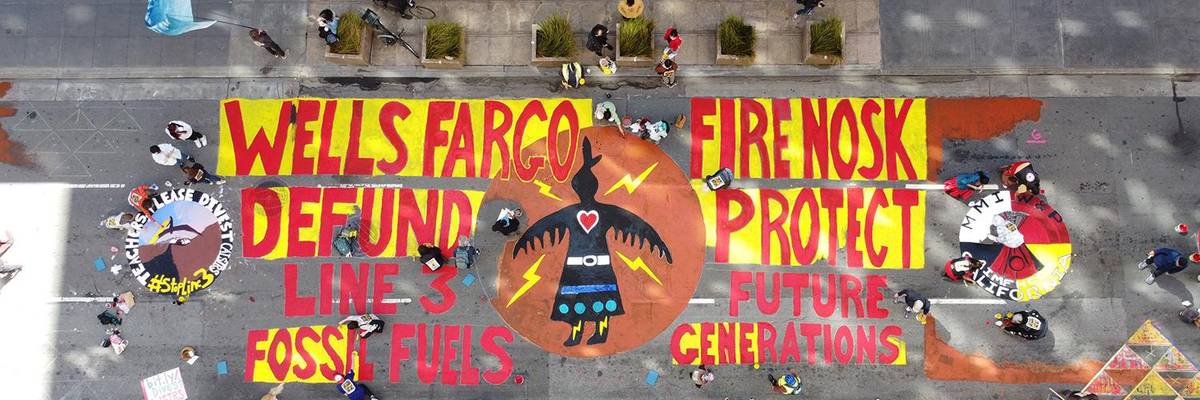
On Friday, hundreds of activists in San Francisco painted the street outside of Wells Fargo's headquarters, urging the bank to both stop funding Line 3, and remove Noski from the head of the bank. (Photo: Arthur Koch)
Along with many others, I've spent the last four years urging JPMorgan Chase to stop providing financial services to the fossil fuel industry. It's been no easy task. Since the Paris Agreement was signed, Chase has loaned more than $317 billion to the fossil fuel industry--33% more than any other bank on the planet. Want to build a massive new tar sands pipeline? JPMorgan is your bank. What to build a vast new coal mine? Just give Chase CEO Jamie Dimon a call, he's your man.
In the climate fight, Lee Raymond is the ultimate Bond villain. As the CEO of ExxonMobil, he was the chief architect of a decades-long disinformation campaign to discredit climate science and brainwash Americans into questioning the reality of climate change.In years of campaigning against JPMorgan, activists have tried a lot of tactics--from filing shareholder resolutions to shutting down streets outside of their headquarters. But last year, the campaign took a new twist. For the first time, it got personal.
In the climate fight, Lee Raymond is the ultimate Bond villain. As the CEO of ExxonMobil, he was the chief architect of a decades-long disinformation campaign to discredit climate science and brainwash Americans into questioning the reality of climate change. For more than thirty years, he was also a lead figure on JPMorgan Chase's board.
Last year, a broad coalition of groups (many of whom are a part of the Stop the Money Pipeline coalition) launched a campaign to oust Lee Raymond from Chase's board. And they won. Just a few months after major investors joined with activists in calling for Raymond to get the boot, he was gone for good.
Now, an investor advocacy group, Majority Action, has released a list of 30 corporate directors who are obstacles to climate progress--directors who should be voted out of positions of power to make way for people who are more climate literate.
Not every one of those directors is a supervillain like Lee Raymond. Some of them are just everyday members of the 1%--the majority of them are wealthy, white men and all of them have a long track record of putting profits above all else.
The Chairman of Wells Fargo's board, Charles Noski, is a case in point. Noski hasn't spent a significant portion of his career consorting with climate deniers. Yet, under Noski's leadership, Wells Fargo has re-established itself as the world's largest funder of fracking, doubled down on backing Line 3, and loaned billions to coal, oil, and gas companies. That alone is reason enough that he should be removed as the head of Wells Fargo's board; he's already proven himself incapable of leading a major corporation in the time of climate crisis.
Dear Common Dreams reader, It’s been nearly 30 years since I co-founded Common Dreams with my late wife, Lina Newhouser. We had the radical notion that journalism should serve the public good, not corporate profits. It was clear to us from the outset what it would take to build such a project. No paid advertisements. No corporate sponsors. No millionaire publisher telling us what to think or do. Many people said we wouldn't last a year, but we proved those doubters wrong. Together with a tremendous team of journalists and dedicated staff, we built an independent media outlet free from the constraints of profits and corporate control. Our mission has always been simple: To inform. To inspire. To ignite change for the common good. Building Common Dreams was not easy. Our survival was never guaranteed. When you take on the most powerful forces—Wall Street greed, fossil fuel industry destruction, Big Tech lobbyists, and uber-rich oligarchs who have spent billions upon billions rigging the economy and democracy in their favor—the only bulwark you have is supporters who believe in your work. But here’s the urgent message from me today. It's never been this bad out there. And it's never been this hard to keep us going. At the very moment Common Dreams is most needed, the threats we face are intensifying. We need your support now more than ever. We don't accept corporate advertising and never will. We don't have a paywall because we don't think people should be blocked from critical news based on their ability to pay. Everything we do is funded by the donations of readers like you. When everyone does the little they can afford, we are strong. But if that support retreats or dries up, so do we. Will you donate now to make sure Common Dreams not only survives but thrives? —Craig Brown, Co-founder |
Along with many others, I've spent the last four years urging JPMorgan Chase to stop providing financial services to the fossil fuel industry. It's been no easy task. Since the Paris Agreement was signed, Chase has loaned more than $317 billion to the fossil fuel industry--33% more than any other bank on the planet. Want to build a massive new tar sands pipeline? JPMorgan is your bank. What to build a vast new coal mine? Just give Chase CEO Jamie Dimon a call, he's your man.
In the climate fight, Lee Raymond is the ultimate Bond villain. As the CEO of ExxonMobil, he was the chief architect of a decades-long disinformation campaign to discredit climate science and brainwash Americans into questioning the reality of climate change.In years of campaigning against JPMorgan, activists have tried a lot of tactics--from filing shareholder resolutions to shutting down streets outside of their headquarters. But last year, the campaign took a new twist. For the first time, it got personal.
In the climate fight, Lee Raymond is the ultimate Bond villain. As the CEO of ExxonMobil, he was the chief architect of a decades-long disinformation campaign to discredit climate science and brainwash Americans into questioning the reality of climate change. For more than thirty years, he was also a lead figure on JPMorgan Chase's board.
Last year, a broad coalition of groups (many of whom are a part of the Stop the Money Pipeline coalition) launched a campaign to oust Lee Raymond from Chase's board. And they won. Just a few months after major investors joined with activists in calling for Raymond to get the boot, he was gone for good.
Now, an investor advocacy group, Majority Action, has released a list of 30 corporate directors who are obstacles to climate progress--directors who should be voted out of positions of power to make way for people who are more climate literate.
Not every one of those directors is a supervillain like Lee Raymond. Some of them are just everyday members of the 1%--the majority of them are wealthy, white men and all of them have a long track record of putting profits above all else.
The Chairman of Wells Fargo's board, Charles Noski, is a case in point. Noski hasn't spent a significant portion of his career consorting with climate deniers. Yet, under Noski's leadership, Wells Fargo has re-established itself as the world's largest funder of fracking, doubled down on backing Line 3, and loaned billions to coal, oil, and gas companies. That alone is reason enough that he should be removed as the head of Wells Fargo's board; he's already proven himself incapable of leading a major corporation in the time of climate crisis.
Along with many others, I've spent the last four years urging JPMorgan Chase to stop providing financial services to the fossil fuel industry. It's been no easy task. Since the Paris Agreement was signed, Chase has loaned more than $317 billion to the fossil fuel industry--33% more than any other bank on the planet. Want to build a massive new tar sands pipeline? JPMorgan is your bank. What to build a vast new coal mine? Just give Chase CEO Jamie Dimon a call, he's your man.
In the climate fight, Lee Raymond is the ultimate Bond villain. As the CEO of ExxonMobil, he was the chief architect of a decades-long disinformation campaign to discredit climate science and brainwash Americans into questioning the reality of climate change.In years of campaigning against JPMorgan, activists have tried a lot of tactics--from filing shareholder resolutions to shutting down streets outside of their headquarters. But last year, the campaign took a new twist. For the first time, it got personal.
In the climate fight, Lee Raymond is the ultimate Bond villain. As the CEO of ExxonMobil, he was the chief architect of a decades-long disinformation campaign to discredit climate science and brainwash Americans into questioning the reality of climate change. For more than thirty years, he was also a lead figure on JPMorgan Chase's board.
Last year, a broad coalition of groups (many of whom are a part of the Stop the Money Pipeline coalition) launched a campaign to oust Lee Raymond from Chase's board. And they won. Just a few months after major investors joined with activists in calling for Raymond to get the boot, he was gone for good.
Now, an investor advocacy group, Majority Action, has released a list of 30 corporate directors who are obstacles to climate progress--directors who should be voted out of positions of power to make way for people who are more climate literate.
Not every one of those directors is a supervillain like Lee Raymond. Some of them are just everyday members of the 1%--the majority of them are wealthy, white men and all of them have a long track record of putting profits above all else.
The Chairman of Wells Fargo's board, Charles Noski, is a case in point. Noski hasn't spent a significant portion of his career consorting with climate deniers. Yet, under Noski's leadership, Wells Fargo has re-established itself as the world's largest funder of fracking, doubled down on backing Line 3, and loaned billions to coal, oil, and gas companies. That alone is reason enough that he should be removed as the head of Wells Fargo's board; he's already proven himself incapable of leading a major corporation in the time of climate crisis.