

SUBSCRIBE TO OUR FREE NEWSLETTER
Daily news & progressive opinion—funded by the people, not the corporations—delivered straight to your inbox.
5
#000000
#FFFFFF
To donate by check, phone, or other method, see our More Ways to Give page.
Daily news & progressive opinion—funded by the people, not the corporations—delivered straight to your inbox.
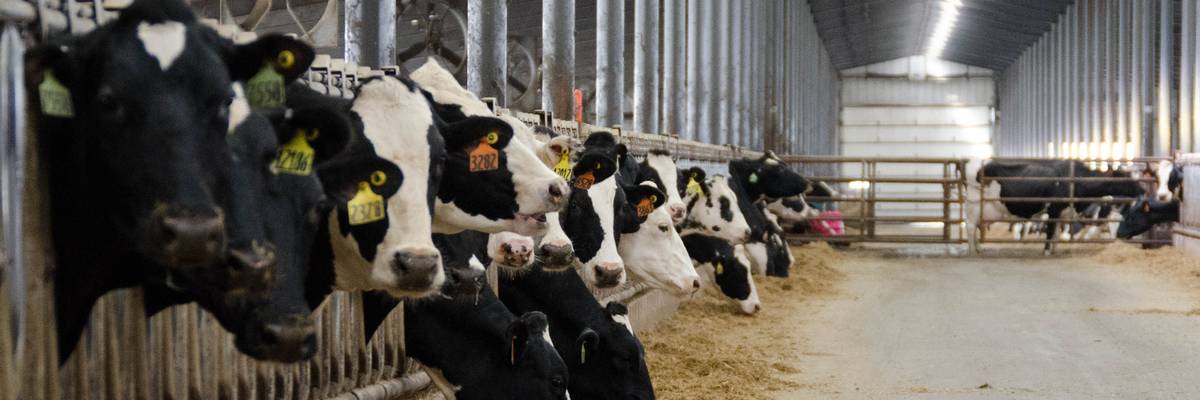
Black and white spotted dairy cows eat hay and silage at a farm in Deerfield, Wisconsin.
Congress should pass measures like the Milk From Family Dairies Act (MFDA), which ensures farmers a decent price without driving up costs for consumers and relying on taxpayer-funded subsidies.
Sometimes the truth stares you right in the face.
Case in point—in the middle of his agricultural roundtable event with farmers and Republican representatives held this past June 5 in Chippewa Falls, Wisconsin, President Donald Trump took a moment to reflect about a different meeting he once had with another group of producers. As the president remembered, he told the farmers, “I’m going to get you a subsidy.” To his surprise they responded that they didn’t want subsidies, but rather, “a level playing field.”
It would be easy to gloss over the truth in Trump’s recollection, especially as he rambled on about many things unrelated to farming such as repairing monuments around Washington DC, his disdain for Democrats, and how the Southern border was closed to migrants. This, as NFL Hall-of-Famer Joe Thomas sat to Trump’s side and drew gushing remarks from the president about the retired player’s body.
Unlike Thomas, most farmers cannot draw on millions to stay on the land. Instead, they can turn to the government to promote fair markets. As much could happen now, during June Dairy Month, as the Farm Bill is working through Congress and much needed relief could come by including in the ominous piece of legislation key reforms to the dairy industry.
Instead of such piecemeal fixes, the dairy industry needs industry-wide reform, as the farmers who spoke with Trump once said, “to level the playing field.”
To be fair, discussion during Trump’s roundtable did include some dairy policies.
Agriculture Secretary Brooke Rollins, for instance, alluded to trade deals that would increase exports. Rep. Derrick Van Orden (R-Wis.), whose district the roundtable took place in and who appears in danger of losing his seat to the daughter of dairy farmers, Rebecca Cooke, touted the Whole Milk for Healthy Kids Act. The act restores whole and reduced fat (2%) milk options at schools.
The problem is that both initiatives don’t do much.
First, the evidence shows that increasing exports doesn’t keep people farming.
Farm Bureau data shows that since 2016, total dairy export value has doubled from just over $4 million to over $8 in 2024. But during this same period, the number of licensed dairy herds has collapsed, from over 40,000, to under 25,000.
Meanwhile, serving milk at school lunch does open markets. And nationwide, since 2024, more people have been consuming milk after years of decline. But even amid rising demand, in 2025 Wisconsin saw a 700% increase in bankruptcies, particularly hitting dairy farmers.
Instead of such piecemeal fixes, the dairy industry needs industry-wide reform, as the farmers who spoke with Trump once said, “to level the playing field.”
The proposal that would advance such change is the Milk From Family Dairies Act (MFDA). Created by the National Family Farm Coalition and endorsed by over 90 organizations, the MFDA ensures farmers a decent price without driving up costs for consumers and relying on taxpayer-funded subsidies.
The principle behind the MFDA is supply management, similar to the system in Canada. In this system, consumer supply demands are balanced with prices that farmers are paid for their milk in regular meetings of stakeholders. For farmers, receiving compensation for at least the cost of production is a big deal, as since 2021, even taking into consideration advantages of increasing herd size, dairy producers across the board have consistently had to sell their milk at a loss as the price of feed, seed, and fertilizer rise.
Consumers benefit as the MFDA makes investments in local dairy processors, increasing competition to drive down prices, and corporate concentration in the industry is targeted with anti-trust enforcement to curtail price gouging by large-scale retailers at the grocery store. Currently, taxpayers pick up the tab for farmers who have financial troubles with subsidies, or direct payments, which Trump has handed out repeatedly across his administrations.
Unlike Joe Thomas, most farmers don’t have millions to keep them going. Instead, they have the government, which should ensure fair markets. So, to mark June Dairy month, our lawmakers should listen to farmers, level the playing field, and include elements from the MFDA into the Farm Bill.
Dear Common Dreams reader, It’s been nearly 30 years since I co-founded Common Dreams with my late wife, Lina Newhouser. We had the radical notion that journalism should serve the public good, not corporate profits. It was clear to us from the outset what it would take to build such a project. No paid advertisements. No corporate sponsors. No millionaire publisher telling us what to think or do. Many people said we wouldn't last a year, but we proved those doubters wrong. Together with a tremendous team of journalists and dedicated staff, we built an independent media outlet free from the constraints of profits and corporate control. Our mission has always been simple: To inform. To inspire. To ignite change for the common good. Building Common Dreams was not easy. Our survival was never guaranteed. When you take on the most powerful forces—Wall Street greed, fossil fuel industry destruction, Big Tech lobbyists, and uber-rich oligarchs who have spent billions upon billions rigging the economy and democracy in their favor—the only bulwark you have is supporters who believe in your work. But here’s the urgent message from me today. It's never been this bad out there. And it's never been this hard to keep us going. At the very moment Common Dreams is most needed, the threats we face are intensifying. We need your support now more than ever. We don't accept corporate advertising and never will. We don't have a paywall because we don't think people should be blocked from critical news based on their ability to pay. Everything we do is funded by the donations of readers like you. When everyone does the little they can afford, we are strong. But if that support retreats or dries up, so do we. Will you donate now to make sure Common Dreams not only survives but thrives? —Craig Brown, Co-founder |
Sometimes the truth stares you right in the face.
Case in point—in the middle of his agricultural roundtable event with farmers and Republican representatives held this past June 5 in Chippewa Falls, Wisconsin, President Donald Trump took a moment to reflect about a different meeting he once had with another group of producers. As the president remembered, he told the farmers, “I’m going to get you a subsidy.” To his surprise they responded that they didn’t want subsidies, but rather, “a level playing field.”
It would be easy to gloss over the truth in Trump’s recollection, especially as he rambled on about many things unrelated to farming such as repairing monuments around Washington DC, his disdain for Democrats, and how the Southern border was closed to migrants. This, as NFL Hall-of-Famer Joe Thomas sat to Trump’s side and drew gushing remarks from the president about the retired player’s body.
Unlike Thomas, most farmers cannot draw on millions to stay on the land. Instead, they can turn to the government to promote fair markets. As much could happen now, during June Dairy Month, as the Farm Bill is working through Congress and much needed relief could come by including in the ominous piece of legislation key reforms to the dairy industry.
Instead of such piecemeal fixes, the dairy industry needs industry-wide reform, as the farmers who spoke with Trump once said, “to level the playing field.”
To be fair, discussion during Trump’s roundtable did include some dairy policies.
Agriculture Secretary Brooke Rollins, for instance, alluded to trade deals that would increase exports. Rep. Derrick Van Orden (R-Wis.), whose district the roundtable took place in and who appears in danger of losing his seat to the daughter of dairy farmers, Rebecca Cooke, touted the Whole Milk for Healthy Kids Act. The act restores whole and reduced fat (2%) milk options at schools.
The problem is that both initiatives don’t do much.
First, the evidence shows that increasing exports doesn’t keep people farming.
Farm Bureau data shows that since 2016, total dairy export value has doubled from just over $4 million to over $8 in 2024. But during this same period, the number of licensed dairy herds has collapsed, from over 40,000, to under 25,000.
Meanwhile, serving milk at school lunch does open markets. And nationwide, since 2024, more people have been consuming milk after years of decline. But even amid rising demand, in 2025 Wisconsin saw a 700% increase in bankruptcies, particularly hitting dairy farmers.
Instead of such piecemeal fixes, the dairy industry needs industry-wide reform, as the farmers who spoke with Trump once said, “to level the playing field.”
The proposal that would advance such change is the Milk From Family Dairies Act (MFDA). Created by the National Family Farm Coalition and endorsed by over 90 organizations, the MFDA ensures farmers a decent price without driving up costs for consumers and relying on taxpayer-funded subsidies.
The principle behind the MFDA is supply management, similar to the system in Canada. In this system, consumer supply demands are balanced with prices that farmers are paid for their milk in regular meetings of stakeholders. For farmers, receiving compensation for at least the cost of production is a big deal, as since 2021, even taking into consideration advantages of increasing herd size, dairy producers across the board have consistently had to sell their milk at a loss as the price of feed, seed, and fertilizer rise.
Consumers benefit as the MFDA makes investments in local dairy processors, increasing competition to drive down prices, and corporate concentration in the industry is targeted with anti-trust enforcement to curtail price gouging by large-scale retailers at the grocery store. Currently, taxpayers pick up the tab for farmers who have financial troubles with subsidies, or direct payments, which Trump has handed out repeatedly across his administrations.
Unlike Joe Thomas, most farmers don’t have millions to keep them going. Instead, they have the government, which should ensure fair markets. So, to mark June Dairy month, our lawmakers should listen to farmers, level the playing field, and include elements from the MFDA into the Farm Bill.
Sometimes the truth stares you right in the face.
Case in point—in the middle of his agricultural roundtable event with farmers and Republican representatives held this past June 5 in Chippewa Falls, Wisconsin, President Donald Trump took a moment to reflect about a different meeting he once had with another group of producers. As the president remembered, he told the farmers, “I’m going to get you a subsidy.” To his surprise they responded that they didn’t want subsidies, but rather, “a level playing field.”
It would be easy to gloss over the truth in Trump’s recollection, especially as he rambled on about many things unrelated to farming such as repairing monuments around Washington DC, his disdain for Democrats, and how the Southern border was closed to migrants. This, as NFL Hall-of-Famer Joe Thomas sat to Trump’s side and drew gushing remarks from the president about the retired player’s body.
Unlike Thomas, most farmers cannot draw on millions to stay on the land. Instead, they can turn to the government to promote fair markets. As much could happen now, during June Dairy Month, as the Farm Bill is working through Congress and much needed relief could come by including in the ominous piece of legislation key reforms to the dairy industry.
Instead of such piecemeal fixes, the dairy industry needs industry-wide reform, as the farmers who spoke with Trump once said, “to level the playing field.”
To be fair, discussion during Trump’s roundtable did include some dairy policies.
Agriculture Secretary Brooke Rollins, for instance, alluded to trade deals that would increase exports. Rep. Derrick Van Orden (R-Wis.), whose district the roundtable took place in and who appears in danger of losing his seat to the daughter of dairy farmers, Rebecca Cooke, touted the Whole Milk for Healthy Kids Act. The act restores whole and reduced fat (2%) milk options at schools.
The problem is that both initiatives don’t do much.
First, the evidence shows that increasing exports doesn’t keep people farming.
Farm Bureau data shows that since 2016, total dairy export value has doubled from just over $4 million to over $8 in 2024. But during this same period, the number of licensed dairy herds has collapsed, from over 40,000, to under 25,000.
Meanwhile, serving milk at school lunch does open markets. And nationwide, since 2024, more people have been consuming milk after years of decline. But even amid rising demand, in 2025 Wisconsin saw a 700% increase in bankruptcies, particularly hitting dairy farmers.
Instead of such piecemeal fixes, the dairy industry needs industry-wide reform, as the farmers who spoke with Trump once said, “to level the playing field.”
The proposal that would advance such change is the Milk From Family Dairies Act (MFDA). Created by the National Family Farm Coalition and endorsed by over 90 organizations, the MFDA ensures farmers a decent price without driving up costs for consumers and relying on taxpayer-funded subsidies.
The principle behind the MFDA is supply management, similar to the system in Canada. In this system, consumer supply demands are balanced with prices that farmers are paid for their milk in regular meetings of stakeholders. For farmers, receiving compensation for at least the cost of production is a big deal, as since 2021, even taking into consideration advantages of increasing herd size, dairy producers across the board have consistently had to sell their milk at a loss as the price of feed, seed, and fertilizer rise.
Consumers benefit as the MFDA makes investments in local dairy processors, increasing competition to drive down prices, and corporate concentration in the industry is targeted with anti-trust enforcement to curtail price gouging by large-scale retailers at the grocery store. Currently, taxpayers pick up the tab for farmers who have financial troubles with subsidies, or direct payments, which Trump has handed out repeatedly across his administrations.
Unlike Joe Thomas, most farmers don’t have millions to keep them going. Instead, they have the government, which should ensure fair markets. So, to mark June Dairy month, our lawmakers should listen to farmers, level the playing field, and include elements from the MFDA into the Farm Bill.

