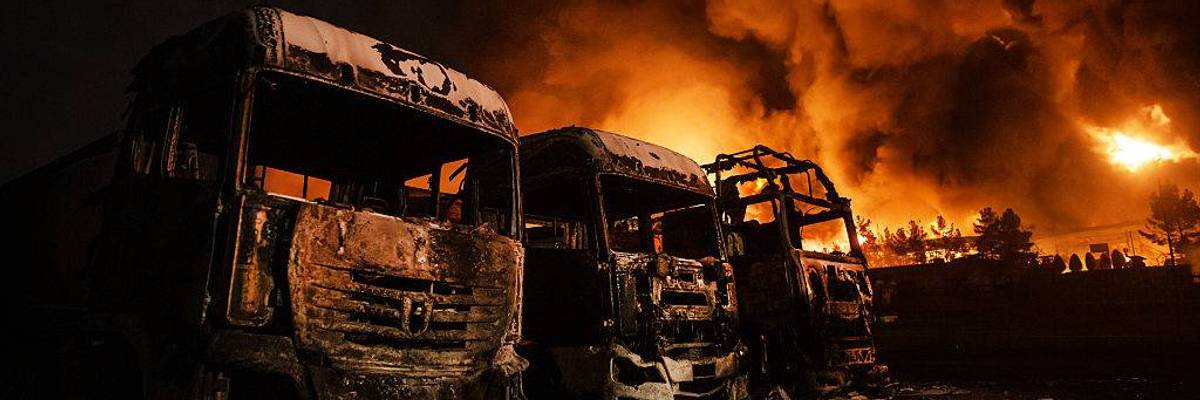
Fire breaks out at the Shahran oil depot after US and Israeli attacks, leaving numerous fuel tankers and vehicles in the area unusable in Tehran, Iran on March 8, 2026.
'The Situation Is Scary': Global Economic Chaos as Trump’s Iran War Sends Markets Diving
"To me, it was not just the worst-case scenario," said one economic analyst. "It was an unthinkable scenario."
President Donald Trump's unprovoked and unconstitutional war against Iran is sending shockwaves across the global economy in the form of skyrocketing oil prices and diving financial markets.
The prices of both Brent crude oil and WTI crude oil futures on Monday surged past $100 per barrel, as countries across the Middle East announced production cuts in the wake of chaos and destruction caused by the Iran war.
The impact of the price surge on the US stock market was immediate, as the Dow Jones Industrial Average opened Monday trading down by more than 600 points, while the Nasdaq dropped by 300 points.
According to a Monday report from the Wall Street Journal, both Iraq and Kuwait have announced oil production curbs because they have been unable to ship their supply through the Strait of Hormuz and have thus run out of space to store excess petroleum.
JPMorgan Chase analyst Natasha Kaneva noted to the Journal that this is the first time in recorded history that the Strait of Hormuz has ever been completely closed off for shipping, and warned the economic consequences would be severe.
"To me, it was not just the worst-case scenario," Kaneva said of the strait's closing. "It was an unthinkable scenario."
The Journal wrote that Trump's decision to launch a war with Iran has already sparked "the most severe energy crisis since the 1970s," which is now "threatening the global economy."
Petroleum industry analyst Patrick De Haan wrote in a Monday analysis that US drivers should expect to feel the impact of this oil shock in the coming days.
"Gasoline prices in many states could climb another 20 to 50 cents per gallon this week, with price-cycling markets potentially seeing increases as early as today," De Haan projected. "Diesel may rise even more sharply, with increases of 35 to 75 cents per gallon possible as global distillate markets react."
In a Monday analysis posted on his Substack page, Nobel Prize-winning economist Paul Krugman dove into the logistics of stopping and restarting oil production, and argued that the impact of the strait's closure will grow significantly as time goes on.
"As the Strait remains closed, producers are shutting down, and this isn’t like turning off a tap that can be quickly restarted," Krugman explained. "There’s apparently a real nonlinearity here: a two-week closure of the Strait has much more than twice the adverse impact on global oil supply as a one-week closure. If this goes on for multiple weeks... oil prices, which retreated slightly off their highs early this morning, could go much higher."
Krugman said that the shock was not yet bad enough to make an economic crisis inevitable because the US is much less dependent on oil than it was in the 1970s.
Nonetheless, Krugman cautioned, "the situation is scary."
Punchbowl News reported on Monday that the politics of the Iran war "have to worry" incumbent Republicans who were already in real danger of losing their majority in the US House of Representatives even before Trump launched an illegal war.
"With the Strait of Hormuz closed, oil prices have soared to more than $100 per barrel (from just under $70 per barrel 10 days ago)," wrote Punchbowl News. "There’s been a huge spike in gas prices nationally."
The report added that Trump has not been helping his party by expressing indifference bordering on hostility to Americans' concerns about how his war will impact their personal finances.
"Short term oil prices, which will drop rapidly when the destruction of the Iran nuclear threat is over, is a very small price to pay for U.S.A., and World, Safety and Peace," Trump wrote in a Sunday Truth Social post. "ONLY FOOLS WOULD THINK DIFFERENTLY!"
We are at a crossroads
This country and this world are at a monumental crossroads. In a few short weeks, US voters will have an opportunity to beat back the forces of fascism and confront the billionaires who are rigging the economy, our media system, and our democracy, making it increasingly impossible for ordinary people to get by. We’re not just talking about the election. We’re talking about what must be done once these fascist elements are vanquished from power. We need a bolder set of solutions than what either major party has so far been willing to offer and a working-class movement ready to fight like hell for it. Trump didn't emerge from nowhere. The conditions that fueled MAGA authoritarianism were created by decades of radical neoliberal economic policies and a corrupt political system dominated by corporate interests. They slashed taxes on the super-rich, promising that the benefits would trickle down. They said giveaways to the corporate titans would make life more affordable for the rest of us. It was all bullshit. And when a bitter, betrayed populace searches for someone to blame, right-wing demagogues have little trouble finding scapegoats. People know when they're being lied to, but you won't hear any of this from the corporate media. Only independent journalism—powered and funded by people who believe in building a better world—can deliver truly trustworthy daily news. Our Fall Campaign is underway, and we need your help. To power our newsroom through the rest of the year, we need to raise $125,000 by midnight on October 31. So if you share our vision, please contribute whatever you can to sustain our work. |
President Donald Trump's unprovoked and unconstitutional war against Iran is sending shockwaves across the global economy in the form of skyrocketing oil prices and diving financial markets.
The prices of both Brent crude oil and WTI crude oil futures on Monday surged past $100 per barrel, as countries across the Middle East announced production cuts in the wake of chaos and destruction caused by the Iran war.
The impact of the price surge on the US stock market was immediate, as the Dow Jones Industrial Average opened Monday trading down by more than 600 points, while the Nasdaq dropped by 300 points.
According to a Monday report from the Wall Street Journal, both Iraq and Kuwait have announced oil production curbs because they have been unable to ship their supply through the Strait of Hormuz and have thus run out of space to store excess petroleum.
JPMorgan Chase analyst Natasha Kaneva noted to the Journal that this is the first time in recorded history that the Strait of Hormuz has ever been completely closed off for shipping, and warned the economic consequences would be severe.
"To me, it was not just the worst-case scenario," Kaneva said of the strait's closing. "It was an unthinkable scenario."
The Journal wrote that Trump's decision to launch a war with Iran has already sparked "the most severe energy crisis since the 1970s," which is now "threatening the global economy."
Petroleum industry analyst Patrick De Haan wrote in a Monday analysis that US drivers should expect to feel the impact of this oil shock in the coming days.
"Gasoline prices in many states could climb another 20 to 50 cents per gallon this week, with price-cycling markets potentially seeing increases as early as today," De Haan projected. "Diesel may rise even more sharply, with increases of 35 to 75 cents per gallon possible as global distillate markets react."
In a Monday analysis posted on his Substack page, Nobel Prize-winning economist Paul Krugman dove into the logistics of stopping and restarting oil production, and argued that the impact of the strait's closure will grow significantly as time goes on.
"As the Strait remains closed, producers are shutting down, and this isn’t like turning off a tap that can be quickly restarted," Krugman explained. "There’s apparently a real nonlinearity here: a two-week closure of the Strait has much more than twice the adverse impact on global oil supply as a one-week closure. If this goes on for multiple weeks... oil prices, which retreated slightly off their highs early this morning, could go much higher."
Krugman said that the shock was not yet bad enough to make an economic crisis inevitable because the US is much less dependent on oil than it was in the 1970s.
Nonetheless, Krugman cautioned, "the situation is scary."
Punchbowl News reported on Monday that the politics of the Iran war "have to worry" incumbent Republicans who were already in real danger of losing their majority in the US House of Representatives even before Trump launched an illegal war.
"With the Strait of Hormuz closed, oil prices have soared to more than $100 per barrel (from just under $70 per barrel 10 days ago)," wrote Punchbowl News. "There’s been a huge spike in gas prices nationally."
The report added that Trump has not been helping his party by expressing indifference bordering on hostility to Americans' concerns about how his war will impact their personal finances.
"Short term oil prices, which will drop rapidly when the destruction of the Iran nuclear threat is over, is a very small price to pay for U.S.A., and World, Safety and Peace," Trump wrote in a Sunday Truth Social post. "ONLY FOOLS WOULD THINK DIFFERENTLY!"
- Trump's Economic War on Iran: 88% Reduction in Oil Exports, 6% Shrinkage of Economy ›
- 'So Sick': War Profiteer Stocks Jump as Iran Strikes Israel ›
- 'Unlike the United States,' Says Security Chief, Iran 'Has Prepared Itself for a Long War' ›
- Climate Group Says Rich Nations 'Must Tax Fossil Fuel Windfall Profits' Tied to Iran War | Common Dreams ›
- Opinion | Why Haven't We Set the World on Fire to End This War? | Common Dreams ›
- Johnson Vows Gas Price Hikes ‘Just a Temporary Blip.’ Expert Analyses Warn Otherwise | Common Dreams ›
- Opinion | How the Iran War Could Lead to a Crash Worse Than 2008 | Common Dreams ›
- Oil Giants' Profits Soar as Trump's Iran War Estimated to Deliver $1 Trillion Hit to World Economy | Common Dreams ›
- ‘Yeah, So What?’ Elites Shrug Off Working-Class Pain Caused by Trump Tariffs, Iran War | Common Dreams ›
- Opinion | No Matter Who Wins the Iran War, the Global Economy Is Losing | Common Dreams ›
- Opinion | Without a US-Iran Peace Deal, the World Is Headed for an Energy Crisis Apocalypse | Common Dreams ›
President Donald Trump's unprovoked and unconstitutional war against Iran is sending shockwaves across the global economy in the form of skyrocketing oil prices and diving financial markets.
The prices of both Brent crude oil and WTI crude oil futures on Monday surged past $100 per barrel, as countries across the Middle East announced production cuts in the wake of chaos and destruction caused by the Iran war.
The impact of the price surge on the US stock market was immediate, as the Dow Jones Industrial Average opened Monday trading down by more than 600 points, while the Nasdaq dropped by 300 points.
According to a Monday report from the Wall Street Journal, both Iraq and Kuwait have announced oil production curbs because they have been unable to ship their supply through the Strait of Hormuz and have thus run out of space to store excess petroleum.
JPMorgan Chase analyst Natasha Kaneva noted to the Journal that this is the first time in recorded history that the Strait of Hormuz has ever been completely closed off for shipping, and warned the economic consequences would be severe.
"To me, it was not just the worst-case scenario," Kaneva said of the strait's closing. "It was an unthinkable scenario."
The Journal wrote that Trump's decision to launch a war with Iran has already sparked "the most severe energy crisis since the 1970s," which is now "threatening the global economy."
Petroleum industry analyst Patrick De Haan wrote in a Monday analysis that US drivers should expect to feel the impact of this oil shock in the coming days.
"Gasoline prices in many states could climb another 20 to 50 cents per gallon this week, with price-cycling markets potentially seeing increases as early as today," De Haan projected. "Diesel may rise even more sharply, with increases of 35 to 75 cents per gallon possible as global distillate markets react."
In a Monday analysis posted on his Substack page, Nobel Prize-winning economist Paul Krugman dove into the logistics of stopping and restarting oil production, and argued that the impact of the strait's closure will grow significantly as time goes on.
"As the Strait remains closed, producers are shutting down, and this isn’t like turning off a tap that can be quickly restarted," Krugman explained. "There’s apparently a real nonlinearity here: a two-week closure of the Strait has much more than twice the adverse impact on global oil supply as a one-week closure. If this goes on for multiple weeks... oil prices, which retreated slightly off their highs early this morning, could go much higher."
Krugman said that the shock was not yet bad enough to make an economic crisis inevitable because the US is much less dependent on oil than it was in the 1970s.
Nonetheless, Krugman cautioned, "the situation is scary."
Punchbowl News reported on Monday that the politics of the Iran war "have to worry" incumbent Republicans who were already in real danger of losing their majority in the US House of Representatives even before Trump launched an illegal war.
"With the Strait of Hormuz closed, oil prices have soared to more than $100 per barrel (from just under $70 per barrel 10 days ago)," wrote Punchbowl News. "There’s been a huge spike in gas prices nationally."
The report added that Trump has not been helping his party by expressing indifference bordering on hostility to Americans' concerns about how his war will impact their personal finances.
"Short term oil prices, which will drop rapidly when the destruction of the Iran nuclear threat is over, is a very small price to pay for U.S.A., and World, Safety and Peace," Trump wrote in a Sunday Truth Social post. "ONLY FOOLS WOULD THINK DIFFERENTLY!"
- Trump's Economic War on Iran: 88% Reduction in Oil Exports, 6% Shrinkage of Economy ›
- 'So Sick': War Profiteer Stocks Jump as Iran Strikes Israel ›
- 'Unlike the United States,' Says Security Chief, Iran 'Has Prepared Itself for a Long War' ›
- Climate Group Says Rich Nations 'Must Tax Fossil Fuel Windfall Profits' Tied to Iran War | Common Dreams ›
- Opinion | Why Haven't We Set the World on Fire to End This War? | Common Dreams ›
- Johnson Vows Gas Price Hikes ‘Just a Temporary Blip.’ Expert Analyses Warn Otherwise | Common Dreams ›
- Opinion | How the Iran War Could Lead to a Crash Worse Than 2008 | Common Dreams ›
- Oil Giants' Profits Soar as Trump's Iran War Estimated to Deliver $1 Trillion Hit to World Economy | Common Dreams ›
- ‘Yeah, So What?’ Elites Shrug Off Working-Class Pain Caused by Trump Tariffs, Iran War | Common Dreams ›
- Opinion | No Matter Who Wins the Iran War, the Global Economy Is Losing | Common Dreams ›
- Opinion | Without a US-Iran Peace Deal, the World Is Headed for an Energy Crisis Apocalypse | Common Dreams ›