5
#000000
#FFFFFF
To donate by check, phone, or other method, see our More Ways to Give page.
Daily news & progressive opinion—funded by the people, not the corporations—delivered straight to your inbox.
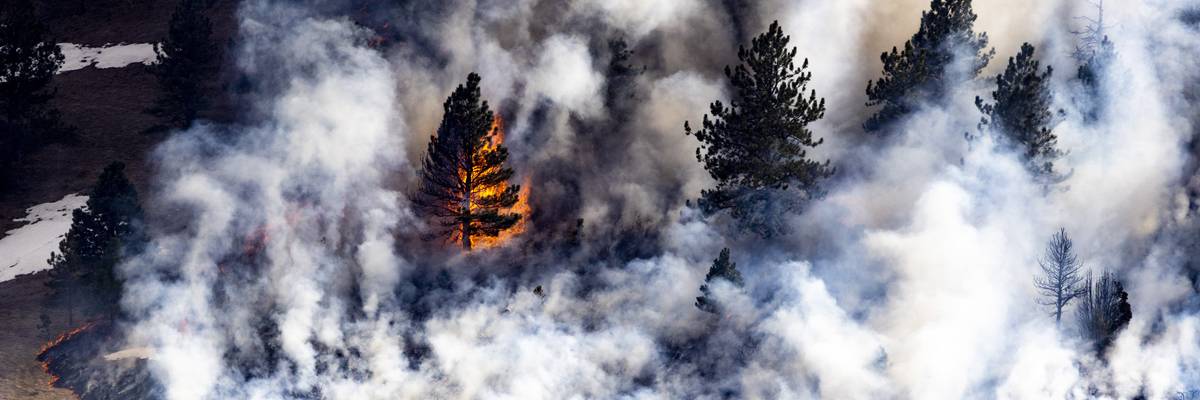
A tree goes up in flames as the NCAR Fire burns on March 26, 2022 in Boulder, Colorado.
In recent years, insurers have pointed to growing climate risk as the reason for raising rates and dropping coverage. Now, they’re supporting the very industry driving that risk rather than the communities facing it. Why?
The US Supreme Court opens its new term on October 5 with oral arguments in Suncor v. Boulder—the most consequential climate case it has heard to date. The fossil fuel defendants are trying to block local governments from suing them for climate deception and harm. In an alarming display of corporate allegiance, the nation’s largest property insurance associations have sided with the oil companies seeking to avoid responsibility for climate losses, over the public entities and policyholders footing the growing bill.
In recent years, insurers have pointed to growing climate risk as the reason for raising rates and dropping coverage. Now, they’re supporting the very industry driving that risk rather than the communities facing it. Why?
From establishing cooling centers and flood protection plans to equipping firefighters and emergency responders, communities are shouldering the mounting costs of climate change. The burden is both untenable and unfair. That’s why a growing number of states and local governments have turned to courts to make fossil fuel companies pay their share for driving the climate crisis.
Fossil-fueled climate destruction threatens human life, health, the economy, and vital ecosystems on which all depend. That reality should incentivize insurers to break free from fossil fuels faster and protect the public from climate peril.
Of the nearly three dozen such suits pending across the US, Suncor v. Boulder is the first to reach the Supreme Court.
The case, brought by the city and county of Boulder, alleges Suncor and ExxonMobil knowingly contributed to climate change for decades by producing fossil fuels while deceiving the public about their dangers. Boulder argues the companies should be on the hook for the resulting climate harms and the rising costs of adapting to a warming world.
Rather than address the legal claims on their merits, the fossil fuel defendants have instead sought to get the case thrown out. They are urging the Supreme Court to bar Boulder’s suit on the grounds that it aims to regulate greenhouse gas emissions, something they claim only federal law can do. But as the plaintiffs and dozens of supporters explain, Boulder is seeking to recoup the costs of local harm and to hold the fossil fuel defendants accountable for misleading consumers, not pollution controls.
If the court rules for the defendants, it could close the door not just on this suit but others like it nationwide—leaving the public and local governments, rather than the companies that caused the harm, to keep covering the costs.
Nearly 70 friend-of-the-court briefs were filed in the case—many, like the Center for International Environmental Law’s, supporting the plaintiffs. Others, however, came in on the side of the fossil fuel industry. Among the 38 briefs backing Suncor and ExxonMobil, Consumer Watchdog found that 25 of them have documented financial ties to fossil fuel companies or the dark-money networks behind decades of climate denial.
Three major US insurance trade associations—the American Property Casualty Insurance Association (APCIA), the Complex Insurance Claims Litigation Association, and the Reinsurance Association of America—also submitted a brief in support of the defendants. These trade groups weren’t part of Consumer Watchdog’s analysis. But insurers, including members of these very associations, have their own story to tell of financial entanglement with the fossil fuel industry.
Like others helping the fossil fuel industry dodge accountability, the insurance sector has well-documented financial ties to oil and gas companies. Property and casualty insurers hold a growing financial stake in fossil fuels—the same products causing the climate losses that are driving insurers to hike premiums and withdraw coverage.
As of 2023, the US property and casualty insurance industry held $84.6 billion in fossil fuel investments. The share of insurers’ portfolios tied up in fossil fuels climbed from 3.8% in 2014 to 4.4% by 2023.
Every premium dollar that flows into those investments comes from policyholders, many of whom are already struggling to afford coverage in fire- and flood-prone areas. While warning it can no longer absorb climate risk, the insurance industry is betting on the very companies creating that risk.
In their published brief in support of the Suncor defendants, the insurance associations argue that allowing state tort claims like Boulder’s could make it harder for fossil fuel companies to get liability insurance—potentially creating uncertainty and instability in the insurance market.
But they ignore the actual uncertainty and instability facing tens of millions of homeowners and tenants in the US who are bearing the brunt of climate losses and a deepening insurance crisis. In 2025, the US saw more than 23 billion-dollar weather events. The country racked up the lion’s share of global insured losses last year from what the industry continues to call “natural catastrophes,” which include climate-intensified events.
Citing climate risk, insurers are raising rates, dropping policies, and widening the climate protection gap. Home insurance premiums in the US grew by almost 50% between 2020 and 2024—more than double the rate of inflation. And since 2018, insurers have dropped more than 1.9 million home insurance contracts nationwide, contributing to a rising number of uninsured homes.
Yet the insurance industry opposes efforts to make the fossil fuel companies responsible for rising climate risk pay their fair share for resulting climate harm. If insurers are sounding the alarm, it should be about the reality of climate change, not the prospect of climate accountability.
It’s no wonder fossil fuel companies are seeking to stay out of court. The facts are not on their side—and neither is the law. Why, then, are the insurers?
Make no mistake, real climate accountability would be destabilizing for the fossil fuel industry. But climate change is already more destabilizing—for everyone. The inevitable and transient upheaval that will come from holding polluters responsible for the harm they have caused will be far less destabilizing than the predicted and irreparable impacts of unchecked climate change.
Fossil-fueled climate destruction threatens human life, health, the economy, and vital ecosystems on which all depend. That reality should incentivize insurers to break free from fossil fuels faster and protect the public from climate peril, rather than insulate polluters from the climate costs they have knowingly unleashed.
The message to the insurance industry is clear: Insure our collective future and make fossil fuels a thing of the past.
Dear Common Dreams reader, It’s been nearly 30 years since I co-founded Common Dreams with my late wife, Lina Newhouser. We had the radical notion that journalism should serve the public good, not corporate profits. It was clear to us from the outset what it would take to build such a project. No paid advertisements. No corporate sponsors. No millionaire publisher telling us what to think or do. Many people said we wouldn't last a year, but we proved those doubters wrong. Together with a tremendous team of journalists and dedicated staff, we built an independent media outlet free from the constraints of profits and corporate control. Our mission has always been simple: To inform. To inspire. To ignite change for the common good. Building Common Dreams was not easy. Our survival was never guaranteed. When you take on the most powerful forces—Wall Street greed, fossil fuel industry destruction, Big Tech lobbyists, and uber-rich oligarchs who have spent billions upon billions rigging the economy and democracy in their favor—the only bulwark you have is supporters who believe in your work. But here’s the urgent message from me today. It's never been this bad out there. And it's never been this hard to keep us going. At the very moment Common Dreams is most needed, the threats we face are intensifying. We need your support now more than ever. We don't accept corporate advertising and never will. We don't have a paywall because we don't think people should be blocked from critical news based on their ability to pay. Everything we do is funded by the donations of readers like you. When everyone does the little they can afford, we are strong. But if that support retreats or dries up, so do we. Will you donate now to make sure Common Dreams not only survives but thrives? —Craig Brown, Co-founder |
The US Supreme Court opens its new term on October 5 with oral arguments in Suncor v. Boulder—the most consequential climate case it has heard to date. The fossil fuel defendants are trying to block local governments from suing them for climate deception and harm. In an alarming display of corporate allegiance, the nation’s largest property insurance associations have sided with the oil companies seeking to avoid responsibility for climate losses, over the public entities and policyholders footing the growing bill.
In recent years, insurers have pointed to growing climate risk as the reason for raising rates and dropping coverage. Now, they’re supporting the very industry driving that risk rather than the communities facing it. Why?
From establishing cooling centers and flood protection plans to equipping firefighters and emergency responders, communities are shouldering the mounting costs of climate change. The burden is both untenable and unfair. That’s why a growing number of states and local governments have turned to courts to make fossil fuel companies pay their share for driving the climate crisis.
Fossil-fueled climate destruction threatens human life, health, the economy, and vital ecosystems on which all depend. That reality should incentivize insurers to break free from fossil fuels faster and protect the public from climate peril.
Of the nearly three dozen such suits pending across the US, Suncor v. Boulder is the first to reach the Supreme Court.
The case, brought by the city and county of Boulder, alleges Suncor and ExxonMobil knowingly contributed to climate change for decades by producing fossil fuels while deceiving the public about their dangers. Boulder argues the companies should be on the hook for the resulting climate harms and the rising costs of adapting to a warming world.
Rather than address the legal claims on their merits, the fossil fuel defendants have instead sought to get the case thrown out. They are urging the Supreme Court to bar Boulder’s suit on the grounds that it aims to regulate greenhouse gas emissions, something they claim only federal law can do. But as the plaintiffs and dozens of supporters explain, Boulder is seeking to recoup the costs of local harm and to hold the fossil fuel defendants accountable for misleading consumers, not pollution controls.
If the court rules for the defendants, it could close the door not just on this suit but others like it nationwide—leaving the public and local governments, rather than the companies that caused the harm, to keep covering the costs.
Nearly 70 friend-of-the-court briefs were filed in the case—many, like the Center for International Environmental Law’s, supporting the plaintiffs. Others, however, came in on the side of the fossil fuel industry. Among the 38 briefs backing Suncor and ExxonMobil, Consumer Watchdog found that 25 of them have documented financial ties to fossil fuel companies or the dark-money networks behind decades of climate denial.
Three major US insurance trade associations—the American Property Casualty Insurance Association (APCIA), the Complex Insurance Claims Litigation Association, and the Reinsurance Association of America—also submitted a brief in support of the defendants. These trade groups weren’t part of Consumer Watchdog’s analysis. But insurers, including members of these very associations, have their own story to tell of financial entanglement with the fossil fuel industry.
Like others helping the fossil fuel industry dodge accountability, the insurance sector has well-documented financial ties to oil and gas companies. Property and casualty insurers hold a growing financial stake in fossil fuels—the same products causing the climate losses that are driving insurers to hike premiums and withdraw coverage.
As of 2023, the US property and casualty insurance industry held $84.6 billion in fossil fuel investments. The share of insurers’ portfolios tied up in fossil fuels climbed from 3.8% in 2014 to 4.4% by 2023.
Every premium dollar that flows into those investments comes from policyholders, many of whom are already struggling to afford coverage in fire- and flood-prone areas. While warning it can no longer absorb climate risk, the insurance industry is betting on the very companies creating that risk.
In their published brief in support of the Suncor defendants, the insurance associations argue that allowing state tort claims like Boulder’s could make it harder for fossil fuel companies to get liability insurance—potentially creating uncertainty and instability in the insurance market.
But they ignore the actual uncertainty and instability facing tens of millions of homeowners and tenants in the US who are bearing the brunt of climate losses and a deepening insurance crisis. In 2025, the US saw more than 23 billion-dollar weather events. The country racked up the lion’s share of global insured losses last year from what the industry continues to call “natural catastrophes,” which include climate-intensified events.
Citing climate risk, insurers are raising rates, dropping policies, and widening the climate protection gap. Home insurance premiums in the US grew by almost 50% between 2020 and 2024—more than double the rate of inflation. And since 2018, insurers have dropped more than 1.9 million home insurance contracts nationwide, contributing to a rising number of uninsured homes.
Yet the insurance industry opposes efforts to make the fossil fuel companies responsible for rising climate risk pay their fair share for resulting climate harm. If insurers are sounding the alarm, it should be about the reality of climate change, not the prospect of climate accountability.
It’s no wonder fossil fuel companies are seeking to stay out of court. The facts are not on their side—and neither is the law. Why, then, are the insurers?
Make no mistake, real climate accountability would be destabilizing for the fossil fuel industry. But climate change is already more destabilizing—for everyone. The inevitable and transient upheaval that will come from holding polluters responsible for the harm they have caused will be far less destabilizing than the predicted and irreparable impacts of unchecked climate change.
Fossil-fueled climate destruction threatens human life, health, the economy, and vital ecosystems on which all depend. That reality should incentivize insurers to break free from fossil fuels faster and protect the public from climate peril, rather than insulate polluters from the climate costs they have knowingly unleashed.
The message to the insurance industry is clear: Insure our collective future and make fossil fuels a thing of the past.
The US Supreme Court opens its new term on October 5 with oral arguments in Suncor v. Boulder—the most consequential climate case it has heard to date. The fossil fuel defendants are trying to block local governments from suing them for climate deception and harm. In an alarming display of corporate allegiance, the nation’s largest property insurance associations have sided with the oil companies seeking to avoid responsibility for climate losses, over the public entities and policyholders footing the growing bill.
In recent years, insurers have pointed to growing climate risk as the reason for raising rates and dropping coverage. Now, they’re supporting the very industry driving that risk rather than the communities facing it. Why?
From establishing cooling centers and flood protection plans to equipping firefighters and emergency responders, communities are shouldering the mounting costs of climate change. The burden is both untenable and unfair. That’s why a growing number of states and local governments have turned to courts to make fossil fuel companies pay their share for driving the climate crisis.
Fossil-fueled climate destruction threatens human life, health, the economy, and vital ecosystems on which all depend. That reality should incentivize insurers to break free from fossil fuels faster and protect the public from climate peril.
Of the nearly three dozen such suits pending across the US, Suncor v. Boulder is the first to reach the Supreme Court.
The case, brought by the city and county of Boulder, alleges Suncor and ExxonMobil knowingly contributed to climate change for decades by producing fossil fuels while deceiving the public about their dangers. Boulder argues the companies should be on the hook for the resulting climate harms and the rising costs of adapting to a warming world.
Rather than address the legal claims on their merits, the fossil fuel defendants have instead sought to get the case thrown out. They are urging the Supreme Court to bar Boulder’s suit on the grounds that it aims to regulate greenhouse gas emissions, something they claim only federal law can do. But as the plaintiffs and dozens of supporters explain, Boulder is seeking to recoup the costs of local harm and to hold the fossil fuel defendants accountable for misleading consumers, not pollution controls.
If the court rules for the defendants, it could close the door not just on this suit but others like it nationwide—leaving the public and local governments, rather than the companies that caused the harm, to keep covering the costs.
Nearly 70 friend-of-the-court briefs were filed in the case—many, like the Center for International Environmental Law’s, supporting the plaintiffs. Others, however, came in on the side of the fossil fuel industry. Among the 38 briefs backing Suncor and ExxonMobil, Consumer Watchdog found that 25 of them have documented financial ties to fossil fuel companies or the dark-money networks behind decades of climate denial.
Three major US insurance trade associations—the American Property Casualty Insurance Association (APCIA), the Complex Insurance Claims Litigation Association, and the Reinsurance Association of America—also submitted a brief in support of the defendants. These trade groups weren’t part of Consumer Watchdog’s analysis. But insurers, including members of these very associations, have their own story to tell of financial entanglement with the fossil fuel industry.
Like others helping the fossil fuel industry dodge accountability, the insurance sector has well-documented financial ties to oil and gas companies. Property and casualty insurers hold a growing financial stake in fossil fuels—the same products causing the climate losses that are driving insurers to hike premiums and withdraw coverage.
As of 2023, the US property and casualty insurance industry held $84.6 billion in fossil fuel investments. The share of insurers’ portfolios tied up in fossil fuels climbed from 3.8% in 2014 to 4.4% by 2023.
Every premium dollar that flows into those investments comes from policyholders, many of whom are already struggling to afford coverage in fire- and flood-prone areas. While warning it can no longer absorb climate risk, the insurance industry is betting on the very companies creating that risk.
In their published brief in support of the Suncor defendants, the insurance associations argue that allowing state tort claims like Boulder’s could make it harder for fossil fuel companies to get liability insurance—potentially creating uncertainty and instability in the insurance market.
But they ignore the actual uncertainty and instability facing tens of millions of homeowners and tenants in the US who are bearing the brunt of climate losses and a deepening insurance crisis. In 2025, the US saw more than 23 billion-dollar weather events. The country racked up the lion’s share of global insured losses last year from what the industry continues to call “natural catastrophes,” which include climate-intensified events.
Citing climate risk, insurers are raising rates, dropping policies, and widening the climate protection gap. Home insurance premiums in the US grew by almost 50% between 2020 and 2024—more than double the rate of inflation. And since 2018, insurers have dropped more than 1.9 million home insurance contracts nationwide, contributing to a rising number of uninsured homes.
Yet the insurance industry opposes efforts to make the fossil fuel companies responsible for rising climate risk pay their fair share for resulting climate harm. If insurers are sounding the alarm, it should be about the reality of climate change, not the prospect of climate accountability.
It’s no wonder fossil fuel companies are seeking to stay out of court. The facts are not on their side—and neither is the law. Why, then, are the insurers?
Make no mistake, real climate accountability would be destabilizing for the fossil fuel industry. But climate change is already more destabilizing—for everyone. The inevitable and transient upheaval that will come from holding polluters responsible for the harm they have caused will be far less destabilizing than the predicted and irreparable impacts of unchecked climate change.
Fossil-fueled climate destruction threatens human life, health, the economy, and vital ecosystems on which all depend. That reality should incentivize insurers to break free from fossil fuels faster and protect the public from climate peril, rather than insulate polluters from the climate costs they have knowingly unleashed.
The message to the insurance industry is clear: Insure our collective future and make fossil fuels a thing of the past.