5
#000000
#FFFFFF
To donate by check, phone, or other method, see our More Ways to Give page.
Daily news & progressive opinion—funded by the people, not the corporations—delivered straight to your inbox.
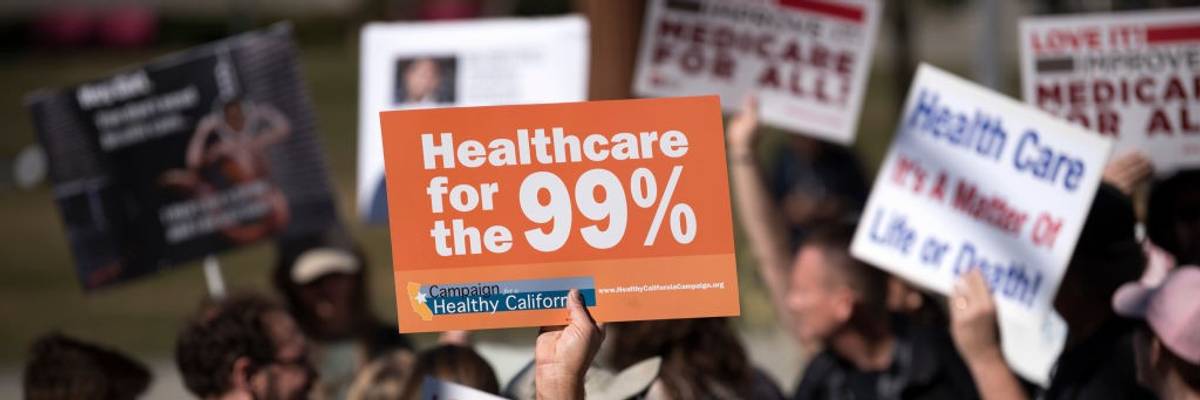
The process of getting to Medicare for All will not be easy. There are enormous political obstacles at every step. But we can get there—and make progress along the way.
The elections this month seem to have put Medicare for All back on the agenda, with even Donald Trump hinting he might support it. (Don’t count on that one.) I and many others have written on steps to get to universal Medicare. In a short piece I did a few years back, I had four major steps:
1) Lowering the Medicare age to 64;
2) Beating down the cost of health care inputs;
3) Improving the traditional Medicare program;
4) Allowing everyone to buy into Medicare.
Those still seem like the right steps. I will say a bit about all of them, but I think the big deal is really #2, getting down the costs of health care inputs. The most important item here is ending the system of government-granted patent monopolies for financing the development of drugs and medical equipment. This government policy is an invitation to corruption, and it literally creates the problem of high prices for many drugs and tests. If we are thinking big, this change really needs to be front and center. But before making the case here, I’ll spend a bit of time on other items.
I proposed 64 primarily to emphasize the need to go slow. The point here is that it is important not to overwhelm the system. We can likely add the 64-year-olds without major disruptions, perhaps even 63-year-olds and 62-year-olds, but it is crucial that a transition not bite off too much at first.
Remember when the Obamacare exchanges first went live, and the website didn’t work? That hugely undermined confidence in the program. If we add a huge swath of people to the Medicare program all at once, and Centers for Medicare and Medicaid Services is not fully prepared for the flood of people, there will be political hell to pay.
To drive home this point, consider the flood of outrage generated by the Fox News gang over Hunter Biden selling a few pictures for $50K a shot. Compare that to the extent of the controversy around the Trump kids getting multibillion-dollar government contracts for the companies in which they invest. Face it, their team does outrage far better than ours, and if we did a Medicare expansion where people were not getting the coverage they were promised, the outrage would be justified.
The original age is a starting point, not an endpoint. If we do it well, going further will be easy. Going too far will endanger the whole project. It’s also worth mentioning that soon-to-be speaker Hakeem Jeffries advocates covering kids. This is also a good route, since covering kids is cheap and 40 percent already are on Medicaid or other government insurance. The key point is to take a step towards extending coverage and doing it right to ensure that it is not the last one.
There has been a deliberate policy of allowing the quality of traditional Medicare to deteriorate to force people into Medicare Advantage plans. More than half of beneficiaries are now in Medicare Advantage plans, and the share is rising. This needs to be reversed. The main issue is the need to include coverage for vision, hearing, and dental care under traditional Medicare. When Medicare was created in 1965, none of these would have been major expenses, but the world has changed in 60 years. These should be included in Medicare now.
The other item that should be covered in Medicare is prescription drugs. Creating the separate Part D program only made sense as a handout to the insurance industry. Stand-alone drug insurance plans don’t exist in the private sector; why should they exist in Medicare? Part D needs to be rolled into traditional Medicare. In addition to being more efficient, this eliminates a major reason people opt for Medicare Advantage plans.
The other essential change is that there needs to be an out-of-pocket cap on health care expenditures in Medicare. Medicare Advantage plans are required to have an out-of-pocket cap of $9,250 or less. We can argue over the right number, but there needs to be a reasonable cap. This would eliminate the need that most beneficiaries feel for buying supplemental plans.
This is the public option that has long been proposed. The idea is to ensure that everyone has a good plan available to them. This is ostensibly what the Obamacare exchanges are supposed to do, but that has not always worked out well. And with lower administrative costs and massive market power, a Medicare buy-in should be able to offer far lower rates.
It is important that the cost be an age-adjusted rate for the population as a whole (with income-based subsidies), not the specific pool of people buying into the system. As long as most working-age people get their insurance through their jobs, the uninsured population is likely to have worse health on average than the general population. To ensure these people can get affordable insurance and avoid the risk of adverse selection worsening the pool further, the premiums should be based on the average for the population as a whole.
Given the reverence for free markets in the United States, it is remarkable how government-granted patent monopolies are accepted without question. This is a very serious problem with drugs and medical equipment both because they make them expensive, but also because they encourage corruption.
The first point cannot be emphasized enough; drugs are almost invariably cheap to manufacture and distribute. The reason that drugs can cost tens or hundreds of thousands of dollars is that the manufacturer has a monopoly on a product that is essential for people’s health or life. In the absence of these monopolies, few drugs would sell for more than $20 or $30 per prescription, and the most sophisticated medical scan would not cost much more than an X-Ray.
If drugs were sold in a free market, there would almost never be an issue with people not getting the drugs that their doctors felt were best for their treatment. It’s worth noting that the problem of insurers being reluctant to pay $50K or $100K for a drug is not really the fault of insurers.
For that sort of price, it is reasonable to have some assurance that the drug actually is needed and is better than cheaper alternatives. We would want that even if it were a government-run program with no profit motive. After all, when a company can sell a drug for $20,000 that costs it $20 to make, it has an enormous incentive to lie about its effectiveness and safety. If one of RFK Jr.’s buddies was selling some snake oil for $80k, we would want to be sure it actually had some medical value before shelling out the money.
The amount of corruption in the pharmaceutical industry cannot be overstated. My CEPR colleague Brandon Novick’s new book, Unreliable, documents how every aspect of the medical research process, including journals and the FDA approval process, is tainted as a result of the enormous amount of money at stake. This not only results in much money being wasted on ineffective drugs, it can also lead to seriously bad health outcomes, which we saw in the extreme with the opioid crisis.
If we took away the patent monopolies, we would remove the incentive to lie about the effectiveness and safety of drugs and medical equipment. This is the classic economics lesson. If you want to end the crime associated with a black market, say with alcohol and prohibition, you take the money out of it by making it legal. The same story applies with drugs and medical equipment. If we take away the patent monopolies, the incentive to mislead doctors and the public largely disappears.
It is necessary to pay for the innovation, but we don’t need patent monopolies for innovation. The federal government spends more than $50 billion a year on biomedical research through the National Institutes of Health and other government agencies. By all accounts, this research is tremendously valuable.
It’s true that the bulk of this research is more basic science, but it is only a bizarre superstition that if a larger sum were directed towards more downstream drug development, it would all be wasted. There is nothing magical about what drug companies do with the incentive of patent monopolies. There is no reason the government could not triple or quadruple the amount spent on research in order to fully replace the research supported by patents.
The country will spend close to $1 trillion ($7,500 per household) on pharmaceuticals and medical equipment in 2027. It would likely spend close to one-fifth of this amount if drugs and medical equipment were sold in a free market without patent monopolies. If it increased spending on research by $100-$150 billion to replace patent-supported research, there would still be enormous savings.
The switch to directly funded research can also fit well with a move to Medicare for All. The government has begun pushing down drug prices in Medicare with negotiations as a result of a provision in the 2022 Inflation Reduction Act. The switch to directly funded research can allow the government to move faster and farther in lowering prices. The industry’s argument against lower prices is that they will do less research. With direct funding, we don’t want them to do research. Their researchers can look to get paid through government contracts and not rely on patent monopoly pricing.
Having drugs and medical equipment selling at free market prices would do much to reduce the cost and simplify the process of providing healthcare coverage. However, the country still has serious shortages of physicians, nurses, physician assistants, and many other types of healthcare workers. Any move towards Medicare for All should be coupled with a massive effort to train more people for these occupations.
This should mean making college and medical training free. We should also look to remove unnecessary barriers that prevent qualified foreign physicians from practicing in the United States. In the case of developing countries, we should compensate them for any of their citizens who end up practicing in the United States. If we paid their governments two or three times the cost of training a physician, this would be the classic story of free trade being win-win that economists always like to talk about. The United States would get more well-trained physicians now, while developing countries would be able to train two or three doctors for every one that leaves. Reducing unnecessary licensing barriers, such as restricting nurse practitioners or physician assistants from doing tasks for which they are fully competent, should also help to ease shortages of supply.
More supply of medical professionals is essential. We need it both for lowering costs — the pay of doctors, especially highly paid specialists, needs to be brought in line with other wealthy countries — and improving care. It is not acceptable that people often need to wait months to see a doctor. Improving the accessibility of doctors and other professionals would be a benefit that people could easily see. It is essential that any move to Medicare for All be associated with an improvement in the quality of care generally, not just for the uninsured who will be gaining coverage.
The process of getting to Medicare for All will not be easy. There are enormous political obstacles at every step. Interest groups, like drug companies and insurers, will be prepared to kill to protect their profits. But it is crazy to be needlessly throwing away trillions of dollars while still not providing adequate care to much of the country. And even the people with good coverage always must worry about losing it. If the elections this month opened a pathway to Medicare for All, we have to push the politicians to take it.
This country and this world are at a monumental crossroads. US voters have an opportunity to beat back the forces of fascism and confront the billionaires who are rigging the economy, our media system, and our democracy, making it increasingly impossible for ordinary people to get by. We’re not just talking about the election. We’re talking about what must be done once these fascist elements are vanquished from power. We need a bolder set of solutions than what either major party has so far been willing to offer and a working-class movement ready to fight like hell for it. Trump didn't emerge from nowhere. The conditions that fueled MAGA authoritarianism were created by decades of radical neoliberal economic policies and a corrupt political system dominated by corporate interests. They slashed taxes on the super-rich, promising that the benefits would trickle down. They said giveaways to the corporate titans would make life more affordable for the rest of us. It was all bullshit. And when a bitter, betrayed populace searches for someone to blame, right-wing demagogues have little trouble finding scapegoats. People know when they're being lied to, but you won't hear any of this from the corporate media. Only independent journalism—powered and funded by people who believe in building a better world—can deliver truly trustworthy daily news. If you share our vision, please contribute whatever you can to sustain our work. |
The elections this month seem to have put Medicare for All back on the agenda, with even Donald Trump hinting he might support it. (Don’t count on that one.) I and many others have written on steps to get to universal Medicare. In a short piece I did a few years back, I had four major steps:
1) Lowering the Medicare age to 64;
2) Beating down the cost of health care inputs;
3) Improving the traditional Medicare program;
4) Allowing everyone to buy into Medicare.
Those still seem like the right steps. I will say a bit about all of them, but I think the big deal is really #2, getting down the costs of health care inputs. The most important item here is ending the system of government-granted patent monopolies for financing the development of drugs and medical equipment. This government policy is an invitation to corruption, and it literally creates the problem of high prices for many drugs and tests. If we are thinking big, this change really needs to be front and center. But before making the case here, I’ll spend a bit of time on other items.
I proposed 64 primarily to emphasize the need to go slow. The point here is that it is important not to overwhelm the system. We can likely add the 64-year-olds without major disruptions, perhaps even 63-year-olds and 62-year-olds, but it is crucial that a transition not bite off too much at first.
Remember when the Obamacare exchanges first went live, and the website didn’t work? That hugely undermined confidence in the program. If we add a huge swath of people to the Medicare program all at once, and Centers for Medicare and Medicaid Services is not fully prepared for the flood of people, there will be political hell to pay.
To drive home this point, consider the flood of outrage generated by the Fox News gang over Hunter Biden selling a few pictures for $50K a shot. Compare that to the extent of the controversy around the Trump kids getting multibillion-dollar government contracts for the companies in which they invest. Face it, their team does outrage far better than ours, and if we did a Medicare expansion where people were not getting the coverage they were promised, the outrage would be justified.
The original age is a starting point, not an endpoint. If we do it well, going further will be easy. Going too far will endanger the whole project. It’s also worth mentioning that soon-to-be speaker Hakeem Jeffries advocates covering kids. This is also a good route, since covering kids is cheap and 40 percent already are on Medicaid or other government insurance. The key point is to take a step towards extending coverage and doing it right to ensure that it is not the last one.
There has been a deliberate policy of allowing the quality of traditional Medicare to deteriorate to force people into Medicare Advantage plans. More than half of beneficiaries are now in Medicare Advantage plans, and the share is rising. This needs to be reversed. The main issue is the need to include coverage for vision, hearing, and dental care under traditional Medicare. When Medicare was created in 1965, none of these would have been major expenses, but the world has changed in 60 years. These should be included in Medicare now.
The other item that should be covered in Medicare is prescription drugs. Creating the separate Part D program only made sense as a handout to the insurance industry. Stand-alone drug insurance plans don’t exist in the private sector; why should they exist in Medicare? Part D needs to be rolled into traditional Medicare. In addition to being more efficient, this eliminates a major reason people opt for Medicare Advantage plans.
The other essential change is that there needs to be an out-of-pocket cap on health care expenditures in Medicare. Medicare Advantage plans are required to have an out-of-pocket cap of $9,250 or less. We can argue over the right number, but there needs to be a reasonable cap. This would eliminate the need that most beneficiaries feel for buying supplemental plans.
This is the public option that has long been proposed. The idea is to ensure that everyone has a good plan available to them. This is ostensibly what the Obamacare exchanges are supposed to do, but that has not always worked out well. And with lower administrative costs and massive market power, a Medicare buy-in should be able to offer far lower rates.
It is important that the cost be an age-adjusted rate for the population as a whole (with income-based subsidies), not the specific pool of people buying into the system. As long as most working-age people get their insurance through their jobs, the uninsured population is likely to have worse health on average than the general population. To ensure these people can get affordable insurance and avoid the risk of adverse selection worsening the pool further, the premiums should be based on the average for the population as a whole.
Given the reverence for free markets in the United States, it is remarkable how government-granted patent monopolies are accepted without question. This is a very serious problem with drugs and medical equipment both because they make them expensive, but also because they encourage corruption.
The first point cannot be emphasized enough; drugs are almost invariably cheap to manufacture and distribute. The reason that drugs can cost tens or hundreds of thousands of dollars is that the manufacturer has a monopoly on a product that is essential for people’s health or life. In the absence of these monopolies, few drugs would sell for more than $20 or $30 per prescription, and the most sophisticated medical scan would not cost much more than an X-Ray.
If drugs were sold in a free market, there would almost never be an issue with people not getting the drugs that their doctors felt were best for their treatment. It’s worth noting that the problem of insurers being reluctant to pay $50K or $100K for a drug is not really the fault of insurers.
For that sort of price, it is reasonable to have some assurance that the drug actually is needed and is better than cheaper alternatives. We would want that even if it were a government-run program with no profit motive. After all, when a company can sell a drug for $20,000 that costs it $20 to make, it has an enormous incentive to lie about its effectiveness and safety. If one of RFK Jr.’s buddies was selling some snake oil for $80k, we would want to be sure it actually had some medical value before shelling out the money.
The amount of corruption in the pharmaceutical industry cannot be overstated. My CEPR colleague Brandon Novick’s new book, Unreliable, documents how every aspect of the medical research process, including journals and the FDA approval process, is tainted as a result of the enormous amount of money at stake. This not only results in much money being wasted on ineffective drugs, it can also lead to seriously bad health outcomes, which we saw in the extreme with the opioid crisis.
If we took away the patent monopolies, we would remove the incentive to lie about the effectiveness and safety of drugs and medical equipment. This is the classic economics lesson. If you want to end the crime associated with a black market, say with alcohol and prohibition, you take the money out of it by making it legal. The same story applies with drugs and medical equipment. If we take away the patent monopolies, the incentive to mislead doctors and the public largely disappears.
It is necessary to pay for the innovation, but we don’t need patent monopolies for innovation. The federal government spends more than $50 billion a year on biomedical research through the National Institutes of Health and other government agencies. By all accounts, this research is tremendously valuable.
It’s true that the bulk of this research is more basic science, but it is only a bizarre superstition that if a larger sum were directed towards more downstream drug development, it would all be wasted. There is nothing magical about what drug companies do with the incentive of patent monopolies. There is no reason the government could not triple or quadruple the amount spent on research in order to fully replace the research supported by patents.
The country will spend close to $1 trillion ($7,500 per household) on pharmaceuticals and medical equipment in 2027. It would likely spend close to one-fifth of this amount if drugs and medical equipment were sold in a free market without patent monopolies. If it increased spending on research by $100-$150 billion to replace patent-supported research, there would still be enormous savings.
The switch to directly funded research can also fit well with a move to Medicare for All. The government has begun pushing down drug prices in Medicare with negotiations as a result of a provision in the 2022 Inflation Reduction Act. The switch to directly funded research can allow the government to move faster and farther in lowering prices. The industry’s argument against lower prices is that they will do less research. With direct funding, we don’t want them to do research. Their researchers can look to get paid through government contracts and not rely on patent monopoly pricing.
Having drugs and medical equipment selling at free market prices would do much to reduce the cost and simplify the process of providing healthcare coverage. However, the country still has serious shortages of physicians, nurses, physician assistants, and many other types of healthcare workers. Any move towards Medicare for All should be coupled with a massive effort to train more people for these occupations.
This should mean making college and medical training free. We should also look to remove unnecessary barriers that prevent qualified foreign physicians from practicing in the United States. In the case of developing countries, we should compensate them for any of their citizens who end up practicing in the United States. If we paid their governments two or three times the cost of training a physician, this would be the classic story of free trade being win-win that economists always like to talk about. The United States would get more well-trained physicians now, while developing countries would be able to train two or three doctors for every one that leaves. Reducing unnecessary licensing barriers, such as restricting nurse practitioners or physician assistants from doing tasks for which they are fully competent, should also help to ease shortages of supply.
More supply of medical professionals is essential. We need it both for lowering costs — the pay of doctors, especially highly paid specialists, needs to be brought in line with other wealthy countries — and improving care. It is not acceptable that people often need to wait months to see a doctor. Improving the accessibility of doctors and other professionals would be a benefit that people could easily see. It is essential that any move to Medicare for All be associated with an improvement in the quality of care generally, not just for the uninsured who will be gaining coverage.
The process of getting to Medicare for All will not be easy. There are enormous political obstacles at every step. Interest groups, like drug companies and insurers, will be prepared to kill to protect their profits. But it is crazy to be needlessly throwing away trillions of dollars while still not providing adequate care to much of the country. And even the people with good coverage always must worry about losing it. If the elections this month opened a pathway to Medicare for All, we have to push the politicians to take it.