5
#000000
#FFFFFF
To donate by check, phone, or other method, see our More Ways to Give page.
Daily news & progressive opinion—funded by the people, not the corporations—delivered straight to your inbox.
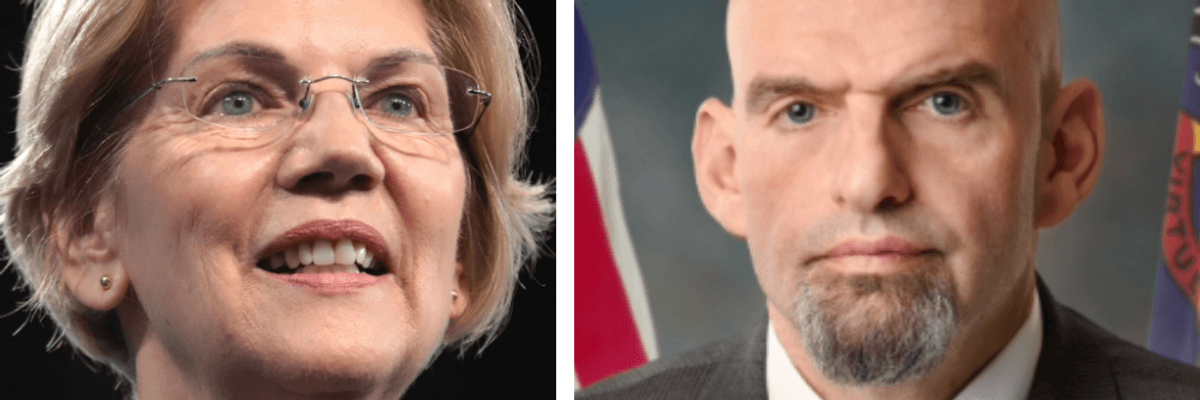
Sens. Elizabeth Warren (D-Mass.) and John Fetterman (D-Pa.) are shown side by side.
In contrast with Sen. John Fetterman's (D-Pa.) contrarian grandstanding, Sen. Elizabeth Warren (D-Mass.) has spent the last two years (and more) showing Democrats that it’s possible to reach across the aisle without losing your soul.
Democrats’ chances of taking back the Senate look better than ever, but even if November brings a blue wave, they will still not have control of the legislative and executive branches simultaneously until at least 2029.
The question facing Democratic lawmakers now is how they should conduct themselves during these wilderness years if they want to regain a trifecta in the next presidential election.
Voting down any idea the White House or GOP leadership propose without suggesting any alternative is a bad idea. More than three-quarters of Americans say they want more bipartisanship in Washington, and voters often punish opposition parties they view as do-nothing obstructionists.
Fetterman, take notes: When you vote with Republicans, do it to help working-class families buy homes, not to make sure gas prices keep going up.
But when we say Democrats should be more bipartisan, it’s important to specify what we mean. This moment has provided exemplars of two very different kinds of aisle crossing, which I’ll refer to as John Fetterman Bipartisanship and Elizabeth Warren Bipartisanship.
Sen. Fetterman’s (D-Pa.) bipartisanship is largely performative. He’s constantly appearing on Fox News to scold his fellow Democrats for calling President Donald Trump a fascist, denounce democratic socialism, defend Israel’s devastation of Gaza, or praise the giant monument to Trump’s ego that is the White House ballroom.
And when it’s not performative, it’s actively harmful. Fetterman voted to confirm disastrous Trump appointees like former Attorney General Pam Bondi and former Department of Homeland Security Secretary Kristi Noem—both of whom turned out to be too incompetent even for this administration. He voted against war powers resolutions that could have hastened the end of the costly and unnecessary conflict with Iran. He voted to end last year’s government shutdown, throwing away leverage Democrats could have used to keep healthcare affordable for millions of families. And he voted to keep funding Immigration and Customs Enforcement after agents murdered two Americans in the streets.
It’s a voting record defined by cruelty, contrarianism, and pettiness. In his home state of Pennsylvania, Republicans have rewarded him with a near 80% approval rating, and Trump is actively courting him to switch parties.
Whether he does or not, Fetterman has already betrayed the people who elected him and undermined the party whose donors and campaign arm spent over $100 million on his Senate race.
Thankfully, Fetterman Bipartisanship is not the only alternative to blind obstructionism. Sen. Elizabeth Warren (D-Mass.) has spent the last two years (and more) showing Democrats that it’s possible to reach across the aisle without losing your soul.
Last month, Warren signed a letter to the CEOs of Midwest Real Estate Data—a multiple listing service (MLS) that serves as a database for property listings in the Chicago area—and Compass, the country’s largest brokerage firm. The two had signed an agreement that hides certain listings from members of the public and makes them available only to brokers who pay a subscription fee. This practice, Warren warned, will create a “two-tiered housing market” that benefits insiders while driving up prices for regular people who have to compete for a smaller pool of homes.
Warren wasn’t the first to raise the alarm about this corrupt bargain. Rep. Scott Fitzgerald (R-Wis.) beat her to it by about two weeks. But instead of treating the MRED-Compass deal as a toxic GOP issue, Warren threw her weight behind the probe to stop corporate greed from making homeownership even more prohibitively expensive.
And speaking of affordable housing, she also co-sponsored the 21st Century ROAD to Housing Act—the most consequential federal housing legislation in 30 years. This bill cuts red tape to make home construction cheaper and easier, rewards jurisdictions that build more housing, and bans private equity from buying up homes that should go to families. And as an added bonus, Trump was too focused on disenfranchising minorities to be bothered to sign the thing. It became law without his signature, but his total lack of interest makes it easy for Democrats to claim the legislation as their win.
Fetterman, take notes: When you vote with Republicans, do it to help working-class families buy homes, not to make sure gas prices keep going up.
Warren also joined Sen. Josh Hawley (R-Mo.) to co-sponsor the Break Up Big Medicine Act and co-authored an op-ed with Sen. Bernie Moreno (R-Ohio) calling for a tax increase on the wealthy to save Social Security.
Even if these proposals never become law, they provide Democrats with a powerful argument for 2028: “We’ve been proposing solutions all along. We even tried to work with reasonable Republicans. It’s not our fault they failed, and if you vote for us, they won’t fail again.”
Calling Trump a Nazi or a threat to democracy is a great way to fire up the base, but independents are tired of hearing it. They want to know what Democrats will do to make their groceries, health insurance premiums, day care bills, mortgages, and gas station trips more affordable. We won’t win them over by parroting stale Fox News talking points, but if we can show that we care more about affordability than about partisan bickering, we might just pull it off.
Dear Common Dreams reader, It’s been nearly 30 years since I co-founded Common Dreams with my late wife, Lina Newhouser. We had the radical notion that journalism should serve the public good, not corporate profits. It was clear to us from the outset what it would take to build such a project. No paid advertisements. No corporate sponsors. No millionaire publisher telling us what to think or do. Many people said we wouldn't last a year, but we proved those doubters wrong. Together with a tremendous team of journalists and dedicated staff, we built an independent media outlet free from the constraints of profits and corporate control. Our mission has always been simple: To inform. To inspire. To ignite change for the common good. Building Common Dreams was not easy. Our survival was never guaranteed. When you take on the most powerful forces—Wall Street greed, fossil fuel industry destruction, Big Tech lobbyists, and uber-rich oligarchs who have spent billions upon billions rigging the economy and democracy in their favor—the only bulwark you have is supporters who believe in your work. But here’s the urgent message from me today. It's never been this bad out there. And it's never been this hard to keep us going. At the very moment Common Dreams is most needed, the threats we face are intensifying. We need your support now more than ever. We don't accept corporate advertising and never will. We don't have a paywall because we don't think people should be blocked from critical news based on their ability to pay. Everything we do is funded by the donations of readers like you. When everyone does the little they can afford, we are strong. But if that support retreats or dries up, so do we. Will you donate now to make sure Common Dreams not only survives but thrives? —Craig Brown, Co-founder |
Democrats’ chances of taking back the Senate look better than ever, but even if November brings a blue wave, they will still not have control of the legislative and executive branches simultaneously until at least 2029.
The question facing Democratic lawmakers now is how they should conduct themselves during these wilderness years if they want to regain a trifecta in the next presidential election.
Voting down any idea the White House or GOP leadership propose without suggesting any alternative is a bad idea. More than three-quarters of Americans say they want more bipartisanship in Washington, and voters often punish opposition parties they view as do-nothing obstructionists.
Fetterman, take notes: When you vote with Republicans, do it to help working-class families buy homes, not to make sure gas prices keep going up.
But when we say Democrats should be more bipartisan, it’s important to specify what we mean. This moment has provided exemplars of two very different kinds of aisle crossing, which I’ll refer to as John Fetterman Bipartisanship and Elizabeth Warren Bipartisanship.
Sen. Fetterman’s (D-Pa.) bipartisanship is largely performative. He’s constantly appearing on Fox News to scold his fellow Democrats for calling President Donald Trump a fascist, denounce democratic socialism, defend Israel’s devastation of Gaza, or praise the giant monument to Trump’s ego that is the White House ballroom.
And when it’s not performative, it’s actively harmful. Fetterman voted to confirm disastrous Trump appointees like former Attorney General Pam Bondi and former Department of Homeland Security Secretary Kristi Noem—both of whom turned out to be too incompetent even for this administration. He voted against war powers resolutions that could have hastened the end of the costly and unnecessary conflict with Iran. He voted to end last year’s government shutdown, throwing away leverage Democrats could have used to keep healthcare affordable for millions of families. And he voted to keep funding Immigration and Customs Enforcement after agents murdered two Americans in the streets.
It’s a voting record defined by cruelty, contrarianism, and pettiness. In his home state of Pennsylvania, Republicans have rewarded him with a near 80% approval rating, and Trump is actively courting him to switch parties.
Whether he does or not, Fetterman has already betrayed the people who elected him and undermined the party whose donors and campaign arm spent over $100 million on his Senate race.
Thankfully, Fetterman Bipartisanship is not the only alternative to blind obstructionism. Sen. Elizabeth Warren (D-Mass.) has spent the last two years (and more) showing Democrats that it’s possible to reach across the aisle without losing your soul.
Last month, Warren signed a letter to the CEOs of Midwest Real Estate Data—a multiple listing service (MLS) that serves as a database for property listings in the Chicago area—and Compass, the country’s largest brokerage firm. The two had signed an agreement that hides certain listings from members of the public and makes them available only to brokers who pay a subscription fee. This practice, Warren warned, will create a “two-tiered housing market” that benefits insiders while driving up prices for regular people who have to compete for a smaller pool of homes.
Warren wasn’t the first to raise the alarm about this corrupt bargain. Rep. Scott Fitzgerald (R-Wis.) beat her to it by about two weeks. But instead of treating the MRED-Compass deal as a toxic GOP issue, Warren threw her weight behind the probe to stop corporate greed from making homeownership even more prohibitively expensive.
And speaking of affordable housing, she also co-sponsored the 21st Century ROAD to Housing Act—the most consequential federal housing legislation in 30 years. This bill cuts red tape to make home construction cheaper and easier, rewards jurisdictions that build more housing, and bans private equity from buying up homes that should go to families. And as an added bonus, Trump was too focused on disenfranchising minorities to be bothered to sign the thing. It became law without his signature, but his total lack of interest makes it easy for Democrats to claim the legislation as their win.
Fetterman, take notes: When you vote with Republicans, do it to help working-class families buy homes, not to make sure gas prices keep going up.
Warren also joined Sen. Josh Hawley (R-Mo.) to co-sponsor the Break Up Big Medicine Act and co-authored an op-ed with Sen. Bernie Moreno (R-Ohio) calling for a tax increase on the wealthy to save Social Security.
Even if these proposals never become law, they provide Democrats with a powerful argument for 2028: “We’ve been proposing solutions all along. We even tried to work with reasonable Republicans. It’s not our fault they failed, and if you vote for us, they won’t fail again.”
Calling Trump a Nazi or a threat to democracy is a great way to fire up the base, but independents are tired of hearing it. They want to know what Democrats will do to make their groceries, health insurance premiums, day care bills, mortgages, and gas station trips more affordable. We won’t win them over by parroting stale Fox News talking points, but if we can show that we care more about affordability than about partisan bickering, we might just pull it off.
Democrats’ chances of taking back the Senate look better than ever, but even if November brings a blue wave, they will still not have control of the legislative and executive branches simultaneously until at least 2029.
The question facing Democratic lawmakers now is how they should conduct themselves during these wilderness years if they want to regain a trifecta in the next presidential election.
Voting down any idea the White House or GOP leadership propose without suggesting any alternative is a bad idea. More than three-quarters of Americans say they want more bipartisanship in Washington, and voters often punish opposition parties they view as do-nothing obstructionists.
Fetterman, take notes: When you vote with Republicans, do it to help working-class families buy homes, not to make sure gas prices keep going up.
But when we say Democrats should be more bipartisan, it’s important to specify what we mean. This moment has provided exemplars of two very different kinds of aisle crossing, which I’ll refer to as John Fetterman Bipartisanship and Elizabeth Warren Bipartisanship.
Sen. Fetterman’s (D-Pa.) bipartisanship is largely performative. He’s constantly appearing on Fox News to scold his fellow Democrats for calling President Donald Trump a fascist, denounce democratic socialism, defend Israel’s devastation of Gaza, or praise the giant monument to Trump’s ego that is the White House ballroom.
And when it’s not performative, it’s actively harmful. Fetterman voted to confirm disastrous Trump appointees like former Attorney General Pam Bondi and former Department of Homeland Security Secretary Kristi Noem—both of whom turned out to be too incompetent even for this administration. He voted against war powers resolutions that could have hastened the end of the costly and unnecessary conflict with Iran. He voted to end last year’s government shutdown, throwing away leverage Democrats could have used to keep healthcare affordable for millions of families. And he voted to keep funding Immigration and Customs Enforcement after agents murdered two Americans in the streets.
It’s a voting record defined by cruelty, contrarianism, and pettiness. In his home state of Pennsylvania, Republicans have rewarded him with a near 80% approval rating, and Trump is actively courting him to switch parties.
Whether he does or not, Fetterman has already betrayed the people who elected him and undermined the party whose donors and campaign arm spent over $100 million on his Senate race.
Thankfully, Fetterman Bipartisanship is not the only alternative to blind obstructionism. Sen. Elizabeth Warren (D-Mass.) has spent the last two years (and more) showing Democrats that it’s possible to reach across the aisle without losing your soul.
Last month, Warren signed a letter to the CEOs of Midwest Real Estate Data—a multiple listing service (MLS) that serves as a database for property listings in the Chicago area—and Compass, the country’s largest brokerage firm. The two had signed an agreement that hides certain listings from members of the public and makes them available only to brokers who pay a subscription fee. This practice, Warren warned, will create a “two-tiered housing market” that benefits insiders while driving up prices for regular people who have to compete for a smaller pool of homes.
Warren wasn’t the first to raise the alarm about this corrupt bargain. Rep. Scott Fitzgerald (R-Wis.) beat her to it by about two weeks. But instead of treating the MRED-Compass deal as a toxic GOP issue, Warren threw her weight behind the probe to stop corporate greed from making homeownership even more prohibitively expensive.
And speaking of affordable housing, she also co-sponsored the 21st Century ROAD to Housing Act—the most consequential federal housing legislation in 30 years. This bill cuts red tape to make home construction cheaper and easier, rewards jurisdictions that build more housing, and bans private equity from buying up homes that should go to families. And as an added bonus, Trump was too focused on disenfranchising minorities to be bothered to sign the thing. It became law without his signature, but his total lack of interest makes it easy for Democrats to claim the legislation as their win.
Fetterman, take notes: When you vote with Republicans, do it to help working-class families buy homes, not to make sure gas prices keep going up.
Warren also joined Sen. Josh Hawley (R-Mo.) to co-sponsor the Break Up Big Medicine Act and co-authored an op-ed with Sen. Bernie Moreno (R-Ohio) calling for a tax increase on the wealthy to save Social Security.
Even if these proposals never become law, they provide Democrats with a powerful argument for 2028: “We’ve been proposing solutions all along. We even tried to work with reasonable Republicans. It’s not our fault they failed, and if you vote for us, they won’t fail again.”
Calling Trump a Nazi or a threat to democracy is a great way to fire up the base, but independents are tired of hearing it. They want to know what Democrats will do to make their groceries, health insurance premiums, day care bills, mortgages, and gas station trips more affordable. We won’t win them over by parroting stale Fox News talking points, but if we can show that we care more about affordability than about partisan bickering, we might just pull it off.