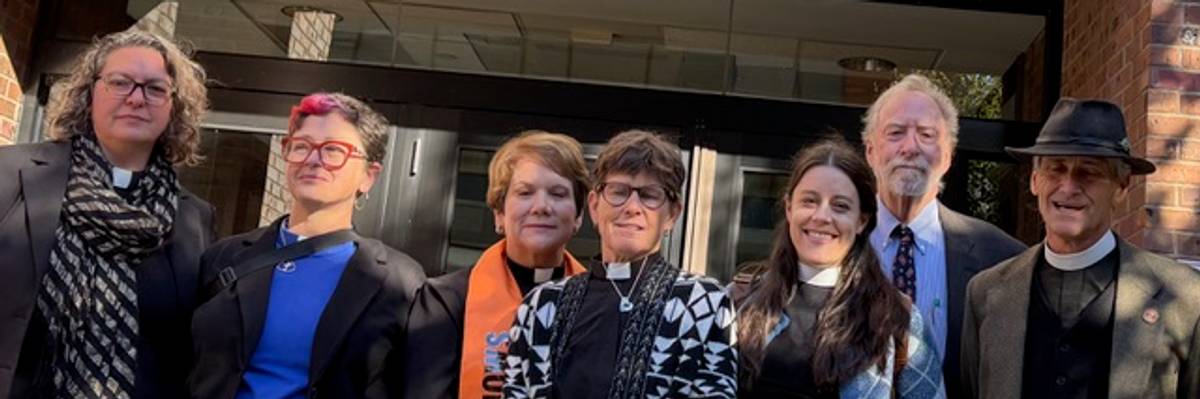
Left to right: Rebecca Girrell, Karen Johnston, Jessica Derise, Susan McMillan, Elizabeth Gleich, Robert Appel, and Earl Kooperkamp stand outside the Vermont Superior Court; Catherine Bockappeared by Zoom.
'We Will Not Be Deterred': Faith Leaders Defend Trespassing on ICE in Vermont
The leaders’ civil disobedience action spotlights the fact that, as some protesters put it, “ICE violence begins in Vermont.”
On a glowing September day in Vermont, most people were working or taking a walk in the woods or raking leaves or just being thankful for the beauty. Instead, seven faith leaders blocked the entrance to Immigration and Custom Enforcement’s National Criminal Analysis and Targeting Center with their bodies.
Protesting wanton and intentional cruelty all around the country, the seven prayed, sang, and spoke about how their beliefs—Methodist, Congregational, Unitarian, Episcopal, and Quaker—compelled them to obstruct access to the Targeting Center which launches many ICE raids. The seven stood up and witnessed to the universal principles that all major world religions teach us: Do no harm, love your neighbor, care for the needy, and welcome the stranger in our midst. They read the names of some who died in ICE custody, or were murdered by agents. For these actions they were arrested, carried off, and booked, then prosecuted and arraigned in late October.
The leaders’ civil disobedience action spotlights the fact that, as some protesters put it, “ICE violence begins in Vermont.” Many ICE raids start in Williston, where 2 of the 3 national ICE Targeting Operations Division Centers are lodged in unmarked buildings. In the inconspicuous White Cap mini-mall surrounded by pine trees, the Targeting Center where the leaders protested sits next to a dentist, a medical imaging office, a café, and the local newspaper’s circulation staff. As if the ICE center were just one more office. But its job is surveillance of social media and multiple databases to help ICE target which individuals to pursue everywhere, leading to thousands of people being hunted down and whisked away, sometimes injured or even killed. In the second Trump administration, more than 600,000 have been detained.
“We are not the first of the people arrested there and we will not be the last. We will continue as long as it takes to stop ICE for good.”
After the faith leaders’ blockade, more people rallied, and October began with a full Week of Action to expose and protest the ICE presence in Williston, a former Abenaki hunting ground which became a dairy and agricultural center, then urban sprawl. The first of the week’s actions was a nationally publicized funeral for those who have been murdered or died in ICE custody, and the week culminated in a peaceful protest on the front porch of the ICE Law Enforcement Resource Center (the second Center in Williston). The festive scene was set with a floral couch, a rug, music, and song—plus lots of chalked admonitions on the building and driveway like, “You don’t have to erase this,” and handwritten notes taped to the windows.
Rather than confront the peaceful protesters, ICE withdrew; the word was that many local personnel had been sent home for the week. Only two local police kept a respectful distance in the almost empty parking lot, appearing briefly and politely when a camera had been covered up. It was a far cry from the debacle of March 12, when ICE officials insisted on precipitating a massive confrontation involving their own officers plus dozens of state troopers and local police—to pursue three people for whom they didn’t have a warrant, who were ultimately released.
Last week, the focus was back on the faith leaders, who were arraigned in Vermont Superior Court. The State Police (who arrested them) bypassed the local prosecutor Sarah George, who earlier said she has better things to do with taxpayer dollars than prosecute people who are peacefully protesting ICE. At that time, the Democratic State Attorney General, Charity Clark, disagreed, even though she herself has engaged in public protest at times, including at ICE. She feels that she cannot pick and choose whom to prosecute for political reasons. Her decision to go after a number of anti-ICE activists has riled up some of her supporters, particularly those who applaud her relentless pursuit of more than 70 lawsuits against Trump.
The faith leaders’ arraignment was much lower key than the prominent cases in nearby Federal District Court (such as those of Rumeysa Ozturk, Kseniia Petrova, and Mohsen Mahdawi). Spectators could even keep our phones and car keys. Outside the courtroom, a young Black man in dreads wearing a T-shirt with a clenched fist told me and a couple of men in clerical garb which door was ours. The benches inside were less comfy than the feds’, but the greater closeness to Judge Colin Owyang made up for it. Soon the court was packed with supporters for six women and one man: a United Methodist minister, two United Church of Christ ministers, an Episcopal priest and the archdeacon of the Episcopal Diocese of Vermont, a Quaker leader, and a Unitarian Universalist minister (in alphabetical order Catherine Bock, 78; Jessica Derise, 54; Rebecca Girrell, 47; Elizabeth Gleich, 36; Karen Johnston, 58; Earl Kooperkamp, 69; and Susan McMillan, 65). People were chuckling and chatting as they rarely do in the more formal federal court.
The faith leaders were called on one by one, each pleading not guilty. The rulings were uniform. The leaders were not to visit the ICE facility except in the context of their “lawful pastoral duties.” They were to avoid contact with the property manager. They were not to discuss the case among themselves except with a written joint defense agreement (which they executed before leaving the courthouse).
One moment of humor occurred when the visibly pregnant Rev. Gleich appeared. After the judge stated the followup court date, he said “subject to contingencies” with a smile.
“If I’m actively giving birth, I won’t be here,” said the Rev. Gleich with a sparkle in her voice.
“In that case,” said the prosecutor, “the state would not seek a warrant.”
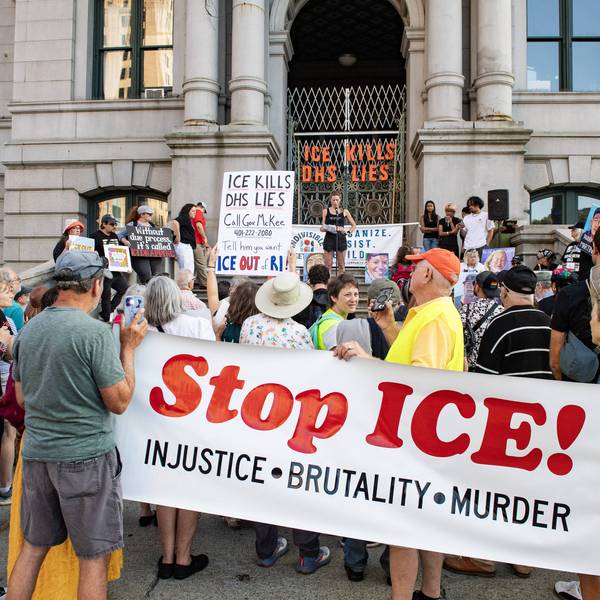
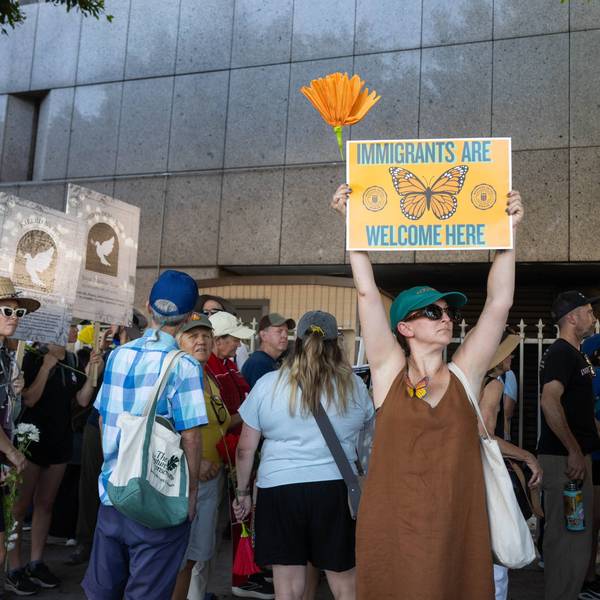
Coming out of the courthouse, a huge “ICE OUT OF WHITE CAP” sign greeted us across the street, as well as numerous supporters. I was especially moved to see the 90-year-old daughter of a Dutch resister to the Nazis, an indefatigable presence for democracy all her adult life. When the faith leaders emerged with their noted human rights attorney Robert Appel, there was a huge cheer. They spoke sequentially to reinforce their message, each in a strong, bold voice accustomed to a pulpit. They said that the rulings represented an “escalation of judicial tactics” versus the fewer conditions meted out to earlier protesters.
Their words were powerful: “Join us in standing with our friends and neighbors against the lawlessness of ICE.”
“Violating human and civil rights is the real crime which must be stopped.”
Bringing people to court on these minor charges “is a poor use of resources and an ineffective scare tactic.”
“We will not be deterred. We will continue to sit and stand and kneel and pray.”
They emphasized the importance of this particular Targeting Center in terrorizing communities and persecuting people with no criminal history: “We are not the first of the people arrested there and we will not be the last. We will continue as long as it takes to stop ICE for good.”
To be continued, as the days darken and winter sets in. And if the last few months are any indication, they will be far from alone.
We are at a crossroads
This country and this world are at a monumental crossroads. In a few short weeks, US voters will have an opportunity to beat back the forces of fascism and confront the billionaires who are rigging the economy, our media system, and our democracy, making it increasingly impossible for ordinary people to get by. We’re not just talking about the election. We’re talking about what must be done once these fascist elements are vanquished from power. We need a bolder set of solutions than what either major party has so far been willing to offer and a working-class movement ready to fight like hell for it. Trump didn't emerge from nowhere. The conditions that fueled MAGA authoritarianism were created by decades of radical neoliberal economic policies and a corrupt political system dominated by corporate interests. They slashed taxes on the super-rich, promising that the benefits would trickle down. They said giveaways to the corporate titans would make life more affordable for the rest of us. It was all bullshit. And when a bitter, betrayed populace searches for someone to blame, right-wing demagogues have little trouble finding scapegoats. People know when they're being lied to, but you won't hear any of this from the corporate media. Only independent journalism—powered and funded by people who believe in building a better world—can deliver truly trustworthy daily news. Our Fall Campaign is underway, and we need your help. To power our newsroom through the rest of the year, we need to raise $125,000 by midnight on October 31. So if you share our vision, please contribute whatever you can to sustain our work. |
Mary Dingee Fillmore is the author of An Address in Amsterdam, an historical novel about a young Jewish woman who risks her life in the anti-Nazi underground. Based on her 13 years of research for this 2017 Kirkus Indie Book of the Month, Mary speaks widely on “Resistance Then and Now: Learning from the Dutch.”
On a glowing September day in Vermont, most people were working or taking a walk in the woods or raking leaves or just being thankful for the beauty. Instead, seven faith leaders blocked the entrance to Immigration and Custom Enforcement’s National Criminal Analysis and Targeting Center with their bodies.
Protesting wanton and intentional cruelty all around the country, the seven prayed, sang, and spoke about how their beliefs—Methodist, Congregational, Unitarian, Episcopal, and Quaker—compelled them to obstruct access to the Targeting Center which launches many ICE raids. The seven stood up and witnessed to the universal principles that all major world religions teach us: Do no harm, love your neighbor, care for the needy, and welcome the stranger in our midst. They read the names of some who died in ICE custody, or were murdered by agents. For these actions they were arrested, carried off, and booked, then prosecuted and arraigned in late October.
The leaders’ civil disobedience action spotlights the fact that, as some protesters put it, “ICE violence begins in Vermont.” Many ICE raids start in Williston, where 2 of the 3 national ICE Targeting Operations Division Centers are lodged in unmarked buildings. In the inconspicuous White Cap mini-mall surrounded by pine trees, the Targeting Center where the leaders protested sits next to a dentist, a medical imaging office, a café, and the local newspaper’s circulation staff. As if the ICE center were just one more office. But its job is surveillance of social media and multiple databases to help ICE target which individuals to pursue everywhere, leading to thousands of people being hunted down and whisked away, sometimes injured or even killed. In the second Trump administration, more than 600,000 have been detained.
“We are not the first of the people arrested there and we will not be the last. We will continue as long as it takes to stop ICE for good.”
After the faith leaders’ blockade, more people rallied, and October began with a full Week of Action to expose and protest the ICE presence in Williston, a former Abenaki hunting ground which became a dairy and agricultural center, then urban sprawl. The first of the week’s actions was a nationally publicized funeral for those who have been murdered or died in ICE custody, and the week culminated in a peaceful protest on the front porch of the ICE Law Enforcement Resource Center (the second Center in Williston). The festive scene was set with a floral couch, a rug, music, and song—plus lots of chalked admonitions on the building and driveway like, “You don’t have to erase this,” and handwritten notes taped to the windows.
Rather than confront the peaceful protesters, ICE withdrew; the word was that many local personnel had been sent home for the week. Only two local police kept a respectful distance in the almost empty parking lot, appearing briefly and politely when a camera had been covered up. It was a far cry from the debacle of March 12, when ICE officials insisted on precipitating a massive confrontation involving their own officers plus dozens of state troopers and local police—to pursue three people for whom they didn’t have a warrant, who were ultimately released.
Last week, the focus was back on the faith leaders, who were arraigned in Vermont Superior Court. The State Police (who arrested them) bypassed the local prosecutor Sarah George, who earlier said she has better things to do with taxpayer dollars than prosecute people who are peacefully protesting ICE. At that time, the Democratic State Attorney General, Charity Clark, disagreed, even though she herself has engaged in public protest at times, including at ICE. She feels that she cannot pick and choose whom to prosecute for political reasons. Her decision to go after a number of anti-ICE activists has riled up some of her supporters, particularly those who applaud her relentless pursuit of more than 70 lawsuits against Trump.
The faith leaders’ arraignment was much lower key than the prominent cases in nearby Federal District Court (such as those of Rumeysa Ozturk, Kseniia Petrova, and Mohsen Mahdawi). Spectators could even keep our phones and car keys. Outside the courtroom, a young Black man in dreads wearing a T-shirt with a clenched fist told me and a couple of men in clerical garb which door was ours. The benches inside were less comfy than the feds’, but the greater closeness to Judge Colin Owyang made up for it. Soon the court was packed with supporters for six women and one man: a United Methodist minister, two United Church of Christ ministers, an Episcopal priest and the archdeacon of the Episcopal Diocese of Vermont, a Quaker leader, and a Unitarian Universalist minister (in alphabetical order Catherine Bock, 78; Jessica Derise, 54; Rebecca Girrell, 47; Elizabeth Gleich, 36; Karen Johnston, 58; Earl Kooperkamp, 69; and Susan McMillan, 65). People were chuckling and chatting as they rarely do in the more formal federal court.
The faith leaders were called on one by one, each pleading not guilty. The rulings were uniform. The leaders were not to visit the ICE facility except in the context of their “lawful pastoral duties.” They were to avoid contact with the property manager. They were not to discuss the case among themselves except with a written joint defense agreement (which they executed before leaving the courthouse).
One moment of humor occurred when the visibly pregnant Rev. Gleich appeared. After the judge stated the followup court date, he said “subject to contingencies” with a smile.
“If I’m actively giving birth, I won’t be here,” said the Rev. Gleich with a sparkle in her voice.
“In that case,” said the prosecutor, “the state would not seek a warrant.”
Coming out of the courthouse, a huge “ICE OUT OF WHITE CAP” sign greeted us across the street, as well as numerous supporters. I was especially moved to see the 90-year-old daughter of a Dutch resister to the Nazis, an indefatigable presence for democracy all her adult life. When the faith leaders emerged with their noted human rights attorney Robert Appel, there was a huge cheer. They spoke sequentially to reinforce their message, each in a strong, bold voice accustomed to a pulpit. They said that the rulings represented an “escalation of judicial tactics” versus the fewer conditions meted out to earlier protesters.
Their words were powerful: “Join us in standing with our friends and neighbors against the lawlessness of ICE.”
“Violating human and civil rights is the real crime which must be stopped.”
Bringing people to court on these minor charges “is a poor use of resources and an ineffective scare tactic.”
“We will not be deterred. We will continue to sit and stand and kneel and pray.”
They emphasized the importance of this particular Targeting Center in terrorizing communities and persecuting people with no criminal history: “We are not the first of the people arrested there and we will not be the last. We will continue as long as it takes to stop ICE for good.”
To be continued, as the days darken and winter sets in. And if the last few months are any indication, they will be far from alone.
- 'Step Up and Speak Out': Chicago Pastors Lead the Charge Against ICE Detentions ›
- 'Not an Anomaly... A Blueprint': Homan Says Minnesota ICE Surge Ending—But Mass Deportations Aren't ›
- "It Doesn't Have to Be This Way": Faith Leaders Rally at Detention Center Demanding End to Inhumane Treatment of Immigrants ›
- 'The Power of Christ Compels You!' CodePink Priest Goes Full Exorcist on Kristi Noem at House Hearing ›
- Tears Alone Won’t be Enough: Dispatch From the Front Lines in Minneapolis ›
- 'This Is Not of God': Faith Leaders Demand Release of Pastors, End to ICE 'Terror' ›