SUBSCRIBE TO OUR FREE NEWSLETTER
Daily news & progressive opinion—funded by the people, not the corporations—delivered straight to your inbox.
5
#000000
#FFFFFF
To donate by check, phone, or other method, see our More Ways to Give page.
Daily news & progressive opinion—funded by the people, not the corporations—delivered straight to your inbox.
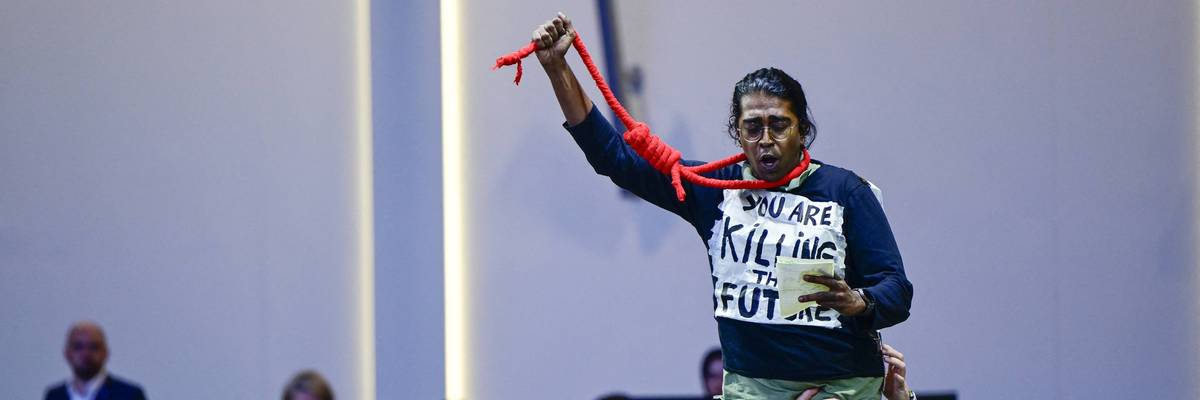
A person protests during a closing plenary meeting attended by the COP31 president during the United Nations Climate Change Conference (COP31) at the Antalya Expo Centre, in Antalya, Türkiye, on November 20, 2026.
The climate crisis is a problem that requires solidarity and cooperation based on equity—our collective survival on this planet demands it. Climate leaders are those who are ready to stop funding destruction abroad and instead fund resilience everywhere.
Dear European Union leaders,
In the final hours of COP31 in Antalya, you rejected the final text on the basis that it did not include language on fossil fuels. In your statements, Irish climate minister Darragh O’Brien, on behalf of the EU, stated that you “could not in good conscience” accept the text. For us, maybe the most shocking assertion of COP31 lies in that statement; the EU claims to have a conscience.
EU countries came to Antalya with “road maps” to transition away from fossil fuels, these are at best restatements of existing policy, and none of them live up to the action that is needed. Civil society came to this COP with the hope that we would see the just transition mechanism, hard won in Belém, realised in Antalya. The EU, alongside other Global North countries, destroyed this hope. Now you present yourselves as leaders in the fight against fossil fuels, and from a distance, the world admires the emperor’s new clothes.
At COP31, governments contributed a historically low $50 million to the adaptation fund, an amount that civil society estimates is half the price of an F-35 fighter jet.
This year, we heard that overshooting the 1.5°C degree target is now inevitable; meeting the urgency of this moment requires every country to act rapidly, based on their respective capacities and historical responsibility for causing the climate crisis. An analysis by civil society found that Global North countries' national commitments are falling dramatically short of their fair share of the global mitigation effort. Commitments by Global North countries, including those within the EU, show that the gap between commitments and responsibility is getting wider. Whereas Global South countries are meeting, or close to meeting, their fair share of the mitigation effort. As a result of decades of inaction and obstruction, domestic emissions reductions in the EU are not enough: In order to be able to do their fair share, the EU must also provide finance for mitigation abroad.
The EU continuously chooses to place the blame for their own shortcomings on the Global South. At the 2026 Bonn climate talks, Global South countries asked the scientific community to enhance analysis of equity when drawing out mitigation pathways. These countries were then accused of being “anti-science” by parties including the European Union. Current global mitigation pathways continue to assume high fossil fuel consumption in the Global North, well above their fair share. This overconsumption is then magically accounted for through unprecedented amounts of carbon dioxide removal that threaten food security in the Global South. The EU has also said that it will not support the inclusion of equity in climate modelling as a research gap.
Provision of public finance is what unlocks the equitable ambition gap equation. It is what enables the Global South to address the climate crisis and enables the Global North to meet their fair share. As Meena Raman, deputy director of Third World Network put it: ‘’We cannot DIY ourselves out of the climate crisis. If poor countries could DIY, we wouldn't have come here.’’ The fair share framework debunks the false dichotomy between science and equity: Put simply, the ambition gap is an equity gap.
For many in the Global South, including in Kenya, a country which is bearing the brunt of a crisis it had the least role in causing and whose fiscal space is constrained by unjust debt burdens, provision of public finance represents hope. It is this very finance that the EU’s climate commissioner Woepke Hoekstra said ‘’was dead in the water’’ At COP31. The EU prevented strong outcomes on the climate finance work program by refusing to engage with the text, instead reducing the talks to procedural matters and talk about the expansion of the contributor base. The work program was set to hold Global North countries accountable under Article 9 of the Paris Agreement. Distractions and attempts to evade responsibility do not change the reality: You have a moral obligation and responsibility to provide the finance necessary for a just transition. Without finance at the scale required, global climate negotiations will remain trapped along the same fault lines: mitigation without the means to implement it, and demands for ambition without accountability for finance.
In 2027, Africans, led by the Ethiopian government, will be welcoming the world to Africa for COP32. African civil society will be awaiting climate reparations. The finance isn't dead in the water, it is funneled into ever-expanding wars which, according to data on EU military spending from Stockholm International Peace Research Institute, rose by 14% to $864 billion in 2025. Comparatively, at COP31, governments contributed a historically low $50 million to the adaptation fund, an amount that civil society estimates is half the price of an F-35 fighter jet. From the perspective of a climate-vulnerable country in East Africa, where rich countries only meet 4% of the funds required to address the climate crisis, the EU’s climate “leadership” barely registers. To us, the statement “new finance is dead in the water’’ is tantamount to an act of violence.
The climate crisis is a problem that requires solidarity and cooperation based on equity—our collective survival on this planet demands it. Climate leaders are those who are ready to stop funding destruction abroad and instead fund resilience everywhere. This finance is not charity. It is what justice demands.
This country and this world are at a monumental crossroads. US voters have an opportunity to beat back the forces of fascism and confront the billionaires who are rigging the economy, our media system, and our democracy, making it increasingly impossible for ordinary people to get by. We’re not just talking about the election. We’re talking about what must be done once these fascist elements are vanquished from power. We need a bolder set of solutions than what either major party has so far been willing to offer and a working-class movement ready to fight like hell for it. Trump didn't emerge from nowhere. The conditions that fueled MAGA authoritarianism were created by decades of radical neoliberal economic policies and a corrupt political system dominated by corporate interests. They slashed taxes on the super-rich, promising that the benefits would trickle down. They said giveaways to the corporate titans would make life more affordable for the rest of us. It was all bullshit. And when a bitter, betrayed populace searches for someone to blame, right-wing demagogues have little trouble finding scapegoats. People know when they're being lied to, but you won't hear any of this from the corporate media. Only independent journalism—powered and funded by people who believe in building a better world—can deliver truly trustworthy daily news. If you share our vision, please contribute whatever you can to sustain our work. |
Dear European Union leaders,
In the final hours of COP31 in Antalya, you rejected the final text on the basis that it did not include language on fossil fuels. In your statements, Irish climate minister Darragh O’Brien, on behalf of the EU, stated that you “could not in good conscience” accept the text. For us, maybe the most shocking assertion of COP31 lies in that statement; the EU claims to have a conscience.
EU countries came to Antalya with “road maps” to transition away from fossil fuels, these are at best restatements of existing policy, and none of them live up to the action that is needed. Civil society came to this COP with the hope that we would see the just transition mechanism, hard won in Belém, realised in Antalya. The EU, alongside other Global North countries, destroyed this hope. Now you present yourselves as leaders in the fight against fossil fuels, and from a distance, the world admires the emperor’s new clothes.
At COP31, governments contributed a historically low $50 million to the adaptation fund, an amount that civil society estimates is half the price of an F-35 fighter jet.
This year, we heard that overshooting the 1.5°C degree target is now inevitable; meeting the urgency of this moment requires every country to act rapidly, based on their respective capacities and historical responsibility for causing the climate crisis. An analysis by civil society found that Global North countries' national commitments are falling dramatically short of their fair share of the global mitigation effort. Commitments by Global North countries, including those within the EU, show that the gap between commitments and responsibility is getting wider. Whereas Global South countries are meeting, or close to meeting, their fair share of the mitigation effort. As a result of decades of inaction and obstruction, domestic emissions reductions in the EU are not enough: In order to be able to do their fair share, the EU must also provide finance for mitigation abroad.
The EU continuously chooses to place the blame for their own shortcomings on the Global South. At the 2026 Bonn climate talks, Global South countries asked the scientific community to enhance analysis of equity when drawing out mitigation pathways. These countries were then accused of being “anti-science” by parties including the European Union. Current global mitigation pathways continue to assume high fossil fuel consumption in the Global North, well above their fair share. This overconsumption is then magically accounted for through unprecedented amounts of carbon dioxide removal that threaten food security in the Global South. The EU has also said that it will not support the inclusion of equity in climate modelling as a research gap.
Provision of public finance is what unlocks the equitable ambition gap equation. It is what enables the Global South to address the climate crisis and enables the Global North to meet their fair share. As Meena Raman, deputy director of Third World Network put it: ‘’We cannot DIY ourselves out of the climate crisis. If poor countries could DIY, we wouldn't have come here.’’ The fair share framework debunks the false dichotomy between science and equity: Put simply, the ambition gap is an equity gap.
For many in the Global South, including in Kenya, a country which is bearing the brunt of a crisis it had the least role in causing and whose fiscal space is constrained by unjust debt burdens, provision of public finance represents hope. It is this very finance that the EU’s climate commissioner Woepke Hoekstra said ‘’was dead in the water’’ At COP31. The EU prevented strong outcomes on the climate finance work program by refusing to engage with the text, instead reducing the talks to procedural matters and talk about the expansion of the contributor base. The work program was set to hold Global North countries accountable under Article 9 of the Paris Agreement. Distractions and attempts to evade responsibility do not change the reality: You have a moral obligation and responsibility to provide the finance necessary for a just transition. Without finance at the scale required, global climate negotiations will remain trapped along the same fault lines: mitigation without the means to implement it, and demands for ambition without accountability for finance.
In 2027, Africans, led by the Ethiopian government, will be welcoming the world to Africa for COP32. African civil society will be awaiting climate reparations. The finance isn't dead in the water, it is funneled into ever-expanding wars which, according to data on EU military spending from Stockholm International Peace Research Institute, rose by 14% to $864 billion in 2025. Comparatively, at COP31, governments contributed a historically low $50 million to the adaptation fund, an amount that civil society estimates is half the price of an F-35 fighter jet. From the perspective of a climate-vulnerable country in East Africa, where rich countries only meet 4% of the funds required to address the climate crisis, the EU’s climate “leadership” barely registers. To us, the statement “new finance is dead in the water’’ is tantamount to an act of violence.
The climate crisis is a problem that requires solidarity and cooperation based on equity—our collective survival on this planet demands it. Climate leaders are those who are ready to stop funding destruction abroad and instead fund resilience everywhere. This finance is not charity. It is what justice demands.