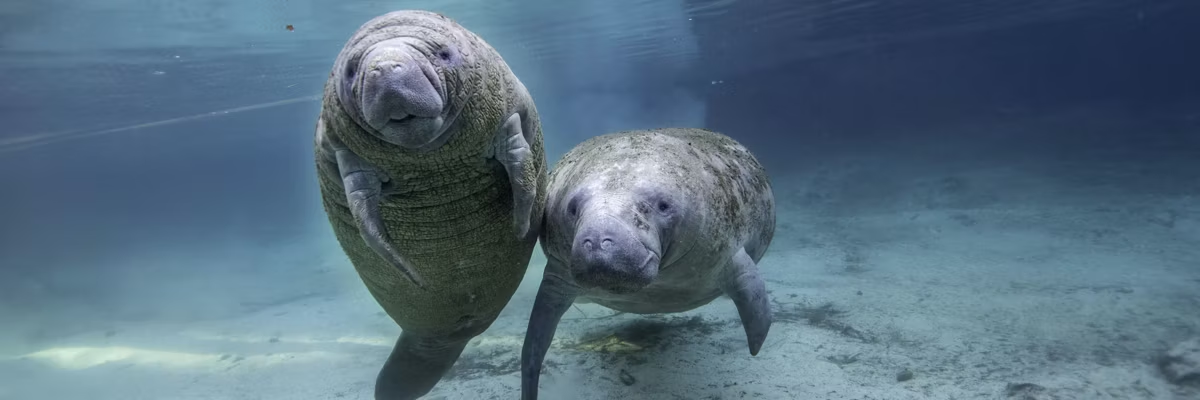
Baby and juvenile manatees swim together in a freshwater spring in Florida.
We Are Closer Than We Think to Losing Our Wild Neighbors
You do not need to fire a shot to kill an animal and imperil its entire species’ existence—you only need to take away the place it lives. A Trump administration Endangered Species Act rollback would do just that.
There is a vision of this country that still exists to anyone who grew up near its wild places: manatees drifting beneath a dock, Florida leafwing butterflies fluttering through the wind, yellow-billed cuckoos migrating in the spring and fall. For generations of Americans, these were not rare sightings. They were proof that people and wildlife could share the same natural inheritance
That inheritance is now under direct threat, and the erosion is no longer incremental. It is accelerating at an unprecedented pace.
Earlier this month, the Trump administration formally rescinded the regulatory definition of "harm" under the Endangered Species Act (ESA)—a single word that has helped to protect this nation's imperiled wildlife for more than 50 years. For decades, "harm" was understood to include not just the direct killing or injuring of an endangered animal, but the destruction or degradation of the habitat that animal depends on to breed, feed, migrate, or shelter. That understanding was not a bureaucratic technicality. It was the legal recognition of a basic ecological truth: An animal cannot survive the loss of its home and its resources for daily living any more than a person can. Each of these species has a story that will end the same way without habitat protection: not a quick death by bullet but a slow death by a thousand cuts.
Remove that definition, and you remove the government's ability to regulate clear-cutting old growth forest filled with an endangered bird’s nesting sites, draining a wetland key for an endangered frog’s breeding, or dumping pollution into the lagoon where sea turtles and marine mammals graze. You do not need to fire a shot to kill an animal and imperil its entire species’ existence. You only need to take away the place it lives.
Habitat destruction is already the leading driver of species decline in the US, and this rollback removes one of the few legal tools available to slow it.
Congress enacted the ESA in 1973 with overwhelming bipartisan support, and Republican President Richard Nixon signed it, "to provide a means whereby the ecosystems upon which endangered species and threatened species depend may be conserved." In the more than five decades since, the ESA has prevented the extinction of an estimated 99% of the species placed under its protection—one of the most successful conservation records in the world.
Rescinding the definition of harm will eviscerate the ESA. And it does so under the pretense of streamlining obstacles to American economic growth, as if the nation's economy runs on oil, gas, logging, and mining alone. But our national economy—and our national welfare—are inextricably linked to healthy, thriving wildlife and habitats. Wildlife watching, for example, supports a $250.2 billion industry in the US. Commercial and recreational fisheries generate $319 billion in sales and sustain 2.1 million jobs. Hunting and fishing support $400 billion in annual economic value. And the ecosystem services nature provides for free—clean water, crop pollination, flood control, pest suppression—are valued at an estimated $5 trillion a year.
Habitat destruction is already the leading driver of species decline in the US, and this rollback removes one of the few legal tools available to slow it.
Consider the Florida manatee, listed as threatened under the ESA. Manatees lack blubber and cannot fully regulate their own body temperature; in winter, their survival depends on access to water near 72°F. Coastal development and polluted runoff have devastated the seagrass beds manatees depend on and degraded the natural springs that once kept them warm through the winter. More than half of Florida's manatees now survive only because they cluster near the artificial warm-water discharge of aging power plants. Without the harm definition, it will be exponentially harder to protect and restore their foraging and sheltering habitats they need to survive and recover.
The same pattern will repeat across the country. The North American wolverine depends on vanishing high-elevation snowpack at risk of being lost to development and expanding winter recreation. The whooping crane, one of the rarest birds in North America, needs undisturbed wetland corridors to complete its migration. In the Arctic National Wildlife Refuge, polar bears depend on undisturbed denning sites; seismic testing, vehicle traffic, and aircraft noise associated with oil exploration can cause mother bears to abandon their dens and cubs. For five decades, the ESA enabled economic activities in the habitats species need to survive and recover, with permitting guardrails to ensure adequate protections. Now that the administration has eliminated those guardrails, it’s open season for industry to sacrifice habitat—and the future of our imperiled wildlife species. Defenders of Wildlife, along with other conservation organizations, has already gone to federal court to challenge this unlawful action.
At the same time, we’re standing up to defend the ESA itself from anti-wildlife members of Congress who favor unfettered logging, mining, grazing, and drilling, no matter the cost to endangered animals—or to our irreplaceable natural heritage. One of the most effective actions concerned citizens can take right now is to call their representative and senators and oppose any effort to undermine this bedrock wildlife law.
We are closer than most people realize to losing the manatees in our canals, the whooping cranes in our wetlands, and the wolverines in our mountains. What remains to be seen is whether we act while there is still habitat left to save.
We are at a crossroads
This country and this world are at a monumental crossroads. In a few short weeks, US voters will have an opportunity to beat back the forces of fascism and confront the billionaires who are rigging the economy, our media system, and our democracy, making it increasingly impossible for ordinary people to get by. We’re not just talking about the election. We’re talking about what must be done once these fascist elements are vanquished from power. We need a bolder set of solutions than what either major party has so far been willing to offer and a working-class movement ready to fight like hell for it. Trump didn't emerge from nowhere. The conditions that fueled MAGA authoritarianism were created by decades of radical neoliberal economic policies and a corrupt political system dominated by corporate interests. They slashed taxes on the super-rich, promising that the benefits would trickle down. They said giveaways to the corporate titans would make life more affordable for the rest of us. It was all bullshit. And when a bitter, betrayed populace searches for someone to blame, right-wing demagogues have little trouble finding scapegoats. People know when they're being lied to, but you won't hear any of this from the corporate media. Only independent journalism—powered and funded by people who believe in building a better world—can deliver truly trustworthy daily news. Our Fall Campaign is underway, and we need your help. To power our newsroom through the rest of the year, we need to raise $125,000 by midnight on October 31. So if you share our vision, please contribute whatever you can to sustain our work. |
There is a vision of this country that still exists to anyone who grew up near its wild places: manatees drifting beneath a dock, Florida leafwing butterflies fluttering through the wind, yellow-billed cuckoos migrating in the spring and fall. For generations of Americans, these were not rare sightings. They were proof that people and wildlife could share the same natural inheritance
That inheritance is now under direct threat, and the erosion is no longer incremental. It is accelerating at an unprecedented pace.
Earlier this month, the Trump administration formally rescinded the regulatory definition of "harm" under the Endangered Species Act (ESA)—a single word that has helped to protect this nation's imperiled wildlife for more than 50 years. For decades, "harm" was understood to include not just the direct killing or injuring of an endangered animal, but the destruction or degradation of the habitat that animal depends on to breed, feed, migrate, or shelter. That understanding was not a bureaucratic technicality. It was the legal recognition of a basic ecological truth: An animal cannot survive the loss of its home and its resources for daily living any more than a person can. Each of these species has a story that will end the same way without habitat protection: not a quick death by bullet but a slow death by a thousand cuts.
Remove that definition, and you remove the government's ability to regulate clear-cutting old growth forest filled with an endangered bird’s nesting sites, draining a wetland key for an endangered frog’s breeding, or dumping pollution into the lagoon where sea turtles and marine mammals graze. You do not need to fire a shot to kill an animal and imperil its entire species’ existence. You only need to take away the place it lives.
Habitat destruction is already the leading driver of species decline in the US, and this rollback removes one of the few legal tools available to slow it.
Congress enacted the ESA in 1973 with overwhelming bipartisan support, and Republican President Richard Nixon signed it, "to provide a means whereby the ecosystems upon which endangered species and threatened species depend may be conserved." In the more than five decades since, the ESA has prevented the extinction of an estimated 99% of the species placed under its protection—one of the most successful conservation records in the world.
Rescinding the definition of harm will eviscerate the ESA. And it does so under the pretense of streamlining obstacles to American economic growth, as if the nation's economy runs on oil, gas, logging, and mining alone. But our national economy—and our national welfare—are inextricably linked to healthy, thriving wildlife and habitats. Wildlife watching, for example, supports a $250.2 billion industry in the US. Commercial and recreational fisheries generate $319 billion in sales and sustain 2.1 million jobs. Hunting and fishing support $400 billion in annual economic value. And the ecosystem services nature provides for free—clean water, crop pollination, flood control, pest suppression—are valued at an estimated $5 trillion a year.
Habitat destruction is already the leading driver of species decline in the US, and this rollback removes one of the few legal tools available to slow it.
Consider the Florida manatee, listed as threatened under the ESA. Manatees lack blubber and cannot fully regulate their own body temperature; in winter, their survival depends on access to water near 72°F. Coastal development and polluted runoff have devastated the seagrass beds manatees depend on and degraded the natural springs that once kept them warm through the winter. More than half of Florida's manatees now survive only because they cluster near the artificial warm-water discharge of aging power plants. Without the harm definition, it will be exponentially harder to protect and restore their foraging and sheltering habitats they need to survive and recover.
The same pattern will repeat across the country. The North American wolverine depends on vanishing high-elevation snowpack at risk of being lost to development and expanding winter recreation. The whooping crane, one of the rarest birds in North America, needs undisturbed wetland corridors to complete its migration. In the Arctic National Wildlife Refuge, polar bears depend on undisturbed denning sites; seismic testing, vehicle traffic, and aircraft noise associated with oil exploration can cause mother bears to abandon their dens and cubs. For five decades, the ESA enabled economic activities in the habitats species need to survive and recover, with permitting guardrails to ensure adequate protections. Now that the administration has eliminated those guardrails, it’s open season for industry to sacrifice habitat—and the future of our imperiled wildlife species. Defenders of Wildlife, along with other conservation organizations, has already gone to federal court to challenge this unlawful action.
At the same time, we’re standing up to defend the ESA itself from anti-wildlife members of Congress who favor unfettered logging, mining, grazing, and drilling, no matter the cost to endangered animals—or to our irreplaceable natural heritage. One of the most effective actions concerned citizens can take right now is to call their representative and senators and oppose any effort to undermine this bedrock wildlife law.
We are closer than most people realize to losing the manatees in our canals, the whooping cranes in our wetlands, and the wolverines in our mountains. What remains to be seen is whether we act while there is still habitat left to save.
- Conservationists Sound Alarm as Republicans Take Aim at Endangered Species Act ›
- Mike Johnson to Unleash 'Catastrophic' Attack on Endangered Species Act ›
- Conservation Groups Sue Over Trump Killing Habitat Protections for Endangered Species ›
- Trump Proposal to Weaken Endangered Species Act Will 'Accelerate the Extinction Crisis,' Green Groups Warn ›
- 'One-Way Ticket to Extinction': Trump Admin Again Guts Endangered Species Act ›
- Outrage as Trump Blows Up Endangered Species Act Protection by Redefining One Word ›
There is a vision of this country that still exists to anyone who grew up near its wild places: manatees drifting beneath a dock, Florida leafwing butterflies fluttering through the wind, yellow-billed cuckoos migrating in the spring and fall. For generations of Americans, these were not rare sightings. They were proof that people and wildlife could share the same natural inheritance
That inheritance is now under direct threat, and the erosion is no longer incremental. It is accelerating at an unprecedented pace.
Earlier this month, the Trump administration formally rescinded the regulatory definition of "harm" under the Endangered Species Act (ESA)—a single word that has helped to protect this nation's imperiled wildlife for more than 50 years. For decades, "harm" was understood to include not just the direct killing or injuring of an endangered animal, but the destruction or degradation of the habitat that animal depends on to breed, feed, migrate, or shelter. That understanding was not a bureaucratic technicality. It was the legal recognition of a basic ecological truth: An animal cannot survive the loss of its home and its resources for daily living any more than a person can. Each of these species has a story that will end the same way without habitat protection: not a quick death by bullet but a slow death by a thousand cuts.
Remove that definition, and you remove the government's ability to regulate clear-cutting old growth forest filled with an endangered bird’s nesting sites, draining a wetland key for an endangered frog’s breeding, or dumping pollution into the lagoon where sea turtles and marine mammals graze. You do not need to fire a shot to kill an animal and imperil its entire species’ existence. You only need to take away the place it lives.
Habitat destruction is already the leading driver of species decline in the US, and this rollback removes one of the few legal tools available to slow it.
Congress enacted the ESA in 1973 with overwhelming bipartisan support, and Republican President Richard Nixon signed it, "to provide a means whereby the ecosystems upon which endangered species and threatened species depend may be conserved." In the more than five decades since, the ESA has prevented the extinction of an estimated 99% of the species placed under its protection—one of the most successful conservation records in the world.
Rescinding the definition of harm will eviscerate the ESA. And it does so under the pretense of streamlining obstacles to American economic growth, as if the nation's economy runs on oil, gas, logging, and mining alone. But our national economy—and our national welfare—are inextricably linked to healthy, thriving wildlife and habitats. Wildlife watching, for example, supports a $250.2 billion industry in the US. Commercial and recreational fisheries generate $319 billion in sales and sustain 2.1 million jobs. Hunting and fishing support $400 billion in annual economic value. And the ecosystem services nature provides for free—clean water, crop pollination, flood control, pest suppression—are valued at an estimated $5 trillion a year.
Habitat destruction is already the leading driver of species decline in the US, and this rollback removes one of the few legal tools available to slow it.
Consider the Florida manatee, listed as threatened under the ESA. Manatees lack blubber and cannot fully regulate their own body temperature; in winter, their survival depends on access to water near 72°F. Coastal development and polluted runoff have devastated the seagrass beds manatees depend on and degraded the natural springs that once kept them warm through the winter. More than half of Florida's manatees now survive only because they cluster near the artificial warm-water discharge of aging power plants. Without the harm definition, it will be exponentially harder to protect and restore their foraging and sheltering habitats they need to survive and recover.
The same pattern will repeat across the country. The North American wolverine depends on vanishing high-elevation snowpack at risk of being lost to development and expanding winter recreation. The whooping crane, one of the rarest birds in North America, needs undisturbed wetland corridors to complete its migration. In the Arctic National Wildlife Refuge, polar bears depend on undisturbed denning sites; seismic testing, vehicle traffic, and aircraft noise associated with oil exploration can cause mother bears to abandon their dens and cubs. For five decades, the ESA enabled economic activities in the habitats species need to survive and recover, with permitting guardrails to ensure adequate protections. Now that the administration has eliminated those guardrails, it’s open season for industry to sacrifice habitat—and the future of our imperiled wildlife species. Defenders of Wildlife, along with other conservation organizations, has already gone to federal court to challenge this unlawful action.
At the same time, we’re standing up to defend the ESA itself from anti-wildlife members of Congress who favor unfettered logging, mining, grazing, and drilling, no matter the cost to endangered animals—or to our irreplaceable natural heritage. One of the most effective actions concerned citizens can take right now is to call their representative and senators and oppose any effort to undermine this bedrock wildlife law.
We are closer than most people realize to losing the manatees in our canals, the whooping cranes in our wetlands, and the wolverines in our mountains. What remains to be seen is whether we act while there is still habitat left to save.
- Conservationists Sound Alarm as Republicans Take Aim at Endangered Species Act ›
- Mike Johnson to Unleash 'Catastrophic' Attack on Endangered Species Act ›
- Conservation Groups Sue Over Trump Killing Habitat Protections for Endangered Species ›
- Trump Proposal to Weaken Endangered Species Act Will 'Accelerate the Extinction Crisis,' Green Groups Warn ›
- 'One-Way Ticket to Extinction': Trump Admin Again Guts Endangered Species Act ›
- Outrage as Trump Blows Up Endangered Species Act Protection by Redefining One Word ›