SUBSCRIBE TO OUR FREE NEWSLETTER
Daily news & progressive opinion—funded by the people, not the corporations—delivered straight to your inbox.
5
#000000
#FFFFFF
To donate by check, phone, or other method, see our More Ways to Give page.
Daily news & progressive opinion—funded by the people, not the corporations—delivered straight to your inbox.
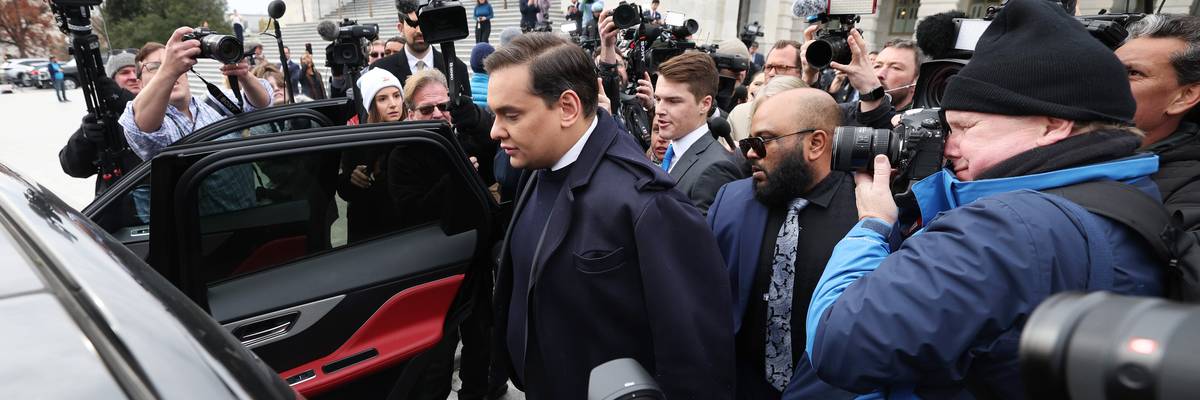
It was old-fashioned, pound-the-pavement reporting that exposed New York Republican congressman George Santos’ falsified biography, ultimately leading to his ejection from Congress.
If this year is a litmus test for democracy around the world, a pre-indicator will be how the media are treated.
In just the first week of this year, at least 18 journalists were assaulted or harassed while covering alleged election irregularities and violence in Bangladesh. Then, in early February, journalists in Pakistan were hindered from covering elections by a wave of violence, widespread internet blackouts, and mobile-network suspensions. In March, journalists in Turkey had been shot at and banned from observing local elections, despite their legal right to do so.
It was a worrying, but not especially surprising, start to this “super election year.” With half the world’s population casting ballots, independent reporting on the candidates and the issues is essential. Yet attacks on the media are rising, even in more mature democracies. In the United States, Donald Trump’s return as a candidate has brought back fresh memories of January 6, 2021, when his supporters stormed the Capitol, lunged at journalists and destroyed their cameras, and scribbled “Murder the media” on the doors.
Such examples are illustrative of a broader problem. From the U.S. to India, hard-won freedoms and rights are being eroded. In 2023, the V-Dem Institute, which monitors democracy around the world, published a report warning that the progress made toward democratization since 1989 is being reversed. The authors identify increased attacks on journalists as a leading indicator of autocratization: “Aspects of freedom of expression and the media are the ones ‘wannabe dictators’ attack the most and often first.”
Independent, professional journalism—both local and national—is even more important now that misinformation and disinformation are flooding into the public domain.
There is no doubt that threats to journalists are on the rise, and not just in countries where independent media is always a target. Over the past three years, the Committee to Protect Journalists has documented near-record numbers of journalists (and even top media executives) behind bars, including in supposed democracies such as Guatemala, and in places that once enjoyed relatively high levels of personal and political freedom, such as Hong Kong.
Journalist killings are at their highest levels in almost a decade. In 2022, the American investigative journalist Jeff German was stabbed outside his home in Las Vegas, and a politician whom German had reported on is now awaiting trial for the murder. From Washington and Westminster to Buenos Aires and Budapest, journalists who cover politics receive death threats daily and are increasingly vulnerable to being targeted at political rallies and protests.
According to a 2021 UNESCO report, three-quarters of women journalists surveyed had experienced online hate, harassment, or threats of violence. Among the most likely triggers for such abuse was reporting on “politics and elections.” Women and those from marginalized communities bear the brunt of this anti-media harassment online, and the vitriol frequently spills over into real-world violence.
The consequences of this disturbing trend are not limited to the media. Attacks on journalists harm us all. Journalists perform the public’s due diligence on candidates, probing their professional records, the veracity of their claims, and the credibility of their promises. By reporting on policy achievements and failures, they help corroborate—or contradict—a candidate’s official narrative, exposing lies and smear campaigns for what they are. They also provide practical information about voting processes, and monitor for electoral irregularities and campaign-finance violations. Without such information, there can be no democracy, but rather what V-Dem calls “electoral autocracy,” where elections are empty rituals.
Independent reporting is also crucial for holding accountable those already in power. It was old-fashioned, pound-the-pavement reporting that exposed New York Republican congressman George Santos’ falsified biography, ultimately leading to his ejection from Congress (not to mention criminal charges). It was the news media that aired recordings of Peru’s secret-police chief, Vladimiro Montesinos Torres, bribing judges and politicians—revelations that would lead to the downfall of President Alberto Fujimori. And it was independent reporting on “Partygate” that ultimately forced Boris Johnson out as prime minister of the United Kingdom.
Independent, professional journalism—both local and national—is even more important now that misinformation and disinformation are flooding into the public domain. A recent report by The Associated Press finds that artificial intelligence is “supercharging” the spread of election lies through deepfake images and audio that is impossible to distinguish from authentic recordings. Similarly, a study released in March by the Africa Center for Strategic Studies found that disinformation had increased fourfold (compared to 2022) ahead of recent elections across the continent.
Independent news media are essential to counter this technology-driven trend. Consider Taiwan’s election earlier this year. Although lies flooded online channels throughout the campaign, studies suggest that much of the disinformation was defused by the combined efforts of local media, election authorities, and fact checkers, all of whom deliberately focused on building trust and furnishing voters with what they needed to make an informed, meaningful choice.
We now need to heed these lessons and watch carefully for warning signs. If this year is a litmus test for democracy around the world, a pre-indicator will be how the media are treated. We will have to remain vigilant in defending a free and independent press, and in championing a vibrant and curious local media. If we don’t, you can be certain that the erosion of freedoms will not stop with us.
Dear Common Dreams reader, It’s been nearly 30 years since I co-founded Common Dreams with my late wife, Lina Newhouser. We had the radical notion that journalism should serve the public good, not corporate profits. It was clear to us from the outset what it would take to build such a project. No paid advertisements. No corporate sponsors. No millionaire publisher telling us what to think or do. Many people said we wouldn't last a year, but we proved those doubters wrong. Together with a tremendous team of journalists and dedicated staff, we built an independent media outlet free from the constraints of profits and corporate control. Our mission has always been simple: To inform. To inspire. To ignite change for the common good. Building Common Dreams was not easy. Our survival was never guaranteed. When you take on the most powerful forces—Wall Street greed, fossil fuel industry destruction, Big Tech lobbyists, and uber-rich oligarchs who have spent billions upon billions rigging the economy and democracy in their favor—the only bulwark you have is supporters who believe in your work. But here’s the urgent message from me today. It's never been this bad out there. And it's never been this hard to keep us going. At the very moment Common Dreams is most needed, the threats we face are intensifying. We need your support now more than ever. We don't accept corporate advertising and never will. We don't have a paywall because we don't think people should be blocked from critical news based on their ability to pay. Everything we do is funded by the donations of readers like you. When everyone does the little they can afford, we are strong. But if that support retreats or dries up, so do we. Will you donate now to make sure Common Dreams not only survives but thrives? —Craig Brown, Co-founder |
In just the first week of this year, at least 18 journalists were assaulted or harassed while covering alleged election irregularities and violence in Bangladesh. Then, in early February, journalists in Pakistan were hindered from covering elections by a wave of violence, widespread internet blackouts, and mobile-network suspensions. In March, journalists in Turkey had been shot at and banned from observing local elections, despite their legal right to do so.
It was a worrying, but not especially surprising, start to this “super election year.” With half the world’s population casting ballots, independent reporting on the candidates and the issues is essential. Yet attacks on the media are rising, even in more mature democracies. In the United States, Donald Trump’s return as a candidate has brought back fresh memories of January 6, 2021, when his supporters stormed the Capitol, lunged at journalists and destroyed their cameras, and scribbled “Murder the media” on the doors.
Such examples are illustrative of a broader problem. From the U.S. to India, hard-won freedoms and rights are being eroded. In 2023, the V-Dem Institute, which monitors democracy around the world, published a report warning that the progress made toward democratization since 1989 is being reversed. The authors identify increased attacks on journalists as a leading indicator of autocratization: “Aspects of freedom of expression and the media are the ones ‘wannabe dictators’ attack the most and often first.”
Independent, professional journalism—both local and national—is even more important now that misinformation and disinformation are flooding into the public domain.
There is no doubt that threats to journalists are on the rise, and not just in countries where independent media is always a target. Over the past three years, the Committee to Protect Journalists has documented near-record numbers of journalists (and even top media executives) behind bars, including in supposed democracies such as Guatemala, and in places that once enjoyed relatively high levels of personal and political freedom, such as Hong Kong.
Journalist killings are at their highest levels in almost a decade. In 2022, the American investigative journalist Jeff German was stabbed outside his home in Las Vegas, and a politician whom German had reported on is now awaiting trial for the murder. From Washington and Westminster to Buenos Aires and Budapest, journalists who cover politics receive death threats daily and are increasingly vulnerable to being targeted at political rallies and protests.
According to a 2021 UNESCO report, three-quarters of women journalists surveyed had experienced online hate, harassment, or threats of violence. Among the most likely triggers for such abuse was reporting on “politics and elections.” Women and those from marginalized communities bear the brunt of this anti-media harassment online, and the vitriol frequently spills over into real-world violence.
The consequences of this disturbing trend are not limited to the media. Attacks on journalists harm us all. Journalists perform the public’s due diligence on candidates, probing their professional records, the veracity of their claims, and the credibility of their promises. By reporting on policy achievements and failures, they help corroborate—or contradict—a candidate’s official narrative, exposing lies and smear campaigns for what they are. They also provide practical information about voting processes, and monitor for electoral irregularities and campaign-finance violations. Without such information, there can be no democracy, but rather what V-Dem calls “electoral autocracy,” where elections are empty rituals.
Independent reporting is also crucial for holding accountable those already in power. It was old-fashioned, pound-the-pavement reporting that exposed New York Republican congressman George Santos’ falsified biography, ultimately leading to his ejection from Congress (not to mention criminal charges). It was the news media that aired recordings of Peru’s secret-police chief, Vladimiro Montesinos Torres, bribing judges and politicians—revelations that would lead to the downfall of President Alberto Fujimori. And it was independent reporting on “Partygate” that ultimately forced Boris Johnson out as prime minister of the United Kingdom.
Independent, professional journalism—both local and national—is even more important now that misinformation and disinformation are flooding into the public domain. A recent report by The Associated Press finds that artificial intelligence is “supercharging” the spread of election lies through deepfake images and audio that is impossible to distinguish from authentic recordings. Similarly, a study released in March by the Africa Center for Strategic Studies found that disinformation had increased fourfold (compared to 2022) ahead of recent elections across the continent.
Independent news media are essential to counter this technology-driven trend. Consider Taiwan’s election earlier this year. Although lies flooded online channels throughout the campaign, studies suggest that much of the disinformation was defused by the combined efforts of local media, election authorities, and fact checkers, all of whom deliberately focused on building trust and furnishing voters with what they needed to make an informed, meaningful choice.
We now need to heed these lessons and watch carefully for warning signs. If this year is a litmus test for democracy around the world, a pre-indicator will be how the media are treated. We will have to remain vigilant in defending a free and independent press, and in championing a vibrant and curious local media. If we don’t, you can be certain that the erosion of freedoms will not stop with us.
In just the first week of this year, at least 18 journalists were assaulted or harassed while covering alleged election irregularities and violence in Bangladesh. Then, in early February, journalists in Pakistan were hindered from covering elections by a wave of violence, widespread internet blackouts, and mobile-network suspensions. In March, journalists in Turkey had been shot at and banned from observing local elections, despite their legal right to do so.
It was a worrying, but not especially surprising, start to this “super election year.” With half the world’s population casting ballots, independent reporting on the candidates and the issues is essential. Yet attacks on the media are rising, even in more mature democracies. In the United States, Donald Trump’s return as a candidate has brought back fresh memories of January 6, 2021, when his supporters stormed the Capitol, lunged at journalists and destroyed their cameras, and scribbled “Murder the media” on the doors.
Such examples are illustrative of a broader problem. From the U.S. to India, hard-won freedoms and rights are being eroded. In 2023, the V-Dem Institute, which monitors democracy around the world, published a report warning that the progress made toward democratization since 1989 is being reversed. The authors identify increased attacks on journalists as a leading indicator of autocratization: “Aspects of freedom of expression and the media are the ones ‘wannabe dictators’ attack the most and often first.”
Independent, professional journalism—both local and national—is even more important now that misinformation and disinformation are flooding into the public domain.
There is no doubt that threats to journalists are on the rise, and not just in countries where independent media is always a target. Over the past three years, the Committee to Protect Journalists has documented near-record numbers of journalists (and even top media executives) behind bars, including in supposed democracies such as Guatemala, and in places that once enjoyed relatively high levels of personal and political freedom, such as Hong Kong.
Journalist killings are at their highest levels in almost a decade. In 2022, the American investigative journalist Jeff German was stabbed outside his home in Las Vegas, and a politician whom German had reported on is now awaiting trial for the murder. From Washington and Westminster to Buenos Aires and Budapest, journalists who cover politics receive death threats daily and are increasingly vulnerable to being targeted at political rallies and protests.
According to a 2021 UNESCO report, three-quarters of women journalists surveyed had experienced online hate, harassment, or threats of violence. Among the most likely triggers for such abuse was reporting on “politics and elections.” Women and those from marginalized communities bear the brunt of this anti-media harassment online, and the vitriol frequently spills over into real-world violence.
The consequences of this disturbing trend are not limited to the media. Attacks on journalists harm us all. Journalists perform the public’s due diligence on candidates, probing their professional records, the veracity of their claims, and the credibility of their promises. By reporting on policy achievements and failures, they help corroborate—or contradict—a candidate’s official narrative, exposing lies and smear campaigns for what they are. They also provide practical information about voting processes, and monitor for electoral irregularities and campaign-finance violations. Without such information, there can be no democracy, but rather what V-Dem calls “electoral autocracy,” where elections are empty rituals.
Independent reporting is also crucial for holding accountable those already in power. It was old-fashioned, pound-the-pavement reporting that exposed New York Republican congressman George Santos’ falsified biography, ultimately leading to his ejection from Congress (not to mention criminal charges). It was the news media that aired recordings of Peru’s secret-police chief, Vladimiro Montesinos Torres, bribing judges and politicians—revelations that would lead to the downfall of President Alberto Fujimori. And it was independent reporting on “Partygate” that ultimately forced Boris Johnson out as prime minister of the United Kingdom.
Independent, professional journalism—both local and national—is even more important now that misinformation and disinformation are flooding into the public domain. A recent report by The Associated Press finds that artificial intelligence is “supercharging” the spread of election lies through deepfake images and audio that is impossible to distinguish from authentic recordings. Similarly, a study released in March by the Africa Center for Strategic Studies found that disinformation had increased fourfold (compared to 2022) ahead of recent elections across the continent.
Independent news media are essential to counter this technology-driven trend. Consider Taiwan’s election earlier this year. Although lies flooded online channels throughout the campaign, studies suggest that much of the disinformation was defused by the combined efforts of local media, election authorities, and fact checkers, all of whom deliberately focused on building trust and furnishing voters with what they needed to make an informed, meaningful choice.
We now need to heed these lessons and watch carefully for warning signs. If this year is a litmus test for democracy around the world, a pre-indicator will be how the media are treated. We will have to remain vigilant in defending a free and independent press, and in championing a vibrant and curious local media. If we don’t, you can be certain that the erosion of freedoms will not stop with us.