

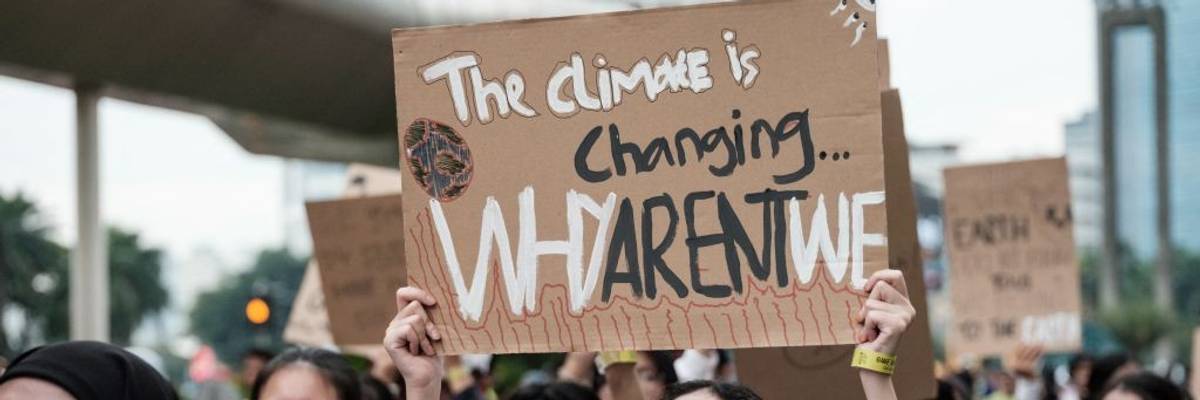
Participants hold placards as they march on a street ahead of Earth Day on April 22, the annual environmental awareness day, in Jakarta on April 21, 2024.
Earth Action Day: Unleashing Our Power for Our Planet
Last year was a disaster for the planet and its people. In 2025, we must all strive to do so much better.
Tomorrow — Tuesday, April 22nd — will mark the 55th anniversary of Earth Day. The power of those 20 million voices that came out on the streets on that first Earth Day decades ago led the U.S. to create the Environemental Protection Agency and the first generation of environmental laws addressing clean air, clean water, and the threat of toxics.
Fast forward to today. Under the “Our Power. Our Planet” banner, EARTHDAY.ORG, the global organizer of Earth Day, is calling on people from all walks of life to join in “Earth Action Day”—an effort to once again mobilize people power to tackle the current generation of environmental crises.
Last year was a disaster for the planet and its people. According to NASA, 2024 was the warmest year since temperatures began being recorded in 1880. In the U.S. alone, there were 27 climate and weather events resulting in at least a billion dollars of damage — second only to 2023 with 28 such events.
While a number of factors have contributed to the increase in these catastrophic events, research demonstrates that "human-caused climate change is increasing the frequency and intensity of certain types of extreme weather that lead to billion-dollar disasters—most notably the rise in vulnerability to drought, lengthening wildfire seasons in the Western states, and the potential for extremely heavy rainfall becoming more common in the eastern states.”
The news about plastic pollution is similarly dark. Earth Action reported that on last September 5 – Plastic Overshoot Day – the amount of plastic waste exceeded the capacity of waste systems to manage. An estimated 220 million tonnes of plastic waste were expected to be produced in 2024, with 66 percent of the population living in places where the amount of waste exceeds local capacity. While negotiation of a strong global treaty on plastics last year held forth the promise of handling some of these issues, negotiators failed to reach an agreement and the talks drag on while the industry continues to pollute year after year.
All of this is taking place in the face of increasing scientific news about the harmful impacts of plastics on humans and their health. World Wildlife Federation reported that humans could be ingesting up to 5 grams of plastic each week and a recent report found that high levels of plastics have been found in human brains. Additional research has shown that plastics are associated with everything from cancer to endocrine disruption, which can impair reproduction, growth, and cognitive abilities. Wildlife is also suffering, with plastic ingestion and entanglement contributing to starvation and strangulation, among other issues.
For years we have been told by the plastics industry that we can clean up and recycle our way out of this problem , but continued use of plastics however means continued use of fossil fuels and recycling has been demonstrated to be largely myth due to factors including quality degradation, contamination, and non-recyclable content.
What is the common thread of all these challenges facing our planet and the survival of its people ? The cause of all of these threats can be traced to one source: human greed and disregard.
But the encouraging and hopefully inspiring news is that the solutions to these problems also rest in the hands of the people. We have the collective power not only to protect our planet but also to improve lives and livelihoods.
The link between greenhouse gas emissions and climate change is now scientifically indisputable. According to the United Nations, fossil fuels make up 75% of greenhouse gas emissions and 90% of carbon dioxide emissions. The good news from the International Renewable Energy Agency is that 90% of global electricity can and should come from renewable sources by 2050.
Slowing the climate crisis is only one of many reasons to switch to renewables. Renewable energy prices are falling, and in most places of the world today, it is the least expensive option. Other benefits range from preventing unhealthy air associated with the burning of fossil fuels to creating up to 30 million jobs to supporting energy security.
Whether you choose to power your home or vehicle with renewable energy, support community solar, or call on government leaders for more research and investment, the options for taking action to accelerate the transition to renewables are many. Similarly, as consumers we can choose plastic-free products, demand a reduction in the use of plastics from businesses, while at the same time pressuring government leaders to reduce production globally, end the use of toxic ingredients, and improve waste management systems.
So this Earth Action Day exercise your power! We need to demonstrate to our leaders in government and business that we are still here, we are a witness to their actions, and we will hold them accountable to do right by our planet and its people.
We are at a crossroads
This country and this world are at a monumental crossroads. In a few short weeks, US voters will have an opportunity to beat back the forces of fascism and confront the billionaires who are rigging the economy, our media system, and our democracy, making it increasingly impossible for ordinary people to get by. We’re not just talking about the election. We’re talking about what must be done once these fascist elements are vanquished from power. We need a bolder set of solutions than what either major party has so far been willing to offer and a working-class movement ready to fight like hell for it. Trump didn't emerge from nowhere. The conditions that fueled MAGA authoritarianism were created by decades of radical neoliberal economic policies and a corrupt political system dominated by corporate interests. They slashed taxes on the super-rich, promising that the benefits would trickle down. They said giveaways to the corporate titans would make life more affordable for the rest of us. It was all bullshit. And when a bitter, betrayed populace searches for someone to blame, right-wing demagogues have little trouble finding scapegoats. People know when they're being lied to, but you won't hear any of this from the corporate media. Only independent journalism—powered and funded by people who believe in building a better world—can deliver truly trustworthy daily news. Our Fall Campaign is underway, and we need your help. To power our newsroom through the rest of the year, we need to raise $125,000 by midnight on October 31. So if you share our vision, please contribute whatever you can to sustain our work. |
Tomorrow — Tuesday, April 22nd — will mark the 55th anniversary of Earth Day. The power of those 20 million voices that came out on the streets on that first Earth Day decades ago led the U.S. to create the Environemental Protection Agency and the first generation of environmental laws addressing clean air, clean water, and the threat of toxics.
Fast forward to today. Under the “Our Power. Our Planet” banner, EARTHDAY.ORG, the global organizer of Earth Day, is calling on people from all walks of life to join in “Earth Action Day”—an effort to once again mobilize people power to tackle the current generation of environmental crises.
Last year was a disaster for the planet and its people. According to NASA, 2024 was the warmest year since temperatures began being recorded in 1880. In the U.S. alone, there were 27 climate and weather events resulting in at least a billion dollars of damage — second only to 2023 with 28 such events.
While a number of factors have contributed to the increase in these catastrophic events, research demonstrates that "human-caused climate change is increasing the frequency and intensity of certain types of extreme weather that lead to billion-dollar disasters—most notably the rise in vulnerability to drought, lengthening wildfire seasons in the Western states, and the potential for extremely heavy rainfall becoming more common in the eastern states.”
The news about plastic pollution is similarly dark. Earth Action reported that on last September 5 – Plastic Overshoot Day – the amount of plastic waste exceeded the capacity of waste systems to manage. An estimated 220 million tonnes of plastic waste were expected to be produced in 2024, with 66 percent of the population living in places where the amount of waste exceeds local capacity. While negotiation of a strong global treaty on plastics last year held forth the promise of handling some of these issues, negotiators failed to reach an agreement and the talks drag on while the industry continues to pollute year after year.
All of this is taking place in the face of increasing scientific news about the harmful impacts of plastics on humans and their health. World Wildlife Federation reported that humans could be ingesting up to 5 grams of plastic each week and a recent report found that high levels of plastics have been found in human brains. Additional research has shown that plastics are associated with everything from cancer to endocrine disruption, which can impair reproduction, growth, and cognitive abilities. Wildlife is also suffering, with plastic ingestion and entanglement contributing to starvation and strangulation, among other issues.
For years we have been told by the plastics industry that we can clean up and recycle our way out of this problem , but continued use of plastics however means continued use of fossil fuels and recycling has been demonstrated to be largely myth due to factors including quality degradation, contamination, and non-recyclable content.
What is the common thread of all these challenges facing our planet and the survival of its people ? The cause of all of these threats can be traced to one source: human greed and disregard.
But the encouraging and hopefully inspiring news is that the solutions to these problems also rest in the hands of the people. We have the collective power not only to protect our planet but also to improve lives and livelihoods.
The link between greenhouse gas emissions and climate change is now scientifically indisputable. According to the United Nations, fossil fuels make up 75% of greenhouse gas emissions and 90% of carbon dioxide emissions. The good news from the International Renewable Energy Agency is that 90% of global electricity can and should come from renewable sources by 2050.
Slowing the climate crisis is only one of many reasons to switch to renewables. Renewable energy prices are falling, and in most places of the world today, it is the least expensive option. Other benefits range from preventing unhealthy air associated with the burning of fossil fuels to creating up to 30 million jobs to supporting energy security.
Whether you choose to power your home or vehicle with renewable energy, support community solar, or call on government leaders for more research and investment, the options for taking action to accelerate the transition to renewables are many. Similarly, as consumers we can choose plastic-free products, demand a reduction in the use of plastics from businesses, while at the same time pressuring government leaders to reduce production globally, end the use of toxic ingredients, and improve waste management systems.
So this Earth Action Day exercise your power! We need to demonstrate to our leaders in government and business that we are still here, we are a witness to their actions, and we will hold them accountable to do right by our planet and its people.
Tomorrow — Tuesday, April 22nd — will mark the 55th anniversary of Earth Day. The power of those 20 million voices that came out on the streets on that first Earth Day decades ago led the U.S. to create the Environemental Protection Agency and the first generation of environmental laws addressing clean air, clean water, and the threat of toxics.
Fast forward to today. Under the “Our Power. Our Planet” banner, EARTHDAY.ORG, the global organizer of Earth Day, is calling on people from all walks of life to join in “Earth Action Day”—an effort to once again mobilize people power to tackle the current generation of environmental crises.
Last year was a disaster for the planet and its people. According to NASA, 2024 was the warmest year since temperatures began being recorded in 1880. In the U.S. alone, there were 27 climate and weather events resulting in at least a billion dollars of damage — second only to 2023 with 28 such events.
While a number of factors have contributed to the increase in these catastrophic events, research demonstrates that "human-caused climate change is increasing the frequency and intensity of certain types of extreme weather that lead to billion-dollar disasters—most notably the rise in vulnerability to drought, lengthening wildfire seasons in the Western states, and the potential for extremely heavy rainfall becoming more common in the eastern states.”
The news about plastic pollution is similarly dark. Earth Action reported that on last September 5 – Plastic Overshoot Day – the amount of plastic waste exceeded the capacity of waste systems to manage. An estimated 220 million tonnes of plastic waste were expected to be produced in 2024, with 66 percent of the population living in places where the amount of waste exceeds local capacity. While negotiation of a strong global treaty on plastics last year held forth the promise of handling some of these issues, negotiators failed to reach an agreement and the talks drag on while the industry continues to pollute year after year.
All of this is taking place in the face of increasing scientific news about the harmful impacts of plastics on humans and their health. World Wildlife Federation reported that humans could be ingesting up to 5 grams of plastic each week and a recent report found that high levels of plastics have been found in human brains. Additional research has shown that plastics are associated with everything from cancer to endocrine disruption, which can impair reproduction, growth, and cognitive abilities. Wildlife is also suffering, with plastic ingestion and entanglement contributing to starvation and strangulation, among other issues.
For years we have been told by the plastics industry that we can clean up and recycle our way out of this problem , but continued use of plastics however means continued use of fossil fuels and recycling has been demonstrated to be largely myth due to factors including quality degradation, contamination, and non-recyclable content.
What is the common thread of all these challenges facing our planet and the survival of its people ? The cause of all of these threats can be traced to one source: human greed and disregard.
But the encouraging and hopefully inspiring news is that the solutions to these problems also rest in the hands of the people. We have the collective power not only to protect our planet but also to improve lives and livelihoods.
The link between greenhouse gas emissions and climate change is now scientifically indisputable. According to the United Nations, fossil fuels make up 75% of greenhouse gas emissions and 90% of carbon dioxide emissions. The good news from the International Renewable Energy Agency is that 90% of global electricity can and should come from renewable sources by 2050.
Slowing the climate crisis is only one of many reasons to switch to renewables. Renewable energy prices are falling, and in most places of the world today, it is the least expensive option. Other benefits range from preventing unhealthy air associated with the burning of fossil fuels to creating up to 30 million jobs to supporting energy security.
Whether you choose to power your home or vehicle with renewable energy, support community solar, or call on government leaders for more research and investment, the options for taking action to accelerate the transition to renewables are many. Similarly, as consumers we can choose plastic-free products, demand a reduction in the use of plastics from businesses, while at the same time pressuring government leaders to reduce production globally, end the use of toxic ingredients, and improve waste management systems.
So this Earth Action Day exercise your power! We need to demonstrate to our leaders in government and business that we are still here, we are a witness to their actions, and we will hold them accountable to do right by our planet and its people.