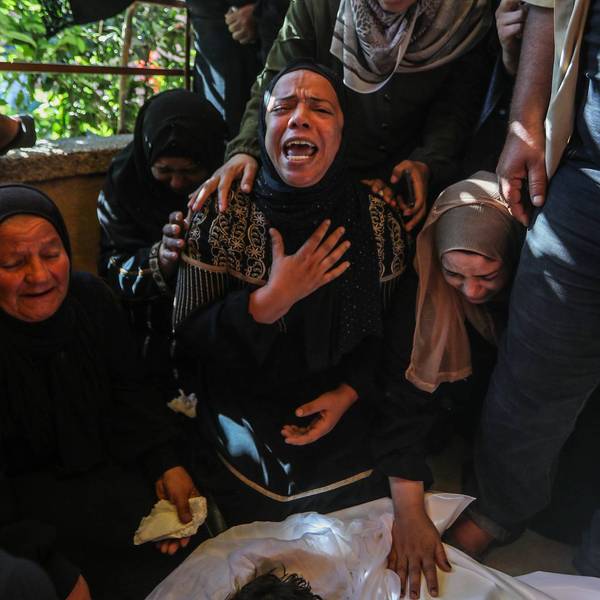

Palestinians fill plastic containers and cans with water distributed by tankers as they struggle with a severe water crisis caused by heavy damage to infrastructure from Israeli attacks in Gaza City, Gaza on January 13, 2026.
Why the World Must Not Look Away From Gaza
The Israeli prime minister has made it explicitly clear that he has no intention of following any peace road map, planning instead for the permanent incremental takeover of Gaza.
Gaza requires urgent international attention.
What is happening in the besieged and devastated strip at the moment by far exceeds an unfolding humanitarian disaster; it is a calculated geopolitical reshaping. Israel is actively executing a plan to permanently occupy the vast majority of Gaza, with consequences that require little elaboration considering what we already know about the ongoing genocide.
Currently, much of the international debate centers on a single official: Bulgarian diplomat Nickolay Mladenov. The former United Nations special coordinator has been designated by the United States as the executive director of the Trump administration’s newly established ‘Board of Peace’—an international council founded to oversee the implementation of Washington's 20-point Gaza road map.
The issue, however, is much bigger than a single Washington-backed bureaucrat. A growing number of Palestinians and political analysts accuse Mladenov of manufacturing the very conditions that continue to obstruct progress on the agreement’s transition to its second phase.
With nearly the entire population of Gaza living in sub-standard tents and surviving on the meager rations permitted through Israeli checkpoints, it is the highest form of immorality to demand political concessions in exchange for basic sustenance.
Under the framework, the official transition to this second phase—which President Donald Trump and the Board of Peace declared to have begun in January 2026—demands sweeping, one-sided Palestinian concessions, most notably the total disarmament of armed factions.
This demand is a recipe for the failure of the entire project, especially given that Israel has completely failed to implement the most basic requirements of the agreement's first phase. It has refused to halt its routine military incursions, has failed to withdraw its forces to the originally mandated "Yellow Line" demarcation, and continues to deny entry permits to the technocratic committee slated to assume civil governance of the Strip.
Mladenov's insistence on Palestinian disarmament before the agreement can advance—without a single guarantee of Israeli compliance—conveniently flips the narrative. It cynically reframes systematic starvation and the blockade of medical and construction supplies as a Palestinian failure to honor commitments.
In reality, Mladenov holds no real cards; he is merely a cog in a larger machinery controlled by Benjamin Netanyahu. The Israeli prime minister has made it explicitly clear that he has no intention of following any peace road map, planning instead for the permanent incremental takeover of Gaza.
Speaking at a conference in an occupied West Bank settlement on May 28, Netanyahu explained his strategy with total clarity, abandoning all diplomatic doublespeak: "We are currently squeezing Hamas; we now control 60% of the territory of the strip—you know this. We were at 50, we moved to 60. My directive is to move to..." he said, pausing as an audience member shouted "100!"
Netanyahu smiled and responded: "Let's go step by step. First of all, 70. Let's start with that. We're pressing them from all sides, we'll deal with the remnants."
This is the actual blueprint of the Israeli government, declared openly to domestic audiences. The admission was so brazen that even US Secretary of State Marco Rubio expressed frustration at Netanyahu's candor. Testifying before Congress on June 2, Rubio remarked, “We have a plan—it doesn’t call for that,” referring to further Israeli territorial expansion.
Yet, Rubio quickly reverted to Washington's standard line: “And at the end of the day, we understand that what we want, and I think what the Israelis would ultimately want, is a Gaza that is governed by a non-Hamas entity.”
While the immediate priority for Palestinians is not governance but lifesaving food, clean water, medicine, and basic survival, Netanyahu and Rubio view the entire crisis through a political lens. The US-Israeli plan is predicated on achieving, through diplomatic strangulation and engineered famine, what they failed to fully achieve through military might.
A rare, decisive answer came from United Nations spokesperson Stéphane Dujarric, who summed up the UN position plainly: “One hundred percent of Gaza should be for the Palestinian people." The problem, however, is that the UN’s rhetoric is backed by no real enforcement mechanisms.
The international community has walked directly into a trap, outsourcing the future of the Gaza Strip to the Trump administration and its Board of Peace. Even the designated technocratic committee has been rendered entirely irrelevant, excluded from a decision-making process left solely to diplomats beholden to the White House.
The situation on the ground remains catastrophic. Since the fragile, heavily compromised ceasefire took effect on October 10, regular Israeli violations and airstrikes have killed nearly 1,000 Palestinians and wounded thousands more—the vast majority women and children. When added to the horrific toll of the initial two years of war, the official number of Palestinians killed has surpassed 73,000, with over 173,000 injured.
Furthermore, credible epidemiological studies and medical journals have concluded that the true death toll is vastly higher.
With nearly the entire population of Gaza living in sub-standard tents and surviving on the meager rations permitted through Israeli checkpoints, it is the highest form of immorality to demand political concessions in exchange for basic sustenance.
Netanyahu's "step-by-step" annexation does not hinge on what Palestinian factions decide to do; his expansionist timeline is shaped independently of Palestinian compliance.
Arab, Muslim, and allied nations must fundamentally shift their diplomatic strategy. They must firmly insist on completely delinking humanitarian aid from the future governance or demilitarization of the Gaza Strip.
Starvation cannot be tolerated as political leverage for war criminals. Netanyahu is emboldened by a history of international impunity, speaking openly of expanding his military footprint regardless of the consequences of such action.
The international community must remind Israel’s government that the survival of millions of Palestinians cannot be held hostage to the political ambitions of an extremist coalition.
We are at a crossroads
This country and this world are at a monumental crossroads. In a few short weeks, US voters will have an opportunity to beat back the forces of fascism and confront the billionaires who are rigging the economy, our media system, and our democracy, making it increasingly impossible for ordinary people to get by. We’re not just talking about the election. We’re talking about what must be done once these fascist elements are vanquished from power. We need a bolder set of solutions than what either major party has so far been willing to offer and a working-class movement ready to fight like hell for it. Trump didn't emerge from nowhere. The conditions that fueled MAGA authoritarianism were created by decades of radical neoliberal economic policies and a corrupt political system dominated by corporate interests. They slashed taxes on the super-rich, promising that the benefits would trickle down. They said giveaways to the corporate titans would make life more affordable for the rest of us. It was all bullshit. And when a bitter, betrayed populace searches for someone to blame, right-wing demagogues have little trouble finding scapegoats. People know when they're being lied to, but you won't hear any of this from the corporate media. Only independent journalism—powered and funded by people who believe in building a better world—can deliver truly trustworthy daily news. Our Fall Campaign is underway, and we need your help. To power our newsroom through the rest of the year, we need to raise $125,000 by midnight on October 31. So if you share our vision, please contribute whatever you can to sustain our work. |
Gaza requires urgent international attention.
What is happening in the besieged and devastated strip at the moment by far exceeds an unfolding humanitarian disaster; it is a calculated geopolitical reshaping. Israel is actively executing a plan to permanently occupy the vast majority of Gaza, with consequences that require little elaboration considering what we already know about the ongoing genocide.
Currently, much of the international debate centers on a single official: Bulgarian diplomat Nickolay Mladenov. The former United Nations special coordinator has been designated by the United States as the executive director of the Trump administration’s newly established ‘Board of Peace’—an international council founded to oversee the implementation of Washington's 20-point Gaza road map.
The issue, however, is much bigger than a single Washington-backed bureaucrat. A growing number of Palestinians and political analysts accuse Mladenov of manufacturing the very conditions that continue to obstruct progress on the agreement’s transition to its second phase.
With nearly the entire population of Gaza living in sub-standard tents and surviving on the meager rations permitted through Israeli checkpoints, it is the highest form of immorality to demand political concessions in exchange for basic sustenance.
Under the framework, the official transition to this second phase—which President Donald Trump and the Board of Peace declared to have begun in January 2026—demands sweeping, one-sided Palestinian concessions, most notably the total disarmament of armed factions.
This demand is a recipe for the failure of the entire project, especially given that Israel has completely failed to implement the most basic requirements of the agreement's first phase. It has refused to halt its routine military incursions, has failed to withdraw its forces to the originally mandated "Yellow Line" demarcation, and continues to deny entry permits to the technocratic committee slated to assume civil governance of the Strip.
Mladenov's insistence on Palestinian disarmament before the agreement can advance—without a single guarantee of Israeli compliance—conveniently flips the narrative. It cynically reframes systematic starvation and the blockade of medical and construction supplies as a Palestinian failure to honor commitments.
In reality, Mladenov holds no real cards; he is merely a cog in a larger machinery controlled by Benjamin Netanyahu. The Israeli prime minister has made it explicitly clear that he has no intention of following any peace road map, planning instead for the permanent incremental takeover of Gaza.
Speaking at a conference in an occupied West Bank settlement on May 28, Netanyahu explained his strategy with total clarity, abandoning all diplomatic doublespeak: "We are currently squeezing Hamas; we now control 60% of the territory of the strip—you know this. We were at 50, we moved to 60. My directive is to move to..." he said, pausing as an audience member shouted "100!"
Netanyahu smiled and responded: "Let's go step by step. First of all, 70. Let's start with that. We're pressing them from all sides, we'll deal with the remnants."
This is the actual blueprint of the Israeli government, declared openly to domestic audiences. The admission was so brazen that even US Secretary of State Marco Rubio expressed frustration at Netanyahu's candor. Testifying before Congress on June 2, Rubio remarked, “We have a plan—it doesn’t call for that,” referring to further Israeli territorial expansion.
Yet, Rubio quickly reverted to Washington's standard line: “And at the end of the day, we understand that what we want, and I think what the Israelis would ultimately want, is a Gaza that is governed by a non-Hamas entity.”
While the immediate priority for Palestinians is not governance but lifesaving food, clean water, medicine, and basic survival, Netanyahu and Rubio view the entire crisis through a political lens. The US-Israeli plan is predicated on achieving, through diplomatic strangulation and engineered famine, what they failed to fully achieve through military might.
A rare, decisive answer came from United Nations spokesperson Stéphane Dujarric, who summed up the UN position plainly: “One hundred percent of Gaza should be for the Palestinian people." The problem, however, is that the UN’s rhetoric is backed by no real enforcement mechanisms.
The international community has walked directly into a trap, outsourcing the future of the Gaza Strip to the Trump administration and its Board of Peace. Even the designated technocratic committee has been rendered entirely irrelevant, excluded from a decision-making process left solely to diplomats beholden to the White House.
The situation on the ground remains catastrophic. Since the fragile, heavily compromised ceasefire took effect on October 10, regular Israeli violations and airstrikes have killed nearly 1,000 Palestinians and wounded thousands more—the vast majority women and children. When added to the horrific toll of the initial two years of war, the official number of Palestinians killed has surpassed 73,000, with over 173,000 injured.
Furthermore, credible epidemiological studies and medical journals have concluded that the true death toll is vastly higher.
With nearly the entire population of Gaza living in sub-standard tents and surviving on the meager rations permitted through Israeli checkpoints, it is the highest form of immorality to demand political concessions in exchange for basic sustenance.
Netanyahu's "step-by-step" annexation does not hinge on what Palestinian factions decide to do; his expansionist timeline is shaped independently of Palestinian compliance.
Arab, Muslim, and allied nations must fundamentally shift their diplomatic strategy. They must firmly insist on completely delinking humanitarian aid from the future governance or demilitarization of the Gaza Strip.
Starvation cannot be tolerated as political leverage for war criminals. Netanyahu is emboldened by a history of international impunity, speaking openly of expanding his military footprint regardless of the consequences of such action.
The international community must remind Israel’s government that the survival of millions of Palestinians cannot be held hostage to the political ambitions of an extremist coalition.