

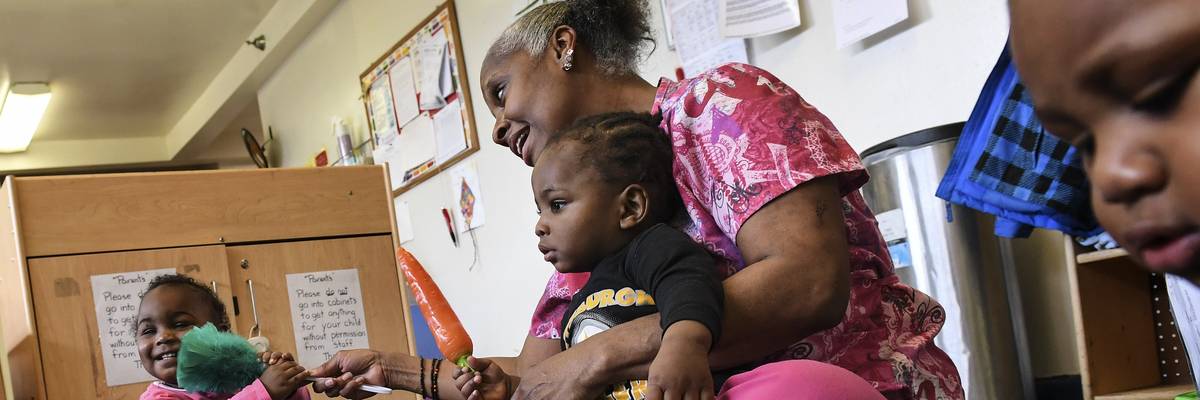
Childcare worker Debbie James-Dean uses a feather duster to tickle Aubrey Albritton, 16 months, as she goes over the color "green" during an activity at a Kids Are Us Learning Center in Southeast Washington, DC, on Friday, March 24, 2017.
I Spent 32 Years Caring for Children and I Still Can't Afford to Retire—I'm Not Alone
The work that our families run on often happens where no one can see it. This Labor Day, as midterms near, I'm thinking about what it will take for the people who do that work—and the people who depend on it—to finally be counted.
What does it say about this country when you can work for more than 40 years and still can’t afford to stop?
I am 66 years old and have spent over 30 years caring for children across the South. When 2024 drew to a close, I tried to retire. I thought I had put in enough time to set myself free from the labor of surviving this economy.
But, as I worried, I couldn't afford it. The price of everything was increasing, including bread, and I realized I had no choice but to return to work within six months of my retirement.
You can tell workers like me that we should have saved more, planned better, chosen a better path toward our retirement. But here’s the problem many domestic and care workers encounter: You cannot save money you never had. When wages barely cover housing, groceries, medicine, and everything else life throws at you, retirement is less like a plan and more like a luxury. In 2025 (the year I was supposed to be retired), early educators had a median wage of $34,980. Other domestic workers, like house cleaners make an estimated median wage of $34,650, and home care workers in 2025 had a median annual income of $22,429. These wages reflect the reality that domestic workers overall are three times as likely to live in poverty as other workers.
With seven children and 18 grandchildren, I do not want another generation of women in my family to inherit a country’s economy where caring for others means giving up their own security.
I come from a legacy of domestic workers. My grandmother, Big Momma, was a Certified Nursing Assistant. My mother was a housekeeper. I became a childcare worker. Three generations of Black women in my family have cared for other people.
We are part of a much longer history, and that is why this work has never paid what it should.
In 1881, 20 Black laundresses organized a movement that grew to nearly 3,000 members and won better wages after striking. Nearly a century later, Dorothy Bolden organized domestic workers across this same city and founded the National Domestic Workers Union of America. Bolden understood that better working conditions and civic power went hand in hand and even made voter registration part of the strategy to organize domestic workers.
When this country finally wrote basic protections into law, such as the right to organize, a minimum wage, and a path to retirement, domestic workers and farmworkers were left out of these protections. That was intentional. Much of that work was done by Black women in the South; leaving it unprotected was no accident. A multigenerational legacy later, we are still living with the consequences these gaps created.
It’s why a person can care for children for over 32 years and still not be able to afford to retire. We didn’t fail to plan; our work was just kept out of sight and out of the protections other workers won.
For most of my career as a childcare worker, children knew me as Miss Cathy. If one of them came to me crying because they were being bullied or something was wrong, I would tell them, "Miss Cathy is going to get to the bottom of it." And trust that Miss Cathy always did.
I adore my work and the children I care for. But loving your work should not require sacrificing your own security.
Or your health.
I have Graves’ disease—a disease that is twice as likely to impact Black women—and often, we face delayed diagnoses and advanced symptoms because of healthcare disparities. For years, I managed it by going to quick clinics when I could afford them and, most of the time, went without care when I couldn't. It was ironic: I was spending my days making sure other people's children were cared for while struggling to afford consistent care for myself. It was not until I turned 65 and qualified for Medicare that I finally had access to health coverage. And even that coverage is at risk.
But this essay is not meant to share all of the challenges I face in care work. No, I am writing this to emphasize that I am no longer the exception. We, as working-class people, have become the rule.
Across the United States, retirement is slipping out of reach for working people of every kind. Wages have not kept up with the cost of the roof over our heads, a simple doctor's visit, a full grocery cart, or care of any kind. More and more people are working into their late 60s, 70s, even 80s, not because they want to, but because stopping simply is not an option. For me, I work until God tells me to stop. The insecurity I’ve referenced has always shadowed domestic workers, and now it’s reaching the rest of the working class. My story reflects the lives of so many working people.
But domestic workers are building a constituency around care: domestic workers, family caregivers, parents, and everyone who understands that care is not some niche issue. It is part of whether a family can afford to live and whether the people who provide that care can afford to grow old, in my case, preferably with a crisp beverage on a beautiful beach.
The economy and affordability are on people's minds. It’s the only thing that’s on my mind. My bank account tells me that things are expensive.
For Black women like me, the right to be heard was never simple. Our grandmothers cleaned other people's homes and were told their voice did not matter in their own country. My father, who raised my siblings and me in 1960s Memphis, taught us that sitting out of the civic process was not optional; he refused to be invisible, and engaging with elected officials was a way to ensure that.
And it is not only domestic workers who have a stake in this. Every family with childcare needs, every person with an aging parent or disabled loved one at home, all of us who will need care someday—we all deeply depend on this work. When we make that care visible, when we insist that it be counted and prioritized, we are looking out for one another.
I want the people in elected office to hear that childcare lets parents go to work, that home care lets people live with dignity, and that we, the people who do that work, should be able to retire from it one day.
Domestic workers are more than our labor. We are neighbors, parents, and grandparents.
With seven children and 18 grandchildren, I do not want another generation of women in my family to inherit a country’s economy where caring for others means giving up their own security.
My grandmother cared for people. My mother cared for people. I spent 32 years caring for children. We have done our part.
This Labor Day, I want the people who represent us—and the country we have spent our lives caring for—to show us they will do theirs.
And if they don't, Miss Cathy is going to get to the bottom of it.
We are at a crossroads
This country and this world are at a monumental crossroads. In a few short weeks, US voters will have an opportunity to beat back the forces of fascism and confront the billionaires who are rigging the economy, our media system, and our democracy, making it increasingly impossible for ordinary people to get by. We’re not just talking about the election. We’re talking about what must be done once these fascist elements are vanquished from power. We need a bolder set of solutions than what either major party has so far been willing to offer and a working-class movement ready to fight like hell for it. Trump didn't emerge from nowhere. The conditions that fueled MAGA authoritarianism were created by decades of radical neoliberal economic policies and a corrupt political system dominated by corporate interests. They slashed taxes on the super-rich, promising that the benefits would trickle down. They said giveaways to the corporate titans would make life more affordable for the rest of us. It was all bullshit. And when a bitter, betrayed populace searches for someone to blame, right-wing demagogues have little trouble finding scapegoats. People know when they're being lied to, but you won't hear any of this from the corporate media. Only independent journalism—powered and funded by people who believe in building a better world—can deliver truly trustworthy daily news. Our Fall Campaign is underway, and we need your help. To power our newsroom through the rest of the year, we need to raise $125,000 by midnight on October 31. So if you share our vision, please contribute whatever you can to sustain our work. |
What does it say about this country when you can work for more than 40 years and still can’t afford to stop?
I am 66 years old and have spent over 30 years caring for children across the South. When 2024 drew to a close, I tried to retire. I thought I had put in enough time to set myself free from the labor of surviving this economy.
But, as I worried, I couldn't afford it. The price of everything was increasing, including bread, and I realized I had no choice but to return to work within six months of my retirement.
You can tell workers like me that we should have saved more, planned better, chosen a better path toward our retirement. But here’s the problem many domestic and care workers encounter: You cannot save money you never had. When wages barely cover housing, groceries, medicine, and everything else life throws at you, retirement is less like a plan and more like a luxury. In 2025 (the year I was supposed to be retired), early educators had a median wage of $34,980. Other domestic workers, like house cleaners make an estimated median wage of $34,650, and home care workers in 2025 had a median annual income of $22,429. These wages reflect the reality that domestic workers overall are three times as likely to live in poverty as other workers.
With seven children and 18 grandchildren, I do not want another generation of women in my family to inherit a country’s economy where caring for others means giving up their own security.
I come from a legacy of domestic workers. My grandmother, Big Momma, was a Certified Nursing Assistant. My mother was a housekeeper. I became a childcare worker. Three generations of Black women in my family have cared for other people.
We are part of a much longer history, and that is why this work has never paid what it should.
In 1881, 20 Black laundresses organized a movement that grew to nearly 3,000 members and won better wages after striking. Nearly a century later, Dorothy Bolden organized domestic workers across this same city and founded the National Domestic Workers Union of America. Bolden understood that better working conditions and civic power went hand in hand and even made voter registration part of the strategy to organize domestic workers.
When this country finally wrote basic protections into law, such as the right to organize, a minimum wage, and a path to retirement, domestic workers and farmworkers were left out of these protections. That was intentional. Much of that work was done by Black women in the South; leaving it unprotected was no accident. A multigenerational legacy later, we are still living with the consequences these gaps created.
It’s why a person can care for children for over 32 years and still not be able to afford to retire. We didn’t fail to plan; our work was just kept out of sight and out of the protections other workers won.
For most of my career as a childcare worker, children knew me as Miss Cathy. If one of them came to me crying because they were being bullied or something was wrong, I would tell them, "Miss Cathy is going to get to the bottom of it." And trust that Miss Cathy always did.
I adore my work and the children I care for. But loving your work should not require sacrificing your own security.
Or your health.
I have Graves’ disease—a disease that is twice as likely to impact Black women—and often, we face delayed diagnoses and advanced symptoms because of healthcare disparities. For years, I managed it by going to quick clinics when I could afford them and, most of the time, went without care when I couldn't. It was ironic: I was spending my days making sure other people's children were cared for while struggling to afford consistent care for myself. It was not until I turned 65 and qualified for Medicare that I finally had access to health coverage. And even that coverage is at risk.
But this essay is not meant to share all of the challenges I face in care work. No, I am writing this to emphasize that I am no longer the exception. We, as working-class people, have become the rule.
Across the United States, retirement is slipping out of reach for working people of every kind. Wages have not kept up with the cost of the roof over our heads, a simple doctor's visit, a full grocery cart, or care of any kind. More and more people are working into their late 60s, 70s, even 80s, not because they want to, but because stopping simply is not an option. For me, I work until God tells me to stop. The insecurity I’ve referenced has always shadowed domestic workers, and now it’s reaching the rest of the working class. My story reflects the lives of so many working people.
But domestic workers are building a constituency around care: domestic workers, family caregivers, parents, and everyone who understands that care is not some niche issue. It is part of whether a family can afford to live and whether the people who provide that care can afford to grow old, in my case, preferably with a crisp beverage on a beautiful beach.
The economy and affordability are on people's minds. It’s the only thing that’s on my mind. My bank account tells me that things are expensive.
For Black women like me, the right to be heard was never simple. Our grandmothers cleaned other people's homes and were told their voice did not matter in their own country. My father, who raised my siblings and me in 1960s Memphis, taught us that sitting out of the civic process was not optional; he refused to be invisible, and engaging with elected officials was a way to ensure that.
And it is not only domestic workers who have a stake in this. Every family with childcare needs, every person with an aging parent or disabled loved one at home, all of us who will need care someday—we all deeply depend on this work. When we make that care visible, when we insist that it be counted and prioritized, we are looking out for one another.
I want the people in elected office to hear that childcare lets parents go to work, that home care lets people live with dignity, and that we, the people who do that work, should be able to retire from it one day.
Domestic workers are more than our labor. We are neighbors, parents, and grandparents.
With seven children and 18 grandchildren, I do not want another generation of women in my family to inherit a country’s economy where caring for others means giving up their own security.
My grandmother cared for people. My mother cared for people. I spent 32 years caring for children. We have done our part.
This Labor Day, I want the people who represent us—and the country we have spent our lives caring for—to show us they will do theirs.
And if they don't, Miss Cathy is going to get to the bottom of it.
What does it say about this country when you can work for more than 40 years and still can’t afford to stop?
I am 66 years old and have spent over 30 years caring for children across the South. When 2024 drew to a close, I tried to retire. I thought I had put in enough time to set myself free from the labor of surviving this economy.
But, as I worried, I couldn't afford it. The price of everything was increasing, including bread, and I realized I had no choice but to return to work within six months of my retirement.
You can tell workers like me that we should have saved more, planned better, chosen a better path toward our retirement. But here’s the problem many domestic and care workers encounter: You cannot save money you never had. When wages barely cover housing, groceries, medicine, and everything else life throws at you, retirement is less like a plan and more like a luxury. In 2025 (the year I was supposed to be retired), early educators had a median wage of $34,980. Other domestic workers, like house cleaners make an estimated median wage of $34,650, and home care workers in 2025 had a median annual income of $22,429. These wages reflect the reality that domestic workers overall are three times as likely to live in poverty as other workers.
With seven children and 18 grandchildren, I do not want another generation of women in my family to inherit a country’s economy where caring for others means giving up their own security.
I come from a legacy of domestic workers. My grandmother, Big Momma, was a Certified Nursing Assistant. My mother was a housekeeper. I became a childcare worker. Three generations of Black women in my family have cared for other people.
We are part of a much longer history, and that is why this work has never paid what it should.
In 1881, 20 Black laundresses organized a movement that grew to nearly 3,000 members and won better wages after striking. Nearly a century later, Dorothy Bolden organized domestic workers across this same city and founded the National Domestic Workers Union of America. Bolden understood that better working conditions and civic power went hand in hand and even made voter registration part of the strategy to organize domestic workers.
When this country finally wrote basic protections into law, such as the right to organize, a minimum wage, and a path to retirement, domestic workers and farmworkers were left out of these protections. That was intentional. Much of that work was done by Black women in the South; leaving it unprotected was no accident. A multigenerational legacy later, we are still living with the consequences these gaps created.
It’s why a person can care for children for over 32 years and still not be able to afford to retire. We didn’t fail to plan; our work was just kept out of sight and out of the protections other workers won.
For most of my career as a childcare worker, children knew me as Miss Cathy. If one of them came to me crying because they were being bullied or something was wrong, I would tell them, "Miss Cathy is going to get to the bottom of it." And trust that Miss Cathy always did.
I adore my work and the children I care for. But loving your work should not require sacrificing your own security.
Or your health.
I have Graves’ disease—a disease that is twice as likely to impact Black women—and often, we face delayed diagnoses and advanced symptoms because of healthcare disparities. For years, I managed it by going to quick clinics when I could afford them and, most of the time, went without care when I couldn't. It was ironic: I was spending my days making sure other people's children were cared for while struggling to afford consistent care for myself. It was not until I turned 65 and qualified for Medicare that I finally had access to health coverage. And even that coverage is at risk.
But this essay is not meant to share all of the challenges I face in care work. No, I am writing this to emphasize that I am no longer the exception. We, as working-class people, have become the rule.
Across the United States, retirement is slipping out of reach for working people of every kind. Wages have not kept up with the cost of the roof over our heads, a simple doctor's visit, a full grocery cart, or care of any kind. More and more people are working into their late 60s, 70s, even 80s, not because they want to, but because stopping simply is not an option. For me, I work until God tells me to stop. The insecurity I’ve referenced has always shadowed domestic workers, and now it’s reaching the rest of the working class. My story reflects the lives of so many working people.
But domestic workers are building a constituency around care: domestic workers, family caregivers, parents, and everyone who understands that care is not some niche issue. It is part of whether a family can afford to live and whether the people who provide that care can afford to grow old, in my case, preferably with a crisp beverage on a beautiful beach.
The economy and affordability are on people's minds. It’s the only thing that’s on my mind. My bank account tells me that things are expensive.
For Black women like me, the right to be heard was never simple. Our grandmothers cleaned other people's homes and were told their voice did not matter in their own country. My father, who raised my siblings and me in 1960s Memphis, taught us that sitting out of the civic process was not optional; he refused to be invisible, and engaging with elected officials was a way to ensure that.
And it is not only domestic workers who have a stake in this. Every family with childcare needs, every person with an aging parent or disabled loved one at home, all of us who will need care someday—we all deeply depend on this work. When we make that care visible, when we insist that it be counted and prioritized, we are looking out for one another.
I want the people in elected office to hear that childcare lets parents go to work, that home care lets people live with dignity, and that we, the people who do that work, should be able to retire from it one day.
Domestic workers are more than our labor. We are neighbors, parents, and grandparents.
With seven children and 18 grandchildren, I do not want another generation of women in my family to inherit a country’s economy where caring for others means giving up their own security.
My grandmother cared for people. My mother cared for people. I spent 32 years caring for children. We have done our part.
This Labor Day, I want the people who represent us—and the country we have spent our lives caring for—to show us they will do theirs.
And if they don't, Miss Cathy is going to get to the bottom of it.