
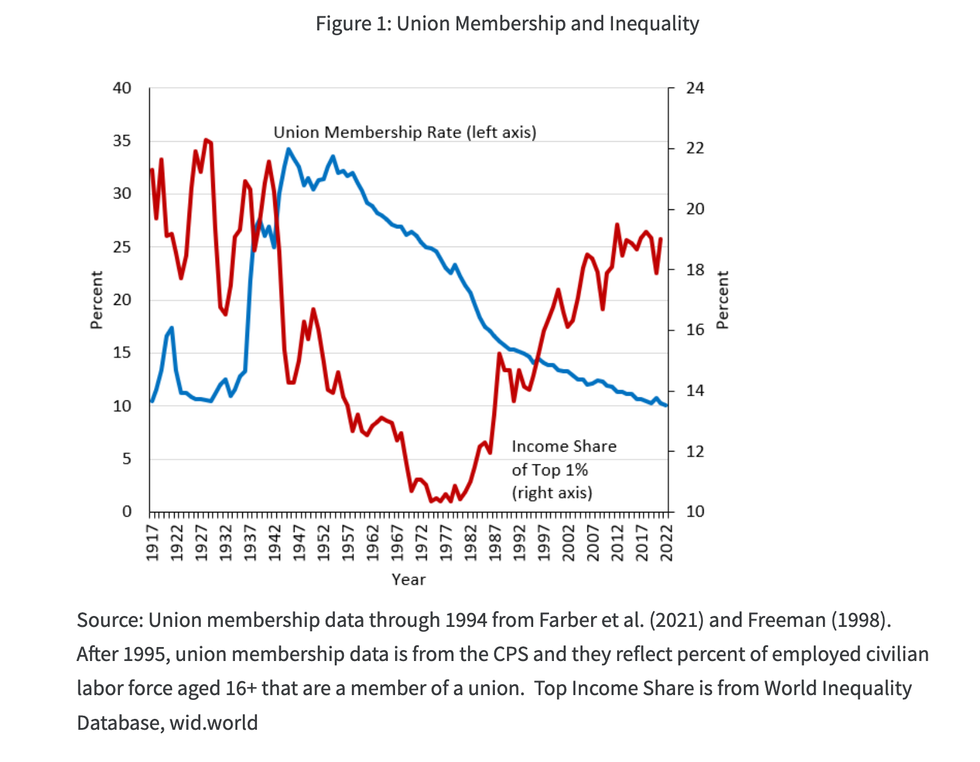
A report released Monday by the U.S. Treasury Department argues that labor unions are critical to combating income inequality, which has risen dramatically in recent decades as union membership has declined and real wages have largely stagnated.
The report estimates that unions boost the wages of their members by between 10% and 15%, an impact that spreads to the broader economy as nonunion workplaces compete for employees.
"Unions also improve fringe benefits and workplace procedures such as retirement plans, workplace grievance policies, and predictable scheduling," the report notes. "These workplace improvements contribute substantially to middle-class financial stability and worker well-being. For example, one study has estimated that the average worker values their ability to avoid short-notice schedule changes at up to 20% of their wages."
In a summary of the report's findings, Treasury Department economist Laura Feiveson wrote that "increased unionization has the potential to contribute to the reversal of the stark increase in inequality seen over the last half-century."
"All in all, the evidence presented in Treasury's report challenges the view that worker empowerment holds back economic prosperity," wrote Feiveson. "In addition to their effect on the economy through more equality, unions can have a positive effect on productivity through employee engagement and union voice effects, providing a roadmap for the type of union campaigns that could lead to additional growth."
The Treasury Department report was released less than a week after UPS Teamsters
ratified a five-year contract that includes substantial wage increases, a deal secured after the union threatened a nationwide strike.
The United Auto Workers (UAW) union is also looking to win a major pay increase for General Motors, Ford, and Stellantis employees. Last week, 97% of UAW members who participated in the vote opted to authorize a strike if contract talks with the three automakers fail.
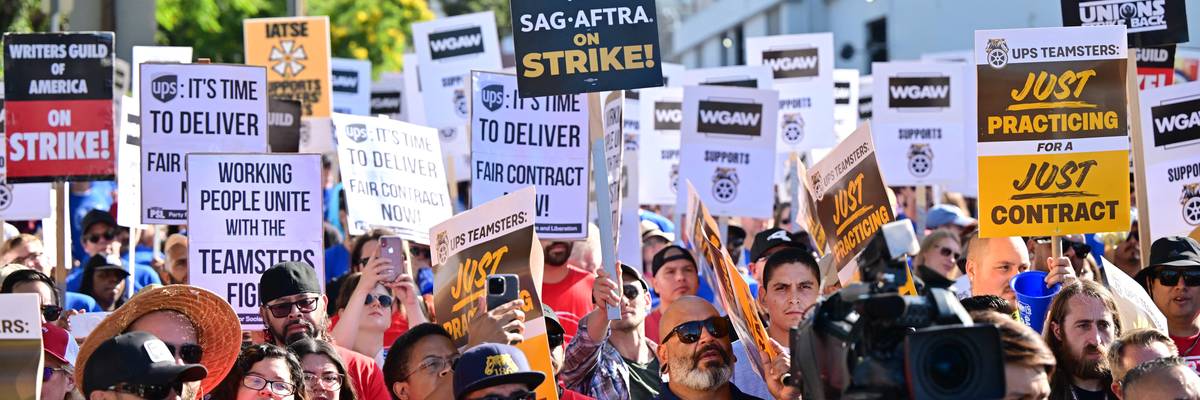
Meanwhile, Hollywood writers and actors are still on strike, and others across the country—including nurses, hotel workers, and city employees—have walked off the job in recent weeks to demand better pay, benefits, and conditions.
The wave of strikes followed significant labor victories in 2022, a year in which Starbucks employees organized hundreds of locations across the U.S.—victories that contributed to an increase in the total number of U.S. workers in unions last year.
The union membership rate, however, fell from 10.3% in 2021 to a record-low 10.1% in 2022 as nonunion jobs grew at a faster rate than union jobs.
In a Monday speech outlining her department's findings, Treasury Secretary Janet Yellen said that unions are "critically important to workers' well-being."
"Unionization also has spillover effects," Yellen added. "Competition means workers at nonunionized firms may see increased wages too. Heightened workplace safety norms can pull up whole industries. Benefits also spill over to workers' families and communities."
A report released Monday by the U.S. Treasury Department argues that labor unions are critical to combating income inequality, which has risen dramatically in recent decades as union membership has declined and real wages have largely stagnated.
The report estimates that unions boost the wages of their members by between 10% and 15%, an impact that spreads to the broader economy as nonunion workplaces compete for employees.
"Unions also improve fringe benefits and workplace procedures such as retirement plans, workplace grievance policies, and predictable scheduling," the report notes. "These workplace improvements contribute substantially to middle-class financial stability and worker well-being. For example, one study has estimated that the average worker values their ability to avoid short-notice schedule changes at up to 20% of their wages."
In a summary of the report's findings, Treasury Department economist Laura Feiveson wrote that "increased unionization has the potential to contribute to the reversal of the stark increase in inequality seen over the last half-century."
"All in all, the evidence presented in Treasury's report challenges the view that worker empowerment holds back economic prosperity," wrote Feiveson. "In addition to their effect on the economy through more equality, unions can have a positive effect on productivity through employee engagement and union voice effects, providing a roadmap for the type of union campaigns that could lead to additional growth."
The Treasury Department report was released less than a week after UPS Teamsters
ratified a five-year contract that includes substantial wage increases, a deal secured after the union threatened a nationwide strike.
The United Auto Workers (UAW) union is also looking to win a major pay increase for General Motors, Ford, and Stellantis employees. Last week, 97% of UAW members who participated in the vote opted to authorize a strike if contract talks with the three automakers fail.
Meanwhile, Hollywood writers and actors are still on strike, and others across the country—including nurses, hotel workers, and city employees—have walked off the job in recent weeks to demand better pay, benefits, and conditions.
The wave of strikes followed significant labor victories in 2022, a year in which Starbucks employees organized hundreds of locations across the U.S.—victories that contributed to an increase in the total number of U.S. workers in unions last year.
The union membership rate, however, fell from 10.3% in 2021 to a record-low 10.1% in 2022 as nonunion jobs grew at a faster rate than union jobs.
In a Monday speech outlining her department's findings, Treasury Secretary Janet Yellen said that unions are "critically important to workers' well-being."
"Unionization also has spillover effects," Yellen added. "Competition means workers at nonunionized firms may see increased wages too. Heightened workplace safety norms can pull up whole industries. Benefits also spill over to workers' families and communities."
A report released Monday by the U.S. Treasury Department argues that labor unions are critical to combating income inequality, which has risen dramatically in recent decades as union membership has declined and real wages have largely stagnated.
The report estimates that unions boost the wages of their members by between 10% and 15%, an impact that spreads to the broader economy as nonunion workplaces compete for employees.
"Unions also improve fringe benefits and workplace procedures such as retirement plans, workplace grievance policies, and predictable scheduling," the report notes. "These workplace improvements contribute substantially to middle-class financial stability and worker well-being. For example, one study has estimated that the average worker values their ability to avoid short-notice schedule changes at up to 20% of their wages."
In a summary of the report's findings, Treasury Department economist Laura Feiveson wrote that "increased unionization has the potential to contribute to the reversal of the stark increase in inequality seen over the last half-century."
"All in all, the evidence presented in Treasury's report challenges the view that worker empowerment holds back economic prosperity," wrote Feiveson. "In addition to their effect on the economy through more equality, unions can have a positive effect on productivity through employee engagement and union voice effects, providing a roadmap for the type of union campaigns that could lead to additional growth."
The Treasury Department report was released less than a week after UPS Teamsters
ratified a five-year contract that includes substantial wage increases, a deal secured after the union threatened a nationwide strike.
The United Auto Workers (UAW) union is also looking to win a major pay increase for General Motors, Ford, and Stellantis employees. Last week, 97% of UAW members who participated in the vote opted to authorize a strike if contract talks with the three automakers fail.
Meanwhile, Hollywood writers and actors are still on strike, and others across the country—including nurses, hotel workers, and city employees—have walked off the job in recent weeks to demand better pay, benefits, and conditions.
The wave of strikes followed significant labor victories in 2022, a year in which Starbucks employees organized hundreds of locations across the U.S.—victories that contributed to an increase in the total number of U.S. workers in unions last year.
The union membership rate, however, fell from 10.3% in 2021 to a record-low 10.1% in 2022 as nonunion jobs grew at a faster rate than union jobs.
In a Monday speech outlining her department's findings, Treasury Secretary Janet Yellen said that unions are "critically important to workers' well-being."
"Unionization also has spillover effects," Yellen added. "Competition means workers at nonunionized firms may see increased wages too. Heightened workplace safety norms can pull up whole industries. Benefits also spill over to workers' families and communities."