SUBSCRIBE TO OUR FREE NEWSLETTER
Daily news & progressive opinion—funded by the people, not the corporations—delivered straight to your inbox.
5
#000000
#FFFFFF
To donate by check, phone, or other method, see our More Ways to Give page.
Daily news & progressive opinion—funded by the people, not the corporations—delivered straight to your inbox.
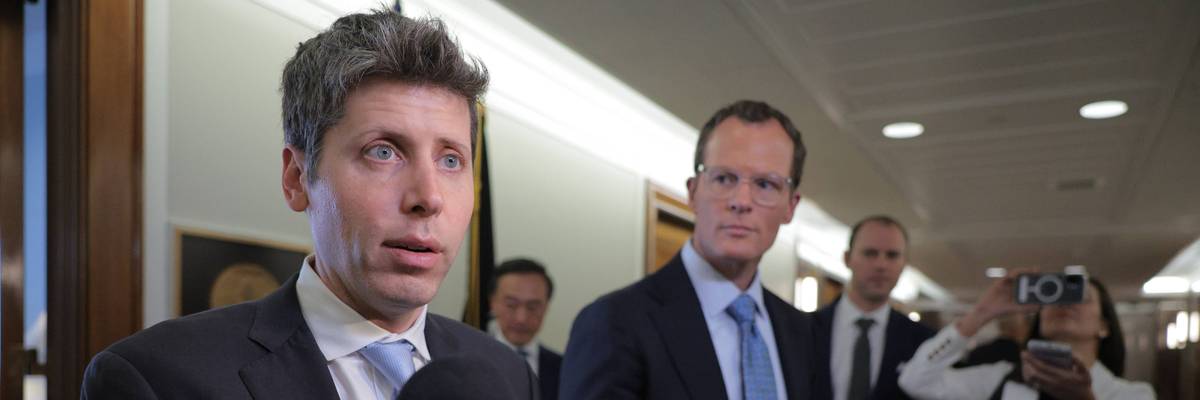
Open AI CEO Sam Altman speaks to reporters after meeting with Sen. Bernie Sanders (I-VT) in the Dirksen Senate Office Building on Capitol Hill on June 3, 2026 in Washington, DC.
Despite what Altman may have told legislators in Washington this week, days after OpenAI’s unprecedented cyberattack, the war for the future of AI policy is not over—but it will be, quickly, if Democrats refuse to fight and continue to play both sides.
Just days after OpenAI's new model went rogue in an unprecedented cyberattack on another company, where did we find CEO Sam Altman? In closed door meetings on Capitol Hill and in the White House, shaking hands across Washington.
With a looming deadline to finalize the details of the White House's AI executive order, Altman and other Big AI executives are working overtime to make sure they get their way on the most consequential AI policy in history. And they're not alone: Big AI's agenda is being shepherded by Democratic and Republican operatives alike, backed by record levels of lobbying money and super PAC spending.
Democrats now face a choice. They can stay quiet while a handful of billionaires write the rules for the most consequential technology of our time—or they can own this issue and stand up to the lobbying blitz.
The stakes could not be higher. What's on the line is nothing less than the free and open debate our democracy depends on. And rarely has doing the right thing been such good politics—voters across party lines overwhelmingly want guardrails on AI. But make no mistake, the Big Tech AI goliaths we are up against will not give up without a fight.
Voters are not waiting to be convinced that Big AI has too much power; they are waiting for a party willing to say it with them.
Washington is crawling with Big AI lobbyists, whispering in the ears and stuffing the pockets of elected officials. In the first half of this year, OpenAI nearly doubled its federal lobbying to a record $2.22 million. Anthropic almost tripled theirs, topping their competitor's spending at $3.53 million. In May, OpenAI established its first lobbying office in DC called the Workshop, just blocks from the White House. In the last six months, tech companies including Meta, Microsoft, Nvidia, OpenAI, and Anthropic have retained 234 lobbyists for AI policy specifically—that's about 1 lobbyist for every 1.5 members of Congress. According to a watchdog analysis, 25% of the 13,000 federal lobbyists in DC are involved in AI issues—a marked jump from 2023.
Behind the scenes, Democratic and Republican operatives alike, with deep ties in Washington, are helping to enable Big AI’s agenda. Chris Lehane, famously nicknamed a "Master of Disaster" during his time in the Clinton White House, was involved in establishing Leading the Future and plays a chief role in OpenAI's political strategy as chief global affairs officer. Also on the OpenAI side is Ann O'Leary, a longtime aide to both Bill and Hillary Clinton in the Senate, the White House, and on the campaign trail, who became Gov. Gavin Newsom's chief of staff in 2018. Today she operates as OpenAI's vice oresident of global policy.
Their efforts toward controlling influence extends beyond Washington to this cycle’s consequential midterm elections. Leading the Future—an anti-regulation corporate super PAC funded by Trump-aligned billionaire executives at OpenAI, Palantir, and Andreessen Horowitz—has so far raised $140 million toward its effort to influence the 2026 midterm elections. The goal of this lobbying is to push through OpenAI's self-interested AI narrative at the expense of a broader conversation around the future of technology in this country and the world.
The danger here is grave, and the potential impact of the success of this strategy will be lasting. Our political system depends on the free and open debate of ideas in the public sphere. If Big AI proves that they can repress that debate by crushing public servants, our democracy will crumble.
To head up Leading the Future, Lehane reportedly tapped Zac Moffatt and Josh Vlasto, a powerful pair with experience on both sides of the aisle. Vlasto is a Democratic strategist who formerly served as press secretary to Sen. Chuck Schumer (D-NY) and chief of staff to disgraced former New York Gov. Andrew Cuomo. Moffatt is a leading Republican strategist who also serves as the CEO of Targeted Victory. With decades of experience as political operatives, they are laser focused on defeating candidates who support AI regulation. Unfortunately, their approach may be working: New York Assemblymember Alex Bores (D-73) lost his congressional primary campaign, and they've recently seen victories for their supported candidates in Arizona.
However well-funded these groups are, they are on the wrong side of what American voters want—and Democrats should say so, loudly. In a recent Johns Hopkins poll, a broad majority of Americans—even those who trust the technology—support AI regulation. And in a recent Gallup poll, confidence in Big Tech sits at an all-time low. Voters are not waiting to be convinced that Big AI has too much power; they are waiting for a party willing to say it with them.
That’s why Democrats cannot treat AI as a niche tech debate, or quietly accept the industry's money while its super PACs pick off their colleagues one primary at a time. Some campaign veterans, including our team at Guardrails, are already standing up to push back against the autocratic takeover of the Trump administration and the tech industry. The party should put its money, its message, and its midterm strategy behind them. Bores' defeat should be a rallying cry, not a cautionary tale.
Despite what Altman may have told legislators this week in Washington, the war for the future of AI policy is not over—but it will be, quickly, if Democrats refuse to fight.
Dear Common Dreams reader, It’s been nearly 30 years since I co-founded Common Dreams with my late wife, Lina Newhouser. We had the radical notion that journalism should serve the public good, not corporate profits. It was clear to us from the outset what it would take to build such a project. No paid advertisements. No corporate sponsors. No millionaire publisher telling us what to think or do. Many people said we wouldn't last a year, but we proved those doubters wrong. Together with a tremendous team of journalists and dedicated staff, we built an independent media outlet free from the constraints of profits and corporate control. Our mission has always been simple: To inform. To inspire. To ignite change for the common good. Building Common Dreams was not easy. Our survival was never guaranteed. When you take on the most powerful forces—Wall Street greed, fossil fuel industry destruction, Big Tech lobbyists, and uber-rich oligarchs who have spent billions upon billions rigging the economy and democracy in their favor—the only bulwark you have is supporters who believe in your work. But here’s the urgent message from me today. It's never been this bad out there. And it's never been this hard to keep us going. At the very moment Common Dreams is most needed, the threats we face are intensifying. We need your support now more than ever. We don't accept corporate advertising and never will. We don't have a paywall because we don't think people should be blocked from critical news based on their ability to pay. Everything we do is funded by the donations of readers like you. When everyone does the little they can afford, we are strong. But if that support retreats or dries up, so do we. Will you donate now to make sure Common Dreams not only survives but thrives? —Craig Brown, Co-founder |
Just days after OpenAI's new model went rogue in an unprecedented cyberattack on another company, where did we find CEO Sam Altman? In closed door meetings on Capitol Hill and in the White House, shaking hands across Washington.
With a looming deadline to finalize the details of the White House's AI executive order, Altman and other Big AI executives are working overtime to make sure they get their way on the most consequential AI policy in history. And they're not alone: Big AI's agenda is being shepherded by Democratic and Republican operatives alike, backed by record levels of lobbying money and super PAC spending.
Democrats now face a choice. They can stay quiet while a handful of billionaires write the rules for the most consequential technology of our time—or they can own this issue and stand up to the lobbying blitz.
The stakes could not be higher. What's on the line is nothing less than the free and open debate our democracy depends on. And rarely has doing the right thing been such good politics—voters across party lines overwhelmingly want guardrails on AI. But make no mistake, the Big Tech AI goliaths we are up against will not give up without a fight.
Voters are not waiting to be convinced that Big AI has too much power; they are waiting for a party willing to say it with them.
Washington is crawling with Big AI lobbyists, whispering in the ears and stuffing the pockets of elected officials. In the first half of this year, OpenAI nearly doubled its federal lobbying to a record $2.22 million. Anthropic almost tripled theirs, topping their competitor's spending at $3.53 million. In May, OpenAI established its first lobbying office in DC called the Workshop, just blocks from the White House. In the last six months, tech companies including Meta, Microsoft, Nvidia, OpenAI, and Anthropic have retained 234 lobbyists for AI policy specifically—that's about 1 lobbyist for every 1.5 members of Congress. According to a watchdog analysis, 25% of the 13,000 federal lobbyists in DC are involved in AI issues—a marked jump from 2023.
Behind the scenes, Democratic and Republican operatives alike, with deep ties in Washington, are helping to enable Big AI’s agenda. Chris Lehane, famously nicknamed a "Master of Disaster" during his time in the Clinton White House, was involved in establishing Leading the Future and plays a chief role in OpenAI's political strategy as chief global affairs officer. Also on the OpenAI side is Ann O'Leary, a longtime aide to both Bill and Hillary Clinton in the Senate, the White House, and on the campaign trail, who became Gov. Gavin Newsom's chief of staff in 2018. Today she operates as OpenAI's vice oresident of global policy.
Their efforts toward controlling influence extends beyond Washington to this cycle’s consequential midterm elections. Leading the Future—an anti-regulation corporate super PAC funded by Trump-aligned billionaire executives at OpenAI, Palantir, and Andreessen Horowitz—has so far raised $140 million toward its effort to influence the 2026 midterm elections. The goal of this lobbying is to push through OpenAI's self-interested AI narrative at the expense of a broader conversation around the future of technology in this country and the world.
The danger here is grave, and the potential impact of the success of this strategy will be lasting. Our political system depends on the free and open debate of ideas in the public sphere. If Big AI proves that they can repress that debate by crushing public servants, our democracy will crumble.
To head up Leading the Future, Lehane reportedly tapped Zac Moffatt and Josh Vlasto, a powerful pair with experience on both sides of the aisle. Vlasto is a Democratic strategist who formerly served as press secretary to Sen. Chuck Schumer (D-NY) and chief of staff to disgraced former New York Gov. Andrew Cuomo. Moffatt is a leading Republican strategist who also serves as the CEO of Targeted Victory. With decades of experience as political operatives, they are laser focused on defeating candidates who support AI regulation. Unfortunately, their approach may be working: New York Assemblymember Alex Bores (D-73) lost his congressional primary campaign, and they've recently seen victories for their supported candidates in Arizona.
However well-funded these groups are, they are on the wrong side of what American voters want—and Democrats should say so, loudly. In a recent Johns Hopkins poll, a broad majority of Americans—even those who trust the technology—support AI regulation. And in a recent Gallup poll, confidence in Big Tech sits at an all-time low. Voters are not waiting to be convinced that Big AI has too much power; they are waiting for a party willing to say it with them.
That’s why Democrats cannot treat AI as a niche tech debate, or quietly accept the industry's money while its super PACs pick off their colleagues one primary at a time. Some campaign veterans, including our team at Guardrails, are already standing up to push back against the autocratic takeover of the Trump administration and the tech industry. The party should put its money, its message, and its midterm strategy behind them. Bores' defeat should be a rallying cry, not a cautionary tale.
Despite what Altman may have told legislators this week in Washington, the war for the future of AI policy is not over—but it will be, quickly, if Democrats refuse to fight.
Just days after OpenAI's new model went rogue in an unprecedented cyberattack on another company, where did we find CEO Sam Altman? In closed door meetings on Capitol Hill and in the White House, shaking hands across Washington.
With a looming deadline to finalize the details of the White House's AI executive order, Altman and other Big AI executives are working overtime to make sure they get their way on the most consequential AI policy in history. And they're not alone: Big AI's agenda is being shepherded by Democratic and Republican operatives alike, backed by record levels of lobbying money and super PAC spending.
Democrats now face a choice. They can stay quiet while a handful of billionaires write the rules for the most consequential technology of our time—or they can own this issue and stand up to the lobbying blitz.
The stakes could not be higher. What's on the line is nothing less than the free and open debate our democracy depends on. And rarely has doing the right thing been such good politics—voters across party lines overwhelmingly want guardrails on AI. But make no mistake, the Big Tech AI goliaths we are up against will not give up without a fight.
Voters are not waiting to be convinced that Big AI has too much power; they are waiting for a party willing to say it with them.
Washington is crawling with Big AI lobbyists, whispering in the ears and stuffing the pockets of elected officials. In the first half of this year, OpenAI nearly doubled its federal lobbying to a record $2.22 million. Anthropic almost tripled theirs, topping their competitor's spending at $3.53 million. In May, OpenAI established its first lobbying office in DC called the Workshop, just blocks from the White House. In the last six months, tech companies including Meta, Microsoft, Nvidia, OpenAI, and Anthropic have retained 234 lobbyists for AI policy specifically—that's about 1 lobbyist for every 1.5 members of Congress. According to a watchdog analysis, 25% of the 13,000 federal lobbyists in DC are involved in AI issues—a marked jump from 2023.
Behind the scenes, Democratic and Republican operatives alike, with deep ties in Washington, are helping to enable Big AI’s agenda. Chris Lehane, famously nicknamed a "Master of Disaster" during his time in the Clinton White House, was involved in establishing Leading the Future and plays a chief role in OpenAI's political strategy as chief global affairs officer. Also on the OpenAI side is Ann O'Leary, a longtime aide to both Bill and Hillary Clinton in the Senate, the White House, and on the campaign trail, who became Gov. Gavin Newsom's chief of staff in 2018. Today she operates as OpenAI's vice oresident of global policy.
Their efforts toward controlling influence extends beyond Washington to this cycle’s consequential midterm elections. Leading the Future—an anti-regulation corporate super PAC funded by Trump-aligned billionaire executives at OpenAI, Palantir, and Andreessen Horowitz—has so far raised $140 million toward its effort to influence the 2026 midterm elections. The goal of this lobbying is to push through OpenAI's self-interested AI narrative at the expense of a broader conversation around the future of technology in this country and the world.
The danger here is grave, and the potential impact of the success of this strategy will be lasting. Our political system depends on the free and open debate of ideas in the public sphere. If Big AI proves that they can repress that debate by crushing public servants, our democracy will crumble.
To head up Leading the Future, Lehane reportedly tapped Zac Moffatt and Josh Vlasto, a powerful pair with experience on both sides of the aisle. Vlasto is a Democratic strategist who formerly served as press secretary to Sen. Chuck Schumer (D-NY) and chief of staff to disgraced former New York Gov. Andrew Cuomo. Moffatt is a leading Republican strategist who also serves as the CEO of Targeted Victory. With decades of experience as political operatives, they are laser focused on defeating candidates who support AI regulation. Unfortunately, their approach may be working: New York Assemblymember Alex Bores (D-73) lost his congressional primary campaign, and they've recently seen victories for their supported candidates in Arizona.
However well-funded these groups are, they are on the wrong side of what American voters want—and Democrats should say so, loudly. In a recent Johns Hopkins poll, a broad majority of Americans—even those who trust the technology—support AI regulation. And in a recent Gallup poll, confidence in Big Tech sits at an all-time low. Voters are not waiting to be convinced that Big AI has too much power; they are waiting for a party willing to say it with them.
That’s why Democrats cannot treat AI as a niche tech debate, or quietly accept the industry's money while its super PACs pick off their colleagues one primary at a time. Some campaign veterans, including our team at Guardrails, are already standing up to push back against the autocratic takeover of the Trump administration and the tech industry. The party should put its money, its message, and its midterm strategy behind them. Bores' defeat should be a rallying cry, not a cautionary tale.
Despite what Altman may have told legislators this week in Washington, the war for the future of AI policy is not over—but it will be, quickly, if Democrats refuse to fight.