SUBSCRIBE TO OUR FREE NEWSLETTER
Daily news & progressive opinion—funded by the people, not the corporations—delivered straight to your inbox.
5
#000000
#FFFFFF
To donate by check, phone, or other method, see our More Ways to Give page.
Daily news & progressive opinion—funded by the people, not the corporations—delivered straight to your inbox.
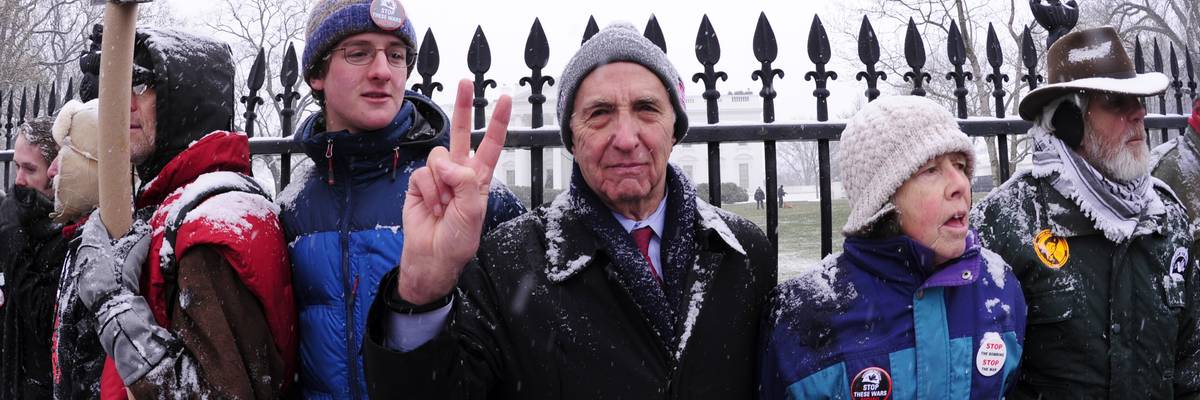
Daniel Ellsberg giving the peace sign in front of the White House during a 2011 demonstration calling for the end of the war in Afghanistan.
We loved him not only for what he had done but also for what he kept doing, for who he was, luminously, ongoing. The power of his vibrant example spurred us to become better than we were.
When Daniel Ellsberg died on Friday, the world lost a transcendent whistleblower with a powerful ethos of compassion and resolve.
Ellsberg’s renown for openly challenging the mentalities of militarism began on June 23, 1971, when he appeared on CBS Evening News ten days after news broke about the Pentagon Papers that he’d provided to journalists. Ellsberg pointedly said that in the 7,000 pages of top-secret documents, “I don’t think there is a line in them that contains an estimate of the likely impact of our policy on the overall casualties among Vietnamese or the refugees to be caused, the effects of defoliation in an ecological sense. There’s neither an estimate nor a calculation of past effects, ever.”
And he added: “The documents simply reflect the internal concerns of our officials. That says nothing more nor less than that our officials never did concern themselves with the effect of our policies on the Vietnamese.”
Ellsberg told anchor Walter Cronkite: “I think we cannot let the officials of the Executive Branch determine for us what it is that the public needs to know about how well and how they are discharging their functions.”
The functions of overseeing the war on Vietnam had become repugnant to Ellsberg as an insider. Many other government officials and top-level consultants with security clearances also had access to documents that showed how mendacious four administrations had been as the U.S. role in Vietnam expanded and then escalated into wholesale slaughter.
Unlike the others, he finally broke free and provided the Pentagon Papers to news media. As he said in the CBS interview, “The fact is that secrets can be held by men in the government whose careers have been spent learning how to keep their mouths shut. I was one of those.”
Ellsberg’s mouth, and heart, never stayed shut again. For the 52 full years that followed his release of the Pentagon Papers, he devoted himself to speaking, writing, and protesting. When the war on Vietnam finally ended, Ellsberg mainly returned to his earlier preoccupation—how to help prevent nuclear war.
Ellsberg often heard that he was inspiring, but he was always far more interested in what people would be inspired to actually do—in a world of war and on the precipice of inconceivable nuclear catastrophe.
This spring, during the three months after diagnosis of pancreatic cancer, Ellsberg made the most of every day, spending time with loved ones and speaking out about the all-too-real dangers of nuclear annihilation. He left behind two brilliant, monumental books published in this century—“Secrets: A Memoir of Vietnam and the Pentagon Papers” (2002) and “The Doomsday Machine: Confessions of a Nuclear War Planner” (2017). They illuminate in sharp ghastly light the patterns of official lies and secrecy about military matters, and the ultimate foreseeable result—nuclear holocaust.
Ellsberg was deeply determined to do all he could to help prevent omnicide. As he said in an interview when “The Doomsday Machine” came out, scientific research has concluded that nuclear war “would loft into the stratosphere many millions of tons of soot and black smoke from the burning cities. It wouldn't be rained out in the stratosphere. It would go around the globe very quickly and reduce sunlight by as much as 70 percent, causing temperatures like that of the Little Ice Age, killing harvests worldwide and starving to death nearly everyone on earth. It probably wouldn't cause extinction. We're so adaptable. Maybe 1 percent of our current population of 7.4 billion could survive, but 98 or 99 percent would not.”
During the profuse interviews that he engaged in during the last few months, what clearly preoccupied Ellsberg was not his own fate but the fate of the Earth’s inhabitants.
He was acutely aware that while admiration for brave whistleblowers might sometimes be widespread, actual emulation is scarce. Ellsberg often heard that he was inspiring, but he was always far more interested in what people would be inspired to actually do—in a world of war and on the precipice of inconceivable nuclear catastrophe.
During the last decades of his life, standard assumptions and efforts by mainstream media and the political establishment aimed to consign Ellsberg to the era of the Vietnam War. But in real-time, Dan Ellsberg continually inspired so many of us to be more than merely inspired. We loved him not only for what he had done but also for what he kept doing, for who he was, luminously, ongoing. The power of his vibrant example spurred us to become better than we were.
In a recent series of short illustrated podcasts created by filmmaker Judith Ehrlich—who co-directed the documentary “The Most Dangerous Man in America: Daniel Ellsberg and the Pentagon Papers”—Ellsberg speaks about the growing dangers of global apocalypse, saying that nuclear war planners “have written plans to kill billions of people,” preparations that amount to “a conspiracy to commit omnicide, near omnicide, the death of everyone.” And he adds: “Can humanity survive the nuclear era? We don’t know. I choose to act as if we have a chance.”
This country and this world are at a monumental crossroads. US voters have an opportunity to beat back the forces of fascism and confront the billionaires who are rigging the economy, our media system, and our democracy, making it increasingly impossible for ordinary people to get by. We’re not just talking about the election. We’re talking about what must be done once these fascist elements are vanquished from power. We need a bolder set of solutions than what either major party has so far been willing to offer and a working-class movement ready to fight like hell for it. Trump didn't emerge from nowhere. The conditions that fueled MAGA authoritarianism were created by decades of radical neoliberal economic policies and a corrupt political system dominated by corporate interests. They slashed taxes on the super-rich, promising that the benefits would trickle down. They said giveaways to the corporate titans would make life more affordable for the rest of us. It was all bullshit. And when a bitter, betrayed populace searches for someone to blame, right-wing demagogues have little trouble finding scapegoats. People know when they're being lied to, but you won't hear any of this from the corporate media. Only independent journalism—powered and funded by people who believe in building a better world—can deliver truly trustworthy daily news. If you share our vision, please contribute whatever you can to sustain our work. |
Norman Solomon is the national director of RootsAction.org and executive director of the Institute for Public Accuracy. The paperback edition of his latest book, War Made Invisible: How America Hides the Human Toll of Its Military Machine, includes an afterword about the Gaza war.
When Daniel Ellsberg died on Friday, the world lost a transcendent whistleblower with a powerful ethos of compassion and resolve.
Ellsberg’s renown for openly challenging the mentalities of militarism began on June 23, 1971, when he appeared on CBS Evening News ten days after news broke about the Pentagon Papers that he’d provided to journalists. Ellsberg pointedly said that in the 7,000 pages of top-secret documents, “I don’t think there is a line in them that contains an estimate of the likely impact of our policy on the overall casualties among Vietnamese or the refugees to be caused, the effects of defoliation in an ecological sense. There’s neither an estimate nor a calculation of past effects, ever.”
And he added: “The documents simply reflect the internal concerns of our officials. That says nothing more nor less than that our officials never did concern themselves with the effect of our policies on the Vietnamese.”
Ellsberg told anchor Walter Cronkite: “I think we cannot let the officials of the Executive Branch determine for us what it is that the public needs to know about how well and how they are discharging their functions.”
The functions of overseeing the war on Vietnam had become repugnant to Ellsberg as an insider. Many other government officials and top-level consultants with security clearances also had access to documents that showed how mendacious four administrations had been as the U.S. role in Vietnam expanded and then escalated into wholesale slaughter.
Unlike the others, he finally broke free and provided the Pentagon Papers to news media. As he said in the CBS interview, “The fact is that secrets can be held by men in the government whose careers have been spent learning how to keep their mouths shut. I was one of those.”
Ellsberg’s mouth, and heart, never stayed shut again. For the 52 full years that followed his release of the Pentagon Papers, he devoted himself to speaking, writing, and protesting. When the war on Vietnam finally ended, Ellsberg mainly returned to his earlier preoccupation—how to help prevent nuclear war.
Ellsberg often heard that he was inspiring, but he was always far more interested in what people would be inspired to actually do—in a world of war and on the precipice of inconceivable nuclear catastrophe.
This spring, during the three months after diagnosis of pancreatic cancer, Ellsberg made the most of every day, spending time with loved ones and speaking out about the all-too-real dangers of nuclear annihilation. He left behind two brilliant, monumental books published in this century—“Secrets: A Memoir of Vietnam and the Pentagon Papers” (2002) and “The Doomsday Machine: Confessions of a Nuclear War Planner” (2017). They illuminate in sharp ghastly light the patterns of official lies and secrecy about military matters, and the ultimate foreseeable result—nuclear holocaust.
Ellsberg was deeply determined to do all he could to help prevent omnicide. As he said in an interview when “The Doomsday Machine” came out, scientific research has concluded that nuclear war “would loft into the stratosphere many millions of tons of soot and black smoke from the burning cities. It wouldn't be rained out in the stratosphere. It would go around the globe very quickly and reduce sunlight by as much as 70 percent, causing temperatures like that of the Little Ice Age, killing harvests worldwide and starving to death nearly everyone on earth. It probably wouldn't cause extinction. We're so adaptable. Maybe 1 percent of our current population of 7.4 billion could survive, but 98 or 99 percent would not.”
During the profuse interviews that he engaged in during the last few months, what clearly preoccupied Ellsberg was not his own fate but the fate of the Earth’s inhabitants.
He was acutely aware that while admiration for brave whistleblowers might sometimes be widespread, actual emulation is scarce. Ellsberg often heard that he was inspiring, but he was always far more interested in what people would be inspired to actually do—in a world of war and on the precipice of inconceivable nuclear catastrophe.
During the last decades of his life, standard assumptions and efforts by mainstream media and the political establishment aimed to consign Ellsberg to the era of the Vietnam War. But in real-time, Dan Ellsberg continually inspired so many of us to be more than merely inspired. We loved him not only for what he had done but also for what he kept doing, for who he was, luminously, ongoing. The power of his vibrant example spurred us to become better than we were.
In a recent series of short illustrated podcasts created by filmmaker Judith Ehrlich—who co-directed the documentary “The Most Dangerous Man in America: Daniel Ellsberg and the Pentagon Papers”—Ellsberg speaks about the growing dangers of global apocalypse, saying that nuclear war planners “have written plans to kill billions of people,” preparations that amount to “a conspiracy to commit omnicide, near omnicide, the death of everyone.” And he adds: “Can humanity survive the nuclear era? We don’t know. I choose to act as if we have a chance.”