
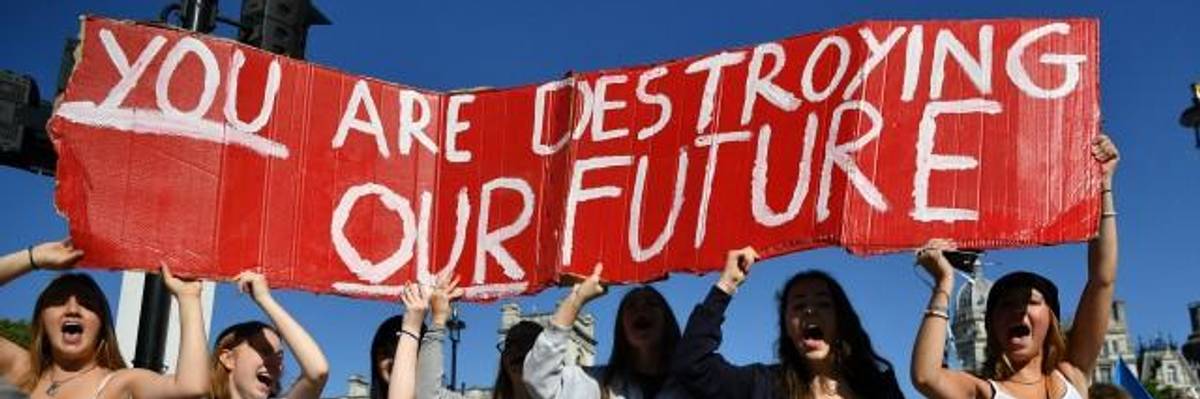
Environmental activists rally during the U.K. Student Climate Network's Global Climate Strike protest action in central London, on September 20, 2019.
Climate Justice Is Not on the Ballot in the 2024 Elections
The climate justice movement must intervene to make it clear that whatever the outcome, the course towards chaos will not have been altered by any new political coloring.
This year more than half of the world's population will be able to vote in national or regional elections, in what will be the year with the most elections in history. These elections are taking place at a time of declining confidence in democracy and the institutions that emerge from electoral processes. The distrust is justified, as decades of popular support for social justice and even climate action have been rejected, disavowed, and thwarted by political parties and governments, and this will be repeated this time around. The climate justice movement must act.
In 2023, the record for global greenhouse gas emissions was broken once again and the hottest year on record was recorded. In none of this year's elections will the solutions to this catastrophic situation be on the ballot, either out of direct service to fossil capitalism or out of political fear. These facts turn today's democracy into a theater exercise that leads to the election of simulacrum parliaments, prevented by their own will and the way they were designed from resolving the catastrophic situation in which we live, in the name of "stability."
In 2024 there will be elections in Pakistan, Indonesia, Belarus, Senegal, Iran, Portugal, Russia, South Korea, Panama, Lithuania, Mexico, Belgium, Rwanda, Mozambique, Uruguay, the United States, Austria, Croatia, India, Namibia, South Africa, Venezuela, possibly the United Kingdom, and for the European Parliament. More than 3 billion people will at least theoretically have the chance to vote to change something. But they won't have the chance to vote to stop the path to climate chaos. The shift to the right and the far right was always going to happen when social and environmental degradation became more evident, and it's only going to get worse over the next few years.
By abdicating from programs of radical transformation of society while this society collapses, the left has surrendered the sense of "alternative" to the far right.
One of the many reasons for distrust of democracy is the catastrophic state of the climate justice debate. In most countries, there will be those who push the issue of climate change under the carpet, removing the biggest crisis in human history from the debate. In other cases, where the issue is present, two major poles are forming:
- Denialism or denial of any relevant action, which corresponds in Europe and the United States to the alliance of conservatives with the far right; and
- Climate tinkering and climate business-making, which corresponds to the alliance of the center with the greens and the left.
The reason why the state of the debate on climate justice is catastrophic is simple: Whatever the outcome of a debate along these lines, the necessary outcome would be catastrophe, climate chaos.
The left's drive to ally itself with the center to try to avoid governments in which the far right participates will only feed the far right's entrenchment in societies, as recent years have made clear. By abdicating from programs of radical transformation of society while this society collapses, the left has surrendered the sense of "alternative" to the far right.
It is irrelevant how passionate the words and how shouted the pledges of commitment to climate action. We've known for many years what needs to be done to stop the climate crisis: Cut 50% of global greenhouse gas emissions by 2030, based on 2010 emissions. In the richest countries, it's a much bigger cut than that. No election, no party is proposing anything that is compatible with what is needed. The result of elections that take place in 2024 in theory is a mandate that will last four or five years, ending one or two years from 2030. By not presenting programs compatible with cutting most emissions in this period, what the parties are telling us is that they reject climate science and expect physics, chemistry, and biology to accommodate their flawed political analysis.
The climate justice movement is in a peculiar situation. On the one hand, it has the urge to ask or propose something to parties it sympathizes with, even though they refuse to take on the climate emergency and have political programs which are compatible with preventing climate breakdown. On the other hand, the movement can't watch these elections from the sidelines, when billions can participate.
Electoral periods are times when there are small hegemonic breaks in society, only for everything to continue more or less the same shortly afterward, when new faces continue the business of capitalism. The climate justice movement must actively intervene in the elections to make it abundantly clear that there is no climate justice program on the ballot, to make it clear that not only are the solutions to the climate crisis not on the ballot and in the debates, but that these solutions are being actively rejected by the political and media apparatuses. It must intervene to make it clear that whatever the outcome, the course towards chaos will not have been altered by any new political coloring.
The polarization between far right and far center, the one that is shaping up in most of this year's elections, is a political fix for civilizational suicide because of the climate crisis. There is no fair industrial and economic transformation policy on the table. An anti-system camp for social and climate justice that denounces and opposes the suicidal debate between the center and the far right is essential, and building it is one of the most urgent tasks of the climate justice movement.
We are at a crossroads
This country and this world are at a monumental crossroads. In a few short weeks, US voters will have an opportunity to beat back the forces of fascism and confront the billionaires who are rigging the economy, our media system, and our democracy, making it increasingly impossible for ordinary people to get by. We’re not just talking about the election. We’re talking about what must be done once these fascist elements are vanquished from power. We need a bolder set of solutions than what either major party has so far been willing to offer and a working-class movement ready to fight like hell for it. Trump didn't emerge from nowhere. The conditions that fueled MAGA authoritarianism were created by decades of radical neoliberal economic policies and a corrupt political system dominated by corporate interests. They slashed taxes on the super-rich, promising that the benefits would trickle down. They said giveaways to the corporate titans would make life more affordable for the rest of us. It was all bullshit. And when a bitter, betrayed populace searches for someone to blame, right-wing demagogues have little trouble finding scapegoats. People know when they're being lied to, but you won't hear any of this from the corporate media. Only independent journalism—powered and funded by people who believe in building a better world—can deliver truly trustworthy daily news. Our Fall Campaign is underway, and we need your help. To power our newsroom through the rest of the year, we need to raise $125,000 by midnight on October 31. So if you share our vision, please contribute whatever you can to sustain our work. |
This year more than half of the world's population will be able to vote in national or regional elections, in what will be the year with the most elections in history. These elections are taking place at a time of declining confidence in democracy and the institutions that emerge from electoral processes. The distrust is justified, as decades of popular support for social justice and even climate action have been rejected, disavowed, and thwarted by political parties and governments, and this will be repeated this time around. The climate justice movement must act.
In 2023, the record for global greenhouse gas emissions was broken once again and the hottest year on record was recorded. In none of this year's elections will the solutions to this catastrophic situation be on the ballot, either out of direct service to fossil capitalism or out of political fear. These facts turn today's democracy into a theater exercise that leads to the election of simulacrum parliaments, prevented by their own will and the way they were designed from resolving the catastrophic situation in which we live, in the name of "stability."
In 2024 there will be elections in Pakistan, Indonesia, Belarus, Senegal, Iran, Portugal, Russia, South Korea, Panama, Lithuania, Mexico, Belgium, Rwanda, Mozambique, Uruguay, the United States, Austria, Croatia, India, Namibia, South Africa, Venezuela, possibly the United Kingdom, and for the European Parliament. More than 3 billion people will at least theoretically have the chance to vote to change something. But they won't have the chance to vote to stop the path to climate chaos. The shift to the right and the far right was always going to happen when social and environmental degradation became more evident, and it's only going to get worse over the next few years.
By abdicating from programs of radical transformation of society while this society collapses, the left has surrendered the sense of "alternative" to the far right.
One of the many reasons for distrust of democracy is the catastrophic state of the climate justice debate. In most countries, there will be those who push the issue of climate change under the carpet, removing the biggest crisis in human history from the debate. In other cases, where the issue is present, two major poles are forming:
- Denialism or denial of any relevant action, which corresponds in Europe and the United States to the alliance of conservatives with the far right; and
- Climate tinkering and climate business-making, which corresponds to the alliance of the center with the greens and the left.
The reason why the state of the debate on climate justice is catastrophic is simple: Whatever the outcome of a debate along these lines, the necessary outcome would be catastrophe, climate chaos.
The left's drive to ally itself with the center to try to avoid governments in which the far right participates will only feed the far right's entrenchment in societies, as recent years have made clear. By abdicating from programs of radical transformation of society while this society collapses, the left has surrendered the sense of "alternative" to the far right.
It is irrelevant how passionate the words and how shouted the pledges of commitment to climate action. We've known for many years what needs to be done to stop the climate crisis: Cut 50% of global greenhouse gas emissions by 2030, based on 2010 emissions. In the richest countries, it's a much bigger cut than that. No election, no party is proposing anything that is compatible with what is needed. The result of elections that take place in 2024 in theory is a mandate that will last four or five years, ending one or two years from 2030. By not presenting programs compatible with cutting most emissions in this period, what the parties are telling us is that they reject climate science and expect physics, chemistry, and biology to accommodate their flawed political analysis.
The climate justice movement is in a peculiar situation. On the one hand, it has the urge to ask or propose something to parties it sympathizes with, even though they refuse to take on the climate emergency and have political programs which are compatible with preventing climate breakdown. On the other hand, the movement can't watch these elections from the sidelines, when billions can participate.
Electoral periods are times when there are small hegemonic breaks in society, only for everything to continue more or less the same shortly afterward, when new faces continue the business of capitalism. The climate justice movement must actively intervene in the elections to make it abundantly clear that there is no climate justice program on the ballot, to make it clear that not only are the solutions to the climate crisis not on the ballot and in the debates, but that these solutions are being actively rejected by the political and media apparatuses. It must intervene to make it clear that whatever the outcome, the course towards chaos will not have been altered by any new political coloring.
The polarization between far right and far center, the one that is shaping up in most of this year's elections, is a political fix for civilizational suicide because of the climate crisis. There is no fair industrial and economic transformation policy on the table. An anti-system camp for social and climate justice that denounces and opposes the suicidal debate between the center and the far right is essential, and building it is one of the most urgent tasks of the climate justice movement.
- Biden's Very Bad Climate Policies Are Also Very Bad Politics ›
- The Dystopian Electoral Outlook Before Us Will Demand This: Candor ›
- Democratic Establishment Seems Ready to Lose With Biden in 2024 ›
- UN Climate Chief Warns Trump Win in 2024 Would Spell Disaster for Planet ›
- Biden Climate Failures Risk 'Disillusioning Young Voters' in 2024, Progressives Warn ›
- Opinion | What Do You Do When Avoiding the Climate Crisis Isn't On the Ballot? | Common Dreams ›
- Opinion | What’s at Stake in the 2024 European Parliament Elections? | Common Dreams ›
- Opinion | It May Not Be the Choice You Want, But Voting Remains Vital When Fascism Is on the Ballot | Common Dreams ›
- Gulf Coast Advocates: 2024 Election Is 'Inflection Point' for Climate Justice | Common Dreams ›
- Opinion | Capitalism, Crisis, and the 2024 Election | Common Dreams ›
- Opinion | Facing the Climate Crisis, Can We Make Politics Move Faster Than Physics? | Common Dreams ›