SUBSCRIBE TO OUR FREE NEWSLETTER
Daily news & progressive opinion—funded by the people, not the corporations—delivered straight to your inbox.
5
#000000
#FFFFFF
To donate by check, phone, or other method, see our More Ways to Give page.
Daily news & progressive opinion—funded by the people, not the corporations—delivered straight to your inbox.
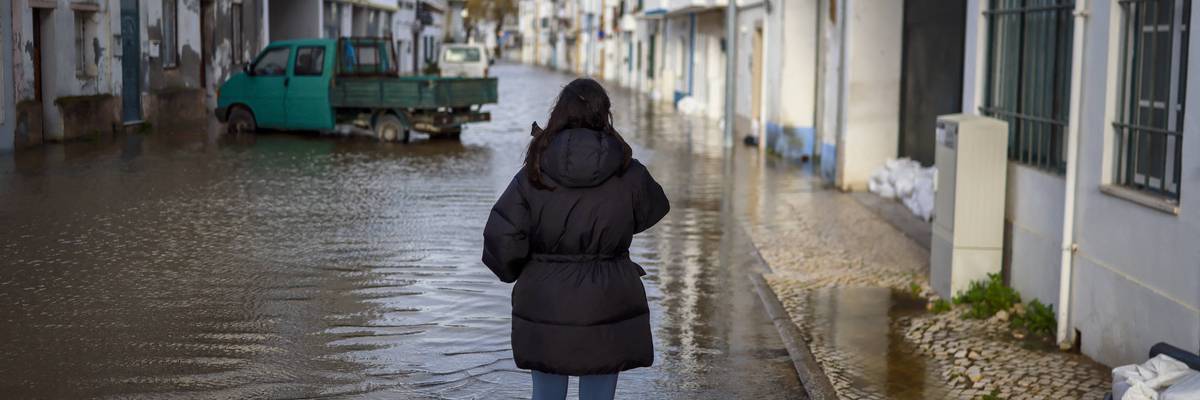
A woman observes floodwaters from the Sado River covering a street in Alcacer do Sal, Portugal, amid Storm Leonardo on February 5, 2026.
Current models "assume the future will behave like the past, even as we push the climate system into uncharted territory," said the lead author of a new report that's based on input from dozens of experts.
In a report published Thursday, UK experts highlighted the "growing gap between real-world climate risk and the economic analysis used to guide policy, supervision, and investment," while also warning that because the "window for preventing catastrophic warming" is narrowing, ambitious action "cannot await perfected models."
Various scientific institutions concur that 2025 was among the hottest years on record—and the ongoing failure of governments across the globe, particularly the Trump administration, to enact policies that would significantly cut planet-heating emissions from fossil fuels is pushing the Paris Agreement's 1.5°C and 2°C goals for this century further out of reach.
The new report from the University of Exeter and the think tank Carbon Tracker Initiative, titled Recalibrating Climate Risk, incorporates the expert opinions of 68 climate scientists from Australia, Austria, Canada, China, France, Germany, the Netherlands, Norway, Spain, Sweden, the United Kingdom, and the United States.
"Our expert elicitation reveals a fundamental disconnect: Climate scientists understand that beyond 2°C, we're not dealing with manageable economic adjustments," said Jesse Abrams, lead author and senior impact fellow at Exeter's Green Futures Solutions, in a statement.
"The climate scientists we surveyed were unambiguous," he explained. "Current economic models systematically underestimate climate damages because they can't capture what matters most—the cascading failures, threshold effects, and compounding shocks that define climate risk in a warmer world and could undermine the very foundations of economic growth."
Abrams said that "for financial institutions and policymakers relying on these models, this isn't a technical problem—it's a fundamental misreading of the risks we face, which current models miss entirely because they assume the future will behave like the past, even as we push the climate system into uncharted territory."
Current economic models miss the mark on climate risks, warning that catastrophic tipping points and extreme weather could crash the global economy, far worse than 2008.As said many times before delaying action will be far costlier than cutting emissions now.www.theguardian.com/environment/...
[image or embed]
— Ian Hall (@ianhall.bsky.social) February 5, 2026 at 12:46 AM
Communities around the world are already contending with devastating droughts, fires, and storms—and, as another report from researchers at Exeter and the UK's Institute and Faculty of Actuaries (IFOA) pointed out last month, "above 1.5°C, we enter the danger zone where multiple climate tipping points may be triggered, such as the collapse of ice sheets in Greenland and Antarctica, permafrost melt, Amazon dieback, and changes in ocean circulation."
The IFOA report "warned that when cascading and systemic risks are taken into account, warming of 2°C by 2050 could result in a 25% hit to projected GDP, rising to a halving of projected economic growth between 2070 and 2090," BusinessGreen editor-in-chief James Murray reported Thursday. "Similarly, a report from consultancy Boston Consulting Group calculated a third of the global economic output could be lost under a scenario where temperatures reach 3°C above preindustrial levels by 2100."
"The studies stand in stark contrast to some mainstream economic models that have suggested warming of 2°C or more will only reduce projected economic growth by a few percentage points—analyses that have been seized upon by opponents of climate action to argue that decarbonization policies can be dropped or delayed," Murray noted.
Abrams told the Guardian that some current economic models "are saying we'll have a 10% GDP loss at between 3°C and 4°C, but the physical climate scientists are saying the economy and society will cease to function as we know it. That's a big mismatch."
Your periodic reminder that the economic models that suggest climate change will knock a couple of percent of future GDP - models that are used widely by governments, investors, and businesses - are almost certainly complete garbage. www.businessgreen.com/news/4525211...
[image or embed]
— James Murray (@james-bg.bsky.social) February 5, 2026 at 7:08 AM
Laurie Laybourn, a Carbon Tracker board member and executive director of Strategic Climate Risks Initiative, cited another recent report that provides a bleak picture of the current moment and what lies ahead.
"As the UK government's landmark security assessment of ecosystem collapse showed last week, we are currently living through a paradigm shift in the speed, scale, and severity of risks driven by the climate-nature crisis," he said. "Yet, beyond this report, there has not been a corresponding paradigm shift in how regulators and government as a whole assess these risks."
"Instead, they're routinely underestimated if not missed entirely, meaning many regulations and government action are dangerously out of touch with reality," he continued. "This threatens disaster when that reality catches up with us. So, it's critical that policymakers change course, providing clear signals and guidance to markets that these risks should be priced accordingly, rather than downplayed."
And, as the experts emphasized Thursday, it's not just policymakers—investors are also still relying on "flawed economic advice," said Carbon Tracker founder and CEO Mark Campanale. The result is "widespread complacency... with many investors viewing climate scenario analysis as a tick-box disclosure exercise."
"Until the gap between scientists and economists' expectations of future climate damages is closed and government bodies act to ensure the integrity of advice upon which investment decisions are made," he added, "financial institutions will continue to chronically underprice climate risks—meaning that pension funds and taxpayers will remain dangerously exposed."
Hetal Patel, head of sustainable investment research at Phoenix Group, the UK's largest and retirement and savings business, said that her firm "supports the report's call for a more robust and coordinated approach to climate‑risk modeling. Underestimating physical risk doesn't just distort financial analysis and investment decisions, it underplays the real‑world consequences that will ultimately affect customer outcomes and society as a whole."
The new report stresses that addressing the "fundamental disconnect between what climate scientists understand about climate impacts and how these impacts are represented in economic models" would require "research investments spanning years," but rather than simply waiting for better modeling, decision-makers "must proceed on the basis of precautionary risk management, physical climate science, and observed impacts."
Dear Common Dreams reader, It’s been nearly 30 years since I co-founded Common Dreams with my late wife, Lina Newhouser. We had the radical notion that journalism should serve the public good, not corporate profits. It was clear to us from the outset what it would take to build such a project. No paid advertisements. No corporate sponsors. No millionaire publisher telling us what to think or do. Many people said we wouldn't last a year, but we proved those doubters wrong. Together with a tremendous team of journalists and dedicated staff, we built an independent media outlet free from the constraints of profits and corporate control. Our mission has always been simple: To inform. To inspire. To ignite change for the common good. Building Common Dreams was not easy. Our survival was never guaranteed. When you take on the most powerful forces—Wall Street greed, fossil fuel industry destruction, Big Tech lobbyists, and uber-rich oligarchs who have spent billions upon billions rigging the economy and democracy in their favor—the only bulwark you have is supporters who believe in your work. But here’s the urgent message from me today. It's never been this bad out there. And it's never been this hard to keep us going. At the very moment Common Dreams is most needed, the threats we face are intensifying. We need your support now more than ever. We don't accept corporate advertising and never will. We don't have a paywall because we don't think people should be blocked from critical news based on their ability to pay. Everything we do is funded by the donations of readers like you. When everyone does the little they can afford, we are strong. But if that support retreats or dries up, so do we. Will you donate now to make sure Common Dreams not only survives but thrives? —Craig Brown, Co-founder |
In a report published Thursday, UK experts highlighted the "growing gap between real-world climate risk and the economic analysis used to guide policy, supervision, and investment," while also warning that because the "window for preventing catastrophic warming" is narrowing, ambitious action "cannot await perfected models."
Various scientific institutions concur that 2025 was among the hottest years on record—and the ongoing failure of governments across the globe, particularly the Trump administration, to enact policies that would significantly cut planet-heating emissions from fossil fuels is pushing the Paris Agreement's 1.5°C and 2°C goals for this century further out of reach.
The new report from the University of Exeter and the think tank Carbon Tracker Initiative, titled Recalibrating Climate Risk, incorporates the expert opinions of 68 climate scientists from Australia, Austria, Canada, China, France, Germany, the Netherlands, Norway, Spain, Sweden, the United Kingdom, and the United States.
"Our expert elicitation reveals a fundamental disconnect: Climate scientists understand that beyond 2°C, we're not dealing with manageable economic adjustments," said Jesse Abrams, lead author and senior impact fellow at Exeter's Green Futures Solutions, in a statement.
"The climate scientists we surveyed were unambiguous," he explained. "Current economic models systematically underestimate climate damages because they can't capture what matters most—the cascading failures, threshold effects, and compounding shocks that define climate risk in a warmer world and could undermine the very foundations of economic growth."
Abrams said that "for financial institutions and policymakers relying on these models, this isn't a technical problem—it's a fundamental misreading of the risks we face, which current models miss entirely because they assume the future will behave like the past, even as we push the climate system into uncharted territory."
Current economic models miss the mark on climate risks, warning that catastrophic tipping points and extreme weather could crash the global economy, far worse than 2008.As said many times before delaying action will be far costlier than cutting emissions now.www.theguardian.com/environment/...
[image or embed]
— Ian Hall (@ianhall.bsky.social) February 5, 2026 at 12:46 AM
Communities around the world are already contending with devastating droughts, fires, and storms—and, as another report from researchers at Exeter and the UK's Institute and Faculty of Actuaries (IFOA) pointed out last month, "above 1.5°C, we enter the danger zone where multiple climate tipping points may be triggered, such as the collapse of ice sheets in Greenland and Antarctica, permafrost melt, Amazon dieback, and changes in ocean circulation."
The IFOA report "warned that when cascading and systemic risks are taken into account, warming of 2°C by 2050 could result in a 25% hit to projected GDP, rising to a halving of projected economic growth between 2070 and 2090," BusinessGreen editor-in-chief James Murray reported Thursday. "Similarly, a report from consultancy Boston Consulting Group calculated a third of the global economic output could be lost under a scenario where temperatures reach 3°C above preindustrial levels by 2100."
"The studies stand in stark contrast to some mainstream economic models that have suggested warming of 2°C or more will only reduce projected economic growth by a few percentage points—analyses that have been seized upon by opponents of climate action to argue that decarbonization policies can be dropped or delayed," Murray noted.
Abrams told the Guardian that some current economic models "are saying we'll have a 10% GDP loss at between 3°C and 4°C, but the physical climate scientists are saying the economy and society will cease to function as we know it. That's a big mismatch."
Your periodic reminder that the economic models that suggest climate change will knock a couple of percent of future GDP - models that are used widely by governments, investors, and businesses - are almost certainly complete garbage. www.businessgreen.com/news/4525211...
[image or embed]
— James Murray (@james-bg.bsky.social) February 5, 2026 at 7:08 AM
Laurie Laybourn, a Carbon Tracker board member and executive director of Strategic Climate Risks Initiative, cited another recent report that provides a bleak picture of the current moment and what lies ahead.
"As the UK government's landmark security assessment of ecosystem collapse showed last week, we are currently living through a paradigm shift in the speed, scale, and severity of risks driven by the climate-nature crisis," he said. "Yet, beyond this report, there has not been a corresponding paradigm shift in how regulators and government as a whole assess these risks."
"Instead, they're routinely underestimated if not missed entirely, meaning many regulations and government action are dangerously out of touch with reality," he continued. "This threatens disaster when that reality catches up with us. So, it's critical that policymakers change course, providing clear signals and guidance to markets that these risks should be priced accordingly, rather than downplayed."
And, as the experts emphasized Thursday, it's not just policymakers—investors are also still relying on "flawed economic advice," said Carbon Tracker founder and CEO Mark Campanale. The result is "widespread complacency... with many investors viewing climate scenario analysis as a tick-box disclosure exercise."
"Until the gap between scientists and economists' expectations of future climate damages is closed and government bodies act to ensure the integrity of advice upon which investment decisions are made," he added, "financial institutions will continue to chronically underprice climate risks—meaning that pension funds and taxpayers will remain dangerously exposed."
Hetal Patel, head of sustainable investment research at Phoenix Group, the UK's largest and retirement and savings business, said that her firm "supports the report's call for a more robust and coordinated approach to climate‑risk modeling. Underestimating physical risk doesn't just distort financial analysis and investment decisions, it underplays the real‑world consequences that will ultimately affect customer outcomes and society as a whole."
The new report stresses that addressing the "fundamental disconnect between what climate scientists understand about climate impacts and how these impacts are represented in economic models" would require "research investments spanning years," but rather than simply waiting for better modeling, decision-makers "must proceed on the basis of precautionary risk management, physical climate science, and observed impacts."
In a report published Thursday, UK experts highlighted the "growing gap between real-world climate risk and the economic analysis used to guide policy, supervision, and investment," while also warning that because the "window for preventing catastrophic warming" is narrowing, ambitious action "cannot await perfected models."
Various scientific institutions concur that 2025 was among the hottest years on record—and the ongoing failure of governments across the globe, particularly the Trump administration, to enact policies that would significantly cut planet-heating emissions from fossil fuels is pushing the Paris Agreement's 1.5°C and 2°C goals for this century further out of reach.
The new report from the University of Exeter and the think tank Carbon Tracker Initiative, titled Recalibrating Climate Risk, incorporates the expert opinions of 68 climate scientists from Australia, Austria, Canada, China, France, Germany, the Netherlands, Norway, Spain, Sweden, the United Kingdom, and the United States.
"Our expert elicitation reveals a fundamental disconnect: Climate scientists understand that beyond 2°C, we're not dealing with manageable economic adjustments," said Jesse Abrams, lead author and senior impact fellow at Exeter's Green Futures Solutions, in a statement.
"The climate scientists we surveyed were unambiguous," he explained. "Current economic models systematically underestimate climate damages because they can't capture what matters most—the cascading failures, threshold effects, and compounding shocks that define climate risk in a warmer world and could undermine the very foundations of economic growth."
Abrams said that "for financial institutions and policymakers relying on these models, this isn't a technical problem—it's a fundamental misreading of the risks we face, which current models miss entirely because they assume the future will behave like the past, even as we push the climate system into uncharted territory."
Current economic models miss the mark on climate risks, warning that catastrophic tipping points and extreme weather could crash the global economy, far worse than 2008.As said many times before delaying action will be far costlier than cutting emissions now.www.theguardian.com/environment/...
[image or embed]
— Ian Hall (@ianhall.bsky.social) February 5, 2026 at 12:46 AM
Communities around the world are already contending with devastating droughts, fires, and storms—and, as another report from researchers at Exeter and the UK's Institute and Faculty of Actuaries (IFOA) pointed out last month, "above 1.5°C, we enter the danger zone where multiple climate tipping points may be triggered, such as the collapse of ice sheets in Greenland and Antarctica, permafrost melt, Amazon dieback, and changes in ocean circulation."
The IFOA report "warned that when cascading and systemic risks are taken into account, warming of 2°C by 2050 could result in a 25% hit to projected GDP, rising to a halving of projected economic growth between 2070 and 2090," BusinessGreen editor-in-chief James Murray reported Thursday. "Similarly, a report from consultancy Boston Consulting Group calculated a third of the global economic output could be lost under a scenario where temperatures reach 3°C above preindustrial levels by 2100."
"The studies stand in stark contrast to some mainstream economic models that have suggested warming of 2°C or more will only reduce projected economic growth by a few percentage points—analyses that have been seized upon by opponents of climate action to argue that decarbonization policies can be dropped or delayed," Murray noted.
Abrams told the Guardian that some current economic models "are saying we'll have a 10% GDP loss at between 3°C and 4°C, but the physical climate scientists are saying the economy and society will cease to function as we know it. That's a big mismatch."
Your periodic reminder that the economic models that suggest climate change will knock a couple of percent of future GDP - models that are used widely by governments, investors, and businesses - are almost certainly complete garbage. www.businessgreen.com/news/4525211...
[image or embed]
— James Murray (@james-bg.bsky.social) February 5, 2026 at 7:08 AM
Laurie Laybourn, a Carbon Tracker board member and executive director of Strategic Climate Risks Initiative, cited another recent report that provides a bleak picture of the current moment and what lies ahead.
"As the UK government's landmark security assessment of ecosystem collapse showed last week, we are currently living through a paradigm shift in the speed, scale, and severity of risks driven by the climate-nature crisis," he said. "Yet, beyond this report, there has not been a corresponding paradigm shift in how regulators and government as a whole assess these risks."
"Instead, they're routinely underestimated if not missed entirely, meaning many regulations and government action are dangerously out of touch with reality," he continued. "This threatens disaster when that reality catches up with us. So, it's critical that policymakers change course, providing clear signals and guidance to markets that these risks should be priced accordingly, rather than downplayed."
And, as the experts emphasized Thursday, it's not just policymakers—investors are also still relying on "flawed economic advice," said Carbon Tracker founder and CEO Mark Campanale. The result is "widespread complacency... with many investors viewing climate scenario analysis as a tick-box disclosure exercise."
"Until the gap between scientists and economists' expectations of future climate damages is closed and government bodies act to ensure the integrity of advice upon which investment decisions are made," he added, "financial institutions will continue to chronically underprice climate risks—meaning that pension funds and taxpayers will remain dangerously exposed."
Hetal Patel, head of sustainable investment research at Phoenix Group, the UK's largest and retirement and savings business, said that her firm "supports the report's call for a more robust and coordinated approach to climate‑risk modeling. Underestimating physical risk doesn't just distort financial analysis and investment decisions, it underplays the real‑world consequences that will ultimately affect customer outcomes and society as a whole."
The new report stresses that addressing the "fundamental disconnect between what climate scientists understand about climate impacts and how these impacts are represented in economic models" would require "research investments spanning years," but rather than simply waiting for better modeling, decision-makers "must proceed on the basis of precautionary risk management, physical climate science, and observed impacts."