SUBSCRIBE TO OUR FREE NEWSLETTER
Daily news & progressive opinion—funded by the people, not the corporations—delivered straight to your inbox.
5
#000000
#FFFFFF
To donate by check, phone, or other method, see our More Ways to Give page.
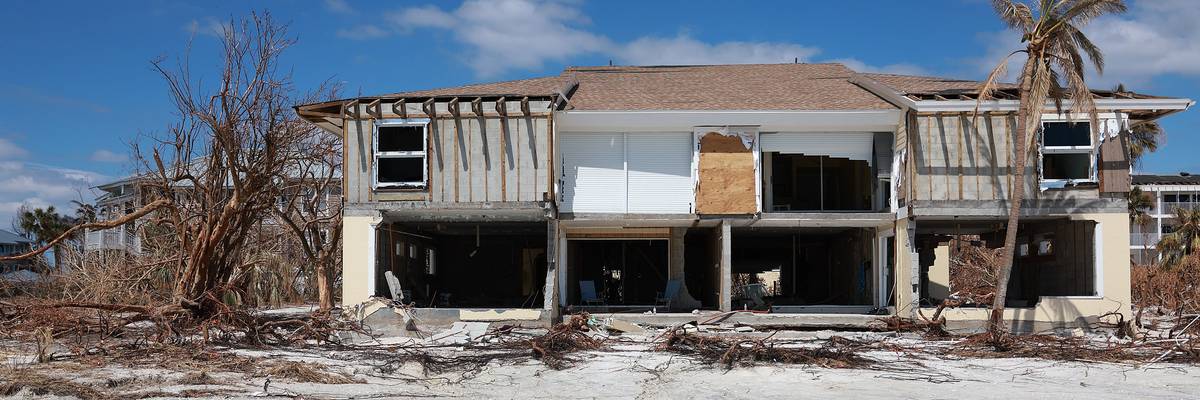
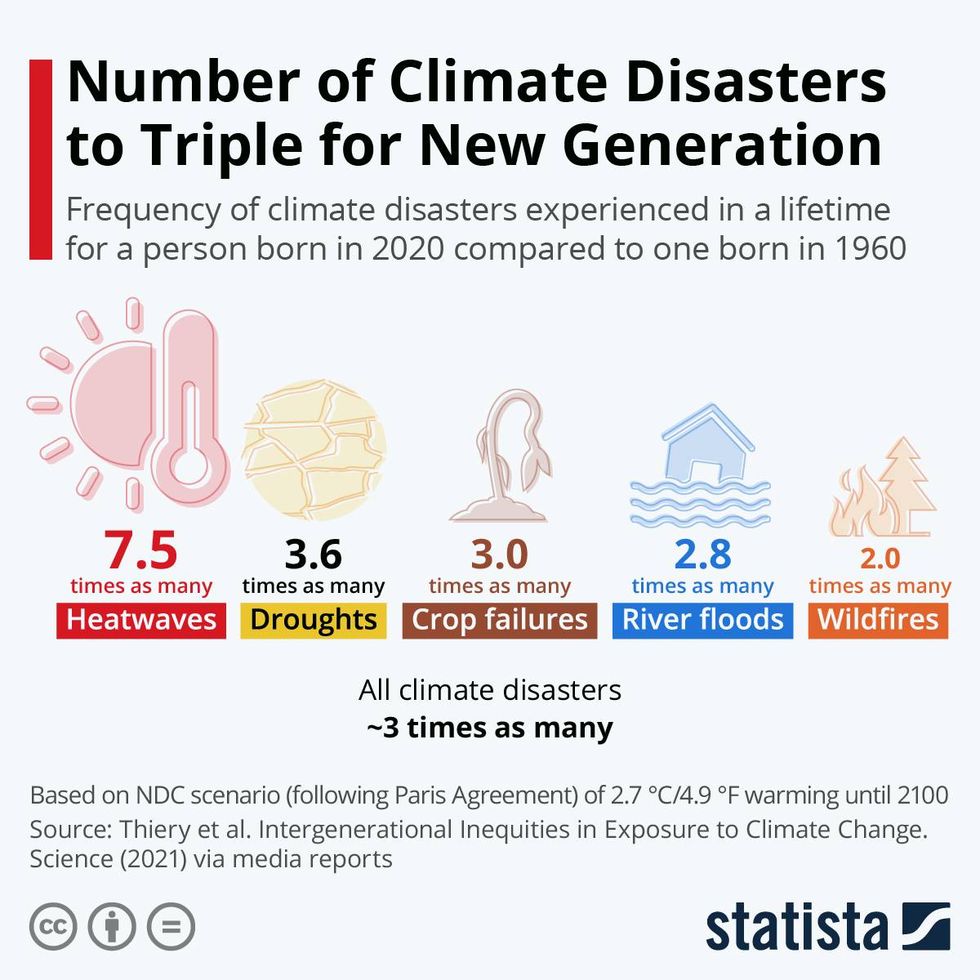
Climate change is now the single biggest health threat facing humanity. The Emergency Events Database reports a record rise in natural disasters globally since the 1960s, detailing over 26,000 mass disasters. The number of reported extreme weather incidents increased from 39 in 1960 to 399 in 2023.
According to the World Economic Forum, climate-related weather disasters will cost the global economy over $2 trillion annually by 2030, with costs escalating dramatically to an estimated $38 trillion per year by 2050, according to the Potsdam Institute for Climate Impact Research (PIK).
Since the Industrial Revolution, global economies have been built around the fossil fuel industry. In 2025, the global oil and gas industry's revenue was estimated at $4 trillion. Despite all the devastating warnings, we are still failing to meet almost every target aimed at curbing emissions.
The burning of fossil fuels comes at a massive price for people, the planet, and our economies. Not only are we spending exorbitant amounts on climate damage, but we are also paying more than ever at the pump and on our energy bills.
Policymakers and world leaders need to start thinking longer term and take steps to prevent the huge economic losses from climate disasters in the first place.
As the US-Israeli war on Iran rages, prices are set to rise further. Targeted attacks on energy facilities have all but closed the Strait of Hormuz, a shipping lane which facilitates the transportation of 20% of global oil and gas supply. The price of crude oil is already 20% higher than it was before the first strikes on Iran on February 28.
Despite the known fact that adaptation is far cheaper than inaction, politicians continue to sit on their hands. Meanwhile, they continue to subsidize the fossil fuel industry, fail to adequately invest in the energy transition, and pass the costs of climate change on to taxpayers.
In the last two full years alone, global economic damages reached $451 billion—a 19% increase compared to the previous eight years. An amount significantly more than that needed to close the global climate adaptation gap.
"Climate change will cause massive economic damages within the next 25 years in almost all countries... We have to cut down our emissions drastically and immediately—if not, economic losses will become even bigger in the second half of the century, amounting to up to 60% on global average by 2100," says Leonie Wenz, a scientist at PIK.
Climate change is not a future problem; it is affecting each and every one of us today.
According to the National Bureau of Economic Research, climate change costs the world 12% in gross domestic product (GDP) losses for every 1°C of warming. This puts the social cost of carbon at around $1,056 per metric ton of carbon dioxide emissions. The report predicts that by the "end of the century, people may well be 50% poorer than they would've been if it wasn't for climate change."
Heatwaves, wildfires, droughts, and storms cost the world more than $120 billion in 2025 alone as 55 billion-dollar weather disasters pounded the Earth. The US bore the brunt with the devastating Californian wildfires, which caused $60 billion of damage and led to the deaths of more than 400 people.
No continent, however, was spared from crippling climate disasters in 2025. It was also noted that disasters are becoming increasingly expensive and their impact underestimated. The Global Assessment Report on Disaster Risk Reduction (GAR) 2025 estimates the annual cost of weather disasters at $202 billion. When other impacts, such as ecosystem costs, are taken into account, the true cost is likely to exceed $2.3 trillion.
Some of the most damaging climate events in 2025 hit poorer nations, including the Philippines, Thailand, Indonesia, Sri Lanka, and Vietnam. These countries have historically contributed little to the climate crisis, have the fewest resources to respond, and are often on the front lines of climate disasters.
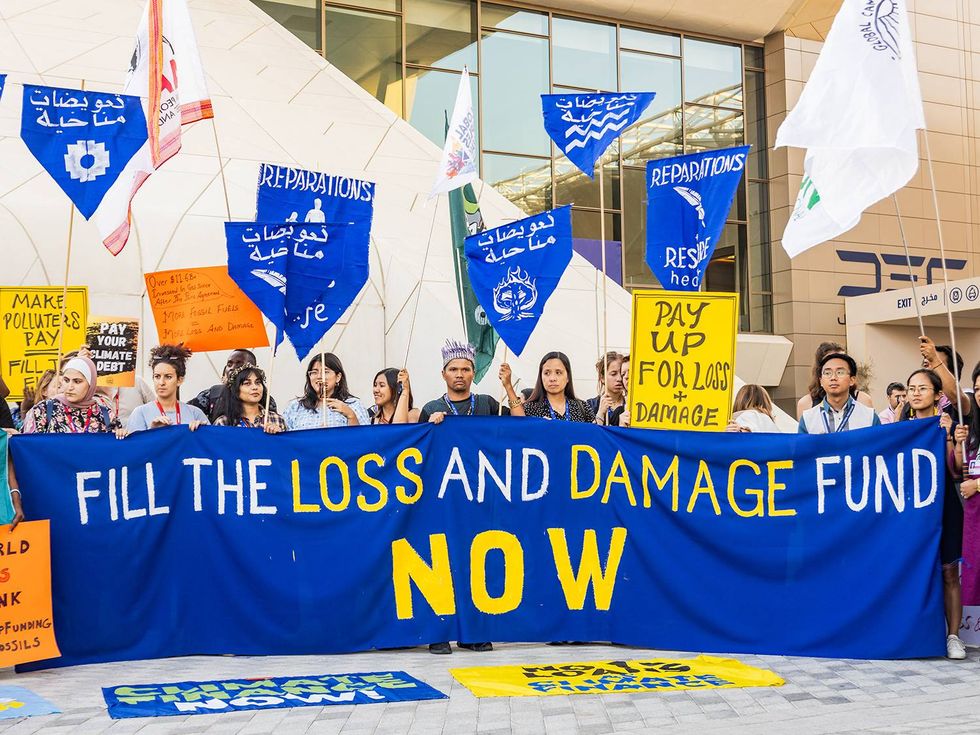 Climate Action Climate Action Network International and other groups demand money for the Loss and Damage Fund at COP28 in Dubai. (Photo by Mídia NINJA/CC BY-NC 2.0)
"On climate finance, the world must pay up, or humanity will pay the price... Climate finance is not charity, it's an investment; climate action is not optional, it's imperative."—António Guterres, United Nations secretary-general.
In relation to the climate crisis, the Polluter Pays Principle states that those who have historically contributed the most to greenhouse gas emissions should bear the costs of repairing the damages caused and adaptation measures. It also acts as a deterrent to end massive investment and subsidies into the fossil fuel industry and instead promotes the development and integration of clean energy sources.
The Loss and Damage fund was created at COP27, the 2022 climate conference. This fund is to compensate developing countries for losses and damages (L&Ds) from natural disasters caused by climate change, for which wealthy countries are disproportionately responsible. It was hailed as a major milestone at the time, but financial commitments have fallen well short of the $400 billion needed annually to address L&Ds and climate injustices adequately.
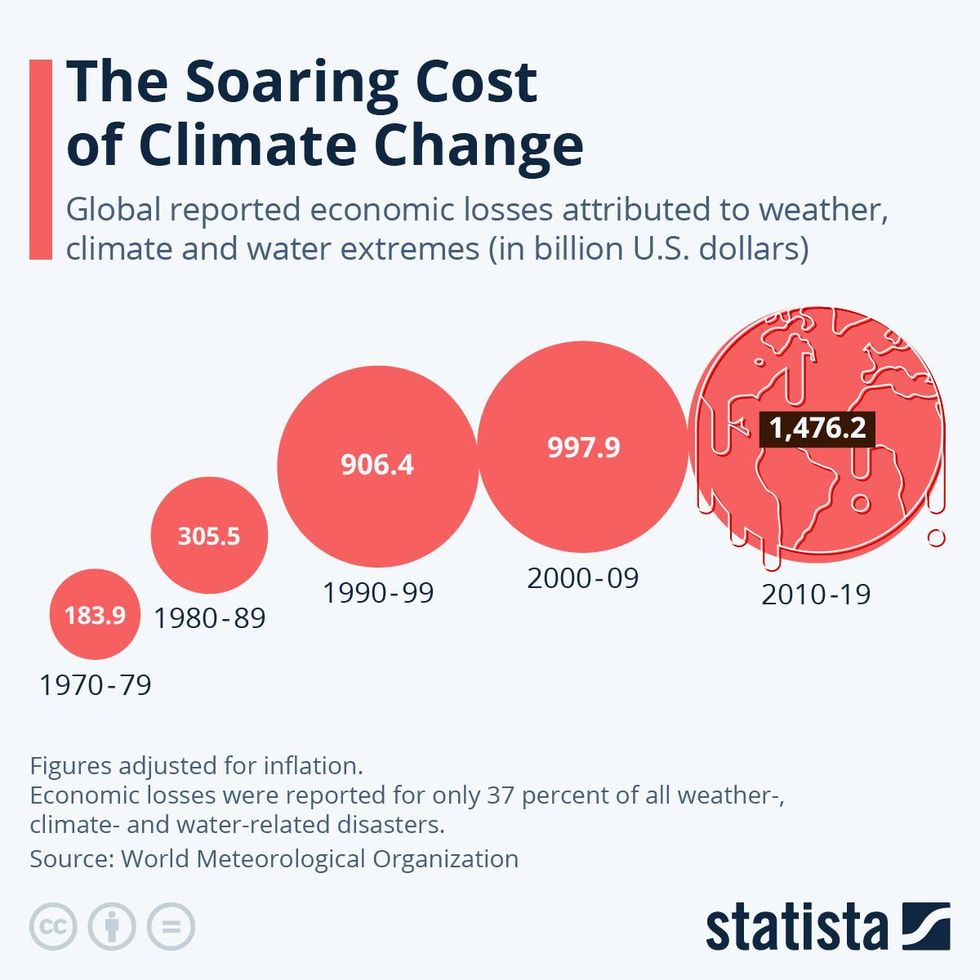
Over the past four decades, the costs of wildfires, storms, hurricanes, droughts, and floods have spiraled. These disasters have become more frequent and far more severe. The cost of all disasters between 1985 and 1995 was $299 billion. Yet the same figure for between 2014 and 2025 was $1.4 trillion.
Below, we list the five most costly disasters over the last three decades. The figures provided are estimates, and likely the true cost was much higher. They are adjusted for inflation and, of course, do not include the social costs, such as the devastating human toll, the health crises that follow, the psychological impact, massive displacement, ecosystem destruction, resource depletion, habitat loss, and agricultural fallout.
Climate adaptation is the process of adjusting to the impacts of climate change to reduce damage, prevent loss of life, and protect people and infrastructure before disaster strikes. It also includes reducing global carbon emissions by transitioning to clean energy to prevent climate change from worsening even further.
Adaptation requires upfront investment, but it is far more cost-effective than inaction, which allows the climate crisis to escalate, causing irreversible damage and out-of-control social and environmental costs.
Examples of adaptation measures include flood defences, the creation of urban wetlands, drought-resistant crops and climate resilient agriculture, ecosystem restoration and conservation, and investment in early warning systems.
There is a huge funding gap in climate adaptation, and the longer governments postpone, the greater the need and the higher the costs become. Annual estimates for developing countries alone range from $215 to $387 billion.
Once we reach 2°C of warming, the global annual cost to protect everyone exposed to climate hazards will reach $1.2 trillion, equivalent to almost 1% of GDP. Heat and drought are the most pressing challenges, with more than three-quarters of adaptation funding needed to provide adequate protection.
Estimates indicate that the benefits of adaptation exceed the upfront costs by a factor of seven. Policymakers and world leaders need to start thinking longer term and take steps to prevent the huge economic losses from climate disasters in the first place.
Adaptation investments also have wider secondary benefits such as improved health and social welfare, a more resilient agricultural sector, stable levels of biodiversity, lower levels of migration and conflict, and reduced inequalities.
The 2019 Global Commission on Adaptation Report found that every $1 invested in adaptation can generate up to $7.1 trillion in total benefits globally by avoiding damages and building social and environmental value.
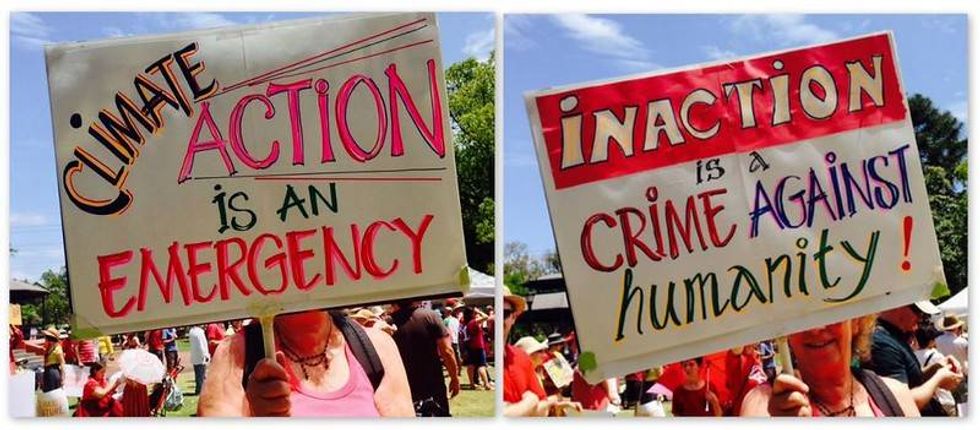 People rally for climate action in Perth, Australia. (Image by Tanyia Maxted/Flickr/CC BY-NC-SA 2.0)
Climate inaction is already leading to massive economic losses from extreme weather. The International Federation of Red Cross and Red Crescent Societies' 2019 Cost of Doing Nothing report estimates that those in need of annual international humanitarian assistance for climate-related disasters could double to over 200 million by 2050, costing an additional $20 billion annually.
The Climate Policy Initiative estimates the financial cost of inaction to be $1,266 trillion. The social cost is much higher:
The two-year Global Stocktake for the Paris Agreement at COP28 confirmed that we are way off track from the targeted 1.5°C target. The window for achieving the Sustainable Development Goals and specific climate goals is rapidly closing.
If governments won't act on climate change for people or the planet, they should at least be motivated by the trillions it will cost them if they continue to do nothing.
Failing to address climate change is a failure for our planet and for humanity. Why pay trillions in disaster relief, conflict mitigation, aid, and migration management when the solutions are at our feet today?
As the Climate Policy Initiative says, "The longer our home remains aflame, the harder and more expensive it will be to extinguish the fire and repair the damage."
Climate change is now the single biggest health threat facing humanity. The Emergency Events Database reports a record rise in natural disasters globally since the 1960s, detailing over 26,000 mass disasters. The number of reported extreme weather incidents increased from 39 in 1960 to 399 in 2023.
According to the World Economic Forum, climate-related weather disasters will cost the global economy over $2 trillion annually by 2030, with costs escalating dramatically to an estimated $38 trillion per year by 2050, according to the Potsdam Institute for Climate Impact Research (PIK).
Since the Industrial Revolution, global economies have been built around the fossil fuel industry. In 2025, the global oil and gas industry's revenue was estimated at $4 trillion. Despite all the devastating warnings, we are still failing to meet almost every target aimed at curbing emissions.
The burning of fossil fuels comes at a massive price for people, the planet, and our economies. Not only are we spending exorbitant amounts on climate damage, but we are also paying more than ever at the pump and on our energy bills.
Policymakers and world leaders need to start thinking longer term and take steps to prevent the huge economic losses from climate disasters in the first place.
As the US-Israeli war on Iran rages, prices are set to rise further. Targeted attacks on energy facilities have all but closed the Strait of Hormuz, a shipping lane which facilitates the transportation of 20% of global oil and gas supply. The price of crude oil is already 20% higher than it was before the first strikes on Iran on February 28.
Despite the known fact that adaptation is far cheaper than inaction, politicians continue to sit on their hands. Meanwhile, they continue to subsidize the fossil fuel industry, fail to adequately invest in the energy transition, and pass the costs of climate change on to taxpayers.
In the last two full years alone, global economic damages reached $451 billion—a 19% increase compared to the previous eight years. An amount significantly more than that needed to close the global climate adaptation gap.
"Climate change will cause massive economic damages within the next 25 years in almost all countries... We have to cut down our emissions drastically and immediately—if not, economic losses will become even bigger in the second half of the century, amounting to up to 60% on global average by 2100," says Leonie Wenz, a scientist at PIK.
Climate change is not a future problem; it is affecting each and every one of us today.
According to the National Bureau of Economic Research, climate change costs the world 12% in gross domestic product (GDP) losses for every 1°C of warming. This puts the social cost of carbon at around $1,056 per metric ton of carbon dioxide emissions. The report predicts that by the "end of the century, people may well be 50% poorer than they would've been if it wasn't for climate change."
Heatwaves, wildfires, droughts, and storms cost the world more than $120 billion in 2025 alone as 55 billion-dollar weather disasters pounded the Earth. The US bore the brunt with the devastating Californian wildfires, which caused $60 billion of damage and led to the deaths of more than 400 people.
No continent, however, was spared from crippling climate disasters in 2025. It was also noted that disasters are becoming increasingly expensive and their impact underestimated. The Global Assessment Report on Disaster Risk Reduction (GAR) 2025 estimates the annual cost of weather disasters at $202 billion. When other impacts, such as ecosystem costs, are taken into account, the true cost is likely to exceed $2.3 trillion.
Some of the most damaging climate events in 2025 hit poorer nations, including the Philippines, Thailand, Indonesia, Sri Lanka, and Vietnam. These countries have historically contributed little to the climate crisis, have the fewest resources to respond, and are often on the front lines of climate disasters.
Climate Action Climate Action Network International and other groups demand money for the Loss and Damage Fund at COP28 in Dubai. (Photo by Mídia NINJA/CC BY-NC 2.0)
"On climate finance, the world must pay up, or humanity will pay the price... Climate finance is not charity, it's an investment; climate action is not optional, it's imperative."—António Guterres, United Nations secretary-general.
In relation to the climate crisis, the Polluter Pays Principle states that those who have historically contributed the most to greenhouse gas emissions should bear the costs of repairing the damages caused and adaptation measures. It also acts as a deterrent to end massive investment and subsidies into the fossil fuel industry and instead promotes the development and integration of clean energy sources.
The Loss and Damage fund was created at COP27, the 2022 climate conference. This fund is to compensate developing countries for losses and damages (L&Ds) from natural disasters caused by climate change, for which wealthy countries are disproportionately responsible. It was hailed as a major milestone at the time, but financial commitments have fallen well short of the $400 billion needed annually to address L&Ds and climate injustices adequately.
Over the past four decades, the costs of wildfires, storms, hurricanes, droughts, and floods have spiraled. These disasters have become more frequent and far more severe. The cost of all disasters between 1985 and 1995 was $299 billion. Yet the same figure for between 2014 and 2025 was $1.4 trillion.
Below, we list the five most costly disasters over the last three decades. The figures provided are estimates, and likely the true cost was much higher. They are adjusted for inflation and, of course, do not include the social costs, such as the devastating human toll, the health crises that follow, the psychological impact, massive displacement, ecosystem destruction, resource depletion, habitat loss, and agricultural fallout.
Climate adaptation is the process of adjusting to the impacts of climate change to reduce damage, prevent loss of life, and protect people and infrastructure before disaster strikes. It also includes reducing global carbon emissions by transitioning to clean energy to prevent climate change from worsening even further.
Adaptation requires upfront investment, but it is far more cost-effective than inaction, which allows the climate crisis to escalate, causing irreversible damage and out-of-control social and environmental costs.
Examples of adaptation measures include flood defences, the creation of urban wetlands, drought-resistant crops and climate resilient agriculture, ecosystem restoration and conservation, and investment in early warning systems.
There is a huge funding gap in climate adaptation, and the longer governments postpone, the greater the need and the higher the costs become. Annual estimates for developing countries alone range from $215 to $387 billion.
Once we reach 2°C of warming, the global annual cost to protect everyone exposed to climate hazards will reach $1.2 trillion, equivalent to almost 1% of GDP. Heat and drought are the most pressing challenges, with more than three-quarters of adaptation funding needed to provide adequate protection.
Estimates indicate that the benefits of adaptation exceed the upfront costs by a factor of seven. Policymakers and world leaders need to start thinking longer term and take steps to prevent the huge economic losses from climate disasters in the first place.
Adaptation investments also have wider secondary benefits such as improved health and social welfare, a more resilient agricultural sector, stable levels of biodiversity, lower levels of migration and conflict, and reduced inequalities.
The 2019 Global Commission on Adaptation Report found that every $1 invested in adaptation can generate up to $7.1 trillion in total benefits globally by avoiding damages and building social and environmental value.
People rally for climate action in Perth, Australia. (Image by Tanyia Maxted/Flickr/CC BY-NC-SA 2.0)
Climate inaction is already leading to massive economic losses from extreme weather. The International Federation of Red Cross and Red Crescent Societies' 2019 Cost of Doing Nothing report estimates that those in need of annual international humanitarian assistance for climate-related disasters could double to over 200 million by 2050, costing an additional $20 billion annually.
The Climate Policy Initiative estimates the financial cost of inaction to be $1,266 trillion. The social cost is much higher:
The two-year Global Stocktake for the Paris Agreement at COP28 confirmed that we are way off track from the targeted 1.5°C target. The window for achieving the Sustainable Development Goals and specific climate goals is rapidly closing.
If governments won't act on climate change for people or the planet, they should at least be motivated by the trillions it will cost them if they continue to do nothing.
Failing to address climate change is a failure for our planet and for humanity. Why pay trillions in disaster relief, conflict mitigation, aid, and migration management when the solutions are at our feet today?
As the Climate Policy Initiative says, "The longer our home remains aflame, the harder and more expensive it will be to extinguish the fire and repair the damage."
Climate change is now the single biggest health threat facing humanity. The Emergency Events Database reports a record rise in natural disasters globally since the 1960s, detailing over 26,000 mass disasters. The number of reported extreme weather incidents increased from 39 in 1960 to 399 in 2023.
According to the World Economic Forum, climate-related weather disasters will cost the global economy over $2 trillion annually by 2030, with costs escalating dramatically to an estimated $38 trillion per year by 2050, according to the Potsdam Institute for Climate Impact Research (PIK).
Since the Industrial Revolution, global economies have been built around the fossil fuel industry. In 2025, the global oil and gas industry's revenue was estimated at $4 trillion. Despite all the devastating warnings, we are still failing to meet almost every target aimed at curbing emissions.
The burning of fossil fuels comes at a massive price for people, the planet, and our economies. Not only are we spending exorbitant amounts on climate damage, but we are also paying more than ever at the pump and on our energy bills.
Policymakers and world leaders need to start thinking longer term and take steps to prevent the huge economic losses from climate disasters in the first place.
As the US-Israeli war on Iran rages, prices are set to rise further. Targeted attacks on energy facilities have all but closed the Strait of Hormuz, a shipping lane which facilitates the transportation of 20% of global oil and gas supply. The price of crude oil is already 20% higher than it was before the first strikes on Iran on February 28.
Despite the known fact that adaptation is far cheaper than inaction, politicians continue to sit on their hands. Meanwhile, they continue to subsidize the fossil fuel industry, fail to adequately invest in the energy transition, and pass the costs of climate change on to taxpayers.
In the last two full years alone, global economic damages reached $451 billion—a 19% increase compared to the previous eight years. An amount significantly more than that needed to close the global climate adaptation gap.
"Climate change will cause massive economic damages within the next 25 years in almost all countries... We have to cut down our emissions drastically and immediately—if not, economic losses will become even bigger in the second half of the century, amounting to up to 60% on global average by 2100," says Leonie Wenz, a scientist at PIK.
Climate change is not a future problem; it is affecting each and every one of us today.
According to the National Bureau of Economic Research, climate change costs the world 12% in gross domestic product (GDP) losses for every 1°C of warming. This puts the social cost of carbon at around $1,056 per metric ton of carbon dioxide emissions. The report predicts that by the "end of the century, people may well be 50% poorer than they would've been if it wasn't for climate change."
Heatwaves, wildfires, droughts, and storms cost the world more than $120 billion in 2025 alone as 55 billion-dollar weather disasters pounded the Earth. The US bore the brunt with the devastating Californian wildfires, which caused $60 billion of damage and led to the deaths of more than 400 people.
No continent, however, was spared from crippling climate disasters in 2025. It was also noted that disasters are becoming increasingly expensive and their impact underestimated. The Global Assessment Report on Disaster Risk Reduction (GAR) 2025 estimates the annual cost of weather disasters at $202 billion. When other impacts, such as ecosystem costs, are taken into account, the true cost is likely to exceed $2.3 trillion.
Some of the most damaging climate events in 2025 hit poorer nations, including the Philippines, Thailand, Indonesia, Sri Lanka, and Vietnam. These countries have historically contributed little to the climate crisis, have the fewest resources to respond, and are often on the front lines of climate disasters.
Climate Action Climate Action Network International and other groups demand money for the Loss and Damage Fund at COP28 in Dubai. (Photo by Mídia NINJA/CC BY-NC 2.0)
"On climate finance, the world must pay up, or humanity will pay the price... Climate finance is not charity, it's an investment; climate action is not optional, it's imperative."—António Guterres, United Nations secretary-general.
In relation to the climate crisis, the Polluter Pays Principle states that those who have historically contributed the most to greenhouse gas emissions should bear the costs of repairing the damages caused and adaptation measures. It also acts as a deterrent to end massive investment and subsidies into the fossil fuel industry and instead promotes the development and integration of clean energy sources.
The Loss and Damage fund was created at COP27, the 2022 climate conference. This fund is to compensate developing countries for losses and damages (L&Ds) from natural disasters caused by climate change, for which wealthy countries are disproportionately responsible. It was hailed as a major milestone at the time, but financial commitments have fallen well short of the $400 billion needed annually to address L&Ds and climate injustices adequately.
Over the past four decades, the costs of wildfires, storms, hurricanes, droughts, and floods have spiraled. These disasters have become more frequent and far more severe. The cost of all disasters between 1985 and 1995 was $299 billion. Yet the same figure for between 2014 and 2025 was $1.4 trillion.
Below, we list the five most costly disasters over the last three decades. The figures provided are estimates, and likely the true cost was much higher. They are adjusted for inflation and, of course, do not include the social costs, such as the devastating human toll, the health crises that follow, the psychological impact, massive displacement, ecosystem destruction, resource depletion, habitat loss, and agricultural fallout.
Climate adaptation is the process of adjusting to the impacts of climate change to reduce damage, prevent loss of life, and protect people and infrastructure before disaster strikes. It also includes reducing global carbon emissions by transitioning to clean energy to prevent climate change from worsening even further.
Adaptation requires upfront investment, but it is far more cost-effective than inaction, which allows the climate crisis to escalate, causing irreversible damage and out-of-control social and environmental costs.
Examples of adaptation measures include flood defences, the creation of urban wetlands, drought-resistant crops and climate resilient agriculture, ecosystem restoration and conservation, and investment in early warning systems.
There is a huge funding gap in climate adaptation, and the longer governments postpone, the greater the need and the higher the costs become. Annual estimates for developing countries alone range from $215 to $387 billion.
Once we reach 2°C of warming, the global annual cost to protect everyone exposed to climate hazards will reach $1.2 trillion, equivalent to almost 1% of GDP. Heat and drought are the most pressing challenges, with more than three-quarters of adaptation funding needed to provide adequate protection.
Estimates indicate that the benefits of adaptation exceed the upfront costs by a factor of seven. Policymakers and world leaders need to start thinking longer term and take steps to prevent the huge economic losses from climate disasters in the first place.
Adaptation investments also have wider secondary benefits such as improved health and social welfare, a more resilient agricultural sector, stable levels of biodiversity, lower levels of migration and conflict, and reduced inequalities.
The 2019 Global Commission on Adaptation Report found that every $1 invested in adaptation can generate up to $7.1 trillion in total benefits globally by avoiding damages and building social and environmental value.
People rally for climate action in Perth, Australia. (Image by Tanyia Maxted/Flickr/CC BY-NC-SA 2.0)
Climate inaction is already leading to massive economic losses from extreme weather. The International Federation of Red Cross and Red Crescent Societies' 2019 Cost of Doing Nothing report estimates that those in need of annual international humanitarian assistance for climate-related disasters could double to over 200 million by 2050, costing an additional $20 billion annually.
The Climate Policy Initiative estimates the financial cost of inaction to be $1,266 trillion. The social cost is much higher:
The two-year Global Stocktake for the Paris Agreement at COP28 confirmed that we are way off track from the targeted 1.5°C target. The window for achieving the Sustainable Development Goals and specific climate goals is rapidly closing.
If governments won't act on climate change for people or the planet, they should at least be motivated by the trillions it will cost them if they continue to do nothing.
Failing to address climate change is a failure for our planet and for humanity. Why pay trillions in disaster relief, conflict mitigation, aid, and migration management when the solutions are at our feet today?
As the Climate Policy Initiative says, "The longer our home remains aflame, the harder and more expensive it will be to extinguish the fire and repair the damage."