SUBSCRIBE TO OUR FREE NEWSLETTER
Daily news & progressive opinion—funded by the people, not the corporations—delivered straight to your inbox.
5
#000000
#FFFFFF
To donate by check, phone, or other method, see our More Ways to Give page.
Daily news & progressive opinion—funded by the people, not the corporations—delivered straight to your inbox.
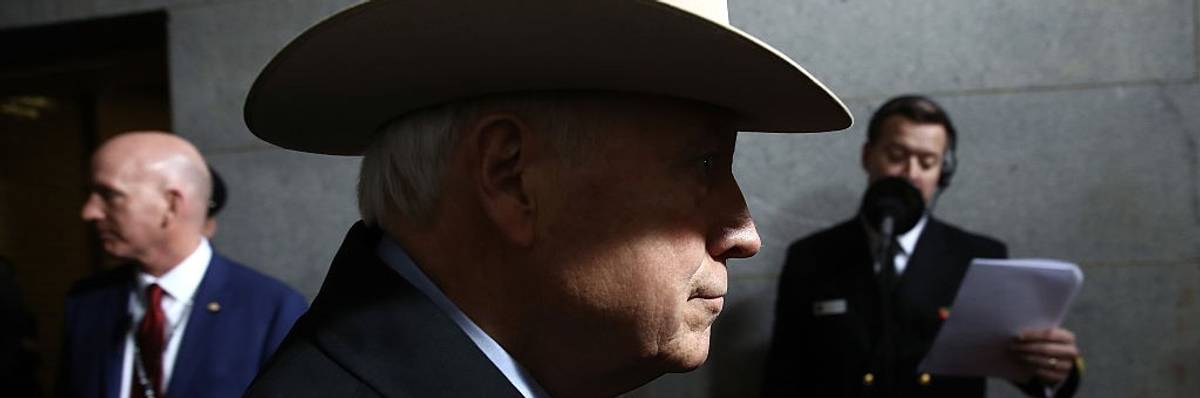
Former Vice President Dick Cheney arrives on the West Front of the U.S. Capitol on January 20, 2017 in Washington, DC. In today's inauguration ceremony Donald J. Trump becomes the 45th president of the United States.
Ultimately, both Trump and Cheney represent different forms of danger to American democracy and global stability. They both deserve nothing less than our eternal scorn.
In an unsurprising yet telling development, Republican former Vice President Dick Cheney has thrown his support behind the Democratic presidential nominee, Vice President Kamala Harris, over his party’s candidate, framing former President Donald Trump as an unprecedented threat to the United States. On its face, this endorsement might appear as a principled defence of democracy from a longstanding Republican stalwart. But beneath the surface lies a troubling irony.
Cheney, the architect of some of the most disastrous foreign and domestic policies of the early 21st century, now seeks to claim the moral high ground. The legacy of his policies – particularly the havoc unleashed during the Iraq War and the broader “war on terror” – continues to reverberate globally, causing suffering and instability that far surpass anything Trump has wrought to date.
During Tuesday’s presidential debate, Harris proudly touted Dick Cheney’s endorsement as a badge of honour – a moment as baffling as it was revealing.
Embracing a man whose policies left a trail of death and destabilization in their wake as a champion of American values lacks any semblance of moral clarity. Cheney, whose hands are stained with the blood of countless innocents from Iraq to Guantanamo, who undermined American democracy and terrorized countless innocent Americans under the “war on terror,” should not be celebrated, especially by someone seeking the mantle of progressive leadership.
While Trump has undeniably stoked internal divisions and undermined democratic norms, Cheney’s actions as vice president set the stage for some of the most catastrophic conflicts of the 21st century.
Cheney’s tenure as vice president under George W Bush is synonymous with neoconservative ambition, a vision of American dominance built on military intervention and disregard for international law. The invasion of Iraq in 2003 is perhaps the most glaring example of this approach. Alongside President Bush, Cheney pushed for a war based on false premises, most notably the existence of weapons of mass destruction (WMDs) in Iraq, and a supposed link between Saddam Hussein’s regime and the 9/11 terrorist attacks. Both claims were categorically debunked in the years that followed, yet the human and financial costs of the war are staggering.
Estimates of Iraqi civilian deaths range from hundreds of thousands to well over a million, depending on the source. This war destabilized an entire region, paving the way for the rise of extremist groups like ISIL (ISIS) and contributing to ongoing cycles of violence and displacement. The political vacuum created by the toppling of Hussein remains unfilled, as Iraq continues to grapple with internal conflicts and external influences.632184874
Domestically, the costs were equally profound. The war drained trillions from the United States economy, money that could have been directed toward infrastructure, education or healthcare. Thousands of US troops lost their lives, and many more returned with life-altering physical and psychological wounds. Veterans of the Iraq conflict have some of the highest rates of PTSD and suicide among recent generations of American soldiers, underscoring the toll of this misadventure.
And yet, those celebrating Cheney’s endorsement of Harris over Trump are now portraying him as a defender of democracy, as if the destabilizing effects of his policies were somehow a lesser evil. The truth is that while Trump’s brand of populist nationalism has damaged the social fabric of the United States, the neoconservative project Cheney helped lead caused immense human suffering on a global scale – far beyond anything Trump has so far accomplished.
Cheney’s endorsement of Harris, framed as a repudiation of Trump’s divisiveness, conveniently ignores his own role in eroding civil liberties in the US and across the world.
One of Cheney’s signature policies, the “war on terror”, brought with it the expansion of executive power and a profound shift in the relationship between the American government and its citizens – especially Muslim Americans.
The Patriot Act, passed in the wake of the 9/11 attacks, granted the US government sweeping surveillance powers, many of which were abused in the name of national security. Cheney was one of the most ardent advocates of these measures, arguing that extraordinary threats required extraordinary responses. In practice, these measures disproportionately targeted minorities, particularly Muslim Americans.
Programs like the National Security Entry-Exit Registration System (NSEERS) singled out men from predominantly Muslim countries, leading to widespread racial profiling and unconstitutional detentions. Muslim communities in the US were left to bear the brunt of Cheney’s overreach, living under a cloud of suspicion that persists to this day.
Internationally, the “war on terror” led to even graver abuses. Cheney oversaw the use of torture in US military operations. “Enhanced interrogation techniques,” such as waterboarding, were deployed at facilities like Guantanamo Bay and CIA black sites across the globe. These practices violated basic human rights and international law, leaving a stain on America’s global reputation. Many of the individuals detained and tortured were never formally charged with any crime. To this day, Guantanamo Bay remains a symbol of injustice, where detainees languish without trial or meaningful recourse.
The erosion of civil liberties Cheney helped to engineer not only devastated communities but also created a culture of fear that Trump later capitalized on during his rise to power. Anti-Muslim rhetoric, which played a key role in Trump’s 2016 campaign, has its roots in the fear-mongering that Cheney and his neoconservative allies perpetuated during the Bush administration. In this sense, the groundwork for Trump’s policies on immigration and national security was laid by Cheney himself.
When examining Cheney’s legacy, no issue looms larger than the invasion of Iraq. The war, waged on false pretenses, remains one of the costliest misadventures in modern American history. Under Cheney’s influence, the Bush administration sidelined diplomacy, dismissing warnings from the international community and bypassing the United Nations Security Council. The war not only violated international law but also undermined the very principles of sovereignty and self-determination that the US purported to champion.
The ripple effects of the Iraq War are still being felt today. The instability it created in the Middle East has made it fertile ground for extremist groups, leading to a proliferation of violence that has engulfed nations far beyond Iraq’s borders. The rise of ISIL, the ongoing Syrian civil war, and the refugee crisis that has strained Europe can all be traced back, at least in part, to the power vacuum created by the toppling of Hussein.
Yet, despite the overwhelming evidence of the war’s catastrophic consequences, Cheney has never fully reckoned with his role in bringing about this disaster. By endorsing Harris, he is attempting to paint himself as a responsible elder statesman, but his track record tells a different story – one of hubris, miscalculation and indifference to human suffering.
One of the reasons Cheney’s endorsement may resonate with some Democrats and centrists is the perception that Trump represents an existential threat to American democracy. Trump’s brand of populism, his encouragement of far-right extremism, and his open disregard for democratic norms have indeed damaged the political fabric of the US. However, Cheney’s legacy of violence and imperialism abroad, coupled with his domestic assault on civil liberties, presents a far more troubling picture of the threats to democracy.
The Democratic Party and some of its liberal and progressive backers’ apparent decision to absolve Cheney of any responsibility for the havoc he unleashed on the world simply because he now opposes Trump is devoid of morality.
Trump’s most egregious actions have played out on American soil, targeting immigrants, people of colour, and marginalised groups. His rhetoric has fueled political violence and stoked deep divisions within American society. But the scope of Cheney’s policies, especially those that played out on the world stage, exceeds Trump’s in terms of sheer human suffering. The wars Cheney championed, particularly the Iraq War, claimed hundreds of thousands of lives and displaced millions. The torture and surveillance programs he helped oversee have left a lasting legacy of fear and suspicion, both at home and abroad.
What makes Cheney’s endorsement, and the Democratic Party’s embrace of it, particularly galling is the way in which they gloss over these past sins in order to paint him as a guardian of American values. While Trump’s rhetoric and policies may have caused harm within the US, Cheney’s decisions inflicted untold suffering on far more people all across the globe. The selective moral outrage they direct at Trump while embracing Cheney as a savior of democracy, is a testament to the hypocrisy of the liberal political establishment in the country.
Both men have caused irreparable harm, and neither should be celebrated for their actions.
As we navigate American politics, we must be careful not to view figures like Cheney solely through a partisan lens. His critique of Trump, while valid in some respects, cannot erase the devastating impact of his own policies. Cheney’s endorsement of Harris should not be interpreted as an act of moral courage, but rather as a cynical attempt to rehabilitate his public image in the face of a deeply divided country.
Ultimately, both Trump and Cheney represent different forms of danger to American democracy and global stability. While Trump has undeniably stoked internal divisions and undermined democratic norms, Cheney’s actions as vice president set the stage for some of the most catastrophic conflicts of the 21st century. His policies eroded civil liberties, violated human rights, and destabilized entire regions, leaving a legacy of fear and instability that continues to haunt the world today.
The Democratic Party and some of its liberal and progressive backers’ apparent decision to absolve Cheney of any responsibility for the havoc he unleashed on the world simply because he now opposes Trump is devoid of morality. Both men have caused irreparable harm, and neither should be celebrated for their actions. Instead, we should take this moment to reflect on the broader failures of the political system that allowed both Cheney and Trump to rise to power in the first place. Only then can we begin to chart a course towards a more just and equitable future.
Dear Common Dreams reader, It’s been nearly 30 years since I co-founded Common Dreams with my late wife, Lina Newhouser. We had the radical notion that journalism should serve the public good, not corporate profits. It was clear to us from the outset what it would take to build such a project. No paid advertisements. No corporate sponsors. No millionaire publisher telling us what to think or do. Many people said we wouldn't last a year, but we proved those doubters wrong. Together with a tremendous team of journalists and dedicated staff, we built an independent media outlet free from the constraints of profits and corporate control. Our mission has always been simple: To inform. To inspire. To ignite change for the common good. Building Common Dreams was not easy. Our survival was never guaranteed. When you take on the most powerful forces—Wall Street greed, fossil fuel industry destruction, Big Tech lobbyists, and uber-rich oligarchs who have spent billions upon billions rigging the economy and democracy in their favor—the only bulwark you have is supporters who believe in your work. But here’s the urgent message from me today. It's never been this bad out there. And it's never been this hard to keep us going. At the very moment Common Dreams is most needed, the threats we face are intensifying. We need your support now more than ever. We don't accept corporate advertising and never will. We don't have a paywall because we don't think people should be blocked from critical news based on their ability to pay. Everything we do is funded by the donations of readers like you. When everyone does the little they can afford, we are strong. But if that support retreats or dries up, so do we. Will you donate now to make sure Common Dreams not only survives but thrives? —Craig Brown, Co-founder |
In an unsurprising yet telling development, Republican former Vice President Dick Cheney has thrown his support behind the Democratic presidential nominee, Vice President Kamala Harris, over his party’s candidate, framing former President Donald Trump as an unprecedented threat to the United States. On its face, this endorsement might appear as a principled defence of democracy from a longstanding Republican stalwart. But beneath the surface lies a troubling irony.
Cheney, the architect of some of the most disastrous foreign and domestic policies of the early 21st century, now seeks to claim the moral high ground. The legacy of his policies – particularly the havoc unleashed during the Iraq War and the broader “war on terror” – continues to reverberate globally, causing suffering and instability that far surpass anything Trump has wrought to date.
During Tuesday’s presidential debate, Harris proudly touted Dick Cheney’s endorsement as a badge of honour – a moment as baffling as it was revealing.
Embracing a man whose policies left a trail of death and destabilization in their wake as a champion of American values lacks any semblance of moral clarity. Cheney, whose hands are stained with the blood of countless innocents from Iraq to Guantanamo, who undermined American democracy and terrorized countless innocent Americans under the “war on terror,” should not be celebrated, especially by someone seeking the mantle of progressive leadership.
While Trump has undeniably stoked internal divisions and undermined democratic norms, Cheney’s actions as vice president set the stage for some of the most catastrophic conflicts of the 21st century.
Cheney’s tenure as vice president under George W Bush is synonymous with neoconservative ambition, a vision of American dominance built on military intervention and disregard for international law. The invasion of Iraq in 2003 is perhaps the most glaring example of this approach. Alongside President Bush, Cheney pushed for a war based on false premises, most notably the existence of weapons of mass destruction (WMDs) in Iraq, and a supposed link between Saddam Hussein’s regime and the 9/11 terrorist attacks. Both claims were categorically debunked in the years that followed, yet the human and financial costs of the war are staggering.
Estimates of Iraqi civilian deaths range from hundreds of thousands to well over a million, depending on the source. This war destabilized an entire region, paving the way for the rise of extremist groups like ISIL (ISIS) and contributing to ongoing cycles of violence and displacement. The political vacuum created by the toppling of Hussein remains unfilled, as Iraq continues to grapple with internal conflicts and external influences.632184874
Domestically, the costs were equally profound. The war drained trillions from the United States economy, money that could have been directed toward infrastructure, education or healthcare. Thousands of US troops lost their lives, and many more returned with life-altering physical and psychological wounds. Veterans of the Iraq conflict have some of the highest rates of PTSD and suicide among recent generations of American soldiers, underscoring the toll of this misadventure.
And yet, those celebrating Cheney’s endorsement of Harris over Trump are now portraying him as a defender of democracy, as if the destabilizing effects of his policies were somehow a lesser evil. The truth is that while Trump’s brand of populist nationalism has damaged the social fabric of the United States, the neoconservative project Cheney helped lead caused immense human suffering on a global scale – far beyond anything Trump has so far accomplished.
Cheney’s endorsement of Harris, framed as a repudiation of Trump’s divisiveness, conveniently ignores his own role in eroding civil liberties in the US and across the world.
One of Cheney’s signature policies, the “war on terror”, brought with it the expansion of executive power and a profound shift in the relationship between the American government and its citizens – especially Muslim Americans.
The Patriot Act, passed in the wake of the 9/11 attacks, granted the US government sweeping surveillance powers, many of which were abused in the name of national security. Cheney was one of the most ardent advocates of these measures, arguing that extraordinary threats required extraordinary responses. In practice, these measures disproportionately targeted minorities, particularly Muslim Americans.
Programs like the National Security Entry-Exit Registration System (NSEERS) singled out men from predominantly Muslim countries, leading to widespread racial profiling and unconstitutional detentions. Muslim communities in the US were left to bear the brunt of Cheney’s overreach, living under a cloud of suspicion that persists to this day.
Internationally, the “war on terror” led to even graver abuses. Cheney oversaw the use of torture in US military operations. “Enhanced interrogation techniques,” such as waterboarding, were deployed at facilities like Guantanamo Bay and CIA black sites across the globe. These practices violated basic human rights and international law, leaving a stain on America’s global reputation. Many of the individuals detained and tortured were never formally charged with any crime. To this day, Guantanamo Bay remains a symbol of injustice, where detainees languish without trial or meaningful recourse.
The erosion of civil liberties Cheney helped to engineer not only devastated communities but also created a culture of fear that Trump later capitalized on during his rise to power. Anti-Muslim rhetoric, which played a key role in Trump’s 2016 campaign, has its roots in the fear-mongering that Cheney and his neoconservative allies perpetuated during the Bush administration. In this sense, the groundwork for Trump’s policies on immigration and national security was laid by Cheney himself.
When examining Cheney’s legacy, no issue looms larger than the invasion of Iraq. The war, waged on false pretenses, remains one of the costliest misadventures in modern American history. Under Cheney’s influence, the Bush administration sidelined diplomacy, dismissing warnings from the international community and bypassing the United Nations Security Council. The war not only violated international law but also undermined the very principles of sovereignty and self-determination that the US purported to champion.
The ripple effects of the Iraq War are still being felt today. The instability it created in the Middle East has made it fertile ground for extremist groups, leading to a proliferation of violence that has engulfed nations far beyond Iraq’s borders. The rise of ISIL, the ongoing Syrian civil war, and the refugee crisis that has strained Europe can all be traced back, at least in part, to the power vacuum created by the toppling of Hussein.
Yet, despite the overwhelming evidence of the war’s catastrophic consequences, Cheney has never fully reckoned with his role in bringing about this disaster. By endorsing Harris, he is attempting to paint himself as a responsible elder statesman, but his track record tells a different story – one of hubris, miscalculation and indifference to human suffering.
One of the reasons Cheney’s endorsement may resonate with some Democrats and centrists is the perception that Trump represents an existential threat to American democracy. Trump’s brand of populism, his encouragement of far-right extremism, and his open disregard for democratic norms have indeed damaged the political fabric of the US. However, Cheney’s legacy of violence and imperialism abroad, coupled with his domestic assault on civil liberties, presents a far more troubling picture of the threats to democracy.
The Democratic Party and some of its liberal and progressive backers’ apparent decision to absolve Cheney of any responsibility for the havoc he unleashed on the world simply because he now opposes Trump is devoid of morality.
Trump’s most egregious actions have played out on American soil, targeting immigrants, people of colour, and marginalised groups. His rhetoric has fueled political violence and stoked deep divisions within American society. But the scope of Cheney’s policies, especially those that played out on the world stage, exceeds Trump’s in terms of sheer human suffering. The wars Cheney championed, particularly the Iraq War, claimed hundreds of thousands of lives and displaced millions. The torture and surveillance programs he helped oversee have left a lasting legacy of fear and suspicion, both at home and abroad.
What makes Cheney’s endorsement, and the Democratic Party’s embrace of it, particularly galling is the way in which they gloss over these past sins in order to paint him as a guardian of American values. While Trump’s rhetoric and policies may have caused harm within the US, Cheney’s decisions inflicted untold suffering on far more people all across the globe. The selective moral outrage they direct at Trump while embracing Cheney as a savior of democracy, is a testament to the hypocrisy of the liberal political establishment in the country.
Both men have caused irreparable harm, and neither should be celebrated for their actions.
As we navigate American politics, we must be careful not to view figures like Cheney solely through a partisan lens. His critique of Trump, while valid in some respects, cannot erase the devastating impact of his own policies. Cheney’s endorsement of Harris should not be interpreted as an act of moral courage, but rather as a cynical attempt to rehabilitate his public image in the face of a deeply divided country.
Ultimately, both Trump and Cheney represent different forms of danger to American democracy and global stability. While Trump has undeniably stoked internal divisions and undermined democratic norms, Cheney’s actions as vice president set the stage for some of the most catastrophic conflicts of the 21st century. His policies eroded civil liberties, violated human rights, and destabilized entire regions, leaving a legacy of fear and instability that continues to haunt the world today.
The Democratic Party and some of its liberal and progressive backers’ apparent decision to absolve Cheney of any responsibility for the havoc he unleashed on the world simply because he now opposes Trump is devoid of morality. Both men have caused irreparable harm, and neither should be celebrated for their actions. Instead, we should take this moment to reflect on the broader failures of the political system that allowed both Cheney and Trump to rise to power in the first place. Only then can we begin to chart a course towards a more just and equitable future.
In an unsurprising yet telling development, Republican former Vice President Dick Cheney has thrown his support behind the Democratic presidential nominee, Vice President Kamala Harris, over his party’s candidate, framing former President Donald Trump as an unprecedented threat to the United States. On its face, this endorsement might appear as a principled defence of democracy from a longstanding Republican stalwart. But beneath the surface lies a troubling irony.
Cheney, the architect of some of the most disastrous foreign and domestic policies of the early 21st century, now seeks to claim the moral high ground. The legacy of his policies – particularly the havoc unleashed during the Iraq War and the broader “war on terror” – continues to reverberate globally, causing suffering and instability that far surpass anything Trump has wrought to date.
During Tuesday’s presidential debate, Harris proudly touted Dick Cheney’s endorsement as a badge of honour – a moment as baffling as it was revealing.
Embracing a man whose policies left a trail of death and destabilization in their wake as a champion of American values lacks any semblance of moral clarity. Cheney, whose hands are stained with the blood of countless innocents from Iraq to Guantanamo, who undermined American democracy and terrorized countless innocent Americans under the “war on terror,” should not be celebrated, especially by someone seeking the mantle of progressive leadership.
While Trump has undeniably stoked internal divisions and undermined democratic norms, Cheney’s actions as vice president set the stage for some of the most catastrophic conflicts of the 21st century.
Cheney’s tenure as vice president under George W Bush is synonymous with neoconservative ambition, a vision of American dominance built on military intervention and disregard for international law. The invasion of Iraq in 2003 is perhaps the most glaring example of this approach. Alongside President Bush, Cheney pushed for a war based on false premises, most notably the existence of weapons of mass destruction (WMDs) in Iraq, and a supposed link between Saddam Hussein’s regime and the 9/11 terrorist attacks. Both claims were categorically debunked in the years that followed, yet the human and financial costs of the war are staggering.
Estimates of Iraqi civilian deaths range from hundreds of thousands to well over a million, depending on the source. This war destabilized an entire region, paving the way for the rise of extremist groups like ISIL (ISIS) and contributing to ongoing cycles of violence and displacement. The political vacuum created by the toppling of Hussein remains unfilled, as Iraq continues to grapple with internal conflicts and external influences.632184874
Domestically, the costs were equally profound. The war drained trillions from the United States economy, money that could have been directed toward infrastructure, education or healthcare. Thousands of US troops lost their lives, and many more returned with life-altering physical and psychological wounds. Veterans of the Iraq conflict have some of the highest rates of PTSD and suicide among recent generations of American soldiers, underscoring the toll of this misadventure.
And yet, those celebrating Cheney’s endorsement of Harris over Trump are now portraying him as a defender of democracy, as if the destabilizing effects of his policies were somehow a lesser evil. The truth is that while Trump’s brand of populist nationalism has damaged the social fabric of the United States, the neoconservative project Cheney helped lead caused immense human suffering on a global scale – far beyond anything Trump has so far accomplished.
Cheney’s endorsement of Harris, framed as a repudiation of Trump’s divisiveness, conveniently ignores his own role in eroding civil liberties in the US and across the world.
One of Cheney’s signature policies, the “war on terror”, brought with it the expansion of executive power and a profound shift in the relationship between the American government and its citizens – especially Muslim Americans.
The Patriot Act, passed in the wake of the 9/11 attacks, granted the US government sweeping surveillance powers, many of which were abused in the name of national security. Cheney was one of the most ardent advocates of these measures, arguing that extraordinary threats required extraordinary responses. In practice, these measures disproportionately targeted minorities, particularly Muslim Americans.
Programs like the National Security Entry-Exit Registration System (NSEERS) singled out men from predominantly Muslim countries, leading to widespread racial profiling and unconstitutional detentions. Muslim communities in the US were left to bear the brunt of Cheney’s overreach, living under a cloud of suspicion that persists to this day.
Internationally, the “war on terror” led to even graver abuses. Cheney oversaw the use of torture in US military operations. “Enhanced interrogation techniques,” such as waterboarding, were deployed at facilities like Guantanamo Bay and CIA black sites across the globe. These practices violated basic human rights and international law, leaving a stain on America’s global reputation. Many of the individuals detained and tortured were never formally charged with any crime. To this day, Guantanamo Bay remains a symbol of injustice, where detainees languish without trial or meaningful recourse.
The erosion of civil liberties Cheney helped to engineer not only devastated communities but also created a culture of fear that Trump later capitalized on during his rise to power. Anti-Muslim rhetoric, which played a key role in Trump’s 2016 campaign, has its roots in the fear-mongering that Cheney and his neoconservative allies perpetuated during the Bush administration. In this sense, the groundwork for Trump’s policies on immigration and national security was laid by Cheney himself.
When examining Cheney’s legacy, no issue looms larger than the invasion of Iraq. The war, waged on false pretenses, remains one of the costliest misadventures in modern American history. Under Cheney’s influence, the Bush administration sidelined diplomacy, dismissing warnings from the international community and bypassing the United Nations Security Council. The war not only violated international law but also undermined the very principles of sovereignty and self-determination that the US purported to champion.
The ripple effects of the Iraq War are still being felt today. The instability it created in the Middle East has made it fertile ground for extremist groups, leading to a proliferation of violence that has engulfed nations far beyond Iraq’s borders. The rise of ISIL, the ongoing Syrian civil war, and the refugee crisis that has strained Europe can all be traced back, at least in part, to the power vacuum created by the toppling of Hussein.
Yet, despite the overwhelming evidence of the war’s catastrophic consequences, Cheney has never fully reckoned with his role in bringing about this disaster. By endorsing Harris, he is attempting to paint himself as a responsible elder statesman, but his track record tells a different story – one of hubris, miscalculation and indifference to human suffering.
One of the reasons Cheney’s endorsement may resonate with some Democrats and centrists is the perception that Trump represents an existential threat to American democracy. Trump’s brand of populism, his encouragement of far-right extremism, and his open disregard for democratic norms have indeed damaged the political fabric of the US. However, Cheney’s legacy of violence and imperialism abroad, coupled with his domestic assault on civil liberties, presents a far more troubling picture of the threats to democracy.
The Democratic Party and some of its liberal and progressive backers’ apparent decision to absolve Cheney of any responsibility for the havoc he unleashed on the world simply because he now opposes Trump is devoid of morality.
Trump’s most egregious actions have played out on American soil, targeting immigrants, people of colour, and marginalised groups. His rhetoric has fueled political violence and stoked deep divisions within American society. But the scope of Cheney’s policies, especially those that played out on the world stage, exceeds Trump’s in terms of sheer human suffering. The wars Cheney championed, particularly the Iraq War, claimed hundreds of thousands of lives and displaced millions. The torture and surveillance programs he helped oversee have left a lasting legacy of fear and suspicion, both at home and abroad.
What makes Cheney’s endorsement, and the Democratic Party’s embrace of it, particularly galling is the way in which they gloss over these past sins in order to paint him as a guardian of American values. While Trump’s rhetoric and policies may have caused harm within the US, Cheney’s decisions inflicted untold suffering on far more people all across the globe. The selective moral outrage they direct at Trump while embracing Cheney as a savior of democracy, is a testament to the hypocrisy of the liberal political establishment in the country.
Both men have caused irreparable harm, and neither should be celebrated for their actions.
As we navigate American politics, we must be careful not to view figures like Cheney solely through a partisan lens. His critique of Trump, while valid in some respects, cannot erase the devastating impact of his own policies. Cheney’s endorsement of Harris should not be interpreted as an act of moral courage, but rather as a cynical attempt to rehabilitate his public image in the face of a deeply divided country.
Ultimately, both Trump and Cheney represent different forms of danger to American democracy and global stability. While Trump has undeniably stoked internal divisions and undermined democratic norms, Cheney’s actions as vice president set the stage for some of the most catastrophic conflicts of the 21st century. His policies eroded civil liberties, violated human rights, and destabilized entire regions, leaving a legacy of fear and instability that continues to haunt the world today.
The Democratic Party and some of its liberal and progressive backers’ apparent decision to absolve Cheney of any responsibility for the havoc he unleashed on the world simply because he now opposes Trump is devoid of morality. Both men have caused irreparable harm, and neither should be celebrated for their actions. Instead, we should take this moment to reflect on the broader failures of the political system that allowed both Cheney and Trump to rise to power in the first place. Only then can we begin to chart a course towards a more just and equitable future.