

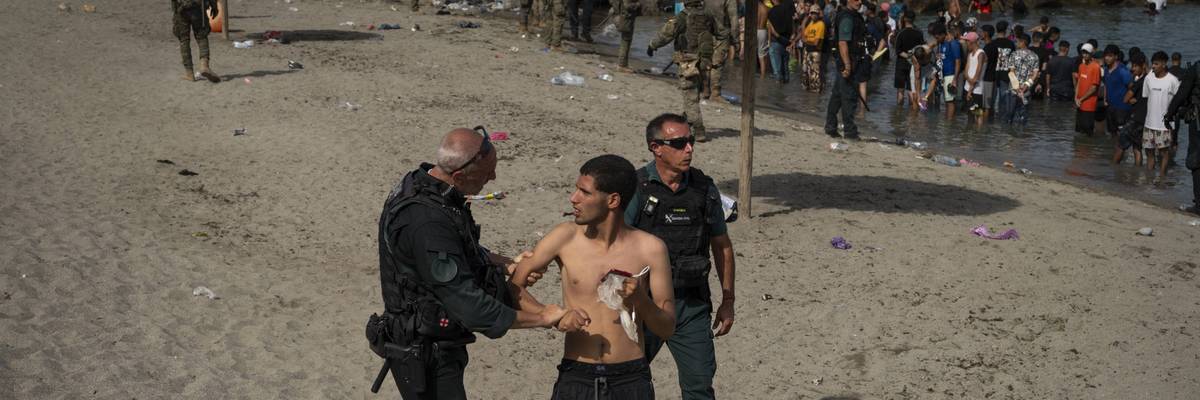
Police checking migrants arrive on Tarajal beach after crossing the border between Spain and Morocco on July 31, 2026 in Ceuta, Spain.
Scores Dead Trying to Reach Ceuta and Still the Wrong Questions
Once again, people have lost their lives at Europe’s border, and once again, the real question remains unanswered.
Last week, at least 72 people died while attempting to reach the Spanish exclave of Ceuta from Morocco. Around 60,000 people made it into Ceuta, many of them by sea, others by climbing over border fences. Within just a few days, however, most of them had already returned to Morocco.
Both Morocco and Ceuta are located in Africa. But politically, Ceuta, like Melilla, belongs to Spain and therefore to the European Union. Europe’s response to the unprecedented influx into the exclave has been almost unanimous. What happened has been described as a “threat to Europe’s security.” Some have even called it an “attack” or an “invasion.” Europe’s external borders, we are told, must be better protected.
Twenty-two of the European Union’s 27 member states have now signed an open letter initiated by Italy’s far-right government under Giorgia Meloni, criticizing Spain’s migration policy and calling for stricter security measures at Europe’s borders. Italy has further suspended its Schengen agreement with Spain. That this is little more than political posturing is evident from the fact that Ceuta is not part of the Schengen Area in the first place.
While Europe appears quick to agree on yet more repression, the 72 lives irreversibly lost have become an afterthought. Most of those who died had most of their lives still ahead of them and hoped for a better future. Instead, they found death on what they believed was the path toward that future. As right-leaning governments across Europe compete with one another in increasingly alarmist security rhetoric, the fundamental question is largely ignored: Why does a young person take such enormous risks in order to reach Europe?
People flee war, violence, persecution, poverty, and the hopelessness that arises when there is little prospect of a safe and dignified life. Border fences cannot deter those who see no viable future where they are, but merely make their journeys more dangerous and more deadly. One can debate at length the respective roles played by colonialism and other historical injustices on the one hand, and current political failures on the other, in creating global inequality. But this does not change the fact that a young person in Morocco, facing high youth unemployment and low wages, has every reason to perceive their situation as profoundly unjust when compared with life in much of Europe.
This inequality is not an abstract concept. In a world where everyone is connected to everyone else, and our planet, in many ways, has become a global village, it is experienced directly. People see how others live on their phone screens every day.
Nineteen-year-old Nok in Thailand can watch in real time as Moritz, her age and from Munich, spontaneously buys a flight ticket to Bangkok and spends six months travelling through Southeast Asia to “find himself.” A comparable journey to Europe is out of reach for Nok, given her limited financial means and the enormous difficulty of obtaining a Schengen visa, and it will remain an impossibility in the foreseeable future.
“Come through legal channels,” Europe tells migrants. Kwame in Ghana wants nothing more than to do exactly that. He successfully applies for a master’s program in Germany, spends months of his time and a considerable amount of money on language tests, certifications, translations, and other documents he needs for his visa application, and saves the required funds for his living expenses in Germany. Yet when he requests an appointment at the German Embassy in Accra, he learns that the waiting time is six to twelve months. He will miss the start of his program. Whether his admission will still be valid the following year remains uncertain.
Amina is eight years old and lives in Sudan. For months, there has been little to no schooling in her region. The healthcare system has largely collapsed. While her parents struggle every day to find enough food and clean water, many children in Europe take education, healthcare, and security for granted.
José is 24 years old and works twelve hours a day in a textile factory in Honduras for a wage that barely allows him to survive. The clothes he sews are later sold in Europe, often for more money than he earns in an entire week.
Nok, Kwame, Amina, and José had no control over where they were born. Neither did Moritz. Yet the consequences of this accident of birth could hardly be more different. It may be easier to demand higher fences, but as long as such extreme inequalities in security, prosperity, and future opportunities exist between different regions of the world, people will continue trying to overcome those fences.
The challenges of migration cannot be solved by sealing oneself off. They require an honest debate about how the global order can be made fairer. This is not simply a matter of extending humanitarian compassion as a voluntary gesture; it is a question of how much inequality can be morally justified when it is based largely on the accident of where someone happens to be born.
If Europe wants to prevent images like those from Ceuta in the future, it must address the root causes of migration more decisively — among other things through fairer trade relations, greater commitment to development cooperation, and the expansion of legal migration pathways. Paradoxically, the opposite trend can often be observed today. Many European countries, for example, have significantly reduced their development aid budgets in recent years — a sign of the growing influence of populism, which prioritizes short-term political gains over long-term solutions. Ultimately, such policies harm not only people in countries of origin, but Europe itself as well.
An Urgent Message From Our Co-Founder
Dear Common Dreams reader, It’s been nearly 30 years since I co-founded Common Dreams with my late wife, Lina Newhouser. We had the radical notion that journalism should serve the public good, not corporate profits. It was clear to us from the outset what it would take to build such a project. No paid advertisements. No corporate sponsors. No millionaire publisher telling us what to think or do. Many people said we wouldn't last a year, but we proved those doubters wrong. Together with a tremendous team of journalists and dedicated staff, we built an independent media outlet free from the constraints of profits and corporate control. Our mission has always been simple: To inform. To inspire. To ignite change for the common good. Building Common Dreams was not easy. Our survival was never guaranteed. When you take on the most powerful forces—Wall Street greed, fossil fuel industry destruction, Big Tech lobbyists, and uber-rich oligarchs who have spent billions upon billions rigging the economy and democracy in their favor—the only bulwark you have is supporters who believe in your work. But here’s the urgent message from me today. It's never been this bad out there. And it's never been this hard to keep us going. At the very moment Common Dreams is most needed, the threats we face are intensifying. We need your support now more than ever. We don't accept corporate advertising and never will. We don't have a paywall because we don't think people should be blocked from critical news based on their ability to pay. Everything we do is funded by the donations of readers like you. When everyone does the little they can afford, we are strong. But if that support retreats or dries up, so do we. Will you donate now to make sure Common Dreams not only survives but thrives? —Craig Brown, Co-founder |
Last week, at least 72 people died while attempting to reach the Spanish exclave of Ceuta from Morocco. Around 60,000 people made it into Ceuta, many of them by sea, others by climbing over border fences. Within just a few days, however, most of them had already returned to Morocco.
Both Morocco and Ceuta are located in Africa. But politically, Ceuta, like Melilla, belongs to Spain and therefore to the European Union. Europe’s response to the unprecedented influx into the exclave has been almost unanimous. What happened has been described as a “threat to Europe’s security.” Some have even called it an “attack” or an “invasion.” Europe’s external borders, we are told, must be better protected.
Twenty-two of the European Union’s 27 member states have now signed an open letter initiated by Italy’s far-right government under Giorgia Meloni, criticizing Spain’s migration policy and calling for stricter security measures at Europe’s borders. Italy has further suspended its Schengen agreement with Spain. That this is little more than political posturing is evident from the fact that Ceuta is not part of the Schengen Area in the first place.
While Europe appears quick to agree on yet more repression, the 72 lives irreversibly lost have become an afterthought. Most of those who died had most of their lives still ahead of them and hoped for a better future. Instead, they found death on what they believed was the path toward that future. As right-leaning governments across Europe compete with one another in increasingly alarmist security rhetoric, the fundamental question is largely ignored: Why does a young person take such enormous risks in order to reach Europe?
People flee war, violence, persecution, poverty, and the hopelessness that arises when there is little prospect of a safe and dignified life. Border fences cannot deter those who see no viable future where they are, but merely make their journeys more dangerous and more deadly. One can debate at length the respective roles played by colonialism and other historical injustices on the one hand, and current political failures on the other, in creating global inequality. But this does not change the fact that a young person in Morocco, facing high youth unemployment and low wages, has every reason to perceive their situation as profoundly unjust when compared with life in much of Europe.
This inequality is not an abstract concept. In a world where everyone is connected to everyone else, and our planet, in many ways, has become a global village, it is experienced directly. People see how others live on their phone screens every day.
Nineteen-year-old Nok in Thailand can watch in real time as Moritz, her age and from Munich, spontaneously buys a flight ticket to Bangkok and spends six months travelling through Southeast Asia to “find himself.” A comparable journey to Europe is out of reach for Nok, given her limited financial means and the enormous difficulty of obtaining a Schengen visa, and it will remain an impossibility in the foreseeable future.
“Come through legal channels,” Europe tells migrants. Kwame in Ghana wants nothing more than to do exactly that. He successfully applies for a master’s program in Germany, spends months of his time and a considerable amount of money on language tests, certifications, translations, and other documents he needs for his visa application, and saves the required funds for his living expenses in Germany. Yet when he requests an appointment at the German Embassy in Accra, he learns that the waiting time is six to twelve months. He will miss the start of his program. Whether his admission will still be valid the following year remains uncertain.
Amina is eight years old and lives in Sudan. For months, there has been little to no schooling in her region. The healthcare system has largely collapsed. While her parents struggle every day to find enough food and clean water, many children in Europe take education, healthcare, and security for granted.
José is 24 years old and works twelve hours a day in a textile factory in Honduras for a wage that barely allows him to survive. The clothes he sews are later sold in Europe, often for more money than he earns in an entire week.
Nok, Kwame, Amina, and José had no control over where they were born. Neither did Moritz. Yet the consequences of this accident of birth could hardly be more different. It may be easier to demand higher fences, but as long as such extreme inequalities in security, prosperity, and future opportunities exist between different regions of the world, people will continue trying to overcome those fences.
The challenges of migration cannot be solved by sealing oneself off. They require an honest debate about how the global order can be made fairer. This is not simply a matter of extending humanitarian compassion as a voluntary gesture; it is a question of how much inequality can be morally justified when it is based largely on the accident of where someone happens to be born.
If Europe wants to prevent images like those from Ceuta in the future, it must address the root causes of migration more decisively — among other things through fairer trade relations, greater commitment to development cooperation, and the expansion of legal migration pathways. Paradoxically, the opposite trend can often be observed today. Many European countries, for example, have significantly reduced their development aid budgets in recent years — a sign of the growing influence of populism, which prioritizes short-term political gains over long-term solutions. Ultimately, such policies harm not only people in countries of origin, but Europe itself as well.
Last week, at least 72 people died while attempting to reach the Spanish exclave of Ceuta from Morocco. Around 60,000 people made it into Ceuta, many of them by sea, others by climbing over border fences. Within just a few days, however, most of them had already returned to Morocco.
Both Morocco and Ceuta are located in Africa. But politically, Ceuta, like Melilla, belongs to Spain and therefore to the European Union. Europe’s response to the unprecedented influx into the exclave has been almost unanimous. What happened has been described as a “threat to Europe’s security.” Some have even called it an “attack” or an “invasion.” Europe’s external borders, we are told, must be better protected.
Twenty-two of the European Union’s 27 member states have now signed an open letter initiated by Italy’s far-right government under Giorgia Meloni, criticizing Spain’s migration policy and calling for stricter security measures at Europe’s borders. Italy has further suspended its Schengen agreement with Spain. That this is little more than political posturing is evident from the fact that Ceuta is not part of the Schengen Area in the first place.
While Europe appears quick to agree on yet more repression, the 72 lives irreversibly lost have become an afterthought. Most of those who died had most of their lives still ahead of them and hoped for a better future. Instead, they found death on what they believed was the path toward that future. As right-leaning governments across Europe compete with one another in increasingly alarmist security rhetoric, the fundamental question is largely ignored: Why does a young person take such enormous risks in order to reach Europe?
People flee war, violence, persecution, poverty, and the hopelessness that arises when there is little prospect of a safe and dignified life. Border fences cannot deter those who see no viable future where they are, but merely make their journeys more dangerous and more deadly. One can debate at length the respective roles played by colonialism and other historical injustices on the one hand, and current political failures on the other, in creating global inequality. But this does not change the fact that a young person in Morocco, facing high youth unemployment and low wages, has every reason to perceive their situation as profoundly unjust when compared with life in much of Europe.
This inequality is not an abstract concept. In a world where everyone is connected to everyone else, and our planet, in many ways, has become a global village, it is experienced directly. People see how others live on their phone screens every day.
Nineteen-year-old Nok in Thailand can watch in real time as Moritz, her age and from Munich, spontaneously buys a flight ticket to Bangkok and spends six months travelling through Southeast Asia to “find himself.” A comparable journey to Europe is out of reach for Nok, given her limited financial means and the enormous difficulty of obtaining a Schengen visa, and it will remain an impossibility in the foreseeable future.
“Come through legal channels,” Europe tells migrants. Kwame in Ghana wants nothing more than to do exactly that. He successfully applies for a master’s program in Germany, spends months of his time and a considerable amount of money on language tests, certifications, translations, and other documents he needs for his visa application, and saves the required funds for his living expenses in Germany. Yet when he requests an appointment at the German Embassy in Accra, he learns that the waiting time is six to twelve months. He will miss the start of his program. Whether his admission will still be valid the following year remains uncertain.
Amina is eight years old and lives in Sudan. For months, there has been little to no schooling in her region. The healthcare system has largely collapsed. While her parents struggle every day to find enough food and clean water, many children in Europe take education, healthcare, and security for granted.
José is 24 years old and works twelve hours a day in a textile factory in Honduras for a wage that barely allows him to survive. The clothes he sews are later sold in Europe, often for more money than he earns in an entire week.
Nok, Kwame, Amina, and José had no control over where they were born. Neither did Moritz. Yet the consequences of this accident of birth could hardly be more different. It may be easier to demand higher fences, but as long as such extreme inequalities in security, prosperity, and future opportunities exist between different regions of the world, people will continue trying to overcome those fences.
The challenges of migration cannot be solved by sealing oneself off. They require an honest debate about how the global order can be made fairer. This is not simply a matter of extending humanitarian compassion as a voluntary gesture; it is a question of how much inequality can be morally justified when it is based largely on the accident of where someone happens to be born.
If Europe wants to prevent images like those from Ceuta in the future, it must address the root causes of migration more decisively — among other things through fairer trade relations, greater commitment to development cooperation, and the expansion of legal migration pathways. Paradoxically, the opposite trend can often be observed today. Many European countries, for example, have significantly reduced their development aid budgets in recent years — a sign of the growing influence of populism, which prioritizes short-term political gains over long-term solutions. Ultimately, such policies harm not only people in countries of origin, but Europe itself as well.