SUBSCRIBE TO OUR FREE NEWSLETTER
Daily news & progressive opinion—funded by the people, not the corporations—delivered straight to your inbox.
5
#000000
#FFFFFF
To donate by check, phone, or other method, see our More Ways to Give page.
Daily news & progressive opinion—funded by the people, not the corporations—delivered straight to your inbox.
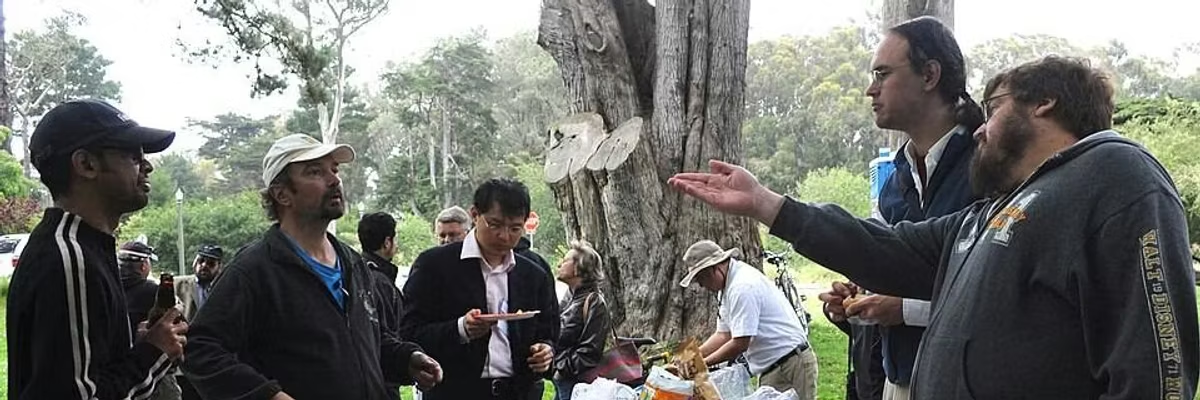
People talking around a picnic table in San Francisco.
The US has become a deeply polarized nation. One idea to overcome this is to pay people to disagree.
America is a polarized nation. Recent polls find that nearly half of us consider members of the opposing party to be “downright evil.” Perhaps this helps explain why more and more of us are choosing to live in towns and cities that match our political leanings—a phenomenon known as “the Big Sort.” Adding to this split is a media landscape where we choose news outlets that confirm our views, and the feeds we scroll offer up more of the same. The result is an American public increasingly sealed off from opposing views. Think about it: When was the last time you had a political conversation where you disagreed with someone? And more importantly, how did it go? You most likely found it stressful rather than informative.
I believe this is because we have lost a core American skill: the ability to disagree well. Not the faceless, angry kind we do online, but the kind that happens when people who disagree come together with the intention to understand one another and compromise. Our country was built on this. A summer of argument produced our Constitution. Four more years of it produced the Bill of Rights. This tradition endured in the form of New England town meetings and union halls. We’ve let this tradition lapse, and it’s costing us.
So here’s a simple idea to point us back in the right direction: We should pay people to disagree.
This isn’t as strange as it sounds. Organizations like Braver Angels have already built a framework for this, borrowing techniques from family conflict resolution and applying them to a country in conflict. I (Natasha, 21) have seen it work firsthand. In high school, one of my classes partnered with a school in Louisiana to run a Red-Blue Workshop—several weeks of facilitated dialogue between my liberal classmates and our conservative counterparts. As is usual in this program, we became fast friends, comfortable talking through the very topics that were supposed to divide us.
America’s problem is not that Americans disagree. It's that we’ve stopped seeing people who disagree with us as fellow citizens with different ideas about what's best for the country and started seeing them as enemies to be vanquished.
We learned what successful dialogue looks like. We learned that the goal isn’t to change the other person’s mind or to completely humiliate them, as is often modeled online (open YouTube, click one political video, and you’ll be recommended hundreds more with titles like “liberal DESTROYS conservative” or vice versa). Instead, the goal is to explore each other’s lived experiences and backgrounds to form a deeper understanding of what our peers believe and why. We left the program with more empathy for one another. We were no longer competitors trying to “win” and prove our side was right, but fellow citizens united by the shared goal of bettering our country.
Now imagine this at scale: a national program teaching Americans how to have effective civil dialogue and demonstrating that the villainous way the other side is depicted online is largely untrue. Who’s to say what would come of this? Maybe we would realize that over 80% of us favor stock trading bans for members of Congress. Or that over 70% of us favor term limits for Supreme Court justices. Maybe we would realize that much of the anger we are taught online is convenient for people in power. Maybe we would conclude that our power lies in looking past the differences we are sold and uniting to fight for issues that matter to us.
Paying people to participate in such a program isn’t completely unheard of either. AmeriCorps has paid Americans for civic work for decades. New York recently paid its residents to shovel snow after this winter’s blizzards. No one regarded either policy as a handout. The work was viewed as an investment in what a functioning city or country needs. Structured dialogue between political opposites belongs on that list of vital infrastructure. This would likely begin as a pilot program in a few cities, but national experiments abroad prove that such dialogue is scalable.
And it would be a bargain! We are already paying a high price for polarization. The most obvious cost is to the health of our democracy. But there’s a literal price tag too. When our government can’t compromise, it shuts down: The Congressional Budget Office (CBO) estimated that in 2025, a single government shutdown cost the economy between $7 billion and $14 billion. Polarization affects the private sector, too. Research on private companies found that more polarized states see meaningfully less business investment overall. Investing in civic infrastructure would pay dividends. And the money is there. If $37 billion of our tax dollars can fund an aimless war in the Middle East, then surely a fraction of that can be used to repair our democracy at home.
America’s problem is not that Americans disagree. It's that we’ve stopped seeing people who disagree with us as fellow citizens with different ideas about what's best for the country and started seeing them as enemies to be vanquished. Of course, paying Americans to sit down together won’t fix this problem overnight. But it’s a start. With it, we can begin the slow work of democratic reconciliation. Doing so will remind us that disagreeing with one another never hurts our country. It is forgetting how to disagree well that does.
Dear Common Dreams reader, It’s been nearly 30 years since I co-founded Common Dreams with my late wife, Lina Newhouser. We had the radical notion that journalism should serve the public good, not corporate profits. It was clear to us from the outset what it would take to build such a project. No paid advertisements. No corporate sponsors. No millionaire publisher telling us what to think or do. Many people said we wouldn't last a year, but we proved those doubters wrong. Together with a tremendous team of journalists and dedicated staff, we built an independent media outlet free from the constraints of profits and corporate control. Our mission has always been simple: To inform. To inspire. To ignite change for the common good. Building Common Dreams was not easy. Our survival was never guaranteed. When you take on the most powerful forces—Wall Street greed, fossil fuel industry destruction, Big Tech lobbyists, and uber-rich oligarchs who have spent billions upon billions rigging the economy and democracy in their favor—the only bulwark you have is supporters who believe in your work. But here’s the urgent message from me today. It's never been this bad out there. And it's never been this hard to keep us going. At the very moment Common Dreams is most needed, the threats we face are intensifying. We need your support now more than ever. We don't accept corporate advertising and never will. We don't have a paywall because we don't think people should be blocked from critical news based on their ability to pay. Everything we do is funded by the donations of readers like you. When everyone does the little they can afford, we are strong. But if that support retreats or dries up, so do we. Will you donate now to make sure Common Dreams not only survives but thrives? —Craig Brown, Co-founder |
America is a polarized nation. Recent polls find that nearly half of us consider members of the opposing party to be “downright evil.” Perhaps this helps explain why more and more of us are choosing to live in towns and cities that match our political leanings—a phenomenon known as “the Big Sort.” Adding to this split is a media landscape where we choose news outlets that confirm our views, and the feeds we scroll offer up more of the same. The result is an American public increasingly sealed off from opposing views. Think about it: When was the last time you had a political conversation where you disagreed with someone? And more importantly, how did it go? You most likely found it stressful rather than informative.
I believe this is because we have lost a core American skill: the ability to disagree well. Not the faceless, angry kind we do online, but the kind that happens when people who disagree come together with the intention to understand one another and compromise. Our country was built on this. A summer of argument produced our Constitution. Four more years of it produced the Bill of Rights. This tradition endured in the form of New England town meetings and union halls. We’ve let this tradition lapse, and it’s costing us.
So here’s a simple idea to point us back in the right direction: We should pay people to disagree.
This isn’t as strange as it sounds. Organizations like Braver Angels have already built a framework for this, borrowing techniques from family conflict resolution and applying them to a country in conflict. I (Natasha, 21) have seen it work firsthand. In high school, one of my classes partnered with a school in Louisiana to run a Red-Blue Workshop—several weeks of facilitated dialogue between my liberal classmates and our conservative counterparts. As is usual in this program, we became fast friends, comfortable talking through the very topics that were supposed to divide us.
America’s problem is not that Americans disagree. It's that we’ve stopped seeing people who disagree with us as fellow citizens with different ideas about what's best for the country and started seeing them as enemies to be vanquished.
We learned what successful dialogue looks like. We learned that the goal isn’t to change the other person’s mind or to completely humiliate them, as is often modeled online (open YouTube, click one political video, and you’ll be recommended hundreds more with titles like “liberal DESTROYS conservative” or vice versa). Instead, the goal is to explore each other’s lived experiences and backgrounds to form a deeper understanding of what our peers believe and why. We left the program with more empathy for one another. We were no longer competitors trying to “win” and prove our side was right, but fellow citizens united by the shared goal of bettering our country.
Now imagine this at scale: a national program teaching Americans how to have effective civil dialogue and demonstrating that the villainous way the other side is depicted online is largely untrue. Who’s to say what would come of this? Maybe we would realize that over 80% of us favor stock trading bans for members of Congress. Or that over 70% of us favor term limits for Supreme Court justices. Maybe we would realize that much of the anger we are taught online is convenient for people in power. Maybe we would conclude that our power lies in looking past the differences we are sold and uniting to fight for issues that matter to us.
Paying people to participate in such a program isn’t completely unheard of either. AmeriCorps has paid Americans for civic work for decades. New York recently paid its residents to shovel snow after this winter’s blizzards. No one regarded either policy as a handout. The work was viewed as an investment in what a functioning city or country needs. Structured dialogue between political opposites belongs on that list of vital infrastructure. This would likely begin as a pilot program in a few cities, but national experiments abroad prove that such dialogue is scalable.
And it would be a bargain! We are already paying a high price for polarization. The most obvious cost is to the health of our democracy. But there’s a literal price tag too. When our government can’t compromise, it shuts down: The Congressional Budget Office (CBO) estimated that in 2025, a single government shutdown cost the economy between $7 billion and $14 billion. Polarization affects the private sector, too. Research on private companies found that more polarized states see meaningfully less business investment overall. Investing in civic infrastructure would pay dividends. And the money is there. If $37 billion of our tax dollars can fund an aimless war in the Middle East, then surely a fraction of that can be used to repair our democracy at home.
America’s problem is not that Americans disagree. It's that we’ve stopped seeing people who disagree with us as fellow citizens with different ideas about what's best for the country and started seeing them as enemies to be vanquished. Of course, paying Americans to sit down together won’t fix this problem overnight. But it’s a start. With it, we can begin the slow work of democratic reconciliation. Doing so will remind us that disagreeing with one another never hurts our country. It is forgetting how to disagree well that does.
America is a polarized nation. Recent polls find that nearly half of us consider members of the opposing party to be “downright evil.” Perhaps this helps explain why more and more of us are choosing to live in towns and cities that match our political leanings—a phenomenon known as “the Big Sort.” Adding to this split is a media landscape where we choose news outlets that confirm our views, and the feeds we scroll offer up more of the same. The result is an American public increasingly sealed off from opposing views. Think about it: When was the last time you had a political conversation where you disagreed with someone? And more importantly, how did it go? You most likely found it stressful rather than informative.
I believe this is because we have lost a core American skill: the ability to disagree well. Not the faceless, angry kind we do online, but the kind that happens when people who disagree come together with the intention to understand one another and compromise. Our country was built on this. A summer of argument produced our Constitution. Four more years of it produced the Bill of Rights. This tradition endured in the form of New England town meetings and union halls. We’ve let this tradition lapse, and it’s costing us.
So here’s a simple idea to point us back in the right direction: We should pay people to disagree.
This isn’t as strange as it sounds. Organizations like Braver Angels have already built a framework for this, borrowing techniques from family conflict resolution and applying them to a country in conflict. I (Natasha, 21) have seen it work firsthand. In high school, one of my classes partnered with a school in Louisiana to run a Red-Blue Workshop—several weeks of facilitated dialogue between my liberal classmates and our conservative counterparts. As is usual in this program, we became fast friends, comfortable talking through the very topics that were supposed to divide us.
America’s problem is not that Americans disagree. It's that we’ve stopped seeing people who disagree with us as fellow citizens with different ideas about what's best for the country and started seeing them as enemies to be vanquished.
We learned what successful dialogue looks like. We learned that the goal isn’t to change the other person’s mind or to completely humiliate them, as is often modeled online (open YouTube, click one political video, and you’ll be recommended hundreds more with titles like “liberal DESTROYS conservative” or vice versa). Instead, the goal is to explore each other’s lived experiences and backgrounds to form a deeper understanding of what our peers believe and why. We left the program with more empathy for one another. We were no longer competitors trying to “win” and prove our side was right, but fellow citizens united by the shared goal of bettering our country.
Now imagine this at scale: a national program teaching Americans how to have effective civil dialogue and demonstrating that the villainous way the other side is depicted online is largely untrue. Who’s to say what would come of this? Maybe we would realize that over 80% of us favor stock trading bans for members of Congress. Or that over 70% of us favor term limits for Supreme Court justices. Maybe we would realize that much of the anger we are taught online is convenient for people in power. Maybe we would conclude that our power lies in looking past the differences we are sold and uniting to fight for issues that matter to us.
Paying people to participate in such a program isn’t completely unheard of either. AmeriCorps has paid Americans for civic work for decades. New York recently paid its residents to shovel snow after this winter’s blizzards. No one regarded either policy as a handout. The work was viewed as an investment in what a functioning city or country needs. Structured dialogue between political opposites belongs on that list of vital infrastructure. This would likely begin as a pilot program in a few cities, but national experiments abroad prove that such dialogue is scalable.
And it would be a bargain! We are already paying a high price for polarization. The most obvious cost is to the health of our democracy. But there’s a literal price tag too. When our government can’t compromise, it shuts down: The Congressional Budget Office (CBO) estimated that in 2025, a single government shutdown cost the economy between $7 billion and $14 billion. Polarization affects the private sector, too. Research on private companies found that more polarized states see meaningfully less business investment overall. Investing in civic infrastructure would pay dividends. And the money is there. If $37 billion of our tax dollars can fund an aimless war in the Middle East, then surely a fraction of that can be used to repair our democracy at home.
America’s problem is not that Americans disagree. It's that we’ve stopped seeing people who disagree with us as fellow citizens with different ideas about what's best for the country and started seeing them as enemies to be vanquished. Of course, paying Americans to sit down together won’t fix this problem overnight. But it’s a start. With it, we can begin the slow work of democratic reconciliation. Doing so will remind us that disagreeing with one another never hurts our country. It is forgetting how to disagree well that does.