SUBSCRIBE TO OUR FREE NEWSLETTER
Daily news & progressive opinion—funded by the people, not the corporations—delivered straight to your inbox.
5
#000000
#FFFFFF
To donate by check, phone, or other method, see our More Ways to Give page.
Daily news & progressive opinion—funded by the people, not the corporations—delivered straight to your inbox.
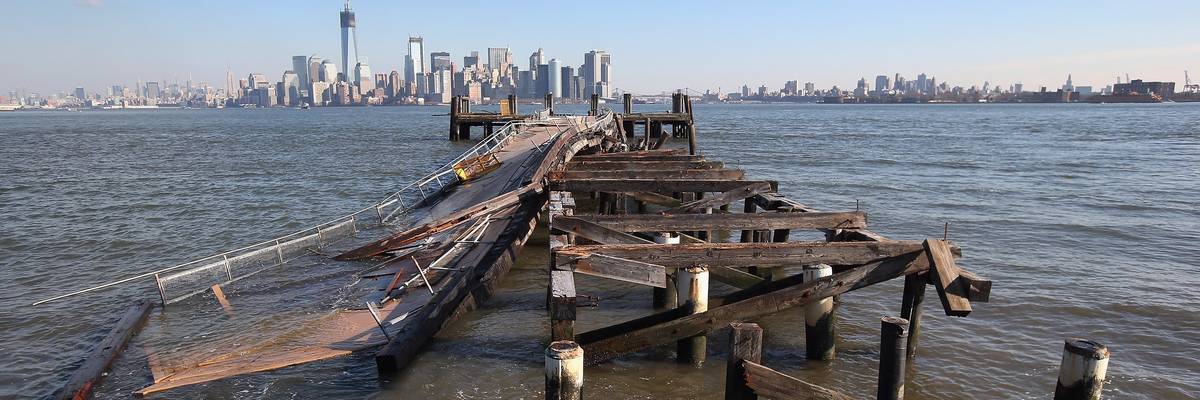
A dock sits damaged near the Statue of Liberty which, remains closed to the public six weeks after Hurricane Sandy on December 13, 2012 in New York City.
Instead of relying on numbers that make our progress appear better on paper, New York state leaders should focus on the investments that actually protect New Yorkers from the impacts of fossil fuels.
Back in 2012, over the course of two days, water, wind, and rain flooded my neighborhood.
At that time, I was living in the Baruch Houses on Manhattan's Lower East Side while working as a babysitter in Park Slope, Brooklyn. Unlike the families I was working for, my neighbors and I didn’t have the luxury of leaving our homes to seek refuge in a safe place. So we stayed.
That night I watched as a green flash cracked across the sky before everything went dark. I didn’t know it at the time, but I later came to find out the Con Edison plant just six minutes away from my building had exploded. The feeling of loss and fear that day didn’t just happen to me: Over 69,000 units were damaged and lost, thousands of New Yorkers were displaced.
Thirteen years later, these vulnerabilities revealed within our infrastructure still remain today, and with every major storm or heavy rainfall, our subways and homes continue to flood. Yet, with the new passage of the New York State Budget and the rollbacks on our climate goals, Albany has chosen to weaken key environmental commitments.
People that look like me pay for fossil fuels with our health, our safety, our democracy, and our children's right to a clean and healthy future.
While the budget still has some investments in clean energy, it also delays our committed climate benchmarks and measurements. Essentially, this budget moves us further away from the emissions goals we’ve legally bound ourselves to. Instead of focusing on meeting these goals already established under state law, Albany has chosen to move the goalposts.
Changing the ways in which we measure our emissions may make progress look better on paper, but it doesn't reduce the actual consequences of climate inaction.
For decades, communities that look like mine have felt the ramification of climate change more harshly. Oftentimes, these ramifications result in not just the physical terror like I and many experienced during Hurricane Sandy but can also manifest in poorer health outcomes.
The fossil fuel sector is literally choking us to death with no regard to how they contribute to the exacerbation of other conditions in my community. Fossil fuel consumption in New York City makes up for 70% of our local greenhouse gas emissions. It also causes around 2,400 premature deaths annually due to air pollution.
So, instead of moving the goalposts and relying on numbers that make our progress appear better on paper, Albany should focus on the investments that actually protect New Yorkers. And, even though with the recent announcement of the $100 million commitment for climate resiliency projects through the Environmental Bond Act is a step in the right direction, we still need to go even further by fully funding and accelerating the comprehensive flood protection plan. This includes the Lower Manhattan Coastal Resiliency Program aimed at strengthening flood resilience, modernizing infrastructure, and safeguarding our communities.
While we associate fossil fuel costs with our utility bills, people that look like me pay for fossil fuels with our health, our safety, our democracy, and our children's right to a clean and healthy future. We can not afford to sacrifice any longer or delay any further the commitment we made to reduce emission. As storms become stronger, and infrastructures continue to decay, the greatest impacts will be on forgotten neighborhoods like mine. And whether I’m elected to represent this district in Albany or not, I will continue to push for the funding we need to no longer live in survival mode every time a storm occurs.
Dear Common Dreams reader, It’s been nearly 30 years since I co-founded Common Dreams with my late wife, Lina Newhouser. We had the radical notion that journalism should serve the public good, not corporate profits. It was clear to us from the outset what it would take to build such a project. No paid advertisements. No corporate sponsors. No millionaire publisher telling us what to think or do. Many people said we wouldn't last a year, but we proved those doubters wrong. Together with a tremendous team of journalists and dedicated staff, we built an independent media outlet free from the constraints of profits and corporate control. Our mission has always been simple: To inform. To inspire. To ignite change for the common good. Building Common Dreams was not easy. Our survival was never guaranteed. When you take on the most powerful forces—Wall Street greed, fossil fuel industry destruction, Big Tech lobbyists, and uber-rich oligarchs who have spent billions upon billions rigging the economy and democracy in their favor—the only bulwark you have is supporters who believe in your work. But here’s the urgent message from me today. It's never been this bad out there. And it's never been this hard to keep us going. At the very moment Common Dreams is most needed, the threats we face are intensifying. We need your support now more than ever. We don't accept corporate advertising and never will. We don't have a paywall because we don't think people should be blocked from critical news based on their ability to pay. Everything we do is funded by the donations of readers like you. When everyone does the little they can afford, we are strong. But if that support retreats or dries up, so do we. Will you donate now to make sure Common Dreams not only survives but thrives? —Craig Brown, Co-founder |
Back in 2012, over the course of two days, water, wind, and rain flooded my neighborhood.
At that time, I was living in the Baruch Houses on Manhattan's Lower East Side while working as a babysitter in Park Slope, Brooklyn. Unlike the families I was working for, my neighbors and I didn’t have the luxury of leaving our homes to seek refuge in a safe place. So we stayed.
That night I watched as a green flash cracked across the sky before everything went dark. I didn’t know it at the time, but I later came to find out the Con Edison plant just six minutes away from my building had exploded. The feeling of loss and fear that day didn’t just happen to me: Over 69,000 units were damaged and lost, thousands of New Yorkers were displaced.
Thirteen years later, these vulnerabilities revealed within our infrastructure still remain today, and with every major storm or heavy rainfall, our subways and homes continue to flood. Yet, with the new passage of the New York State Budget and the rollbacks on our climate goals, Albany has chosen to weaken key environmental commitments.
People that look like me pay for fossil fuels with our health, our safety, our democracy, and our children's right to a clean and healthy future.
While the budget still has some investments in clean energy, it also delays our committed climate benchmarks and measurements. Essentially, this budget moves us further away from the emissions goals we’ve legally bound ourselves to. Instead of focusing on meeting these goals already established under state law, Albany has chosen to move the goalposts.
Changing the ways in which we measure our emissions may make progress look better on paper, but it doesn't reduce the actual consequences of climate inaction.
For decades, communities that look like mine have felt the ramification of climate change more harshly. Oftentimes, these ramifications result in not just the physical terror like I and many experienced during Hurricane Sandy but can also manifest in poorer health outcomes.
The fossil fuel sector is literally choking us to death with no regard to how they contribute to the exacerbation of other conditions in my community. Fossil fuel consumption in New York City makes up for 70% of our local greenhouse gas emissions. It also causes around 2,400 premature deaths annually due to air pollution.
So, instead of moving the goalposts and relying on numbers that make our progress appear better on paper, Albany should focus on the investments that actually protect New Yorkers. And, even though with the recent announcement of the $100 million commitment for climate resiliency projects through the Environmental Bond Act is a step in the right direction, we still need to go even further by fully funding and accelerating the comprehensive flood protection plan. This includes the Lower Manhattan Coastal Resiliency Program aimed at strengthening flood resilience, modernizing infrastructure, and safeguarding our communities.
While we associate fossil fuel costs with our utility bills, people that look like me pay for fossil fuels with our health, our safety, our democracy, and our children's right to a clean and healthy future. We can not afford to sacrifice any longer or delay any further the commitment we made to reduce emission. As storms become stronger, and infrastructures continue to decay, the greatest impacts will be on forgotten neighborhoods like mine. And whether I’m elected to represent this district in Albany or not, I will continue to push for the funding we need to no longer live in survival mode every time a storm occurs.
Back in 2012, over the course of two days, water, wind, and rain flooded my neighborhood.
At that time, I was living in the Baruch Houses on Manhattan's Lower East Side while working as a babysitter in Park Slope, Brooklyn. Unlike the families I was working for, my neighbors and I didn’t have the luxury of leaving our homes to seek refuge in a safe place. So we stayed.
That night I watched as a green flash cracked across the sky before everything went dark. I didn’t know it at the time, but I later came to find out the Con Edison plant just six minutes away from my building had exploded. The feeling of loss and fear that day didn’t just happen to me: Over 69,000 units were damaged and lost, thousands of New Yorkers were displaced.
Thirteen years later, these vulnerabilities revealed within our infrastructure still remain today, and with every major storm or heavy rainfall, our subways and homes continue to flood. Yet, with the new passage of the New York State Budget and the rollbacks on our climate goals, Albany has chosen to weaken key environmental commitments.
People that look like me pay for fossil fuels with our health, our safety, our democracy, and our children's right to a clean and healthy future.
While the budget still has some investments in clean energy, it also delays our committed climate benchmarks and measurements. Essentially, this budget moves us further away from the emissions goals we’ve legally bound ourselves to. Instead of focusing on meeting these goals already established under state law, Albany has chosen to move the goalposts.
Changing the ways in which we measure our emissions may make progress look better on paper, but it doesn't reduce the actual consequences of climate inaction.
For decades, communities that look like mine have felt the ramification of climate change more harshly. Oftentimes, these ramifications result in not just the physical terror like I and many experienced during Hurricane Sandy but can also manifest in poorer health outcomes.
The fossil fuel sector is literally choking us to death with no regard to how they contribute to the exacerbation of other conditions in my community. Fossil fuel consumption in New York City makes up for 70% of our local greenhouse gas emissions. It also causes around 2,400 premature deaths annually due to air pollution.
So, instead of moving the goalposts and relying on numbers that make our progress appear better on paper, Albany should focus on the investments that actually protect New Yorkers. And, even though with the recent announcement of the $100 million commitment for climate resiliency projects through the Environmental Bond Act is a step in the right direction, we still need to go even further by fully funding and accelerating the comprehensive flood protection plan. This includes the Lower Manhattan Coastal Resiliency Program aimed at strengthening flood resilience, modernizing infrastructure, and safeguarding our communities.
While we associate fossil fuel costs with our utility bills, people that look like me pay for fossil fuels with our health, our safety, our democracy, and our children's right to a clean and healthy future. We can not afford to sacrifice any longer or delay any further the commitment we made to reduce emission. As storms become stronger, and infrastructures continue to decay, the greatest impacts will be on forgotten neighborhoods like mine. And whether I’m elected to represent this district in Albany or not, I will continue to push for the funding we need to no longer live in survival mode every time a storm occurs.