5
#000000
#FFFFFF
To donate by check, phone, or other method, see our More Ways to Give page.
Daily news & progressive opinion—funded by the people, not the corporations—delivered straight to your inbox.
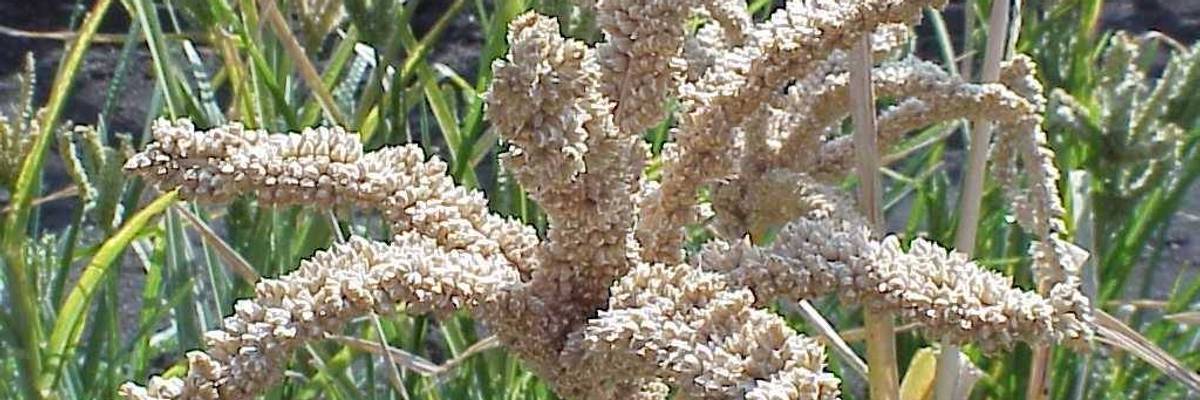
Finger millet grows in Ethiopia in 2002.
Who will control the seeds, science, and markets behind the new interest in Africa’s Indigenous crops?
Millet, sorghum, fonio, Bambara groundnut, cowpea, amaranth, pigeon pea, taro. For decades these crops were treated as the food of the past. Research money, extension, subsidies, and markets went to maize, wheat, and rice. Yet African farmers, most of them women, kept planting them, saving the seed, sharing it with neighbors, and cooking with them. They did it with very little help.
Now, suddenly, the same crops are fashionable. Climate change, poor diets, and tired soils have pushed them into conference halls and donor strategies. I welcome that. But I keep coming back to one question: Who gets to decide what happens to them next?
The question hit me again at a side event on African adapted crops during the Africa Food Systems Forum, hosted by the Africa Adaptation Crops Initiative, the Food Action Alliance, AGRA, TechnoServe, and Bain & Company. I went in encouraged. Before long, the discussion had slipped into a familiar script: raise productivity, formalize seed, mechanize, attract private investment, link farmers to big buyers. I am not against research, processing, or markets. My worry is what happens when crops that African communities developed and protected over generations are treated first as business opportunities. We could change the crop and leave the system exactly as it was.
Let the women who kept these crops alive sit where decisions are taken. And judge success by diets, biodiversity, soil health, incomes, and farmers’ control over seed, not only by tons and dollars.
The same worry applies to the Vision for Adapted Crops and Soils, known as VACS. It was launched by the US State Department with the African Union and Food and Agriculture Organization to promote diverse, nutritious, climate-adapted crops grown in healthy soils. On paper, it takes neglected crops seriously and brings soil back into the conversation. Both are long overdue. So the issue is not whether to invest, but what kind of investment, and controlled by whom.
Look at who was in the room when VACS was designed. Early research profiling possible “opportunity crops” was backed by the Rockefeller Foundation, and in December 2023 Washington announced $150 million in support for that year. African farmer organizations were not consulted while the program was being planned. Alliance for Food Sovereignty in Africa, whose members have campaigned for years to promote nutritious local crops, was never approached. When the journalist Alexander Zaitchik asked me about it, I had to tell him that nobody from VACS’ leadership or affiliate groups had ever reached out to us or our networks.
Who was at the table instead? Zaitchik’s reporting for Truthdig, from the World Food Prize’s Borlaug Dialogue in Des Moines, is revealing. Cargill, Bayer, Syngenta, and John Deere are listed as “VACS champions,” alongside the Rockefeller and Gates foundations. The World Food Prize Foundation, where VACS was showcased, is chaired by a former president of Corteva, the seed giant formed from the Dow and DuPont merger. Cary Fowler, the US special envoy who championed VACS, has told audiences that “the answers to the world’s food insecurity issues may lie in for-profit companies.” When the world’s biggest grain, seed, and agrochemical companies are champions of a program on Africa’s seeds, and African farmers are not even asked, we are entitled to ask whose programme it really is.
Zaitchik’s larger point is that VACS, for all its new language, carries the assumptions of the Green Revolution. The crops are different, but outside expertise is still placed above farmers’ knowledge, and yields above food sovereignty. It was telling that at a 2023 VACS event, then Secretary of State Antony Blinken held up Norman Borlaug as the precedent. The pattern is familiar: Experts define the problem, breeders supply the technology, financiers bring the money, companies build the markets, and farmers adopt and supply.
And opportunity for whom? For the woman who has kept Bambara groundnut varieties alive? For the farmer selling millet at the weekly market? For a public breeder at an African university? Or for a seed company, a food multinational, or investors looking for the next growth market? These interests are not the same.
This is why seed is the heart of the matter. CGIAR, VACS’ main research partner, reports breeding work on Bambara groundnut, finger millet, okra, sesame, taro, amaranth, and pigeon pea, guided by market intelligence and “Target Product Profiles.” VACS officials say CGIAR treats its seeds as public goods. But what outside actors do with those seeds, including patenting them, is up to them. With seed companies among the champions, the risk is plain: Crops that farmers bred over centuries could become more valuable just as farmers lose control of them. As I told Zaitchik, no project involved in advancing punitive seed patent regimes has the interest of African farmers at heart. Seed governance, farmers’ rights, and benefit sharing must be settled before breeding programs are designed, not after.
Farmers have been plant breeders for thousands of years, and diversity is Africa’s real strength: hundreds of cereals, legumes, vegetables, fruits, roots, and local varieties. Once donors and markets pick a short list of “opportunity crops,” money and breeding capacity crowd around them. My concern is everything left off the list. Diversity is not inefficiency. It is our insurance. A farm with millet, cowpea, vegetables, fruit trees,and a few animals may produce fewer tons of millet than a monoculture, but more nutrition, fodder, healthier soil, and a steadier income in a bad year. Judge only the millet yield and we will end up with higher-yielding Indigenous crops on simpler, more fragile farms.
Markets need the same care. A mother buying millet in a village market is demand. A school buying vegetables from nearby farms is demand. Public procurement by schools and hospitals could create reliable markets for these foods and keep money in local economies. Processors and exporters can take part, but policy should not be written backward from their specifications.
So what would I ask of AGRA, VACS, and the others? Start by talking to African farmer movements, and give them a real say in governing research agendas, not a consultation after the decisions are made. Put public money into farmer-managed seed systems and participatory breeding. Commit clearly that seeds developed from African crops will not end up under corporate patents. Let the women who kept these crops alive sit where decisions are taken. And judge success by diets, biodiversity, soil health, incomes, and farmers’ control over seed, not only by tons and dollars.
The world has discovered that crops African farmers refused to abandon may matter for everyone’s climate future. But they were never lost. They were being planted, selected, exchanged, cooked, and protected all along. The people who did that work must not now become raw-material suppliers for someone else’s revolution. Africa’s crops do not need rescuing from African farmers. They need investment that puts those farmers at the center of what comes next.
Dear Common Dreams reader, It’s been nearly 30 years since I co-founded Common Dreams with my late wife, Lina Newhouser. We had the radical notion that journalism should serve the public good, not corporate profits. It was clear to us from the outset what it would take to build such a project. No paid advertisements. No corporate sponsors. No millionaire publisher telling us what to think or do. Many people said we wouldn't last a year, but we proved those doubters wrong. Together with a tremendous team of journalists and dedicated staff, we built an independent media outlet free from the constraints of profits and corporate control. Our mission has always been simple: To inform. To inspire. To ignite change for the common good. Building Common Dreams was not easy. Our survival was never guaranteed. When you take on the most powerful forces—Wall Street greed, fossil fuel industry destruction, Big Tech lobbyists, and uber-rich oligarchs who have spent billions upon billions rigging the economy and democracy in their favor—the only bulwark you have is supporters who believe in your work. But here’s the urgent message from me today. It's never been this bad out there. And it's never been this hard to keep us going. At the very moment Common Dreams is most needed, the threats we face are intensifying. We need your support now more than ever. We don't accept corporate advertising and never will. We don't have a paywall because we don't think people should be blocked from critical news based on their ability to pay. Everything we do is funded by the donations of readers like you. When everyone does the little they can afford, we are strong. But if that support retreats or dries up, so do we. Will you donate now to make sure Common Dreams not only survives but thrives? —Craig Brown, Co-founder |
Millet, sorghum, fonio, Bambara groundnut, cowpea, amaranth, pigeon pea, taro. For decades these crops were treated as the food of the past. Research money, extension, subsidies, and markets went to maize, wheat, and rice. Yet African farmers, most of them women, kept planting them, saving the seed, sharing it with neighbors, and cooking with them. They did it with very little help.
Now, suddenly, the same crops are fashionable. Climate change, poor diets, and tired soils have pushed them into conference halls and donor strategies. I welcome that. But I keep coming back to one question: Who gets to decide what happens to them next?
The question hit me again at a side event on African adapted crops during the Africa Food Systems Forum, hosted by the Africa Adaptation Crops Initiative, the Food Action Alliance, AGRA, TechnoServe, and Bain & Company. I went in encouraged. Before long, the discussion had slipped into a familiar script: raise productivity, formalize seed, mechanize, attract private investment, link farmers to big buyers. I am not against research, processing, or markets. My worry is what happens when crops that African communities developed and protected over generations are treated first as business opportunities. We could change the crop and leave the system exactly as it was.
Let the women who kept these crops alive sit where decisions are taken. And judge success by diets, biodiversity, soil health, incomes, and farmers’ control over seed, not only by tons and dollars.
The same worry applies to the Vision for Adapted Crops and Soils, known as VACS. It was launched by the US State Department with the African Union and Food and Agriculture Organization to promote diverse, nutritious, climate-adapted crops grown in healthy soils. On paper, it takes neglected crops seriously and brings soil back into the conversation. Both are long overdue. So the issue is not whether to invest, but what kind of investment, and controlled by whom.
Look at who was in the room when VACS was designed. Early research profiling possible “opportunity crops” was backed by the Rockefeller Foundation, and in December 2023 Washington announced $150 million in support for that year. African farmer organizations were not consulted while the program was being planned. Alliance for Food Sovereignty in Africa, whose members have campaigned for years to promote nutritious local crops, was never approached. When the journalist Alexander Zaitchik asked me about it, I had to tell him that nobody from VACS’ leadership or affiliate groups had ever reached out to us or our networks.
Who was at the table instead? Zaitchik’s reporting for Truthdig, from the World Food Prize’s Borlaug Dialogue in Des Moines, is revealing. Cargill, Bayer, Syngenta, and John Deere are listed as “VACS champions,” alongside the Rockefeller and Gates foundations. The World Food Prize Foundation, where VACS was showcased, is chaired by a former president of Corteva, the seed giant formed from the Dow and DuPont merger. Cary Fowler, the US special envoy who championed VACS, has told audiences that “the answers to the world’s food insecurity issues may lie in for-profit companies.” When the world’s biggest grain, seed, and agrochemical companies are champions of a program on Africa’s seeds, and African farmers are not even asked, we are entitled to ask whose programme it really is.
Zaitchik’s larger point is that VACS, for all its new language, carries the assumptions of the Green Revolution. The crops are different, but outside expertise is still placed above farmers’ knowledge, and yields above food sovereignty. It was telling that at a 2023 VACS event, then Secretary of State Antony Blinken held up Norman Borlaug as the precedent. The pattern is familiar: Experts define the problem, breeders supply the technology, financiers bring the money, companies build the markets, and farmers adopt and supply.
And opportunity for whom? For the woman who has kept Bambara groundnut varieties alive? For the farmer selling millet at the weekly market? For a public breeder at an African university? Or for a seed company, a food multinational, or investors looking for the next growth market? These interests are not the same.
This is why seed is the heart of the matter. CGIAR, VACS’ main research partner, reports breeding work on Bambara groundnut, finger millet, okra, sesame, taro, amaranth, and pigeon pea, guided by market intelligence and “Target Product Profiles.” VACS officials say CGIAR treats its seeds as public goods. But what outside actors do with those seeds, including patenting them, is up to them. With seed companies among the champions, the risk is plain: Crops that farmers bred over centuries could become more valuable just as farmers lose control of them. As I told Zaitchik, no project involved in advancing punitive seed patent regimes has the interest of African farmers at heart. Seed governance, farmers’ rights, and benefit sharing must be settled before breeding programs are designed, not after.
Farmers have been plant breeders for thousands of years, and diversity is Africa’s real strength: hundreds of cereals, legumes, vegetables, fruits, roots, and local varieties. Once donors and markets pick a short list of “opportunity crops,” money and breeding capacity crowd around them. My concern is everything left off the list. Diversity is not inefficiency. It is our insurance. A farm with millet, cowpea, vegetables, fruit trees,and a few animals may produce fewer tons of millet than a monoculture, but more nutrition, fodder, healthier soil, and a steadier income in a bad year. Judge only the millet yield and we will end up with higher-yielding Indigenous crops on simpler, more fragile farms.
Markets need the same care. A mother buying millet in a village market is demand. A school buying vegetables from nearby farms is demand. Public procurement by schools and hospitals could create reliable markets for these foods and keep money in local economies. Processors and exporters can take part, but policy should not be written backward from their specifications.
So what would I ask of AGRA, VACS, and the others? Start by talking to African farmer movements, and give them a real say in governing research agendas, not a consultation after the decisions are made. Put public money into farmer-managed seed systems and participatory breeding. Commit clearly that seeds developed from African crops will not end up under corporate patents. Let the women who kept these crops alive sit where decisions are taken. And judge success by diets, biodiversity, soil health, incomes, and farmers’ control over seed, not only by tons and dollars.
The world has discovered that crops African farmers refused to abandon may matter for everyone’s climate future. But they were never lost. They were being planted, selected, exchanged, cooked, and protected all along. The people who did that work must not now become raw-material suppliers for someone else’s revolution. Africa’s crops do not need rescuing from African farmers. They need investment that puts those farmers at the center of what comes next.
Millet, sorghum, fonio, Bambara groundnut, cowpea, amaranth, pigeon pea, taro. For decades these crops were treated as the food of the past. Research money, extension, subsidies, and markets went to maize, wheat, and rice. Yet African farmers, most of them women, kept planting them, saving the seed, sharing it with neighbors, and cooking with them. They did it with very little help.
Now, suddenly, the same crops are fashionable. Climate change, poor diets, and tired soils have pushed them into conference halls and donor strategies. I welcome that. But I keep coming back to one question: Who gets to decide what happens to them next?
The question hit me again at a side event on African adapted crops during the Africa Food Systems Forum, hosted by the Africa Adaptation Crops Initiative, the Food Action Alliance, AGRA, TechnoServe, and Bain & Company. I went in encouraged. Before long, the discussion had slipped into a familiar script: raise productivity, formalize seed, mechanize, attract private investment, link farmers to big buyers. I am not against research, processing, or markets. My worry is what happens when crops that African communities developed and protected over generations are treated first as business opportunities. We could change the crop and leave the system exactly as it was.
Let the women who kept these crops alive sit where decisions are taken. And judge success by diets, biodiversity, soil health, incomes, and farmers’ control over seed, not only by tons and dollars.
The same worry applies to the Vision for Adapted Crops and Soils, known as VACS. It was launched by the US State Department with the African Union and Food and Agriculture Organization to promote diverse, nutritious, climate-adapted crops grown in healthy soils. On paper, it takes neglected crops seriously and brings soil back into the conversation. Both are long overdue. So the issue is not whether to invest, but what kind of investment, and controlled by whom.
Look at who was in the room when VACS was designed. Early research profiling possible “opportunity crops” was backed by the Rockefeller Foundation, and in December 2023 Washington announced $150 million in support for that year. African farmer organizations were not consulted while the program was being planned. Alliance for Food Sovereignty in Africa, whose members have campaigned for years to promote nutritious local crops, was never approached. When the journalist Alexander Zaitchik asked me about it, I had to tell him that nobody from VACS’ leadership or affiliate groups had ever reached out to us or our networks.
Who was at the table instead? Zaitchik’s reporting for Truthdig, from the World Food Prize’s Borlaug Dialogue in Des Moines, is revealing. Cargill, Bayer, Syngenta, and John Deere are listed as “VACS champions,” alongside the Rockefeller and Gates foundations. The World Food Prize Foundation, where VACS was showcased, is chaired by a former president of Corteva, the seed giant formed from the Dow and DuPont merger. Cary Fowler, the US special envoy who championed VACS, has told audiences that “the answers to the world’s food insecurity issues may lie in for-profit companies.” When the world’s biggest grain, seed, and agrochemical companies are champions of a program on Africa’s seeds, and African farmers are not even asked, we are entitled to ask whose programme it really is.
Zaitchik’s larger point is that VACS, for all its new language, carries the assumptions of the Green Revolution. The crops are different, but outside expertise is still placed above farmers’ knowledge, and yields above food sovereignty. It was telling that at a 2023 VACS event, then Secretary of State Antony Blinken held up Norman Borlaug as the precedent. The pattern is familiar: Experts define the problem, breeders supply the technology, financiers bring the money, companies build the markets, and farmers adopt and supply.
And opportunity for whom? For the woman who has kept Bambara groundnut varieties alive? For the farmer selling millet at the weekly market? For a public breeder at an African university? Or for a seed company, a food multinational, or investors looking for the next growth market? These interests are not the same.
This is why seed is the heart of the matter. CGIAR, VACS’ main research partner, reports breeding work on Bambara groundnut, finger millet, okra, sesame, taro, amaranth, and pigeon pea, guided by market intelligence and “Target Product Profiles.” VACS officials say CGIAR treats its seeds as public goods. But what outside actors do with those seeds, including patenting them, is up to them. With seed companies among the champions, the risk is plain: Crops that farmers bred over centuries could become more valuable just as farmers lose control of them. As I told Zaitchik, no project involved in advancing punitive seed patent regimes has the interest of African farmers at heart. Seed governance, farmers’ rights, and benefit sharing must be settled before breeding programs are designed, not after.
Farmers have been plant breeders for thousands of years, and diversity is Africa’s real strength: hundreds of cereals, legumes, vegetables, fruits, roots, and local varieties. Once donors and markets pick a short list of “opportunity crops,” money and breeding capacity crowd around them. My concern is everything left off the list. Diversity is not inefficiency. It is our insurance. A farm with millet, cowpea, vegetables, fruit trees,and a few animals may produce fewer tons of millet than a monoculture, but more nutrition, fodder, healthier soil, and a steadier income in a bad year. Judge only the millet yield and we will end up with higher-yielding Indigenous crops on simpler, more fragile farms.
Markets need the same care. A mother buying millet in a village market is demand. A school buying vegetables from nearby farms is demand. Public procurement by schools and hospitals could create reliable markets for these foods and keep money in local economies. Processors and exporters can take part, but policy should not be written backward from their specifications.
So what would I ask of AGRA, VACS, and the others? Start by talking to African farmer movements, and give them a real say in governing research agendas, not a consultation after the decisions are made. Put public money into farmer-managed seed systems and participatory breeding. Commit clearly that seeds developed from African crops will not end up under corporate patents. Let the women who kept these crops alive sit where decisions are taken. And judge success by diets, biodiversity, soil health, incomes, and farmers’ control over seed, not only by tons and dollars.
The world has discovered that crops African farmers refused to abandon may matter for everyone’s climate future. But they were never lost. They were being planted, selected, exchanged, cooked, and protected all along. The people who did that work must not now become raw-material suppliers for someone else’s revolution. Africa’s crops do not need rescuing from African farmers. They need investment that puts those farmers at the center of what comes next.