

SUBSCRIBE TO OUR FREE NEWSLETTER
Daily news & progressive opinion—funded by the people, not the corporations—delivered straight to your inbox.
5
#000000
#FFFFFF
To donate by check, phone, or other method, see our More Ways to Give page.
Daily news & progressive opinion—funded by the people, not the corporations—delivered straight to your inbox.
Carmel Pryor
On Wednesday afternoon, Millennial and Generation Z-led progressive organizations released an open letter to Vice President Joe Biden, expressing concern over his inability to earn the trust of the vast majority of voters under 45 years old and suggesting a number of policies and personnel commitments he could make to bridge the generational divide in the Democratic Party.
"With young people poised to play a critical role deciding the next President, you need to have more young people enthusiastically supporting and campaigning with you to defeat Trump," reads the letter signed by Alliance for Youth Action, Justice Democrats, March for Our Lives Action Fund, NextGen America, Student Action, Sunrise Movement, and United We Dream Action. "Exclusively anti-Trump messaging won't be enough to lead any candidate to victory. We need you to champion the bold ideas that have galvanized our generation and given us hope in the political process."
The coalition has requested several personnel commitments, including:
The coalition has also requested that Biden commit to policy proposals, such as:
"In order to win up and down the ballot in November, the Democratic Party needs the energy and enthusiasm of our generation," reads the letter.
In March, Representative James Clyburn said Biden "should incorporate as much of the efforts being proposed by Bernie Sanders as he can."
The letter advised Biden's campaign that a message around a "return to normalcy" does not energize millennials because their political views have been shaped from a "series of crises that took hold when we came of political age." Even before the coronavirus epidemic, the unemployment rate among recent college graduates in the U.S. was higher than our country's unemployment rate for the first time in over two decades and the median income among the bottom half of college graduates was about 10 percent lower than it was thirty years ago.
"The coronavirus pandemic has exposed not only the failure of Trump, but how decades of policymaking has failed to create a robust social safety net for the vast majority of Americans," reads the letter.
In response to those challenges, the youth-led organizations making up the coalition have powered a number of social movements that captured the hearts and minds of many voters in the Democratic Party: Occupy Wall Street, undocumented immigrant youth, a resurgent climate movement, Black Lives Matter, the Fight for $15, and others.
"The victorious 'Obama coalition' included millions of energized young people fighting for change," read the letter. "But the Democratic Party's last presidential nominee failed to mobilize our enthusiasm where it mattered. We can't afford to see those mistakes repeated."
As documented in extensive polling and a number of primary contests, Biden struggles to garner the support of voters under 45 years old, while Bernie Sanders' base is made primarily of voters under 45. On Super Tuesday, Biden won only 17 percent of voters under 45. Bernie Sanders won voters under 30 in Michigan and Missouri by 76 points and 57 points respectively, according to exit polls. Democratic voters under 45 tend to be more progressive than their older counterparts.
TEXT OF LETTER:
Dear Vice President Joe Biden,
We write to you as leaders from a diverse array of organizations building political power for young people in the United States. We are all deeply committed to ending a presidency that has set the clock back on all of the issues that impact our lives.
While you are now the presumptive Democratic nominee, it is clear that you were unable to win the votes of the vast majority of voters under 45 years old during the primary. With young people poised to play a critical role deciding the next President, you need to have more young people enthusiastically supporting and campaigning with you to defeat Trump. This division must be reconciled so we can unite the party to defeat Trump.
Messaging around a "return to normalcy" does not and has not earned the support and trust of voters from our generation. For so many young people, going back to the way things were "before Trump" isn't a motivating enough reason to cast a ballot in November. And now, the coronavirus pandemic has exposed not only the failure of Trump, but how decades of policymaking has failed to create a robust social safety net for the vast majority of Americans.
The views of younger Americans are the result of a series of crises that took hold when we came of political age, and flow from bad decisions made by those in power from both major parties. For millions of young people, our path to a safe and secure middle class life is far more out-of-reach than it was for our parents or grandparents. We grew up in a world where "doing better than the generation before us" was not a foregone conclusion.
Instead, we grew up with endless war, skyrocketing inequality, crushing student loan debt, mass deportations, police murders of black Americans and mass incarceration, schools which have become killing fields, and knowing that the political leaders of today are choking the planet we will live on long after they are gone. We've spent our whole lives witnessing our political leaders prioritize the voices of wealthy lobbyists and big corporations over our needs. From this hardship, we've powered a resurgence of social movements demanding fundamental change. Why would we want a return to normalcy? We need a vision for the future, not a return to the past.
New leadership in November is an imperative for everything our movements are fighting for. But in order to win up and down the ballot in November, the Democratic Party needs the energy and enthusiasm of our generation. The victorious "Obama coalition" included millions of energized young people fighting for change. But the Democratic Party's last presidential nominee failed to mobilize our enthusiasm where it mattered. We can't afford to see those mistakes repeated.
Young people are issues-first voters. Fewer identify with a political party than any other generation. Exclusively anti-Trump messaging won't be enough to lead any candidate to victory. We need you to champion the bold ideas that have galvanized our generation and given us hope in the political process. As the party's nominee, the following commitments are needed to earn the support of our generation and unite the party for a general election against Donald Trump:
Policy:
Personnel and Future Administration:
In addition to these policy and personnel commitments, you and your campaign must demonstrate a real passion and enthusiasm for engaging with our generation and its leaders. It's not just about the policies and issues, but also about how you prioritize them, how you talk about them, and how you demonstrate real passion for addressing them. You must demonstrate, authentically, that you empathize with our generation's struggles.
Calling for solutions that match the scale, scope, and urgency of the problems we are facing is not radical. If nothing else, this moment of crisis should show that it is the pragmatic thing to do. We want results and we're leading some of the movements that will help deliver them.
The organizations below will spend more than $100 million communicating with more than 10 million young members, supporters, and potential voters this election cycle. We are uniquely suited to help mobilize our communities, but we need help ensuring our efforts will be backed-up by a campaign that speaks to our generation. Our generation is the future of this country. If you aim to motivate, mobilize, and welcome us in, we will work tirelessly to align this nation with its highest ideals.
Signed,

"Banning under-16s risks treating children as the problem rather than addressing the companies and systems that create the risks in the first place."
It's not yet clear whether Australia's ban on social media for children under age 16 has had a positive impact on kids' mental health and safety, but British Prime Minister Keir Starmer said Monday that the country's law is being used as a model for the United Kingdom's own blanket ban—leading critics, including the parent of a child who died by suicide after viewing harmful content on social media, to question whether Starmer was simply opting for a "politically expedient" solution to the harms of online platforms.
Banning young teenagers and children from using social media, said advocacy groups, does nothing to ensure powerful tech companies will make their products safer by design for all users.
Starmer announced the ban online in a video in which he highlighted his support for the policy "as a parent as much as a prime minister," and noted that in public comments, "thousands of parents" said their children "are addicted to social media."
We are banning social media access for under 16s.
These days kids must find their feet in a world where technology intrudes into every area of their life.
I just can’t let that go on anymore. So we’re giving children their childhoods back. pic.twitter.com/jn7iQrcwk8
— Keir Starmer (@Keir_Starmer) June 15, 2026
"It can leave them trapped in a cycle of endless scrolling that displaces play, sleep, and time with the family," said the prime minister, who leads the Labour Party and is facing threats to his leadership following the party's major losses in May's elections. "It can harm their mental health, and frankly, parents need our support on this. That is why today the government has decided to ban social media access for children under 16."
Starmer said new age-related regulations for social media platforms including TikTok, Instagram, and Snapchat, as well as gaming and livestreaming platforms, will be introduced by the end of this year, with the new laws going into effect in early 2027. The government also said it was examining restrictions for users under 18, such as "overnight curfews" and mandated blocking of "infinite scrolling."
More details about the ban are expected to be released next month.
But Kerry Moscoguiri, chief executive of Amnesty International UK, said that removing children from platforms that broadcast harmful content is "a case of the right diagnosis but the wrong prescription."
“The UK government is right to recognize that many children face serious harms online," said Moscoguiri. "Too many social media companies have built products and business models that prioritize keeping children engaged for longer, often at the expense of their well-being, privacy, and rights."
“But the problem is not that children exist on social media; it’s that social media companies have built platforms that are unsafe by design," she added. "Banning under-16s risks treating children as the problem rather than addressing the companies and systems that create the risks in the first place."
The ban comes after mounting reports of Big Tech companies' efforts to keep all users, including young people, on their platforms for as long as possible using algorithms and "infinite scrolling." Numerous cases have linked children's suicides to their exposure to thousands of posts regarding self-harm and suicidal ideation, as well as to cyberbullying through social media. And reporting by Reuters last year revealed that Meta's artificial intelligence chatbots were permitted by the company to have sexually provocative conversations with minors.
Advocacy groups like Amnesty have called for restrictions on social media platforms' most addictive and manipulative features, such as infinite scrolling, autoplay, and hyper-personalized recommendations.
Moscoguiri warned that bans like the one imposed by Australia last year will force children "to surrender their privacy in order to participate in modern digital life." In Australia, companies are required to perform age verification by collecting data from bank accounts or scanning users' photo IDs.
Instead of a blanket ban, she said, "we need strong regulation that tackles surveillance-based business models, protects children’s data, and puts safety ahead of profit.”
“The responsibility for children’s safety should rest first and foremost with the companies that build and profit from these platforms," said Moscoguiri. "Government action should focus on ending invasive profiling of children, [and] tackling addictive and manipulative design features."
As children's safety groups in the UK were expecting Starmer's announcement in recent days, Ian Russell, chair of the Molly Rose Foundation and the father of a 14-year-old girl who died by suicide in 2017 after viewing content related to self-harm and suicide on social media, told the BBC that he was, "quite frankly, dismayed" that a blanket ban was likely coming to the UK.
"Keir Starmer promised to tighten up the online safety world by regulating better," said Russell, who has called for social media giants like Meta to remove and regulate content that's harmful to young users' mental health. "If he's playing politics, what he's doing is gambling with young people's lives, and I find that deplorable."
https://t.co/oqDAdFFI8p
Very strong words ahead of expected social media ban from @mollyroseorg -
Ian Russell tells us govt is rushing in a blanket ban, rather than more sophisticated controls, under political pressure, in a 'deplorable way' pic.twitter.com/AMxcleLixU
— Laura Kuenssberg (@bbclaurak) June 13, 2026
In Australia, which last year became the first country to impose a nationwide blanket ban on kids under 16 using social media, the law has had unclear benefits, with many young teens still managing to use the platforms—where Big Tech has not been forced to place controls that would make it safer for young users to be there.
Carole Cadwalladr, an investigative journalist, said that imposing a ban that includes age verification, as Australia's does, "looks like rushed populist techsolutionism that will hand more power to the platforms."
"This is going to hand even more surveillance powers to the very companies that already know way too much about us. Do you want [X executive chair] Elon [Musk] to have a copy of your biometrics? Do you want [Meta CEO Mark Zuckerberg] to scan your face? That’s what we will all be doing," Cadwalladr added. "This isn’t reining in Silicon Valley power. It’s gifting them even more power. Of course, parents want these companies safe and regulated but that’s a job for government, not the end user."
Sadiq Khan, the mayor of London, acknowledged that he has advocated for a ban on social media for children under 16 and called it "the right step to protect young people"—but said the UK government must impose restrictions on social media giants themselves, not just their most vulnerable users.
"Bans only treat the symptom, not the problem," said Khan. "Social media companies need to reimagine their platforms so they can offer a safe and healthy environment for all users, where restricting access wouldn’t be necessary."
"There’s nothing inevitable about algorithms which feed us a diet of dangerous content," he added. "Londoners deserve platforms which prioritize people, not just profit."
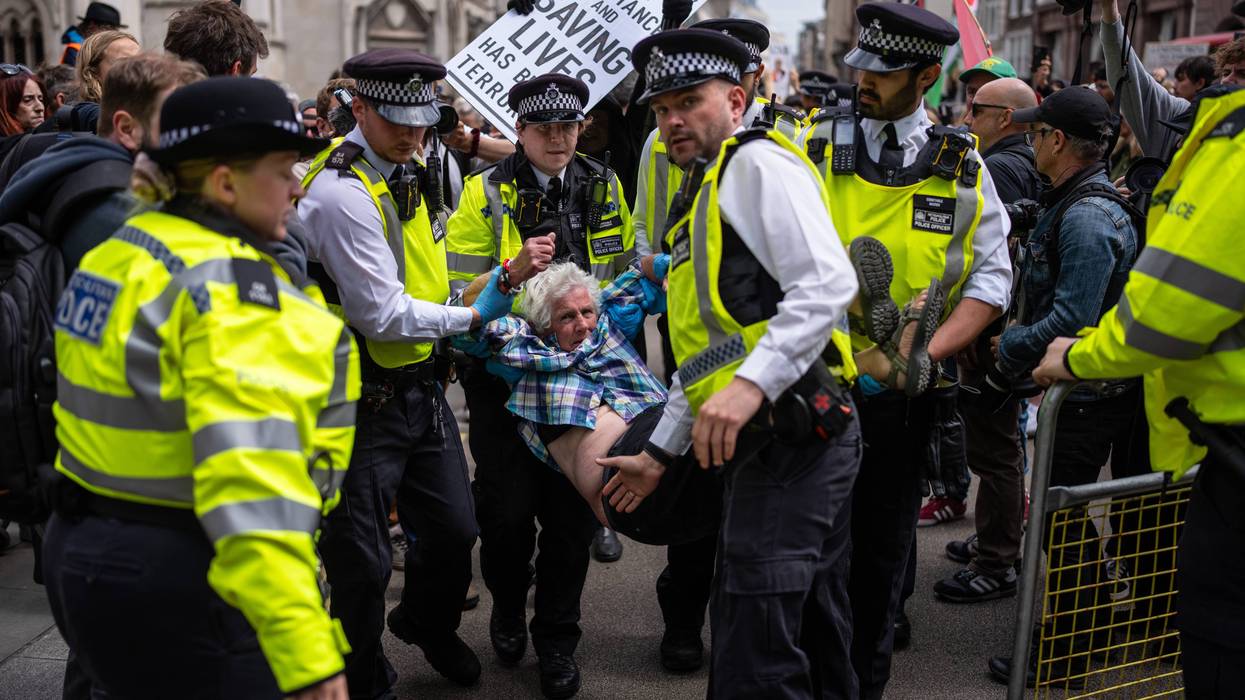
"Classifying protest through direct action as terrorism brings Parliament and our judicial system into disrepute," said one Labour MP.
A UK appeals court is being accused of flouting the law to allow the government to suppress free speech after it upheld a ban on the direct action group Palestine Action.
Just days after four young activists with the group were hit with unprecedented “terrorism” sentences over their 2024 vandalism of an Israeli-owned weapons facility that was being used to supply the genocidal assault on Gaza, the Court of Appeal in London on Monday upheld the Labour government’s proscription of Palestine Action under the Terrorism Act of 2000.
The ban was approved in Parliament in July 2025 and outlawed expressions of support for the group. According to Amnesty International, more than 3,300 people have been arrested across Britain since last July "simply for their engagement in acts of peaceful protest opposing the proscription"—including more than 2,000 who have been arrested simply for holding signs that read "I oppose genocide, I support Palestine Action.”
Outside the Royal Courts of Justice in London, where the decision was handed down, hundreds more Britons rallied in opposition.
“We acknowledge the Court of Appeal’s judgment that the home secretary’s decision to proscribe Palestine Action was lawful,” the Metropolitan Police said in a statement shortly after. “This means that expressing support for the organization remains a criminal offense, and officers will arrest those who break the law.”
“Officers are policing a protest outside the Royal Courts of Justice today where a number of people are displaying placards in support of Palestine Action," it continued. "Arrests are underway.”
Protesters were carried away, while onlookers shouted, “Shame” and “You’re complicit” at officers.
Arrests continue outside the Royal Courts of Justice after Court of Appeal find proscription of Palestine Action to be lawful.
We will continue to protest this Government’s embarrassing attempts to cover up its crimes with intimidation tactics.
Join us: https://t.co/XhFvPsZC3U pic.twitter.com/9okcFkVVtf
— Defend Our Juries (@DefendOurJuries) June 15, 2026
As The New York Times pointed out:
Palestine Action, which no longer exists in its original form, did not promote violence against individuals. But its members damaged sites linked to Elbit Systems, an Israeli weapons manufacturer, and last June broke into [Royal Air Force] Brize Norton, Britain’s largest air force base, in Oxfordshire, vandalizing two aircraft.
The activists who were given hefty sentences on Friday have argued that “innocent lives were saved” by their destruction of military equipment in the Elbit facility. Drones manufactured by the company have been documented in use during attacks on civilians, including the April 2024 strike on a World Central Kitchen convoy that killed seven aid workers.
But although members of the group have never been accused of any premeditated act of violence against other human beings, the British government’s terror designation puts it on the same level, legally speaking, as al-Qaeda, the Taliban, or the neo-Nazi Atomwaffen Division, and expressions of support can carry maximum sentences of 14 years in prison.
In February, the High Court sided with Palestine Action, ruling that the ban on support breached the rights to free expression and assembly under Articles 10 and 11 of the European Convention on Human Rights.
However, a five-judge appeals court panel overruled this decision on Monday, with Chief Justice Sue Carr writing that while the ban was “highly controversial,” and that the group “was supported by many otherwise law-abiding citizens,” it was a “fundamental mistake to overlook the fact that Palestine Action overtly promoted unlawful violence amounting to terrorism.”
Pointing to its sabotage of Elbit, she said the group's actions were “intended to close down lawful businesses” and said that "future threats and risks posed to third-party individuals and property by Palestine Action were perhaps the most important factors to weigh in the balance.”
Carr said that the ban would "not prevent public expressions of support for the Palestinian cause or opposition to Israel and to the Israel Defense Forces, or demonstrations targeted at Elbit."
But in the process, even she acknowledged that such a severe restriction on peaceful assembly in support of Palestine Action could indeed have a "chilling effect" on otherwise law-abiding citizens and cause them to be "deterred from assembling lawfully or making their strongly held anti-Israel and pro-Palestinian views public for fear of their actions being construed as support for Palestine Action."
Palestine Action co-founder Huda Ammori, who challenged the ban in court, said her group would "fight this all the way" and planned to appeal to the UK Supreme Court and potentially even the European Court of Human Rights.
"We will not stop fighting to overturn one of the most extreme attacks on free speech and the right to protest in modern British history," she said. "This unprecedented abuse of power has devastated the lives of thousands of people while silencing dissent over Israel’s slaughter of the Palestinian people during the genocide, when that dissent could not be more urgent.”
Today's ruling by the Court of Appeal is deeply disappointing.
This case remains about much more than one group.
What’s important for all of us to understand is that proscription is one of the strongest powers the government has.
Treating protest as terrorism leaves the… pic.twitter.com/WI3O05LYEn
— Amnesty UK (@AmnestyUK) June 15, 2026
The ruling was met with outrage from supporters of Palestinian rights and human rights groups.
Ammar Kazmi, the senior legal coordinator for the Derby-based Left Legal Fighting Fund, said that with this ruling, the judges allowed the political objective of criminalizing pro-Palestine speech to take precedence over the law.
"The judges allowed policy reasons to override strictly legal arguments, and they showed deference to ‘national security’ questions," he wrote on social media. "They also said that proscription is a ‘proportionate’ interference with free speech rights. In other words, they allowed the government to ride roughshod over the law."
Amnesty UK called the ruling "deeply disappointing," adding that the case "remains about much more than one group."
"What’s important for all of us to understand is that proscribing a group as a terrorist organization is one of the strongest powers the government has," the human rights group said. "The banning of Palestine Action as a terrorist organization is a grave misuse of counterterrorism powers with serious consequences for human rights."
Former Labour Party leader Jeremy Corbyn—whose successor, Prime Minister Keir Starmer—enacted the ban, said, "Today’s ruling to uphold the UK government's proscription of Palestine Action is a travesty of justice."
"One by one, the very foundations of our democracy are being destroyed—all to oil the wheels of British complicity in genocide," said Corbyn, who is leading an unofficial "tribunal" that presented evidence of UK participation in Israel's assault on Gaza to the International Criminal Court in March.
Noting the large number of pensioners who have been hauled off by police for holding protest signs opposing the ban—including dozens arrested on Friday for opposing the sentencing of those involved in the Elbit raid—Labour MP John McDonnell said, "Parliament should reverse the decision to proscribe Palestine Action urgently before we see large numbers of elderly people in particular being dragged before our courts."
He added that "classifying protest through direct action as terrorism brings Parliament and our judicial system into disrepute."
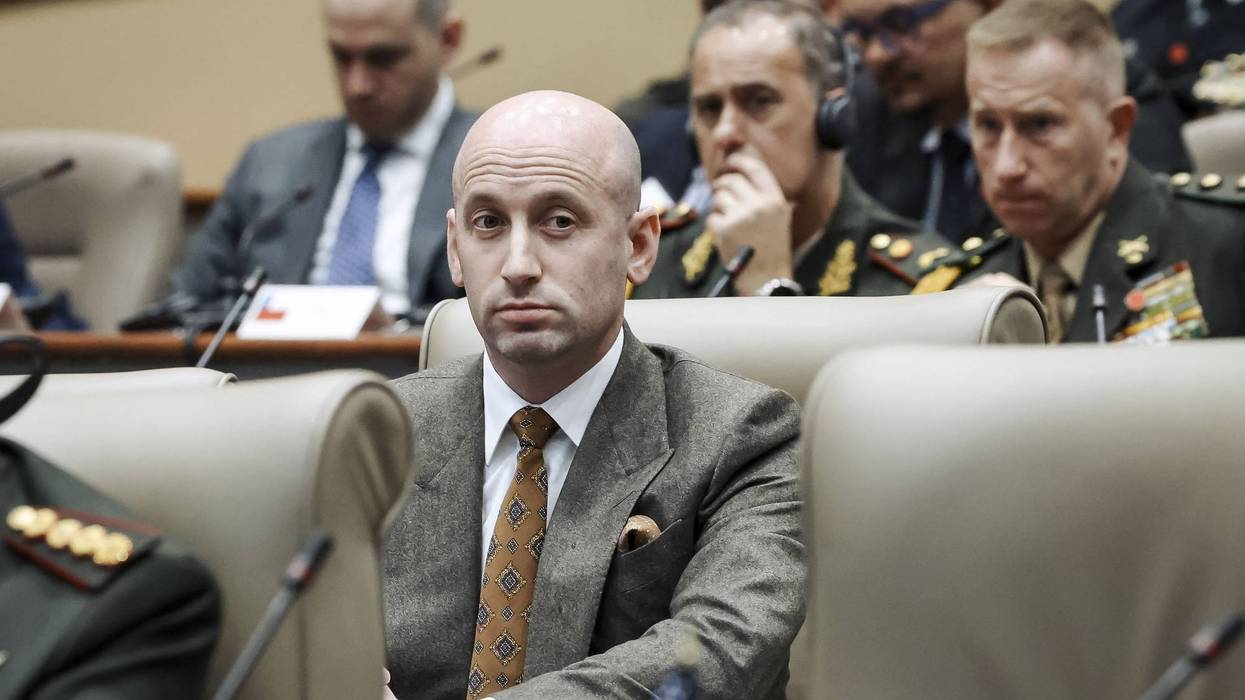
Reporting in The New York Times reveals Vance wanted to use the military "to crush the unrest in Minnesota."
A Monday report in The New York Times revealed what it described as the "alarm" felt by some White House lawyers at proposals made earlier this year by Vice President JD Vance and Trump adviser Stephen Miller as the administration was forced to contend with widespread anger over its anti-immigration agenda.
Among other things, the Times reported that Vance pushed for President Donald Trump to invoke the Insurrection Act, which would allow for the US military to be deployed on American streets, in an effort to shut down mass protests in Minnesota against federal immigration enforcement operations in the state.
A few days after US Immigration and Customs Enforcement (ICE) officers fatally shot demonstrator Alex Pretti in the streets of Minneapolis, the Times reported that Vance—who had also elevated a baseless claim by Miller that Pretti had been a "would-be assassin"—said invoking the Insurrection Act was necessary "to crush the unrest in Minnesota."
Vance also believed invoking the law would send a “message” that “paid agitators could not get away with disrupting ICE operations”—even though, as the Times noted, there is no evidence that Pretti; demonstrator Renee Good, who was also killed by federal agents; or any other organizers in Minnesota or elsewhere received any money in exchange for protesting.
However, right-wing attorney Will Scharf quickly shot down Vance's suggestion, noting that the Insurrection Act is an instrument aimed at putting down armed rebellions rather than groups of citizens blowing whistles at ICE officers.
Former White House Deputy Chief of Staff James Blair then made the political case against invoking the Insurrection Act.
"The scenes of federal agents in Minnesota already looked chaotic, he said, and the public was recoiling," reported the Times. "He put three questions to the room: What does the Insurrection Act give us that we don’t already have? What changes on the ground would be worth the heat? What else could they win that would justify the public relations cost?"
"The room was quiet," the Times added. "Nobody had a good answer."
The Times report also revealed that Trump adviser Stephen Miller, Trump's homeland security adviser and deputy chief of staff, repeatedly pushed the president to suspend the writ of habeas corpus for undocumented immigrants, which would give the administration the power to carry out mass deportations without being subjected to judicial oversight.
As in the case of Vance's proposal, Scharf pushed back against Miller's suggestion, noting that courts have long held that habeas corpus cannot be suspended unilaterally by the president and must be done by an act of Congress.
"Even where Congress has explicitly suspended habeas corpus rights," Scharf wrote in a legal memo obtained by the Times, "the Supreme Court has held that some alternative process must be provided to defendants, with procedural safeguards akin to a habeas corpus action."
Aaron Reichlin-Melnick, senior fellow at the American Immigration Council, said the Times' reporting showed Miller "would happily shred the Constitution into little pieces if he could," before hopefully noting that "even he wasn’t powerful enough to do it" in this instance.
University of Michigan Law School Professor Leah Litman argued that the Times report showed some in the administration were at least still somewhat conscious of public opinion when making decisions.
"In the story about the administration weighing suspending habeas corpus and invoking the Insurrection Act, what moved the needle against the Insurrection Act was concern about 'public relations,'" Litman wrote. "Public pushback, agitation, and outcry can work. Even now. Keep it up."