SUBSCRIBE TO OUR FREE NEWSLETTER
Daily news & progressive opinion—funded by the people, not the corporations—delivered straight to your inbox.
5
#000000
#FFFFFF
To donate by check, phone, or other method, see our More Ways to Give page.
Daily news & progressive opinion—funded by the people, not the corporations—delivered straight to your inbox.
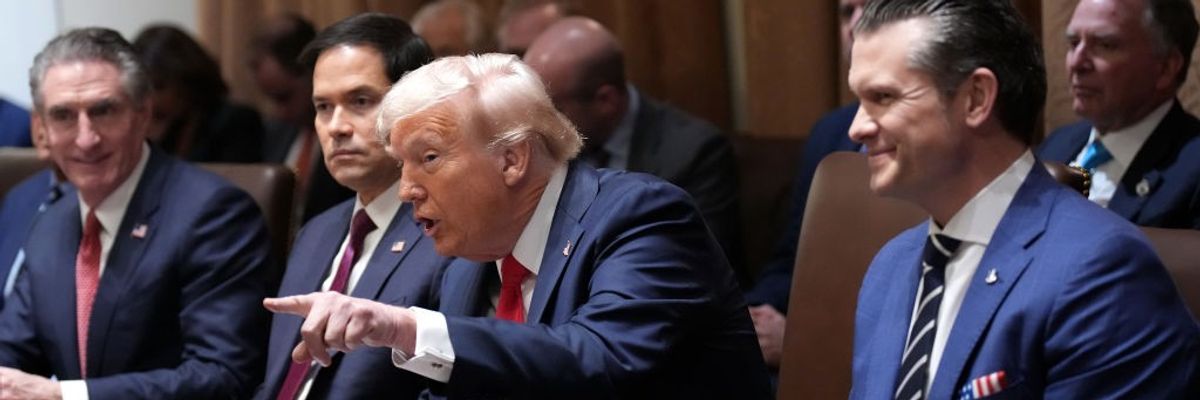
US President Donald Trump delivers remarks during a Cabinet meeting at the White House on February 26, 2025 in Washington, DC.
"As history shows, no nation can kill their way out of the drug problem," argued one critic.
US President Donald Trump has now repeatedly ordered the American military to use deadly force against boats in international waters that are allegedly engaged in drug smuggling, and many experts are raising red flags about both its legality and its effectiveness.
In an essay published by Just Security on Wednesday, Ret. Army Lt. Col. Daniel Maurer argued that Trump and Defense Secretary Pete Hegseth had issued "a patently illegal order" with the attacks on the alleged drug boats, and warned that the service members who carried it out could be exposed to "to a range of criminal punishments" under both federal criminal law and the Uniform Code of Military Justice.
However, Maurer said it was highly unlikely that the service members who followed Trump's orders would actually face consequences given the broad criminal immunity that the US Supreme Court granted presidents last year for carrying out official acts.
Regardless, Maurer concluded that Trump has "prejudiced good order and discipline within the armed forces" by "placing US service members in the position of having to contemplate whether they’d escape justice" by carrying out an illegal action.
John Yoo, an attorney who has long embraced a maximalist view of presidential powers and who has in the past authored legal memos justifying the torture of prisoners in American military custody, nonetheless also argued Trump's drug boat bombing goes too far.
Writing in The Washington Post on Tuesday, Yoo made the case that ordering the military to use deadly force against suspected drug traffickers risks blurring the line between military action and law enforcement in ways that could lead to an "amorphous military campaign against the illegal drug trade, which would violate American law and the Constitution."
Yoo said that the only way the Trump administration could possibly justify military action against cartels would be if it could prove that the cartels were carrying out acts of violence at the behest of a foreign government whose intention was to harm American citizens.
But he cautioned that the administration "has yet to provide compelling evidence in court or to Congress" that this is the case, and he said any action taken without such evidence would constitute "the misuse of the tools of war to fight the eternal social problem of crime."
Daniel DePetris, a fellow at the national security think tank Defense Priorities, argued in Time on Wednesday that Trump's drug boat bombings were not only "likely illegal and unconstitutional," but would prove to be tactically ineffective as well.
"As history shows, no nation can kill their way out of the drug problem," he argued. "Various governments have prefaced their entire anti-drug campaigns on military force before and have consistently failed. For example, the Mexican government declared war on the cartels in 2006 and tasked the military with prosecuting counter-drug operations, only to see those very same cartels get even more violent in their response."
DePetris said that Trump doesn't seem to grasp that as long as US citizens are willing to pay for illegal drugs, there will be criminal enterprises willing to go to extreme lengths to make money from them.
"As long demand is strong and the US remains the world’s top market, these criminal outfits will have billions of dollars’ worth of reasons to continue their operations, no matter the risk," he concluded.
In a Wednesday editorial criticizing Trump's bombing of suspected drug boats, The New York Times noted that the Trump administration has actually harmed efforts to reduce the demand for drugs in the US, despite considerable evidence that doing so is the surest way to hurt cartels.
"The White House has sought huge cuts to programs designed to bring down that demand, including widely praised addiction medicine and harm reduction efforts," the Times editors wrote. "And it is cutting Medicaid, which will leave many users without access to effective treatment programs. It is doing so even though these programs helped produce a 26% decline in overdose deaths in 2024 from the year before."
The Times editorial also linked Trump's use of the military to take out purported drug traffickers with his deployment of the National Guard in US cities under the pretense of combating crime.
"His attacks at sea fit a disturbing pattern of using the military to address law-enforcement problems," the editors wrote. "Just as he continues to send the National Guard into cities in a supposed effort to reduce street crime, he wants to achieve the illusion of dominance over drug smuggling, even if his actions make little difference and even if he kills people, guilty or innocent, in the process."
Dear Common Dreams reader, It’s been nearly 30 years since I co-founded Common Dreams with my late wife, Lina Newhouser. We had the radical notion that journalism should serve the public good, not corporate profits. It was clear to us from the outset what it would take to build such a project. No paid advertisements. No corporate sponsors. No millionaire publisher telling us what to think or do. Many people said we wouldn't last a year, but we proved those doubters wrong. Together with a tremendous team of journalists and dedicated staff, we built an independent media outlet free from the constraints of profits and corporate control. Our mission has always been simple: To inform. To inspire. To ignite change for the common good. Building Common Dreams was not easy. Our survival was never guaranteed. When you take on the most powerful forces—Wall Street greed, fossil fuel industry destruction, Big Tech lobbyists, and uber-rich oligarchs who have spent billions upon billions rigging the economy and democracy in their favor—the only bulwark you have is supporters who believe in your work. But here’s the urgent message from me today. It's never been this bad out there. And it's never been this hard to keep us going. At the very moment Common Dreams is most needed, the threats we face are intensifying. We need your support now more than ever. We don't accept corporate advertising and never will. We don't have a paywall because we don't think people should be blocked from critical news based on their ability to pay. Everything we do is funded by the donations of readers like you. When everyone does the little they can afford, we are strong. But if that support retreats or dries up, so do we. Will you donate now to make sure Common Dreams not only survives but thrives? —Craig Brown, Co-founder |
US President Donald Trump has now repeatedly ordered the American military to use deadly force against boats in international waters that are allegedly engaged in drug smuggling, and many experts are raising red flags about both its legality and its effectiveness.
In an essay published by Just Security on Wednesday, Ret. Army Lt. Col. Daniel Maurer argued that Trump and Defense Secretary Pete Hegseth had issued "a patently illegal order" with the attacks on the alleged drug boats, and warned that the service members who carried it out could be exposed to "to a range of criminal punishments" under both federal criminal law and the Uniform Code of Military Justice.
However, Maurer said it was highly unlikely that the service members who followed Trump's orders would actually face consequences given the broad criminal immunity that the US Supreme Court granted presidents last year for carrying out official acts.
Regardless, Maurer concluded that Trump has "prejudiced good order and discipline within the armed forces" by "placing US service members in the position of having to contemplate whether they’d escape justice" by carrying out an illegal action.
John Yoo, an attorney who has long embraced a maximalist view of presidential powers and who has in the past authored legal memos justifying the torture of prisoners in American military custody, nonetheless also argued Trump's drug boat bombing goes too far.
Writing in The Washington Post on Tuesday, Yoo made the case that ordering the military to use deadly force against suspected drug traffickers risks blurring the line between military action and law enforcement in ways that could lead to an "amorphous military campaign against the illegal drug trade, which would violate American law and the Constitution."
Yoo said that the only way the Trump administration could possibly justify military action against cartels would be if it could prove that the cartels were carrying out acts of violence at the behest of a foreign government whose intention was to harm American citizens.
But he cautioned that the administration "has yet to provide compelling evidence in court or to Congress" that this is the case, and he said any action taken without such evidence would constitute "the misuse of the tools of war to fight the eternal social problem of crime."
Daniel DePetris, a fellow at the national security think tank Defense Priorities, argued in Time on Wednesday that Trump's drug boat bombings were not only "likely illegal and unconstitutional," but would prove to be tactically ineffective as well.
"As history shows, no nation can kill their way out of the drug problem," he argued. "Various governments have prefaced their entire anti-drug campaigns on military force before and have consistently failed. For example, the Mexican government declared war on the cartels in 2006 and tasked the military with prosecuting counter-drug operations, only to see those very same cartels get even more violent in their response."
DePetris said that Trump doesn't seem to grasp that as long as US citizens are willing to pay for illegal drugs, there will be criminal enterprises willing to go to extreme lengths to make money from them.
"As long demand is strong and the US remains the world’s top market, these criminal outfits will have billions of dollars’ worth of reasons to continue their operations, no matter the risk," he concluded.
In a Wednesday editorial criticizing Trump's bombing of suspected drug boats, The New York Times noted that the Trump administration has actually harmed efforts to reduce the demand for drugs in the US, despite considerable evidence that doing so is the surest way to hurt cartels.
"The White House has sought huge cuts to programs designed to bring down that demand, including widely praised addiction medicine and harm reduction efforts," the Times editors wrote. "And it is cutting Medicaid, which will leave many users without access to effective treatment programs. It is doing so even though these programs helped produce a 26% decline in overdose deaths in 2024 from the year before."
The Times editorial also linked Trump's use of the military to take out purported drug traffickers with his deployment of the National Guard in US cities under the pretense of combating crime.
"His attacks at sea fit a disturbing pattern of using the military to address law-enforcement problems," the editors wrote. "Just as he continues to send the National Guard into cities in a supposed effort to reduce street crime, he wants to achieve the illusion of dominance over drug smuggling, even if his actions make little difference and even if he kills people, guilty or innocent, in the process."
US President Donald Trump has now repeatedly ordered the American military to use deadly force against boats in international waters that are allegedly engaged in drug smuggling, and many experts are raising red flags about both its legality and its effectiveness.
In an essay published by Just Security on Wednesday, Ret. Army Lt. Col. Daniel Maurer argued that Trump and Defense Secretary Pete Hegseth had issued "a patently illegal order" with the attacks on the alleged drug boats, and warned that the service members who carried it out could be exposed to "to a range of criminal punishments" under both federal criminal law and the Uniform Code of Military Justice.
However, Maurer said it was highly unlikely that the service members who followed Trump's orders would actually face consequences given the broad criminal immunity that the US Supreme Court granted presidents last year for carrying out official acts.
Regardless, Maurer concluded that Trump has "prejudiced good order and discipline within the armed forces" by "placing US service members in the position of having to contemplate whether they’d escape justice" by carrying out an illegal action.
John Yoo, an attorney who has long embraced a maximalist view of presidential powers and who has in the past authored legal memos justifying the torture of prisoners in American military custody, nonetheless also argued Trump's drug boat bombing goes too far.
Writing in The Washington Post on Tuesday, Yoo made the case that ordering the military to use deadly force against suspected drug traffickers risks blurring the line between military action and law enforcement in ways that could lead to an "amorphous military campaign against the illegal drug trade, which would violate American law and the Constitution."
Yoo said that the only way the Trump administration could possibly justify military action against cartels would be if it could prove that the cartels were carrying out acts of violence at the behest of a foreign government whose intention was to harm American citizens.
But he cautioned that the administration "has yet to provide compelling evidence in court or to Congress" that this is the case, and he said any action taken without such evidence would constitute "the misuse of the tools of war to fight the eternal social problem of crime."
Daniel DePetris, a fellow at the national security think tank Defense Priorities, argued in Time on Wednesday that Trump's drug boat bombings were not only "likely illegal and unconstitutional," but would prove to be tactically ineffective as well.
"As history shows, no nation can kill their way out of the drug problem," he argued. "Various governments have prefaced their entire anti-drug campaigns on military force before and have consistently failed. For example, the Mexican government declared war on the cartels in 2006 and tasked the military with prosecuting counter-drug operations, only to see those very same cartels get even more violent in their response."
DePetris said that Trump doesn't seem to grasp that as long as US citizens are willing to pay for illegal drugs, there will be criminal enterprises willing to go to extreme lengths to make money from them.
"As long demand is strong and the US remains the world’s top market, these criminal outfits will have billions of dollars’ worth of reasons to continue their operations, no matter the risk," he concluded.
In a Wednesday editorial criticizing Trump's bombing of suspected drug boats, The New York Times noted that the Trump administration has actually harmed efforts to reduce the demand for drugs in the US, despite considerable evidence that doing so is the surest way to hurt cartels.
"The White House has sought huge cuts to programs designed to bring down that demand, including widely praised addiction medicine and harm reduction efforts," the Times editors wrote. "And it is cutting Medicaid, which will leave many users without access to effective treatment programs. It is doing so even though these programs helped produce a 26% decline in overdose deaths in 2024 from the year before."
The Times editorial also linked Trump's use of the military to take out purported drug traffickers with his deployment of the National Guard in US cities under the pretense of combating crime.
"His attacks at sea fit a disturbing pattern of using the military to address law-enforcement problems," the editors wrote. "Just as he continues to send the National Guard into cities in a supposed effort to reduce street crime, he wants to achieve the illusion of dominance over drug smuggling, even if his actions make little difference and even if he kills people, guilty or innocent, in the process."