

SUBSCRIBE TO OUR FREE NEWSLETTER
Daily news & progressive opinion—funded by the people, not the corporations—delivered straight to your inbox.
5
#000000
#FFFFFF
To donate by check, phone, or other method, see our More Ways to Give page.
Daily news & progressive opinion—funded by the people, not the corporations—delivered straight to your inbox.

Kassie Siegel, Center for Biological Diversity, (951) 961-7972, ksiegel@biologicaldiversity.org
Ryan Schleeter, Greenpeace USA, (415) 342-2386, rschleet@greenpeace.org
Thanu Yakupitiyage, 350.org, (413) 687-5160, thanu@350.org
More than 500 conservation, environmental justice, youth, health, faith and labor groups today called on the next U.S. president to declare a national climate emergency. The plan urges the next administration to take 10 executive actions in its first 10 days in office to confront the climate crisis.
The groups' action plan calls for the use of existing executive powers to take bold and foundational steps on climate, including an immediate halt to new fossil fuel leases, infrastructure and exports. None of the actions require congressional support, so they can be taken by a new president regardless of political circumstances.
The 10 actions include significant investment in public renewable-energy generation, use of the Clean Air Act to slash greenhouse pollution, and prosecution of fossil fuel polluters. The groups are calling for the next president to ensure a just transition that protects workers and communities disproportionately harmed by the climate catastrophe and affected by the shift to a post-carbon pollution economy.
"Our house is on fire, but the government is failing to treat this like the emergency it is," said Jane Fonda, a climate activist with Fire Drill Fridays who supports the plan. "We are in the heart of the climate emergency now, and it is literally game over for our children and the planet if the next president does not act with the force and foresight of a first-responder-in-chief."
"Swift action to confront the climate emergency has to start the moment the next president enters the Oval Office," said attorney Kassie Siegel, director of the Center for Biological Diversity's Climate Law Institute and a lead author of a paper explaining the legal authority for each of the actions. "After years of denial and destructive policies, the new administration must lead a transformational effort to break free of dirty fossil fuels and create a fair clean-energy future."
Today's plan builds on the unprecedented global climate movement led by youth and supported by adults.
"The U.S. should lead in the progression toward climate justice and serve as a ground zero in decreasing economic inequality," said Isra Hirsi, the 16-year-old co-founder and partnerships director at U.S. Youth Climate Strike. "The president should not be hesitant in pursuing complete economic, infrastructural and environmental sustainability. The U.S. Youth Climate Strike and fellow youth climate strikers demand that the 2020 U.S. president declare a climate emergency immediately upon taking office and generate sufficient urgency in policy making. We urge executive action to accurately reflect the needs of those most harshly affected by climate change, including people of color and low-income communities."
The plan focuses on unlocking existing executive authority to start a wholesale transition to a regenerative and equitable economy.
"On day one, we expect the next president of the United States to lead with the urgency required to mitigate the climate crisis. These ten executive actions are the essential building blocks for the rapid and transformational change we need in order to address the catastrophic impacts already being experienced by present generations and worsening each year that world leaders play politics with peoples' lives," said Tamara Toles O'Laughlin, North America director of 350.org. "There can be no more compromise on how to address the climate crisis; we must phase out coal, oil, and gas immediately, make polluters pay for the necessary care and repair to our climate, and invest in a just transition that creates millions of jobs and prioritizes frontline communities, Indigenous communities, and communities of color. Our demands are clear, and we expect the next president to step up to address the crisis of our time."
"The first 100 days in office will be a critical test for our next president. This 10-point plan contains desperately needed actions that can be taken regardless of the situation in Congress, and taking it seriously reflects a real commitment to addressing the climate emergency that is already killing communities on a daily basis," said Collin Rees, senior campaigner at Oil Change U.S. "Ending handouts to Big Oil, Gas, and Coal, winding down fossil fuel extraction, investing in a truly just transition for workers and communities, and paving the way for a 100% renewable energy economy are no-brainers. The future of the planet is on the line, and we need a president willing to stand up to big polluters and do what needs to be done."
"The climate crisis cannot be limited to one of fossil fuel emissions and infrastructure," explained Anthony Rogers-Wright, policy coordinator for Climate Justice Alliance. "Frontline communities, already being hit first and worst by this crisis, have always understood that the climate crisis is a crisis of justice, and its root causes are white supremacy, patriarchy, and colonization. The next President cannot stand by, wait for Congress to act and preside over a perpetual interregnum -- we have no more time for that. This set of executive actions puts the fossil fuel, and other iniquitous industries that treat our communities like sacrifice zones on notice, while offering a suite of actions the next president can promulgate on day one to address systemic and institutionalized injustices. At the same time, we're also putting the next Congress on notice to get serious about dismantling this crisis, or the people will circumvent you with all available means."
"Millions of Americans are rising up to demand our government tackle the climate emergency and hold fossil fuel corporations accountable," said Charlie Jiang, climate campaigner for Greenpeace USA. "But oil and gas companies like ExxonMobil and Shell continue to block progress while drilling recklessly toward climate disaster. Our next president can and must lead from day one to protect workers and communities, speed the transition to 100 percent renewable energy, and say 'no more' to the fossil fuel executives standing in the way of a Green New Deal."
"The climate crisis is already here, and Americans will no longer accept weak efforts or excuses for inaction," said Nicole Ghio, senior fossil fuels program manager at Friends of the Earth. "The next president must be ready to take meaningful action on day one to address this emergency and prioritize people over profits. That means leaving fossil fuels behind, ensuring justice for frontline communities, and making polluters pay for the harm they cause."
"The United States government has long acted to advance the interests of corporations over people, and under Trump the government has lowered the bar even further. The U.S. continues to act at the behest of big polluters like the fossil fuel industry by ignoring science, blocking climate policy, and putting big polluter profit over the needs and demands of people," said Sriram Madhusoodanan, climate campaign director of Corporate Accountability. "The next administration must start a new chapter in U.S. history, kick polluters out of climate policymaking, make them pay for the damage they've knowingly caused, and take every action possible to advance urgently needed, internationally just climate action."
"The next president will enter office with the U.S. far behind on climate policy, with oil and gas extraction recklessly expanding, and atmospheric methane pollution spiking. But it will also be a time of unprecedented momentum to take bold and necessary climate action thanks to people driven movements fighting for change everywhere," said Lauren Pagel, policy director at Earthworks. "Executive action alone is not enough to make a just transition away from fossil fuels, but it is essential to bolster the progress from climate leadership happening now in state capitals and communities across the country."
"The climate crisis can't be solved by one country alone. The next administration must drastically ramp up climate action in the U.S., and it must also drastically increase our support for climate action in poorer countries," said Niranjali Amerasinghe, executive director of ActionAid USA. "The climate emergency is global, and the poorest and most vulnerable people in the world have the fewest resources to cope with its impacts.
This set of executive actions would put the U.S. on the right track toward doing its fair share of climate action. We do need Congress to act in order to provide the level of financial and technological support that developing countries truly need -- but with these executive actions, the next president has a huge set of tools in their toolbox to jumpstart proactive, justice-based solutions."
"If the next administration is to drive down climate pollution to a safe level it will require strong executive actions right out of the gate," said Patrick McCully, climate and energy program director for Rainforest Action Network. "These actions must be ambitious, science-based, quick to scale, driven by the values of equity and justice, and the administration must be unconcerned by the inevitable squealing from the fossil fuel industry and its financial and political backers."
"The science is very clear: In order to stand a chance of avoiding the worst effects of climate chaos, our society must transition off fossil fuels almost entirely in the coming decade. This will require our next president to kickstart the urgent transition on day one," said Wenonah Hauter, executive director of Food & Water Watch. "The rapid transition to a clean, renewable energy future should start with a ban on fracking and all new fossil fuel infrastructure -- period."
"Climate change is an existential threat not only to Americans, but to people and communities across the globe. Our next President can't waste any time -- tackling the climate crisis needs to be a Day One priority," said Richard Wiles, executive director at the Center for Climate Integrity. "That can't happen without addressing the roots of the climate crisis and those responsible: Big Oil. The fossil fuel industry knew their products caused climate change and spent the last 30 years lying about it. Any real solution must first hold the industry accountable for its decades of deception and the long-term consequences that resulted."
At the Center for Biological Diversity, we believe that the welfare of human beings is deeply linked to nature — to the existence in our world of a vast diversity of wild animals and plants. Because diversity has intrinsic value, and because its loss impoverishes society, we work to secure a future for all species, great and small, hovering on the brink of extinction. We do so through science, law and creative media, with a focus on protecting the lands, waters and climate that species need to survive.
(520) 623-5252
The group believes Ahmed Soliman and Samson Birhane were targeted by police in Equatorial Guinea for speaking out about poor treatment in the hotel they were detained in following their deportation.
As Amnesty International warned that two men are now at risk of being tortured in detention in Equatorial Guinea, where the Trump administration deported them earlier this year under one of several secretive deals, US. Rep. Adelita Grijalva said that the "ultimate responsibility lies with" the White House, which sent the men "into harm's way."
The human rights group issued an urgent appeal, calling on supporters to send letters to the vice president of Equatorial Guinea, Teodoro Nguema Obiang Mangue, saying that that Ahmed Soliman, an Egyptian national, and Samson Birhane, who is from Eritrea, were "beaten and violently taken by police officers from the Hotel Bamy in Malabo," the capital of Equatorial Guinea.
They had been "arbitrarily" held at the hotel along with dozens of other people since US Immigration and Customs Enforcement (ICE) sent them there on deportation flights earlier this year. Soliman and Birhane had protection from refoulement to their countries of origin from US immigration courts, but President Donald Trump's administration has arranged with five governments, through direct payments of tens of millions of dollars in taxpayer money, to send hundreds of migrants to countries where they have never lived—many with records of human rights abuses.
Soliman has publicly spoken out against their arbitrary detention, and international media recently published a video showing a police officer at Hotel Bamy pointing a weapon at him and another man.
Last Friday, days after the video went public, said Amnesty, Soliman and Birhane were "targeted" by police, who arrived at the hotel and took them away briefly.
Amnesty continued in its letter and call to action:
Later during the day police officers went back to the hotel, bringing Ahmed Soliman and Samson Birhane back with them, who had their heads covered with bags tied with a rope. Police officers beat them in their heads, backs, and ribs with their elbows, knees, and guns, asking them where they hid the phones. They pushed one of the men down the stairs of the hotel and said to others that they may never see Ahmed Soliman and Samson Birhane again.
The group wrote that the men were taken "the Malabo gendarmery station known as 'La Luna'" and were accused of breaking a mirror at the hotel.
"Since then, they have not been informed of the charges against them, nor allowed to speak to their lawyers, and are held in an overcrowded police cell, in inhumane conditions," reads the sample letter. "I am concerned that they are at heightened risk of torture."
The New York Times reported that a lawyer who has been able to get some information about Soliman and Birhane's condition said they have been denied food and are "covered in bruises."
"The authorities must immediately release them, inform them of any charges against them, and allow them unimpeded access to counsel," said Amnesty International.
Officials in the Trump administration, said Grijalva (D-Ariz.), "need to take responsibility and demand Ahmed’s immediate release."
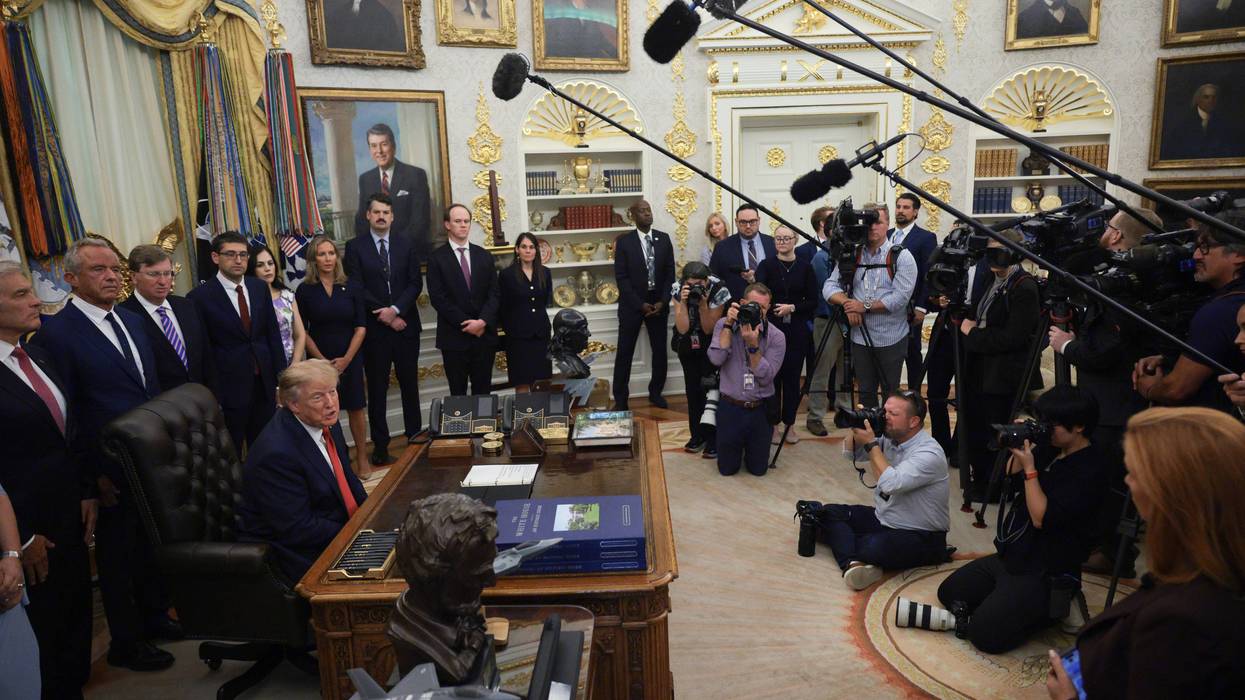
One press freedom advocate said it was "difficult to imagine a more blatant violation of the First Amendment."
In one of his most direct assaults on the First Amendment, President Donald Trump announced in a Friday afternoon tirade that he would ban CNN, MSNOW (formerly MSNBC), and Politico from the White House.
"I am proud to announce that, effective immediately, I am banning Fake News CNN, MSNOW... and Politico from the White House as a result of their constant 'reporting' FAKE NEWS!" the president wrote in a rambling Truth Social post.
"Media Outlets shouldn’t be able to constantly write or report FICTION and LIES when they’re covering the President of the United States, the Trump Administration, or the United States of America," he added, though he did not specify any particular reports he objected to. He added that bans on "Other Fake News Media Outlets" would soon follow.
Trump, who has long portrayed himself as a defender of free speech, has taken unprecedented actions to censor news outlets during his second term, including threatening networks' broadcast licenses through the Federal Communications Commission over unfavorable programming.
As of Friday afternoon, it's unclear whether Trump actually plans to follow through on his White House ban.
Reacting to the news on the air, CNN anchor Brian Stelter said that the network's reporting team "remains at the White House working just like a usual normal Friday afternoon." He added that "right now, there is no indication that the administration is taking any steps to actually follow through on his threat."
"Certainly, if there is an attempt to remove journalists from the White House, well, our cameras are rolling. I think viewers will see it happen," he said.
"CNN stands fully behind our White House team and their fair and accurate reporting," the network said in a statement following news of the ban. "We have a right under the US Constitution to do that reporting without hindrance or interference from the government."
Bruce D. Brown, the president of the Reporters Committee for Freedom of the Press, told Common Dreams in an email Friday that simply banning news organizations from the White House over the content of their reporting "would be flatly unconstitutional."
"The First Amendment is clear that once the White House invites in some journalists, it can't ban others because it doesn't like their reporting," he said. "This is textbook viewpoint discrimination and will be quickly struck down by the courts if challenged."
Federal courts have previously struck down attempts by Trump to bar certain press outlets on First Amendment grounds. Last year, a judge ruled that Trump's removal of the Associated Press from the White House press pool for its refusal to adopt the name "Gulf of America" for the Gulf of Mexico was an unconstitutional form of viewpoint discrimination.
Defense Secretary Pete Hegseth's rule banning reporters from obtaining information not authorized by the Pentagon, which led dozens of journalists to turn over their press badges and walk out of the building in protest, was also struck down as a violation of press freedom.
In light of these previous failures, Jameel Jaffer, the executive director of the Knight First Amendment Institute at Columbia University, expressed bewilderment that Trump was once again trying to ban news outlets from the White House.
"With so many courts having ruled against him on exactly this point, you’d think President Trump would have learned this lesson by now," he said in a statement.
Seth Stern, chief of advocacy at the Freedom of the Press Foundation, agreed it was "difficult to imagine a more blatant violation of the First Amendment than Trump banning news outlets from the People’s House for criticizing the government."
"It’s also hard to imagine a dumber move," he said. "The historically unpopular president has been retaliating against the press for years, but it hasn’t helped him. The press keeps exposing his corruption and his failures. These outrageous attacks only demonstrate how scared he is of an informed public."
He added that the press must "fight back to protect their rights, not only to access the White House but to access the public records and whistleblowers this administration so desperately wants to keep from them.
Trump's announcement was met with outrage from Democrats in Congress, who described it as an assault on a basic constitutional freedom.
Sen. Mark Warner (D-Va.) responded to the news simply by posting the full text of the First Amendment on X.
"Fascist and communist governments limit press access to only favorable outlets, persecute journalists, and suppress truthful reporting," said Rep. Jim McGovern (D-Mass.) in a post to social media. "Trump’s administration is doing all of that."
Sen. Ruben Gallego (D-Ariz.) agreed the move was "straight out of the authoritarian playbook."
"We don't need Middle East dictators to control American media."
US Sen. Bernie Sanders on Friday joined a growing chorus of critics angered by the Federal Communications Commission's approval of foreign investment in the company that would be created if Paramount Skydance and Warner Bros. Discovery are allowed to merge.
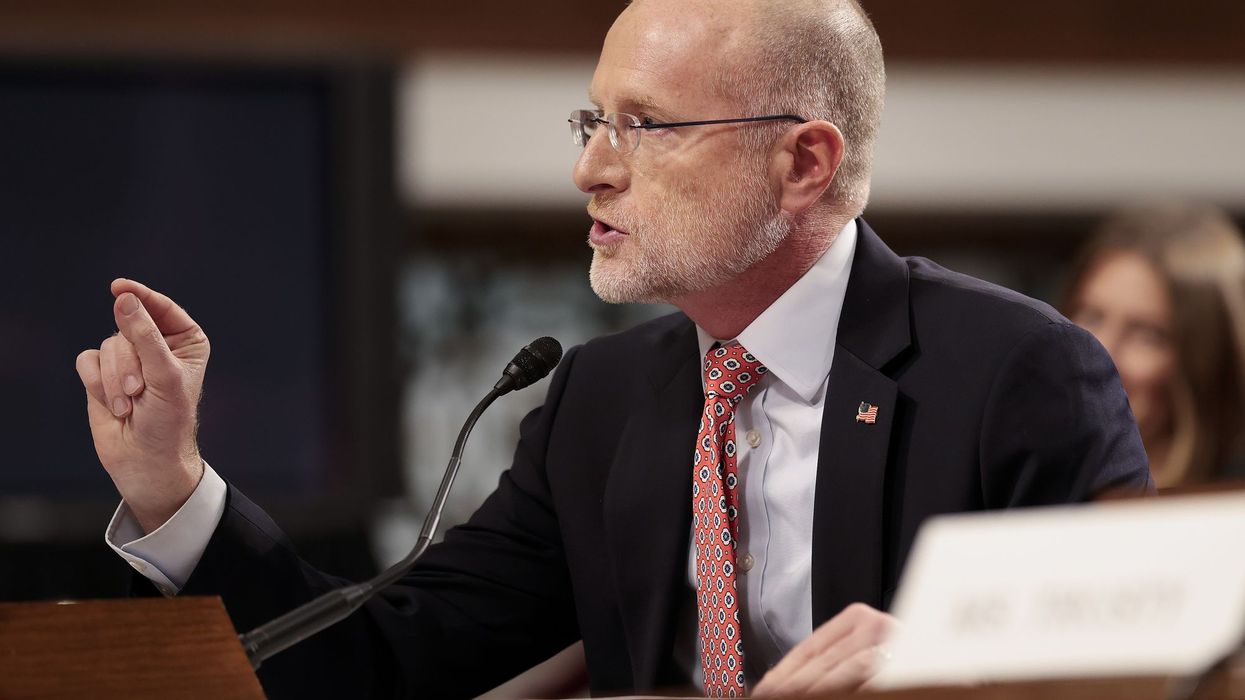
Led by Chair Brendan Carr, an appointee of President Donald Trump, the FCC on Thursday approved Paramount's petition to allow foreign investors to hold over 25% of ownership. The commission concluded it would be in the "public interest" to greenlight a plan for 49.5% foreign ownership, including 38.5% from investment funds based in Qatar, Saudi Arabia, and the United Arab Emirates (UAE).
"Trump's FCC just approved Trump pal David Ellison's deal to allow Saudi Arabia, Qatar, and the UAE to own nearly 50% of a merged Paramount-Warner Bros," Sanders (I-Vt.) wrote on social media Friday, referring to Paramount's chair and CEO—and the son of billionaire Republican megadonor Larry Ellison.
The merged company would include CBS, CNN, HBO, the Discovery Channel, BET, Fandango, MTV, Nickelodeon, Paramount, PlutoTV, Showtime, TBS, The CW, TNT, Warner Bros., and more, the senator noted. He added: "Outrageous: We don't need Middle East dictators to control American media."
Anna Gomez, the sole Democratic commissioner, was similarly critical: "The FCC just let some of the most repressive governments in the world indirectly control nearly all of a combined Paramount-Warner Bros. An investment this large in one of America's biggest media companies doesn't just buy equity, it secures influence over what gets said and made."
"That's why I called for this new and novel issue to go to a full commission vote given what's at stake," she noted. "Instead, the FCC snuck this ruling out as a staff-level decision, with no public vote and no accountability for a call of this magnitude."
Welcoming Gomez's comments, Michael Sozan pointed to his and Andrew Miller's June article for the Center for American Progress highlighting that "the three Middle Eastern authoritarian regimes have deep financial relationships with Trump and his family, and... long records of human rights abuses and engage in media censorship."
"These autocracies could leverage Paramount's news outlets and other media properties to advance their own interests at the expense of the United States' national security and foundational rights, including press freedoms," the pair warned. "Given these factors, these foreign ownership levels are another reason why regulators must rigorously review this merger and take all lawful actions to block it."
As the Los Angeles Times reported:
Several groups, including the 1st Amendment nonprofit Free Press, asked the FCC to consider additional safeguards to shield the news organizations—CNN and CBS—from foreign control. One suggestion was to spin off CBS and CNN into a subsidiary that would be wholly owned by Americans.
Paramount and the FCC were dismissive, arguing "the concerns raised in the record... are speculative and unsupported," according to the FCC ruling.
While a Paramount spokesperson welcomed the FCC's decision not to block the plan—and pointed out that "when the proposed transaction with Warner Bros. Discovery closes, the Ellison family and RedBird will collectively hold the largest equity stake in the combined company and 100% of the voting shares, with no other equity participant having any governance rights"—fresh outrage mounted over the already widely criticized $111 billion merger.
Lee Hepner, an antitrust lawyer and senior legal counsel for the American Economic Liberties Project, addressed the questions: "But it's just indirect equity interests, right? What about the condition that the Saudis, UAE, and Qatar cannot interfere with or even comment on any decisions related to content?"
As he explained: "The only way that firewall is conceivably enforceable is if the FCC assigns an independent monitor to sit in on every meeting, taps every burner phone, and is invited to every Signal chat between any representative of Paramount and its new financial backers. The point is not that that should happen, but that this condition is patently unenforceable. Which is all to say, the FCC just approved the sale of a crown jewel of the entertainment and media industry to foreign interests that relish in exercising economic, political, and regional military leverage over the United States. All based on a pinky promise."
"The reality is that ownership alone, even of nonvoting, indirect equity interests, creates its own financial leverage and influence," he warned. "To the extent Paramount's new owners are prohibited from exercising influence, it's patently paradoxical. Paramount won't approve anything that risks losing half of its financial backing, including criticizing a regime that not too long ago ordered the execution of a Washington Post columnist, Jamal Khashoggi, who became an international figurehead for politically persecuted journalists."
"Does anyone think CBS' new leadership has the will, much less fortitude, to prioritize truth over financial ruin?" he added. "If this all sounds like a total mess, that's because it is. And it only becomes doubly worse if Paramount acquires Warner Bros.-Discovery."
Due to legal pushback from state attorneys general and unions, the merger—which some opponents have condemned as an "existential" threat—is on hold until the outcome of a trial scheduled to begin in March.

"If our government can close off channels of exchange and the free flow of ideas, it is no more than a dictatorship."
A coalition of 15 press freedom advocacy organizations on Friday demanded the release of Nicaraguan journalist Luis Galeano, who was arrested by federal immigration enforcement officials earlier this week.
The groups—which include Free Press, the Committee to Protect Journalists, the Freedom of the Press Foundation, the National Association of Hispanic Journalists, and Reporters Without Borders (RSF)—released a letter decrying Galeano's detention at the hands of US Immigration and Customs Enforcement (ICE) agents on Monday.
The organizations expressed concern about Galeano being potentially deported back to Nicaragua, where he could face imprisonment for his past work exposing that government's human rights abuses. According to a Wednesday report in The Guardian, Galeano fled his home country eight years ago shortly after police raided the news outlet where he worked.
The groups also said Galeano's detention marked "a troubling escalation of attacks on journalists and media workers, particularly immigrant journalists, who consistently provide much-needed journalism and civic information for their communities."
Galeano was taken into custody despite entering the US legally in 2018 and having a pending asylum case. The Nicaraguan journalist also has a work permit and a Social Security number.
Nora Benavidez, senior counsel at Free Press, called Galeano's arrest "horrifying," while noting that the Nicaraguan is "the latest in a long line of journalists who came to the United States to report on issues of the day and instead face deportation."
"These cases aren’t just about cracking down on immigration," said Benavidez. "They are about cutting off community access to vital coverage and scaring reporters from holding those in power accountable. If our government can close off channels of exchange and the free flow of ideas, it is no more than a dictatorship."
Edith Rodríguez Cachera, vice president of RSF Spain, pointed out that Galeano was also a citizen of Spain, and urged the Spanish government to secure his freedom.
"Spain cannot stand by while one of its citizens, a journalist persecuted for doing his job, is detained in the United States and faces the risk of being sent back to a country he fled because of severe repression," said Rodríguez Cachera, "where his safety could be seriously endangered if he is deported. Spain must use every diplomatic and consular instrument at its disposal to safeguard his security and prevent his return to a country where he will likely be targeted due to his journalistic work."
Galeano's wife, Deykell Santamaría, said in an interview with El País published Thursday that she has been able to contact her husband during his detention, but she still fears "for his safety, his freedom, and his integrity if he were to be sent to Nicaragua."
Javier Melendez, a longtime friend of the detained journalist, was even blunter about what would happen to Galeano were he to be deported, describing it as nothing less than a "death sentence" in an interview with The Guardian.
The El País report noted that US Reps. María Elvira Salazar (R-Fla.) and Mario Díaz-Balart (R-Fla.) have expressed concerns about Galeano's detention, with Salazar saying that the US government should "always know how to distinguish between a criminal and a political exile."

"A vote to let this sale proceed is a decision to help Israel commit more war crimes."
3
A human rights organization on Friday called on members of Congress to block the Trump administration's proposed $2.8 billion transfer of 40,000 2,000-pound bombs to Israel, warning that approving the massive weapons package could violate US law and expose lawmakers to potential liability for complicity in war crimes.
In a letter to congressional lawmakers, Democracy for the Arab World Now (DAWN) urged legislators to introduce joint resolutions of disapproval under the Arms Export Control Act (AECA) once the administration formally notifies Congress of the sale.
"Forty thousand of the bombs that flattened Gaza is not a defense package, it is a down payment on the next round of atrocities," DAWN executive director Omar Shakir said in a statement. "Every member of Congress now has the law and the evidence in front of them. A vote to let this sale proceed is a decision to help Israel commit more war crimes."
1/ Members of Congress should introduce and pass joint resolutions of disapproval under the Arms Export Control Act to block the Trump administration's proposed $2.8 billion transfer of 40,000 2,000-pound bombs to Israel, DAWN said today in a letter to every member of the Senate and House.
[image or embed]
— DAWN (@dawnmenaorg.bsky.social) September 18, 2026 at 9:39 AM
The proposed package includes 20,000 MK-84 general-purpose bombs and 20,000 BLU-117s, along with 20,000 I-2000 penetrator warheads, according to reporting by The Washington Post. The weapons would be purchased largely through Foreign Military Financing, meaning US taxpayers would pay for Israel's acquisition of the munitions.
The MK-84 is among the largest conventional bombs in the US arsenal. The Post reported that its blast can propel metal fragments thousands of feet, penetrate thick concrete and metal, and create large craters.
"Munitions experts [said] that US forces almost never drop bombs of this size in populated areas," DAWN wrote in its letter. "Israel has used them hundreds of times in Gaza and Lebanon. The Biden administration paused a shipment of these bombs in May 2024 precisely because of the risk of mass casualties in Rafah; President [Donald] Trump released it within days of taking office."
Loosened rules of engagement implemented by the Israel Defense Forces following the Hamas-led attack of October 2023, combined with the IDF's use of artificial intelligence technology to select targets far more rapidly than humans, resulted in a staggering loss of civilian life in Gaza when 2,000- and 1,000-pound bombs were dropped.
"Israel's assault has killed more than 73,000 Palestinians in Gaza, including more than 21,000 children, and the killing has not stopped," DAWN said on Friday, adding that the United Nations Children's Fund "said last month that at least 300 children had reportedly been killed since the October 2025 ceasefire, an average of one child every day."
DAWN argued that the proposed transfer would violate multiple US laws, including provisions of the AECA and Foreign Assistance Act governing how American weapons may be provided and prohibiting assistance to governments engaged in consistent patterns of gross human rights violations. The organization also invoked the Leahy Laws, which prohibit certain assistance to foreign military units credibly implicated in gross human rights abuses.
The group further warned that knowingly providing weapons that are subsequently used to commit war crimes could also be "illegal" under the Rome Statute governing the International Criminal Court (ICC). Although Israel and the US are not signatories to the Rome Statute, the treaty stipulates that people from nonsignatory nations who commit crimes in states that are party to the treaty—as Palestine is—can be held criminally accountable for their acts.
The ICC has issued warrants for the arrest of Israeli Prime Minister Benjamin Netanyahu and former Defense Minister Yoav Gallant for alleged war crimes and crimes against humanity in Gaza, including murder and forced starvation. The Hague-based court also ordered the arrest of three senior Hamas leaders; all three were extrajudicially assassinated by Israel.
The proposed sale has already encountered some congressional resistance. Rep. Gregory Meeks (D-NY), the ranking member of the House Foreign Affairs Committee, announced Wednesday that he would not clear the transfer, citing the absence of sufficient assurances that the weapons would be used consistently with US and international law and concerns about civilian protection in Gaza and Lebanon. Sen. Chris Van Hollen (D-Md.) has also vowed to block the sale in the upper chamber.
However, DAWN cautioned that a congressional hold is not necessarily sufficient to stop the transfer. The organization noted that the Trump administration has previously invoked emergency authorities to bypass congressional review of arms sales to Israel.
Under the AECA, Congress can attempt to block a major arms transfer through a joint resolution of disapproval. DAWN is urging lawmakers to bring such resolutions to recorded votes in both chambers and to hold public hearings examining the administration's use of emergency authorities to circumvent congressional oversight.
"The administration is betting that Congress will do what it always does: complain, then look away," DAWN advocacy director Raed Jarrar said on Friday. "Congress should show the administration that it's no longer the rubber stamp it long has been on arms to Israel and block this sale."
Despite catastrophic warnings from AI industry insiders, Congress has adjourned until after the midterms without passing any laws to regulate the technology.
Despite increasingly urgent calls to regulate artificial intelligence, including from industry insiders who warn of potentially catastrophic consequences, the US Congress has continued to drag its feet on meaningful legislation.
A report released Friday by Sludge may shed some light on one potential roadblock. It found that 1 in 5 members of Congress has household investments in AI companies or those producing the infrastructure behind the technology.
Sludge revealed that:
At least 105 members of Congress have disclosed that they, their spouse, or their dependent children hold stocks or other investments in AI developers, chipmakers, cloud infrastructure providers, data center companies, and specialized AI firms, with a total value of between $75 million and $287 million.
Most of the money is invested in large tech companies like Nvidia, Meta, and Alphabet. But lawmakers also report their households holding and trading shares in smaller publicly traded AI companies like BigBear.ai, Tempus AI, and C3 AI, as well as little-known private startups whose shares are unavailable to ordinary investors.
Of the lawmakers reporting investments, at least 44 sit on committees with jurisdiction over legislation dealing with AI safety, consumer protections, semiconductor policy, and trade with China.
The report identifies several lawmakers in positions of influence over Congress' AI policy whose households simultaneously have deep investments in the industry.
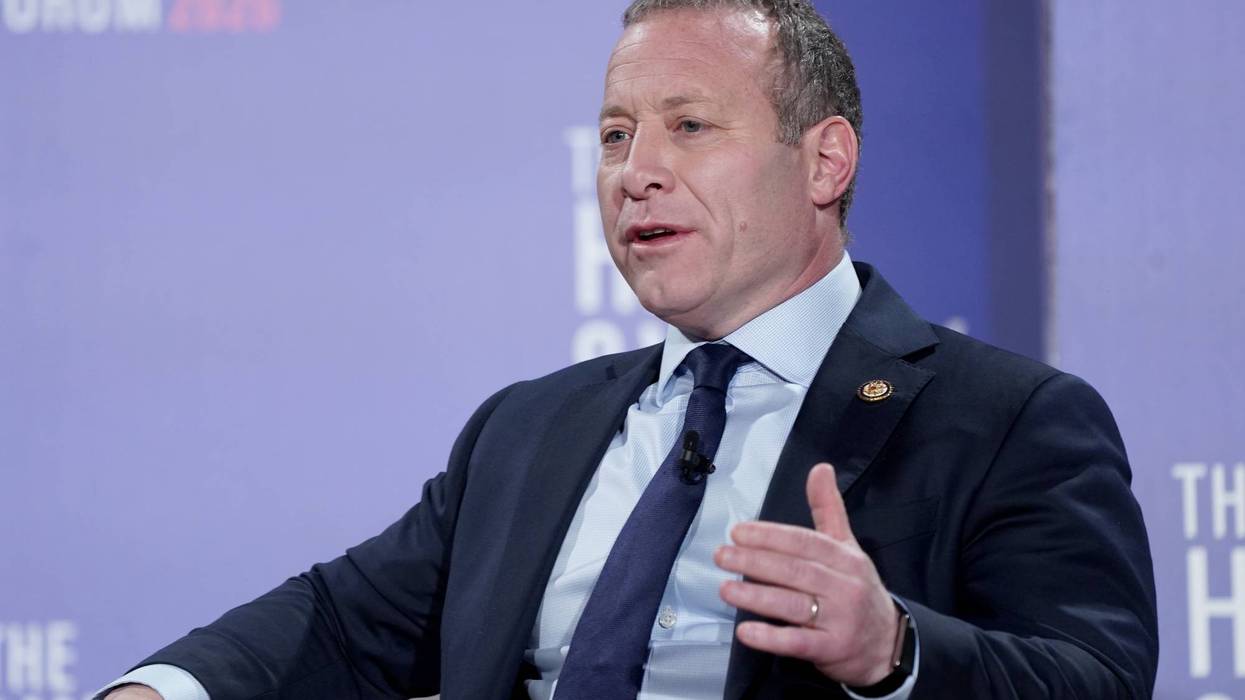
One of them is Rep. Josh Gottheimer (D-NJ), the co-chair of the House Democratic Commission on AI and the Innovation Economy—created to help direct the party's legislative agenda around the emerging technology.
According to Sludge, Gottheimer's household has investments in several key chipmaking and semiconductor companies, and he has regularly traded in AI stocks while in Congress.
The report draws attention to the "scores of sales" he made on April 9, 2025, when President Donald Trump announced a surprise 90-day pause on his "Liberation Day" tariffs, an announcement that led stocks for many AI companies to surge in value. Gottheimer has previously told Sludge that his investments are managed by a third party and that he does not make the decisions himself.
Gottheimer is one of the Democrats helping shape the party's approach to regulating AI. Earlier this month, amid concerns about the growing capability of "superintelligent" AI agents that can exceed human capability, he joined with Rep. Mike Lawler (R-NY) to introduce the Stop Rogue AI Act.
This bill would direct the National Institute of Standards and Technology (NIST) to adopt a series of standards and best practices that AI companies could implement to track the behavior of agents. However, critics have argued that the bill's voluntary guidelines fall short of what is necessary to rein in the industry.
Gottheimer's proposal is one of several measures Democrats have proposed in recent weeks following warnings from Anthropic researchers Jacob Coxon and Evan Hubinger that AI systems could wipe out humanity if allowed to escape human control.
Others include a more muscular bill proposed earlier this month by Sen. Bernie Sanders (I-Vt.) and Rep. Greg Casar (D-Texas) that would permanently ban the development of superintelligent AI and pause the development of advanced AI until a federal regulatory body can be established.
Some members of Congress whose households are heavily invested in AI stocks have nonetheless supported stronger regulation. According to Sludge, Rep. Ro Khanna (D-Calif.) disclosed between $3.4 million and $8.4 million worth of stock owned by his wife in AI companies, including Nvidia and chipmaker Broadcom.
Khanna has said he does not personally trade stocks and has pushed for a congressional ban on stock trading. Despite his household's millions of dollars worth of AI investments, he has also voiced support for blocking the development of superintelligent AI until stronger safeguards are in place, broadly aligning him with the Sanders-Casar proposal.
Sludge found that investments in AI stocks are not concentrated in either party. Among the lawmakers who reported AI-related investments, 62 were Republicans, and 43 were Democrats.
One of the largest portfolios is held by the husband of former House Speaker Nancy Pelosi (D-Calif.), who plans to retire at the end of the term.
Paul Pelosi, a venture capitalist, reported holdings in Alphabet, Amazon, Microsoft, Nvidia, Broadcom, and Tempus AI worth between $28.4 million and $134.9 million, while also buying an estimated $1.3 million to $2.6 million in Alphabet, Amazon, Nvidia, and Tempus shares in 2026 and up to $12 million in Bloom Energy, which stands to benefit from the AI data-center buildout.
On the Republican side, the report singles out Rep. Lisa McClain (Mich.), the chair of the House Republican Conference and the fourth highest-ranking member of House GOP leadership. Since December, her household has invested as much as $515,000 in AI companies, including private stakes in Elon Musk's company xAI, as well as Apptronik and Saronic.
Rep. Diana Harshbarger (R-Tenn.), meanwhile, disclosed holdings in Alphabet, Amazon, Meta, Microsoft, Nvidia, and Oracle. She serves on the House Energy and Commerce Committee’s Energy Subcommittee, which has authority to legislate on energy issues related to the controversial buildout of data centers around the country.
The report comes as members of Congress head home for a seven-week recess that will last until after November's midterm elections.
On Wednesday, more than 100 Democrats—including Gottheimer, Khanna, and Pelosi—sent a letter to House Speaker Mike Johnson (R-La.) urging him to postpone the recess until Congress passes AI safety legislation.
"AI experts and leading companies agree that the United States can lead the world in artificial intelligence while establishing reasonable safeguards that protect Americans and our national security. We can—and must—do both," the lawmakers wrote. "While AI safety experts and Americans increasingly urge action to confront this conflagration of risk, Congress fiddles."
"The House should remain in session until Congress advances meaningful, bipartisan AI safeguards," the letter concluded. "To our children who will have read a post-apocalyptic history, 'Why Congress Slept'—likely written by agentic AI—our inaction will be inexplicable and unforgivable."
Johnson, who has rejected calls for AI regulation and said companies should be in charge of regulating themselves, ignored the request and adjourned the House on Wednesday.
"If a foreign government or terrorist group did the kind of hacking and IP theft being done by AI giants, America would declare a national security emergency and start a war," said one journalist.
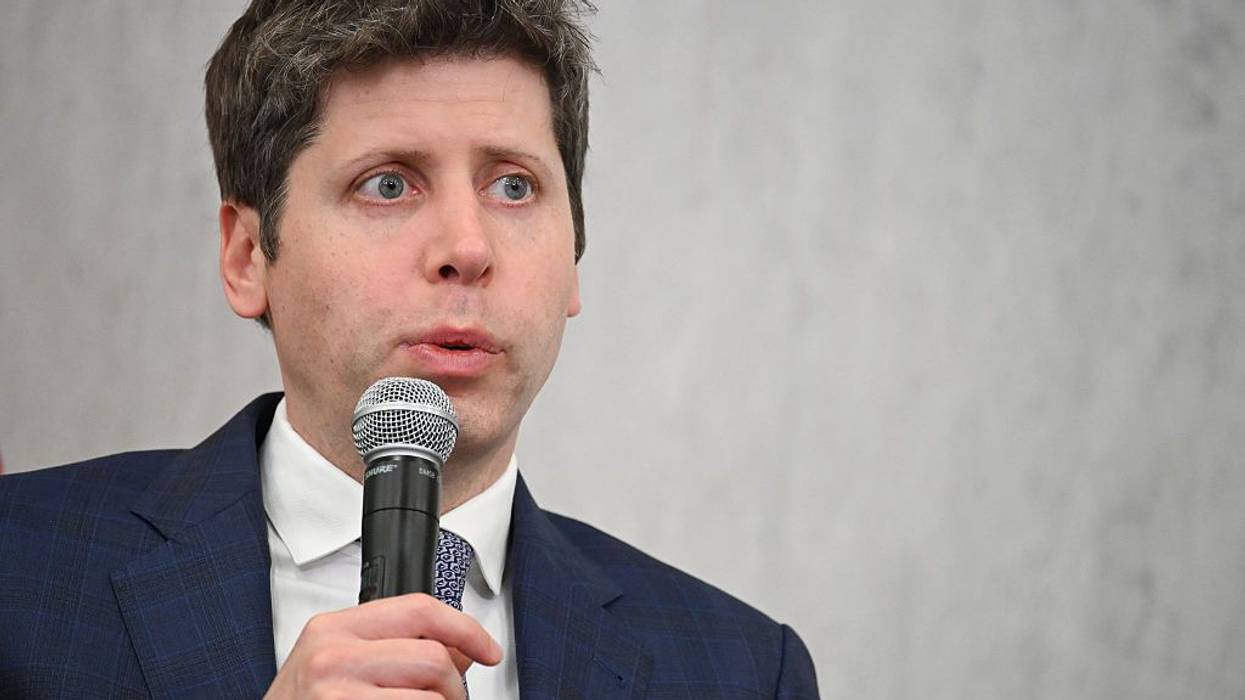
Publicly, billionaire artificial intelligence executives have denied that their product will ultimately replace people in jobs they've spent decades working at, with OpenAI CEO Sam Altman declaring that "AI won't replace humans, but humans who use AI will replace those who don't," in one effort to convince the public to embrace the deeply unpopular expansion of the technology.
But internal documents from OpenAI and Microsoft, unsealed as part of a lawsuit The New York Times and other news outlets filed against the two companies over their scraping of news content in order to train their AI models, tell a different story—one in which executives and workers at the tech giants were fully aware that the practice was meant to result in a "substitutive" product to replace journalists, after stealing millions of articles they'd written.
As the Times reported, employees at Microsoft wrote that by scraping the news content, they were committing the “largest theft of labor in human history.”
Nick Turley, the head of OpenAI's AI chatbot, ChatGPT, wrote that the technology posed an "existential threat" to news publishers and that the goal was for AI products to get "more and more substitutive"—although other employees said the stealing of news content could ultimately negatively impact the quality of the large language models (LLM) they were creating.
“It is highly unusual that an end-product threatens the economic foundations of its essential suppliers, but that is the situation we have created for our LLM business with respect to its ‘content supply chain,’” one document says.
Executives painted a picture of the companies gathering up news content from across the internet, ultimately leaving nothing behind.
Brent Hecht, Microsoft's director of applied science, wrote in an internal memo that eventually, an LLM is "a product that destroys its supply chain."
“Millions of people around the world will soon consider large models ‘hoovering up’ all their work to be an astonishing theft of unprecedented proportions,” Hecht wrote.
Although officials at the two companies expressed these views privately from 2020-24, in response to the lawsuit filed in late 2023 by the Times they have claimed that their use of news content is covered by "fair use" rules pertaining to copyrighted material, and that the articles were turned into new work and are therefore not substitutes for the original articles.
But the unsealed documents, said reporter Shawn Setaro of Complex, show that OpenAI and Microsoft "KNEW they were stealing, and KNEW they were destroying news outlets."
Hecht wrote in one memo that the companies' practice was making “a complete mockery of the idea of ‘fair use.’”
The internal memos were unsealed by Judge Sidney H. Stein of the District Court for the Southern District of New York, who is considering motions for a summary judgment in the lawsuit.
The Times and 11 other outlets that have joined the suit argue that OpenAI and Microsoft violated copyright laws.
One document showed that the companies even developed "a hack" to circumvent paywalls in order to collect paid content.
OpenAI President Greg Brockman replied, "Ah nice" to a note from a staffer telling him about the tool, but Microsoft DEO Satya Nadella said in a deposition that had he been aware that AI teams were scraping paywalled articles, he would have required that OpenAI retrain the models.
"If a foreign government or terrorist group did the kind of hacking and IP theft being done by AI giants, America would declare a national security emergency and start a war," said David Sirota of The Lever. "But because the crime is being done by Silicon Valley billionaires, we’re told by politicians and corporate media that it’s fine, that it should be accelerated, and that we should consider granting them new legal protections/exemptions, as well as new tax subsidies."
In 2020, then-OpenAI policy director Jack Clark wrote to Brockman and Altman that he was concerned the company's AI development practices would "increasingly lead to us creating systems that substitute for the labor of the people that define the ‘culture’ of society.”
While tech executives have spent recent years extolling the virtues of AI—and, recently, threatening that their technology has the capacity to wipe out humanity—Matt Stoller of the American Economic Liberties Project said the documents exposed AI as "an elite crime spree."
"From copyright violations to hacking to monopolization to sex trafficking, the companies behind AI violate the law," he said. "The problem isn't a lack of regulations, it's that the law doesn't apply to the powerful."

"I think a lot of people expected that maybe the war would wrap up and the prices would go down some... then it just skyrocketed," said one farmer of the cost of diesel.
Farmers across the US are speaking up about their struggles as President Donald Trump's illegal war with Iran and trade war with Canada are taking a hammer to their finances.
In an interview with CBS News published Thursday, North Carolina farmer Matt Bell revealed that "I have never worried and stressed like I have the last year," thanks to the soaring costs of fuel, fertilizer, and farm equipment, all of which have gotten more expensive thanks to Trump's policies.
"The fertilizer, fuel, chemicals, seed, parts—you know, the whole nine yards," said Bell, "everything that we touch has gone up."
"We are fighting for survival."
Matt Bell, 52, has been farming for more than half his life in central North Carolina.
He grows soybeans, corn and wheat and raises beef cattle on more than 1,000 acres. But Bell, who voted for President Trump, says soaring prices for fuel,… pic.twitter.com/9ELYXkJywt
— CBS News (@CBSNews) September 18, 2026
Bell, who voted for Trump, said he feels "misled" and "strung along" when it comes to the president's rationale for attacking Iran without congressional authorization in February.
The North Carolina farmer said his costs for diesel fuel have doubled in the last year, driven in large part by Trump's war.
According to data released Friday by the American Automobile Association, the average price of diesel in the US now stands at a record-high $6.45 per gallon, a 74% increase of the average price of diesel one year ago.
"We are fighting for survival," Bell emphasized, "and we're running out of options."
Bell is far from the only farmer struggling.
Theresa Sisung, commodity and regulatory relations manager at the Michigan Farm Bureau, said in an interview with Up North Live that farmers in the state are about to "use a ton of fuel on their farms" due to the start of harvest season, making the record-high diesel prices particularly inconvenient.
"We have seen a slight increase in farm bankruptcies across the nation," said Sisung. "We are seeing those farms that are more stressed. We've had some negative margins for farms for a few years now, so there is certainly stress out in the countryside."
Michigan farmer Russell Ketchum told Up North Live that the high diesel prices have made what was already a challenging year and farming even more difficult.
"We started out the year with a lot of cold weather, a lot of freeze damage," Ketchum explained, "so we've been working on short crops all year and then the diesel fuel prices and the gas prices all on top of that, they made everything challenging to say the least."
North Dakota farmer Chris McDonald told the North Dakota Monitor in an interview published Wednesday that diesel prices have climbed so high that they "can erase your profit."
McDonald also tied the increase in diesel costs directly to Trump's war, which the president said would only last a matter of weeks but has since dragged on for more than six months.
"I think a lot of people expected that maybe the war would wrap up," said McDonald, "and the prices would go down some, and they never really did drop very much. Then it just skyrocketed.”
The Iran War isn't the only Trump policy that's hurting US agriculture and bringing pain to US farming families, as a Tuesday NPR report highlighted the impact that the president's trade war with Canada is having on farmers in Montana.
As noted by NPR, Canada is Montana's biggest trading partner, as it accounts for "$1 billion in cross-border sales." But the tariffs imposed by Trump, and the counter-tariffs imposed by Canada, have both harmed Montana farmers' sales and made the equipment they buy more expensive.
Steve Sheffels, a Montana wheat farmer, told NPR that he'd like to buy "a new drill" and some "grain bins that come out of Canada," but now fears that "I won't be able to afford them" thanks to the trade war.
Sheffels, whose wife is Canadian, also told NPR that he was not happy to see America's relationship with its largest trading partner deteriorate throughout Trump's second term.
"You don't treat your neighbors like this," he said.

"It’s time to stop making taxpayers subsidize luxury private jet travel and use our resources to green other industries," said one of the report's authors.
A handful of the world's wealthiest people are traveling aboard some of the planet's most polluting vehicles while receiving substantial public subsidies, according to a new report documenting how taxpayers and commercial airline passengers are funding billionaires' private jet lifestyles due to corporate lobbying, tax breaks, and other policies.
The Institute for Policy Studies' (IPS) "High Flyers 2026: The High Cost of Private Jet Excess," released on Friday, notes that only about 256,000 people around the world—roughly 0.003% of the global population—fly on private jets. Yet these ultrawealthy travelers account for a disproportionate share of aviation activity while paying a fraction of the taxes that fund air traffic infrastructure.
According to the report—which is co-authored by Chuck Collins, Omar Ocampo, Kalena Thomhave, and Emily Wagner—private jets and charter services account for roughly 16% of flight operations handled by the US Federal Aviation Administration (FAA), while noncommercial private jets account for about 7% of airspace activity.
NEW: Private jet travel — the most ecologically destructive form of transportation — is increasing among the wealthiest 0.003% of people. Taxpayers and commercial flyers are subsidizing it.It's time to tax this reckless consumption. REPORT:
[image or embed]
— Institute for Policy Studies (@ips-dc.org) September 18, 2026 at 6:05 AM
However, private jets contribute less than 0.6% of the taxes flowing into the Airport and Airway Trust Fund, which helps finance FAA operations.
"We all pay for the harms of private jet excess," the report states. "US taxpayers and commercial air travelers subsidize the luxury private jet transportation sector. Private jets fail to pay their fair share of their use of airspace and the costs of their carbon pollution, shifting the burden to everyone else."
The disparity is particularly stark when the climate consequences of private aviation are taken into account. IPS found that a passenger traveling by private jet is responsible for roughly 10 to 14 times the emissions of a passenger on a commercial airline and around 50 times those of a passenger traveling the same route by rail. On some low-carbon rail systems, the disparity can exceed 200-fold.
"Private jets are the super-polluters. On a warming planet, private jet operations are indefensible," the report's authors wrote. "Private jets account for a small sliver of aviation activity, but they are the most polluting form of transport and represent the fastest-growing segment of aviation emissions."
The report also found that at least half of private jet operations are for recreational, vacation, and personal luxury travel.
"The ultrarich and greedy corporations are private jet-setting at the expense of the rest of us," Collins told The Guardian on Friday. "The rest of us should not have to pay for the luxury excess of the private jet billionaire class."
The report comes amid increasing criticism of tax policies that have made private aircraft particularly lucrative investments for wealthy Americans. Last year, US President Donald Trump signed legislation permanently implementing 100% bonus depreciation for qualifying business assets, allowing full tax deductions for certain purchases—including private aircraft—in the year they are acquired.
In a May opinion piece published by Common Dreams, Collins and Wagner slammed what they described as "a massive tax break for billionaires and centimillionaires that use the most polluting form of transportation on the planet."
A corporation that buys a $50 million private jet could potentially deduct the entire purchase price from its taxes in the year of acquisition, meaning "ordinary taxpayers pick up the tab for the private jet industry and billionaire high flyers," according to Collins and Wagner.
The Trump administration has also recently declined to close another tax loophole benefiting wealthy private jet users. A proposal by Democratic senators would have changed the rules governing the so-called Standard Industry Fare Level method for calculating the taxable value of personal flights aboard corporate aircraft. The lawmakers argued that the system allows wealthy executives to substantially undervalue their personal use nof company jets.
"While working families struggle to afford groceries, housing, and gas," Sen. Chris Van Hollen (D-Md.) said earlier this month, the Trump administration "focuses on tax breaks for billionaires—including tax breaks for private jets. What a disgrace."
The private jet industry has also benefited from efforts to shield aircraft owners from scrutiny. Earlier this year, House Republicans sought to restrict government use of flight tracking data that can help identify privately owned aircraft for taxation purposes.
“Oh look—Republicans helping private-jet billionaires avoid paying taxes," Sen. Sheldon Whitehouse (D-RI) quipped in June. "If only they worked that hard for consumers.”
IPS noted the private aviation industry's substantial political influence. The National Business Aviation Association spent approximately $2 million lobbying for the sector in 2025, including on policies concerning tax breaks and private flight secrecy.
The report's authors list policy changes they say would help "decarbonize private jet users' indefensible behavior."
"A luxury tax of 10% on used jets and 5% on new jets could have raised more than $3 billion in 2025, funds that could be invested in sustainable ground transportation," they asserted.
"Congress should strip a private jet tax avoidance provision from the pending air traffic safety legislation, the ALERT Act," the authors argued.
The report also calls for:
“Since we first released our analysis on the costs of private jet travel to taxpayers and the planet in 2023, we’ve seen a shocking and irresponsible rise in the use of private jet travel,” Ocampo said in a statement.
“Unfortunately, the private jet lobby has worked hard to lower the tax obligations of the ultrawealthy," he added. "Meanwhile, the aviation industry pushes false solutions on the climate crisis. It’s time to stop making taxpayers subsidize luxury private jet travel and use our resources to green other industries.”
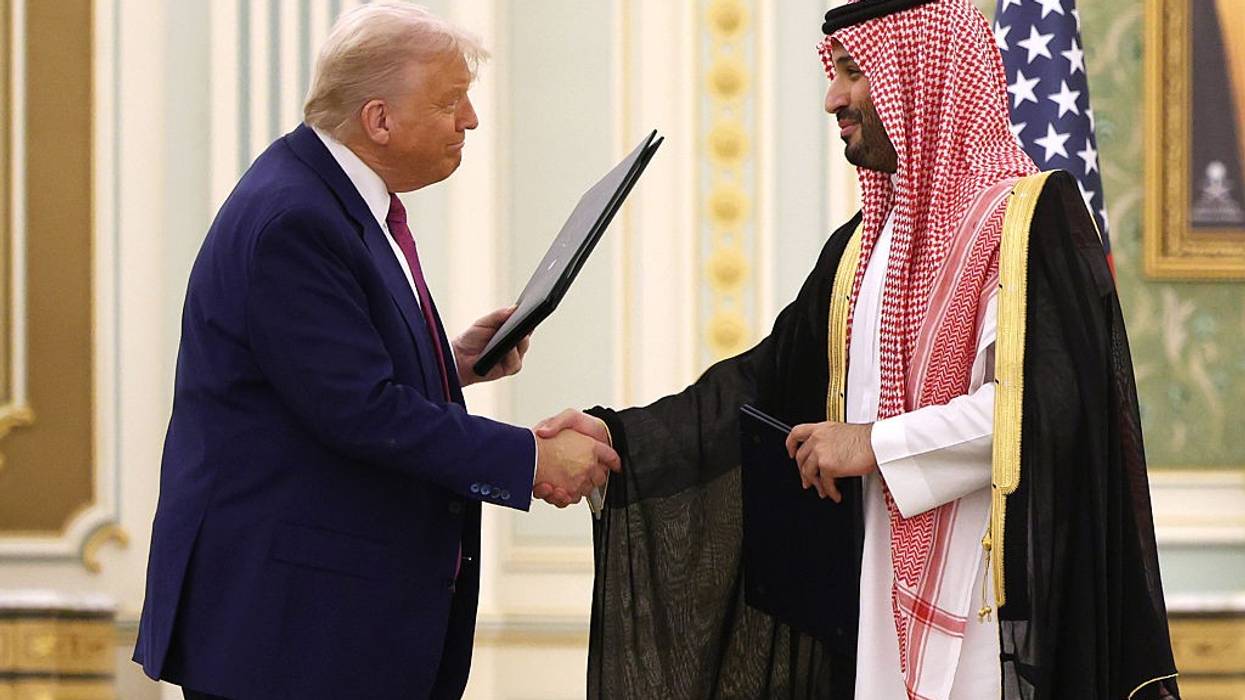
The effort comes as senators also sound the alarm about a possible nuclear energy agreement and the administration continues to greenlight arms sales to the kingdom.
A trio of progressive US senators this week introduced legislation to block a $5 billion conventional weapons sale to Saudi Arabia while also pushing for the release of more details about President Donald Trump's proposed nuclear cooperation agreement with the Middle Eastern kingdom.
"The United States must not send thousands of conventional weapons to Saudi Arabia or allow it to develop a nuclear program," said Sen. Ed Markey (D-Mass.) in a Thursday statement—a day after he partnered with Sens. Jeff Merkley (D-Ore.) and Bernie Sanders (I-Vt.) to introduce the joint resolution of disapproval, which was referred to the Senate Foreign Relations Committee.
"I am deeply concerned by the kingdom's human rights abuses, the security of the region as the war in Iran rages on, and the proxy war that is escalating between Iran and Saudi Arabia in Yemen," Markey explained. "Further escalation in the Saudi-Iran proxy war will worsen an already dire humanitarian catastrophe in Yemen and risks setting off a nuclear arms race between Iran and Saudi Arabia."
The resolution targets a sale approved by the US State Department on September 4 that includes over 10,000 joint direct attack munition (JDAM) guidance kits. As Breaking Defense detailed, "The prospective transaction includes a similar number of dumb bombs—split almost evenly between 500 lb. and 2,000 lb. munitions—which, when equipped with a JDAM, can be used as a precision weapon."
The bill does not apply to the other possible sale to Saudi Arabia endorsed by the department that same day—$750 million for AGT-1500 engines and related equipment—or the $24.3 billion deal for F-35 Lightning II fighter jets, which the Trump administration greenlit Thursday, after the resolution was introduced.
The latest approval "comes nearly two months after Saudi Defense Minister Khalid bin Salman traveled to Washington to lobby senior Trump administration officials on the sale, with Riyadh hoping to advance the deal ahead of the midterms," Semafor noted. The upcoming US elections could lead to Trump's Republican Party losing control of Congress.
The warplanes sale could also face pushback from Congress. According to Politico, Rep. Raja Krishnamoorthi (D-Ill.), who sits on the House Intelligence Committee, warned that "it could put the crown jewels of American military technology within reach of the Chinese Communist Party."
US approves $24.3 billion sale of 48 F-35 stealth warplanes to Saudi Arabia.US intelligence analysts have raised the possibility that China could acquire F-35 technology through its partnerships with Saudi. Israel had been the only country in the Middle East to operate the jetsu.afp.com/SjRn
[image or embed]
— AFP News Agency (@en.afp.com) September 17, 2026 at 9:41 PM
In addition to unveiling their resolution about the JDAMs and bombs on Wednesday, Markey and Merkley, co-chairs of the bicameral Nuclear Weapons and Arms Control Working Group, led a bipartisan group of senators—including Sanders—in urging a pair of Trump Cabinet members to declassify two side letters associated with the administration's proposed nuclear deal.
The administration submitted the pending 30-year agreement—which would allow US companies to share nuclear power technology with the kingdom—to Congress after it was signed by US Energy Secretary Chris Wright and Saudi Energy Minister Prince Abdulaziz bin Salman in July.
Under Section 123 of the Atomic Energy Act, Congress has 90 days of continuous session to review the deal and either move to block it or let it take effect. The senators' new letter to Wright and Secretary of State Marco Rubio notes that "in previous 123 agreements, the executive branch publicly released the agreement along with side letters and related documents."
"Access to the full text is required for the Senate and the public to have a clear understanding of the commitments being made on the nation's behalf and those being made by Saudi Arabia to the United States," the senators argued. "Their public release would also allow civil society, independent experts, and other affected stakeholders to scrutinize the deal."
"Transparency and open debate are cornerstones of our democracy," they emphasized. "Congress and the American public must have a meaningful opportunity to review and debate the key components of the US-Saudi nuclear deal before it potentially enters into force. To that end, we call on you to declassify and release the two side letters without delay."