

SUBSCRIBE TO OUR FREE NEWSLETTER
Daily news & progressive opinion—funded by the people, not the corporations—delivered straight to your inbox.
5
#000000
#FFFFFF
To donate by check, phone, or other method, see our More Ways to Give page.
Daily news & progressive opinion—funded by the people, not the corporations—delivered straight to your inbox.
Sarah Bufkin, smbufkin@gmail.com or 404.285.3413
Teachers, parents, alumni, students and other concerned North Carolinians arrived today, intent on petitioning Senate Leader Berger over the devastating cuts to public schools that he included in his 2014 and previous budgets. They came armed with fact sheets; the teachers brought lesson plans. They demanded repeals to the many extreme laws attacking teachers and schools this year.
The Senator cleared his office and locked the doors before the teachers and students arrived. Undeterred, they held a three-hour Teach-In for members of the legislature and public. Senator Berger only arrived hours after the Teach-In began, and only after he ordered the NC General Assembly police to clear all the supporters out of the building.
"The Forward Together Moral Movement is proud of the courageous teachers, students and parents who decided to stand up for students and schools today by demanding the extremist legislative leadership take decisive action to repeal destructive policies designed to undermine public education in our state," said Rev. Dr. William J. Barber, II, president of the North Carolina NAACP. "These fifteen moral witnesses had doubts as to whether Senate Leader Berger's offers to consider restoring education funding were genuine, but they decided to give him a few days to prove that he will act as a statesman and do the right thing. If he does not, then we will be back for a full and direct action. The teachers and students will not stay home. They and the Forward Together Moral Movement will be back in their offices and the People's House to make sure they do not put public education and opportunities for our children at risk."
Rev. Barber continued, "We have spent the past few years attempting to get a good-faith meeting between the legislative leadership and the Forward Together Moral Movement. For Senator Berger to clear the building before meeting with the moral witnesses, to avoid the people for the past few weeks on Mondays, is shameful. Teachers are smarter than that. The Moral Mondays Movement will not fall for it."
Background:
Last summer, thousands gathered at Moral Monday to protest this extremist General Assembly's decision to slash money from the education budget - hobbling public schools, leaving teacher pay at 47th in the nation, burdening students with skyrocketing tuition rates at public colleges and universities and funneling millions of taxpayer dollars to private schools through a voucher program.
This summer, Senate Leader Phil Berger put together a budget that attempts to raise teachers' wages, but does so at the expense of eliminating vital classroom support, teacher worker protections and other public school funding that enables our children to learn in safe, diverse and supportive environments.
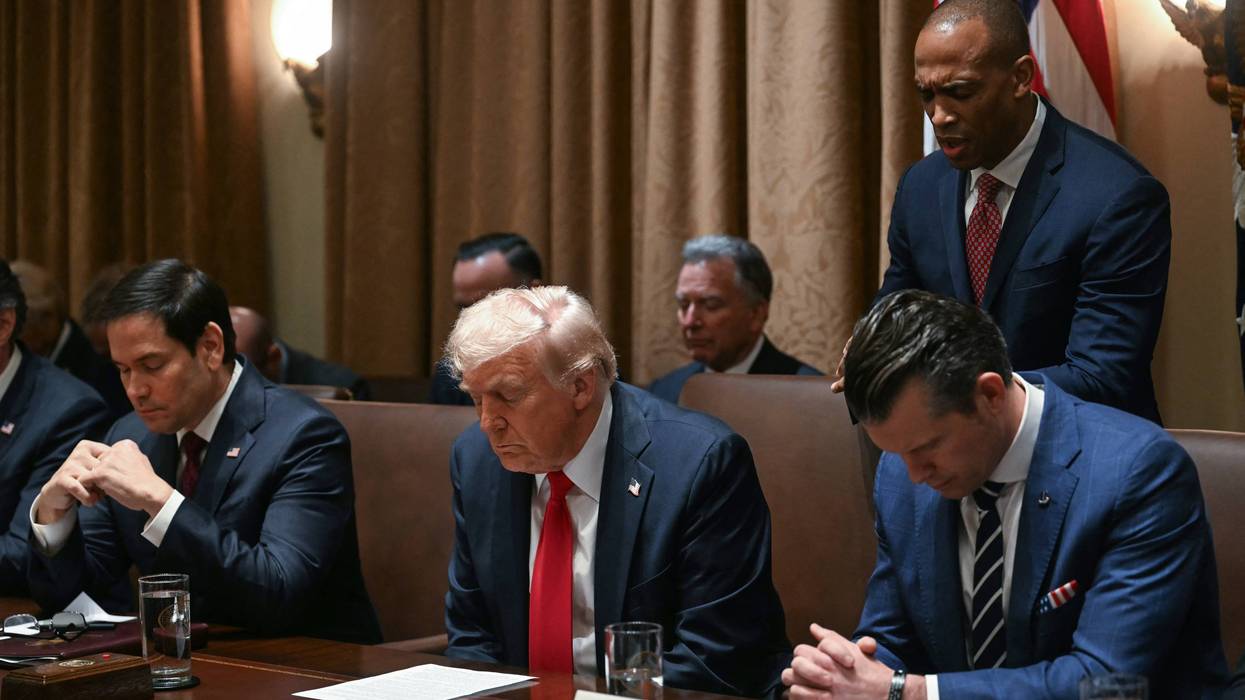
“If President Trump and his allies truly cared about America’s legacy of religious freedom, they would be celebrating church-state separation as the unique American invention that has allowed religious diversity to flourish."
An all-day prayer event scheduled for Sunday on the National Mall is set to feature evangelical Protestant leaders as well as top White House and Republican Party officials as speakers, and is being promoted as a celebration of "thanksgiving" as well as an opportunity for participants to learn about the founding of the nation as the 250th anniversary of its independence approaches.
In reality, said Rachel Laser, president and CEO of Americans United for Separation of Church and State, the "National Jubilee of Prayer, Praise, and Thanksgiving" appears to be a "Jubilee of Christian Nationalism"—with evangelical Christians making up three-quarters of the scheduled speakers, despite the fact that they account for just a quarter of Americans overall.
“If President Trump and his allies truly cared about America’s legacy of religious freedom, they would be celebrating church-state separation as the unique American invention that has allowed religious diversity to flourish in our country," said Laser. "Instead, they continue to threaten this foundational principle by advancing a Christian nationalist crusade to impose one narrow version of Christianity on all Americans."
The event, which is partly funded by taxpayer dollars earmarked for the nation's 250th anniversary, will feature Christian musical performers organized around three "pillars" that are labeled as "miracles" a Christian God bestowed on America, “personal testimonies of God’s healing,” and a "unified moment of rededication."
At a webinar last month, Rev. Paula White-Cain, who serves as a faith adviser to the White House, said the event is "really truly rededicating the country to God.”
The idea that the founders of the United States intended the country to be a Christian one has long been a fixation of evangelical Christian leaders, despite the lack of evidence for such a claim.
“Look at the document," Princeton University history professor Kevin Kruse told The Washington Post, referring to the Constitution. "The only rules they wrote about religion were ones that keep religion at arm’s length. No establishment, no limits on free exercise, no religious test for office... There’s a difference between saying America is a nation with many Christians in it and that America is a nation dedicated to Christianity and defined by it."
Robert Jones, president of the Public Religion Research Institute, told the Post that about a third of Americans currently report that they have no religious affiliation, making the US more religiously diverse than it's ever been.
“We proudly celebrate 250 years of American independence from kings who ruled over both church and state," said Laser. "For 250 years, America has been marching toward the promise of a country where all people can be free to live as themselves and believe as they choose, as long as they don’t harm others. Christian nationalists threaten that promise by undermining church-state separation, a pillar of our democracy."
The jubilee, which will also feature an 18-wheeler "Freedom Truck" featuring educational content made by the right-wing group PragerU and the Christian school Hillsdale College, comes after numerous displays of religiosity from the Trump administration.
Even many of the president's supporters on the Christian right were aghast at an artificial intelligence-generated image he posted last month on social media, appearing to depict him as a Christ figure. Defense Secretary Pete Hegseth, who is set to speak at the jubilee, has spoken about the US-Israeli war on Iran as Christian crusade and has hosted evangelical worship services at the Pentagon, while Agriculture Secretary Brooke Rollins wrote, "He is Risen indeed!" in an Easter email to federal employees that recounted the biblical story of the resurrection.
Robert Weissman, co-president of government watchdog Public Citizen, noted that the corporate sponsors of Freedom 250, the public-private partnership that's organizing the 250th anniversary, "may want to curry favor with the Trump administration."
The sponsors, including John Deere, Oracle, and Lockheed Martin, "should be forced to answer whether they support the extreme agenda they are celebrating," he said.
“This outrageous event makes a mockery of a core constitutional tenet of American life, the separation of church and state, essentially promoting a particular flavor of white evangelical protestantism as state-sponsored religion,” said Weissman. “This self-proclaimed day of thanksgiving torpedoes the best of American traditions—inclusivity and diversity—and has no place being connected to the US government."
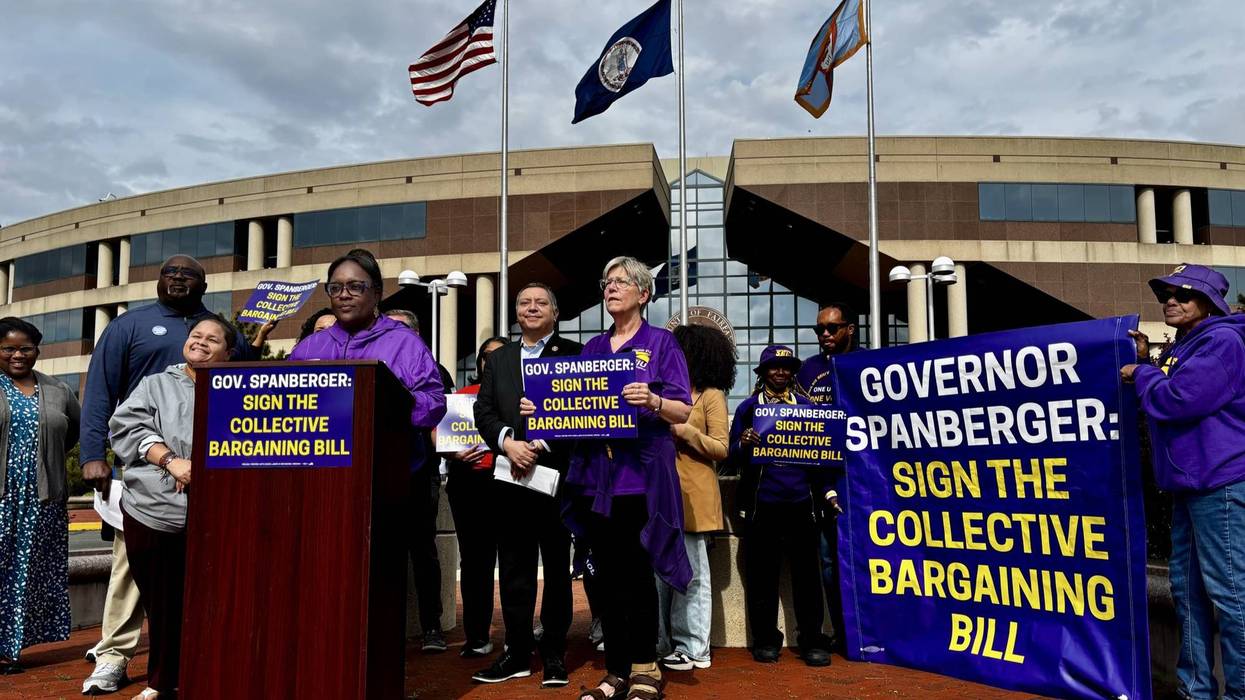
“We believed that she was being authentic and honest with us," said one Virginia labor leader. "She just flat-out flipped."
Labor unions are feeling betrayed after Virginia's Democratic Gov. Abigail Spanberger vetoed a bill on Thursday that would have restored collective bargaining rights for half a million public sector workers.
Virginia is one of the most restrictive states in the country for public sector bargaining, a holdover from the Jim Crow era when the General Assembly and other state legislatures across the South sought to crush the power of a public workforce with many Black employees.
According to the Economic Policy Institute, Virginia has one of the largest public sector pay gaps in the country, with state and local government employees making about 27% less on average than their private-sector peers, and it is similarly stratified in other states with weak collective bargaining rights.
Spanberger, a former US representative who was elected governor this past November, made pro-union messaging central to her affordability-focused platform. She decried President Donald Trump's executive order stripping federal workers of collective bargaining rights last year and said that as governor, she'd "look forward to working with members of our General Assembly to make sure more Virginians can negotiate for the benefits and fair treatment that they earn.”
But since taking office, Spanberger's support for restoring public sector union rights has been more tepid as she's gotten an earful from fiscally conservative Right-to-Work and taxpayer advocacy groups who claimed higher salaries for public employees would drain state funds and raise the cost of services.
When a bill to immediately mandate collective bargaining rights to 500,000 workers was proposed in the Democratic-controlled General Assembly, she introduced amendments aimed at watering down the bill—making it optional for employers to recognize unions, delaying the full implementation until 2030, and introducing what unions called a "kill-switch" that would have allowed future governors to revoke collective bargaining power.
The legislature shot Spanberger's amendments down and passed the bill in its original form. On Thursday, the governor vetoed it altogether.
In her veto message, Spanberger said she wanted the bill's other collective bargaining provisions for state employees, home care workers, and higher education employees to go into effect first "in order to demonstrate the efficacy of this new system" before it was opened up to all public employees.
But the unions that advocated for the bill say Spanberger led workers on with false promises.
"This veto is a devastating betrayal to the hundreds of thousands of public employees who have spent years, and in many cases decades, fighting for a seat at the table," said Doris Crouse-Mays, the president of the Virginia AFL-CIO. "Spanberger campaigned publicly and privately on promises [of] affordability, to support working families and respect workers' rights... Instead, when presented with the opportunity to make history and deliver on those promises, she chose to side with fear, political calculation, business, and the same anti-worker arguments that have been used for generations to deny workers power in Virginia."
LaNoral Thomas, the president of the Service Employees International Union (SEIU) Virginia 512—a union which helped lead the charge to pass the bill—told the Virginia news site Dogwood that her union had "high hopes" for Spanberger when she was elected.
“We believed that she was being authentic and honest with us," Thomas said. "She just flat-out flipped. It is shocking.”
"Public employees are not a special interest. They are our neighbors. They are the educators, bus drivers, social workers, librarians, custodians, and first responders who hold our communities together," said a joint statement from Carol Bauer, president of the Virginia Education Association, and Becky Pringle, president of the National Education Association.
They emphasized that the veto also carried "a deep racial and gender impact," noting that "Virginia’s public sector bargaining ban is rooted in a Jim Crow era effort to silence Black workers at the University of Virginia Hospital who organized for fair pay and dignity." They said, "Preserving that legacy today disproportionately harms women and workers of color, who make up so much of the public-service workforce and who have the most to gain from fair wages, safer workplaces, and a real voice on the job."
Lee Saunders, the president of the American Federation of State, County and Municipal Employees (AFSCME)—the largest national union of public sector workers in the US, with more than 1.4 million members—said that Spanberger had caved to "anti-worker extremists [who] have sidelined working people while starving the public services Virginia families rely on, earning the state a reputation as one of the most anti-worker in the country."
"While the governor has broken her word," Saunders said, "AFSCME members are deeply grateful to the bill’s sponsors and the leadership of both chambers, who kept theirs. Their commitment to working people stands in stark contrast to the governor and will not be forgotten."
"Gov. Spanberger made a choice today," he added. "Working people will remember it."

"No American should be comfortable with the president of the United States accusing a reporter of treason for critical reporting."
President Donald Trump on Friday sparked alarm among press freedom advocates when he accused New York Times reported David Sanger of committing "treason" for portraying his illegal war with Iran in a negative light.
Speaking with journalists aboard Air Force One on his flight home from China, Trump was asked by Sanger about his failure to accomplish political changes in Iran that he swore to achieve when he launched the war without congressional authorization in late February.
"I had a total military victory," Trump replied. "But the fake news, guys like you, write incorrectly. You're a fake guy, and guys like you write incorrectly. We had a total military victory. We knocked out their entire navy, we knocked out their entire air force, we knocked out all their anti-aircraft weaponry."
Trump to NYT's David Sanger: "I had a total military victory. But the fake news, guys like you, write incorrectly. You're a fake guy. We had a total military victory. I actually think it's sort of treasonous what you write. You should be ashamed of yourself. I actually think it's… pic.twitter.com/QK421YHKtq
— Aaron Rupar (@atrupar) May 15, 2026
Despite this purported "total victory," however, Iran still controls the Strait of Hormuz and has prevented commercial vessels from traveling through it for the last two months.
After attacking the Times' reporting about the Iran War, the president pivoted to impugning Sanger's patriotism.
"I actually think it's sort of treasonous what you write," the president said. "You and The New York Times, and CNN, I would say, are the worst... You should be ashamed of yourself. I actually think it's treason."
The Times on Tuesday reported that the Trump administration’s “public portrayal of a shattered Iranian military is sharply at odds with what US intelligence agencies are telling policymakers behind closed doors, according to classified assessments from early this month that show Iran has regained access to most of its missile sites, launchers, and underground facilities.”
Hours after the president's tirade against Sanger—which echoed Trump's previous remarks about media coverage of the war—New York Times spokesperson Charlie Stadtlander released a statement defending its reporting on the Iran war.
"Reporting isn't treason," Stadtlander said. "It's foundational to a free press and the work that America's founders wrote the First Amendment to protect. That includes making clear when the claims of government officials and the reality of their actions don't line up... We will continue this important, constitutionally protected work."
Trump's treason accusation also drew a rebuke from Will Creeley, legal director of the Foundation for Individual Rights and Expression, who said that "no American should be comfortable with the president of the United States accusing a reporter of treason for critical reporting."
New York Times columnist Nicholas Kristof argued that Trump's attack on Sanger was really a sign of weakness given the failures of his military campaign against Iran.
"President Trump unloading on David Sander reflects a combination of anxiety, insecurity, and desperation about the Iran War," Kristof wrote. "David is the dean of national security reporters: experienced, meticulous, and fair. Blaming the messenger underscores that the reality itself is pretty bad."
Kristof's sentiment was echoed by former ABC News journalist Terry Moran, who wrote that he can't "understand how anyone can see Trump here and not see weakness."
Former Republican Illinois Congressman Joe Walsh said Trump's interaction with Sanger exposed him as "the biggest fucking crybaby in all of human history."