SUBSCRIBE TO OUR FREE NEWSLETTER
Daily news & progressive opinion—funded by the people, not the corporations—delivered straight to your inbox.
5
#000000
#FFFFFF
To donate by check, phone, or other method, see our More Ways to Give page.


Daily news & progressive opinion—funded by the people, not the corporations—delivered straight to your inbox.
Mark Kastel, 608-625-2024
Proposition 37, a citizen's initiative on the ballot on November 6 in California, would mandate clear labeling of genetically engineered (GE) ingredients on food packages. It has become a battleground pitting consumer and farmer advocates against multi-billion-dollar agribusiness corporations.
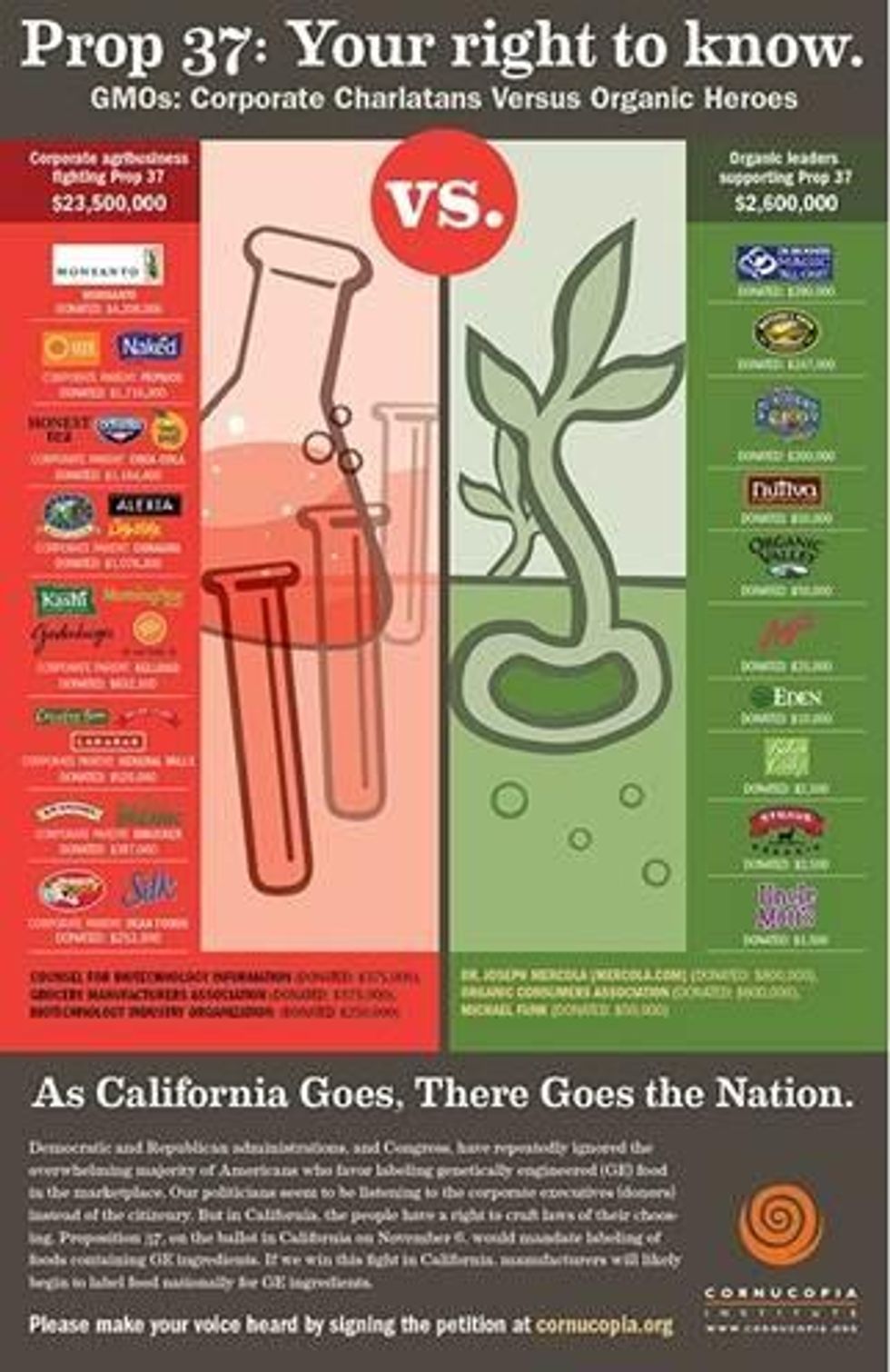
Recent polling indicates almost 70% of citizens support informational labeling. And a flood of new contributions to fight the measure has rolled in from the biotechnology industry and food manufacturers, totaling over $23 million, according to the California Secretary of State. This dwarfs the approximately $3 million contributed by proponents of GE labeling.
"Consumers might be surprised to find out that brands hiding under 'natural' facades are in fact owned by multi-billion-dollar corporations that are contributing bushel baskets of cash to defeating Proposition 37," says Charlotte Vallaeys, Director of Farm and Food Policy at The Cornucopia Institute.
Mandatory labeling of genetically engineered food in California is viewed as a watershed event by many industry observers, as many companies will find it logistically or economically difficult to produce foods with labels identifying GE for California while producing a different product line of foods for the rest of the country.
"Just as we've observed in Europe, where labeling of food containing genetically modified organisms (GMOs) is mandatory, we fully expect that when given a choice, consumers will choose organic or non-GMO products," said Mark A. Kastel, Codirector of Wisconsin-based Cornucopia. "And the industrial food lobby is fully cognizant of this--that's why they're fighting like hell against this grassroots effort."
To make it easier for shoppers to identify and support organic brands whose corporate owners support Proposition 37, and avoid buying brands owned by companies that financially contributed to opposing the "Right to Know" campaign, The Cornucopia Institute has developed a guide for consumers.
"If the food and biotech industries are so proud of their pervasive genetically manipulated crops, why are they so afraid, and so desperately opposed to labeling it?" asked Arran Stephens, founder of Nature's Path, North America's largest certified organic cereal and granola brand with manufacturing plants in the US and Canada.
Besides Nature's Path, those who have contributed in support of Proposition 37 include venerable organic manufacturers such as Dr. Bronner's, Nutiva and Lundberg rice. These companies are all independently-owned businesses that avoid GMOs and are committed to supporting organic agriculture.
"Food companies are required by law to label 'contains peanuts' if included in their product. People deserve the same for GMOs. Our customers want to know if any product contains GMOs," says John Roulac, founder and CEO of Nutiva, an organic food company.
On the other side, joining Monsanto and the giant food lobby group Grocery Manufacturers of America (GMA) in donating money to the effort to defeat the ballot initiative, are multi-billion-dollar, multi-national companies including General Mills, Dean Foods, Kellogg and Pepsico. These companies own brands that are misrepresented to consumers as independent, value-driven businesses.
Biotechnology corporations and corporate agribusinesses have collectively donated millions of dollars to defeat Proposition 37. Monsanto alone has donated $4.2 million, while food giants Pepsico and Coca Cola have each donated more than $1 million.
"Consumers are increasingly interested in 'voting with their forks,' and many want to support companies that share their values," says Vallaeys. "But consumers may not realize that many organic and 'natural' brands are owned by the very same corporations that are spending hundreds of thousands of dollars each, or even millions, in an effort to scuttle Proposition 37 in California," she adds.
For example, Kashi is owned by Kellogg, which has contributed $612,000 to defeating Proposition 37. Last year, The Cornucopia Institute published a study, Cereal Crimes, which revealed that the popular, "natural" Kashi GoLean cereal brand, unbeknownst to its customers, contains genetically engineered ingredients.
In what The Cornucopia Institute characterizes as "creating a facade," nowhere on the Kashi website or packaging is it disclosed that the company is owned by Kellogg, rather than the "small band of passionate people" featured on the Kashi website.
Another example is Silk soymilk, which carries the "Non-GMO Project Verified" seal on its products but is owned by the nation's largest dairy, Dean Foods, which has contributed $253,000 to the effort to kill Prop. 37. Dean Foods also owns the Horizon Organic brand. Both Silk and Horizon profess to consumers that the brands oppose GMOs.
"Talk is cheap," adds Vallaeys. "Consumers should not only know whether there are GMOs in their food, but also whether their hard-earned dollars are supporting companies that then turn around and invest those profits in the effort to sell-out their right to know."
The Cornucopia Institute, which developed the funding guide, stresses that the organization is not against corporate involvement in organics.
"We welcome corporate involvement in the organic food industry, but only when the parent company subscribes to the values that the organic food movement is based on," says Kastel. "We have a problem with the duplicity of corporations that hide under a 'holier-than-thou' marketing brand and then undermine the very values of the organic movement."
"For example, when Kellogg donates money to the Organic Trade Association, the Kashi brand appears on the OTA website. But when the same company donates to the effort to defeat Proposition 37, Kellogg will do everything in its power to make sure that its Kashi customers, who seek wholesome and natural foods, do not associate the Kashi brand with a corporate contributor to the effort to kill Proposition 37," adds Kastel.
The same is true for the R.W. Knudsen and Santa Cruz Organic brands, owned by Smucker, and the Cascadian Farm, Larabar and Muir Glen brands, owned by General Mills. These corporate brand owners have donated $387,000 and $520,000, respectively, to defeating Proposition 37.
By using Cornucopia's Proposition 37 funding guide, consumers can invest their food dollars in organic and non-GMO companies that are truly committed to supporting sustainable agriculture.
"Hiding the truth about our food is pervasive, unethical, and only done for money," says Michael Potter, CEO of Eden Foods, an organic food manufacturer that financially contributed to support Proposition 37. "Let this [Prop. 37] be the beginning of an end to it."
The Cornucopia Institute, a Wisconsin-based nonprofit farm policy research group, is dedicated to the fight for economic justice for the family-scale farming community. Their Organic Integrity Project acts as a corporate and governmental watchdog assuring that no compromises to the credibility of organic farming methods and the food it produces are made in the pursuit of profit.
Israel is seeking to invalidate the ICC's arrest warrants for fugitive Prime Minister Benjamin Netanyahu and former Defense Minister Yoav Gallant for alleged crimes against humanity and war crimes.
Appellate judges at the embattled International Criminal Court on Monday rejected Israel's attempt to block an investigation into alleged Israeli war crimes committed during the Gaza genocide.
The ICC Appeals Chamber dismissed an Israeli challenge to the assertion that the October 7, 2023, attacks and subsequent war on Gaza were part of the same ongoing "situation" under investigation by the Hague-based tribunal since 2021. Israel argued they were separate matters that required new notice; however, the ICC panel found that the initial probe encompasses events on and after October 7.
The ruling—which focuses on but one of several Israeli legal challenges to the ICC—comes amid the tribunal's investigation into an Israeli war and siege that have left at least 250,000 Palestinians dead, maimed, or missing and 2 million more displaced, starved, or sickened.
The probe led to last year's ICC arrest warrants for Israeli Prime Minister Benjamin Netanyhau and former Israeli Defense Minister Yoav Gallant for alleged war crimes and crimes against humanity, including murder and forced starvation. The ICC also issued warrants for the arrest of three Hamas commanders—all of whom have since been killed by Israel.
Israel and the United States, neither of which are party to the Rome Statute governing the ICC, vehemently reject the tribunal's investigation. In the US—which has provided Israel with more than $21 billion in armed aid as well as diplomatic cover throughout the genocide—the Trump administration has sanctioned nine ICC jurists, leaving them and their families "wiped out socially and financially."
The other Hague-based global tribunal, the International Court of Justice, is currently weighing a genocide case against Israel filed in December 2023 by South Africa and backed by more than a dozen nations, as well as regional blocs representing dozens of countries.
University of Copenhagen international law professor Kevin Jon Heller—who is also a special adviser to the ICC prosecutor on war crimes—told Courthouse News Service that “the real importance of the decision is that it strongly implies Israel will lose its far more important challenge to the court’s jurisdiction over Israeli actions in Palestine."
Although Israel is not an ICC member and does not recognize its jurisdiction, Palestine is a state party to the Rome Statute, under which individuals from non-signatory nations can be held liable for crimes committed in the territory of a member state.
The Israeli Foreign Ministry condemned Monday's decision, calling it "yet another example of the ongoing politicization of the ICC and its blatant disregard for the sovereign rights of non-party states, as well as its own obligations under the Rome Statute."
The Council on American-Islamic Relations (CAIR), a Washington, DC-based advocacy group, welcomed the ICC decision.
“This ruling by the International Criminal Court affirms that no state is above the law and that war crimes must be fully and independently investigated," CAIR said in a statement. "Accountability is essential for justice, for the victims, and survivors, and for deterring future crimes against humanity.”
"Wales and Sanger must be stopped from trying to censor the Wikipedia ‘Gaza genocide’ entry that clearly documents Israel’s horrifying crime against humanity.”
More than 40 advocacy groups on Monday called on Wikipedia editors and the Wikimedia board of trustees to reject efforts by the web-based encyclopedia's co-founders to censor the site's entry on the Gaza genocide.
After months of internal debate, editors of the Wikipedia article titled “Allegations of genocide in the 2023 Israeli attack on Gaza” renamed the entry "Gaza genocide" in July 2024, reflecting experts' growing acknowledgement that Israel's annihilation and siege of the Palestinian exclave met the legal definition of the ultimate crime. The entry also notes that the Gaza genocide is not settled legal fact—an International Court of Justice case on the matter is ongoing—and that numerous experts refute the claim that Israel's war is genocidal.
The move, and the subsequent addition of Gaza to Wikipedia's article listing cases of genocide, sparked heated "edit wars" on the community-edited site—which has long been a target of pro-Israeli public relations efforts. In the United States, a pair of House Republicans launched an investigation to reveal the identities of the anonymous Wikipedia editors who posted negative facts about Israel.
"Israeli officials and pro-Israel organizations are attempting to hide the horrifying reality... by putting pressure on institutions like Wikipedia to engage in genocide denial."
Wikipedia co-founders Jimmy Wales and Larry Sanger have intervened in the dispute, with Wales—a self-described "strong supporter of Israel"—publicly stating that the Gaza genocide entry lacked neutrality, failed to meet Wikipedia's "high standards," and required "immediate attention" after an editor blocked changes to the article.
"Wales and Sanger are using their roles as Wikipedia founders to bypass the normal editing and review process and introduce their
own ideological biases into an entry that has already undergone exhaustive vetting and review by Wikipedia editors, including thousands of edits and comments," the 42 advocacy groups said in a letter to Wikimedia's board and site editors.
"Their efforts deny the documented reality of Israel’s genocide in Gaza and contradict the broad consensus among genocide scholars, international human rights organizations, UN experts, and both Palestinian and Israeli human rights organizations," the groups continue. "In doing so, Wales and Sanger are engaging in attempted censorship and genocide denial."
The letters' signers include the American Friends Service Committee, Artists Against Apartheid, Brave New Films, CodePink, Council on American Islamic Relations (CAIR), Democracy for the Arab World Now (DAWN), Doctors Against Genocide, MPower Change Action Fund, Peace Action, and United Methodists for Kairos Response.
Since the Hamas-led October 7, 2023 attack, Israel's retaliatory obliteration and siege on Gaza—for which Israeli Prime Minister Benjamin Netanyahu and former Defense Minister Yoav Gallant are wanted by the International Criminal Court for alleged crimes against humanity and war crimes—have left more than 250,000 Palestinians dead, maimed, or missing. Around 2 million other Palestinians have been forcibly displaced, sickened, or starved in what hunger experts say is an entirely human-caused famine.
"The simple reality is that Israeli officials and pro-Israel organizations are attempting to hide the horrifying reality of Israel’s genocide in Gaza by pretending that there is a substantive debate and by putting pressure on institutions like Wikipedia to engage in genocide denial," the groups' letter asserts.
"Wales’ 'both sides' framework for denying the Gaza genocide," the groups warned, "could also be used to legitimize Holocaust denial, denial of the Armenian genocide, or to platform 'flat-earthers' who deny the Earth’s spherical shape."
"Healthcare is a human right. That’s why we need Medicare for All," said one senator. "And the American people agree!"
In Maine, only one of the top two candidates in the Democratic US Senate primary has expressed support for the specific healthcare reform proposal that continues to be treated by the political establishment as radical—but which is supported by not only a sizable majority of Mainers but also most Americans surveyed in several recent polls.
Graham Platner, a veteran and oyster farmer who was a political novice when he launched his campaign in August and has polled well ahead of Gov. Janet Mills in several recent surveys, and a poll that asked Mainers about healthcare on Saturday showed he is in lockstep with many people in the state.
As the advocacy group Maine AllCare reported, the Pan Atlantic 67th Omnibus poll found that 63% of Mainers support Medicare for All, the proposal to transition the US to a system like that of other wealthy countries, with the government expanding the existing Medicare program and guaranteeing health coverage to all.
Those results bolster the findings of More Perfect Union in October, which found 72% of Mainers backing Medicare for All, and of Data for Progress, which found last month that 65% of all Americans—including 78% of Democratic voters—support a "national health insurance program... that would cover all Americans and replace most private health insurance plans.”
Even more recently, a Pew Research survey released last week found that 66% of respondents nationwide said the government should guarantee health coverage.
Platner has spoken out forcefully in support of Medicare for All, saying unequivocally last month that the proposal "is the answer" to numerous healthcare crises including the loss of primary care providers in many parts of the country and skyrocketing healthcare costs.
He made the comments soon after Mills said at a healthcare roundtable that "it is time" for a universal healthcare system, but did not explicitly endorse Medicare for All.
Maine AllCare noted that the latest polling on Medicare for All in the state comes as Maine "is on the verge of a multi-pronged healthcare crisis" due to Republican federal lawmakers' refusal to extend Affordable Care Act subsidies—which is projected to significantly raise monthly premiums for many Maine families as well as millions of people across the country. People in Maine and other states are also bracing for changes to Medicaid, including eligibility requirements.
Those changes "alongside long-standing affordability and access gaps, are projected to cost Maine billions and trigger deep operating losses in already strained hospitals," said Maine AllCare.
The group emphasized that that the Republican budget reconciliation law that President Donald Trump signed in July is projected to have a range of economic impacts on Maine, including a $450 million decline in statewide economic output, the loss of 4,300 state jobs, and the loss of $700 million in revenue at the state's hospitals due to Medicaid cuts.
“Maine needs a sustainable and universal healthcare system now. Poll after poll show people want Medicare for All. Our leaders can let the current health system continue collapsing—harming families, communities, and the economy of our state—or they can meet the moment and fight like hell to enact change that protects both the people and the future of the state," said David Jolly, a Maine AllCare board member. "That is the work Mainers elected them to do and that is what they must do now.”
Despite the broad popularity of the proposal to expand the Medicare program to everyone in the US—a system that would cost less than the current for-profit health insurance system does, according to numerous studies—supporters, including the 17 cosponsors of the Medicare for All bill in the US Senate and the 110 cosponsors in the US House, continue to face attacks from establishment politicians regarding the cost and feasibility of the proposal.
On Monday, Rep. Ro Khanna (D-Calif.) explained to Fox News anchor Maria Bartiromo how the Affordable Care Act that was passed by the Democratic Party is "not the solution" to the country's healthcare crisis, because it keeps in place the for-profit health insurance industry.
"The solution, as everyone knows, in my view, who has studied this, is Medicare for All," said Khanna. "People should have national health insurance. Healthcare is a human right. You should not be subject to these private insurance companies that have 18% admin costs, that are making billions of dollars in profits."
I made the case for Medicare for All on @MorningsMaria with @MariaBartiromo with facts and basic economics. https://t.co/ExZpCNQT7B pic.twitter.com/F226Kutv16
— Ro Khanna (@RoKhanna) December 15, 2025
Sen. Jeff Merkley (D-Ore.) also spoke out in favor of the proposal, pointing to the recent Data for Progress poll that showed 65% of Americans and 78% of Democrats backing Medicare for All.
"Healthcare is a human right. That’s why we need Medicare for All," said Merkley. "We need to simplify our system and make sure folks can get the care they need, when they need it. And the American people agree!"