SUBSCRIBE TO OUR FREE NEWSLETTER
Daily news & progressive opinion—funded by the people, not the corporations—delivered straight to your inbox.
5
#000000
#FFFFFF
To donate by check, phone, or other method, see our More Ways to Give page.
Daily news & progressive opinion—funded by the people, not the corporations—delivered straight to your inbox.
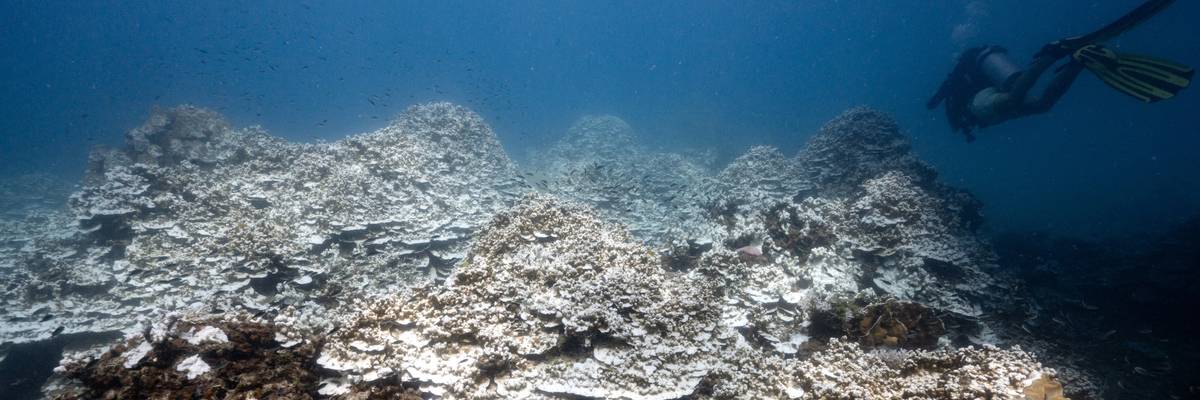
This underwater photo taken on June 15, 2024 shows divers amongst bleached corals around Koh Tao island in the southern Thai province of Surat Thani.
"The magnitude and extent of the heat stress is shocking," said one marine scientist.
A year after scientists warned the world was seeing its fourth mass coral bleaching event, rising ocean temperatures fueled by greenhouse gas emissions have now devastated 84% of Earth's coral reefs—with likely knock-on effects for about a third of all marine species and 1 billion people whose lives and livelihoods are directly impacted by the health of the "rainforests of the sea."
Coral Reef Watch at the U.S. National Oceanic and Atmospheric Administration (NOAA) released its latest data on Wednesday, showing the current bleaching event has become the most widespread on record, impacting reefs from the Indian Ocean to the Atlantic and Pacific.
The news comes three months after scientists confirmed 2024 was the hottest year on record. Last year, meteorologists also found that sea surface temperatures in the North Atlantic were about 2°F higher than the 1990-2020 average and nearly 3°F above the average in the 1980s.
Unusually warm ocean waters cause corals to expel algae that give the reefs their bright color and deliver nutrients, supporting the immense biodiversity that is normally found within the reefs. Prolonged bleaching can kill coral reefs.
"The magnitude and extent of the heat stress is shocking," marine scientist Melanie McField, the founder of the Healthy Reefs for Healthy People initiative in the Caribbean, told Reuters. "Some reefs that had thus far escaped major heat stress and we thought to be somewhat resilient, succumbed to partial mortalities in 2024."
Derek Manzello, director of Coral Reef Watch, told The Guardian that some reefs that had been considered safe from the impact of rising ocean temperatures have now been bleached.
"Some reefs that had thus far escaped major heat stress and we thought to be somewhat resilient, succumbed to partial mortalities in 2024."
“The fact that so many reef areas have been impacted," he said, "suggests that ocean warming has reached a level where there is no longer any safe harbor from coral bleaching and its ramifications."
The current coral bleaching event began in January 2023. That same year, scientists were alarmed by an ocean heatwave off the coast of Florida that rapidly bleached the continental United States' only living barrier reef.
That event prompted NOAA to introduce a new coral bleaching alert scale from Level 1—significant bleaching—to Level 5, at which point a reef is approaching mortality.
Another ocean heatwave last year threatened Australia's Great Barrier Reef, eight years after nearly half of the coral in some northern parts of the 1,400-mile reef was killed by a mass bleaching event.
But recent major bleaching events affecting specific reefs have not compared to the current widespread devastation in the world's oceans.
“Reefs have not encountered this before," said Britta Schaffelke, coordinator of the Global Coral Reef Monitoring Network, told The Guardian. "With the ongoing bleaching it's almost overwhelming the capacity of people to do the monitoring they need to do. The fact that this most recent, global-scale coral bleaching event is still ongoing takes the world's reefs into uncharted waters."
The other three mass bleaching events on record occurred from 2014-17, with 68% of the world's reefs affected; in 2010, when 37% were impacted; and in 1998, when 21% suffered bleaching.
The report from Coral Reef Watch followed the Trump administration's under-the-radar release of climate change data that minimized NOAA's findings about the level of planet-heating carbon dioxide emissions in the atmosphere. President Donald Trump also issued an executive order demanding sunset provisions for every existing energy regulation and notified companies that they can seek exemptions to clean air regulations.
Joerg Wiedenmann, a marine biologist at the Coral Reef Laboratory at the University of Southampton in England, emphasized that taking action to stop the heating of the world's oceans could protect coral reefs, the marine species they provide habitats to, and the communities they support by protecting coastlines and providing fishing and tourism jobs.
"If we manage to decrease ocean warming," Wiedenmann told The Washington Post, "there is always a chance for corals to recover."
Dear Common Dreams reader, It’s been nearly 30 years since I co-founded Common Dreams with my late wife, Lina Newhouser. We had the radical notion that journalism should serve the public good, not corporate profits. It was clear to us from the outset what it would take to build such a project. No paid advertisements. No corporate sponsors. No millionaire publisher telling us what to think or do. Many people said we wouldn't last a year, but we proved those doubters wrong. Together with a tremendous team of journalists and dedicated staff, we built an independent media outlet free from the constraints of profits and corporate control. Our mission has always been simple: To inform. To inspire. To ignite change for the common good. Building Common Dreams was not easy. Our survival was never guaranteed. When you take on the most powerful forces—Wall Street greed, fossil fuel industry destruction, Big Tech lobbyists, and uber-rich oligarchs who have spent billions upon billions rigging the economy and democracy in their favor—the only bulwark you have is supporters who believe in your work. But here’s the urgent message from me today. It's never been this bad out there. And it's never been this hard to keep us going. At the very moment Common Dreams is most needed, the threats we face are intensifying. We need your support now more than ever. We don't accept corporate advertising and never will. We don't have a paywall because we don't think people should be blocked from critical news based on their ability to pay. Everything we do is funded by the donations of readers like you. When everyone does the little they can afford, we are strong. But if that support retreats or dries up, so do we. Will you donate now to make sure Common Dreams not only survives but thrives? —Craig Brown, Co-founder |
A year after scientists warned the world was seeing its fourth mass coral bleaching event, rising ocean temperatures fueled by greenhouse gas emissions have now devastated 84% of Earth's coral reefs—with likely knock-on effects for about a third of all marine species and 1 billion people whose lives and livelihoods are directly impacted by the health of the "rainforests of the sea."
Coral Reef Watch at the U.S. National Oceanic and Atmospheric Administration (NOAA) released its latest data on Wednesday, showing the current bleaching event has become the most widespread on record, impacting reefs from the Indian Ocean to the Atlantic and Pacific.
The news comes three months after scientists confirmed 2024 was the hottest year on record. Last year, meteorologists also found that sea surface temperatures in the North Atlantic were about 2°F higher than the 1990-2020 average and nearly 3°F above the average in the 1980s.
Unusually warm ocean waters cause corals to expel algae that give the reefs their bright color and deliver nutrients, supporting the immense biodiversity that is normally found within the reefs. Prolonged bleaching can kill coral reefs.
"The magnitude and extent of the heat stress is shocking," marine scientist Melanie McField, the founder of the Healthy Reefs for Healthy People initiative in the Caribbean, told Reuters. "Some reefs that had thus far escaped major heat stress and we thought to be somewhat resilient, succumbed to partial mortalities in 2024."
Derek Manzello, director of Coral Reef Watch, told The Guardian that some reefs that had been considered safe from the impact of rising ocean temperatures have now been bleached.
"Some reefs that had thus far escaped major heat stress and we thought to be somewhat resilient, succumbed to partial mortalities in 2024."
“The fact that so many reef areas have been impacted," he said, "suggests that ocean warming has reached a level where there is no longer any safe harbor from coral bleaching and its ramifications."
The current coral bleaching event began in January 2023. That same year, scientists were alarmed by an ocean heatwave off the coast of Florida that rapidly bleached the continental United States' only living barrier reef.
That event prompted NOAA to introduce a new coral bleaching alert scale from Level 1—significant bleaching—to Level 5, at which point a reef is approaching mortality.
Another ocean heatwave last year threatened Australia's Great Barrier Reef, eight years after nearly half of the coral in some northern parts of the 1,400-mile reef was killed by a mass bleaching event.
But recent major bleaching events affecting specific reefs have not compared to the current widespread devastation in the world's oceans.
“Reefs have not encountered this before," said Britta Schaffelke, coordinator of the Global Coral Reef Monitoring Network, told The Guardian. "With the ongoing bleaching it's almost overwhelming the capacity of people to do the monitoring they need to do. The fact that this most recent, global-scale coral bleaching event is still ongoing takes the world's reefs into uncharted waters."
The other three mass bleaching events on record occurred from 2014-17, with 68% of the world's reefs affected; in 2010, when 37% were impacted; and in 1998, when 21% suffered bleaching.
The report from Coral Reef Watch followed the Trump administration's under-the-radar release of climate change data that minimized NOAA's findings about the level of planet-heating carbon dioxide emissions in the atmosphere. President Donald Trump also issued an executive order demanding sunset provisions for every existing energy regulation and notified companies that they can seek exemptions to clean air regulations.
Joerg Wiedenmann, a marine biologist at the Coral Reef Laboratory at the University of Southampton in England, emphasized that taking action to stop the heating of the world's oceans could protect coral reefs, the marine species they provide habitats to, and the communities they support by protecting coastlines and providing fishing and tourism jobs.
"If we manage to decrease ocean warming," Wiedenmann told The Washington Post, "there is always a chance for corals to recover."
A year after scientists warned the world was seeing its fourth mass coral bleaching event, rising ocean temperatures fueled by greenhouse gas emissions have now devastated 84% of Earth's coral reefs—with likely knock-on effects for about a third of all marine species and 1 billion people whose lives and livelihoods are directly impacted by the health of the "rainforests of the sea."
Coral Reef Watch at the U.S. National Oceanic and Atmospheric Administration (NOAA) released its latest data on Wednesday, showing the current bleaching event has become the most widespread on record, impacting reefs from the Indian Ocean to the Atlantic and Pacific.
The news comes three months after scientists confirmed 2024 was the hottest year on record. Last year, meteorologists also found that sea surface temperatures in the North Atlantic were about 2°F higher than the 1990-2020 average and nearly 3°F above the average in the 1980s.
Unusually warm ocean waters cause corals to expel algae that give the reefs their bright color and deliver nutrients, supporting the immense biodiversity that is normally found within the reefs. Prolonged bleaching can kill coral reefs.
"The magnitude and extent of the heat stress is shocking," marine scientist Melanie McField, the founder of the Healthy Reefs for Healthy People initiative in the Caribbean, told Reuters. "Some reefs that had thus far escaped major heat stress and we thought to be somewhat resilient, succumbed to partial mortalities in 2024."
Derek Manzello, director of Coral Reef Watch, told The Guardian that some reefs that had been considered safe from the impact of rising ocean temperatures have now been bleached.
"Some reefs that had thus far escaped major heat stress and we thought to be somewhat resilient, succumbed to partial mortalities in 2024."
“The fact that so many reef areas have been impacted," he said, "suggests that ocean warming has reached a level where there is no longer any safe harbor from coral bleaching and its ramifications."
The current coral bleaching event began in January 2023. That same year, scientists were alarmed by an ocean heatwave off the coast of Florida that rapidly bleached the continental United States' only living barrier reef.
That event prompted NOAA to introduce a new coral bleaching alert scale from Level 1—significant bleaching—to Level 5, at which point a reef is approaching mortality.
Another ocean heatwave last year threatened Australia's Great Barrier Reef, eight years after nearly half of the coral in some northern parts of the 1,400-mile reef was killed by a mass bleaching event.
But recent major bleaching events affecting specific reefs have not compared to the current widespread devastation in the world's oceans.
“Reefs have not encountered this before," said Britta Schaffelke, coordinator of the Global Coral Reef Monitoring Network, told The Guardian. "With the ongoing bleaching it's almost overwhelming the capacity of people to do the monitoring they need to do. The fact that this most recent, global-scale coral bleaching event is still ongoing takes the world's reefs into uncharted waters."
The other three mass bleaching events on record occurred from 2014-17, with 68% of the world's reefs affected; in 2010, when 37% were impacted; and in 1998, when 21% suffered bleaching.
The report from Coral Reef Watch followed the Trump administration's under-the-radar release of climate change data that minimized NOAA's findings about the level of planet-heating carbon dioxide emissions in the atmosphere. President Donald Trump also issued an executive order demanding sunset provisions for every existing energy regulation and notified companies that they can seek exemptions to clean air regulations.
Joerg Wiedenmann, a marine biologist at the Coral Reef Laboratory at the University of Southampton in England, emphasized that taking action to stop the heating of the world's oceans could protect coral reefs, the marine species they provide habitats to, and the communities they support by protecting coastlines and providing fishing and tourism jobs.
"If we manage to decrease ocean warming," Wiedenmann told The Washington Post, "there is always a chance for corals to recover."